If you have ADHD, you probably already know you work better with something in your ears. What's less obvious is why, and which kinds of sound actually help versus which ones just feel like they should. The answer is more interesting than "pick whatever you like." ADHD brains respond to specific acoustic properties in measurable, research-backed ways, and picking the wrong kind of ADHD focus music can cost you as much attention as having none at all.
This article is the deeper version of the guide we wish every ADHD-er had early on. We cover what's actually different about attention and dopamine in the ADHD brain, the three distinct mechanisms by which music affects that system, what the research says about binaural beats, brown noise, classical music, and lo-fi specifically, and a practical framework for matching the right kind of sound to the task in front of you.
What's Different About the ADHD Brain
Most of the useful science on ADHD and sound starts with one idea: ADHD is, at a neurochemical level, largely a problem of dopaminergic signalling. The prefrontal cortex (the part of the brain that handles executive function, sustained attention, and impulse control) relies on stable dopamine tone. In ADHD brains, dopamine transporters clear dopamine out of the synapse faster than average, and receptor sensitivity differs. The net effect is a chronically under-stimulated attention system that actively seeks stimulation.
This has two practical consequences relevant to music:
- The brain craves novelty and stimulation to bring dopamine tone into the range where attention can stabilise. This is why silent rooms are harder for many ADHD-ers to work in, not easier.
- The default mode network (the "mind-wandering" circuit that fires when you're not engaged in a task) is hyperactive in ADHD. It intrudes during tasks that don't occupy enough attentional bandwidth.
Music sits right in the middle of both. It provides steady, mild stimulation (satisfying the first) while occupying just enough background bandwidth to starve the default mode network (helping with the second). That's the neuroscience foundation for why music works. Not as a mood thing, but as a chemical and attentional one.
The Three Mechanisms: How Music Helps the ADHD Brain
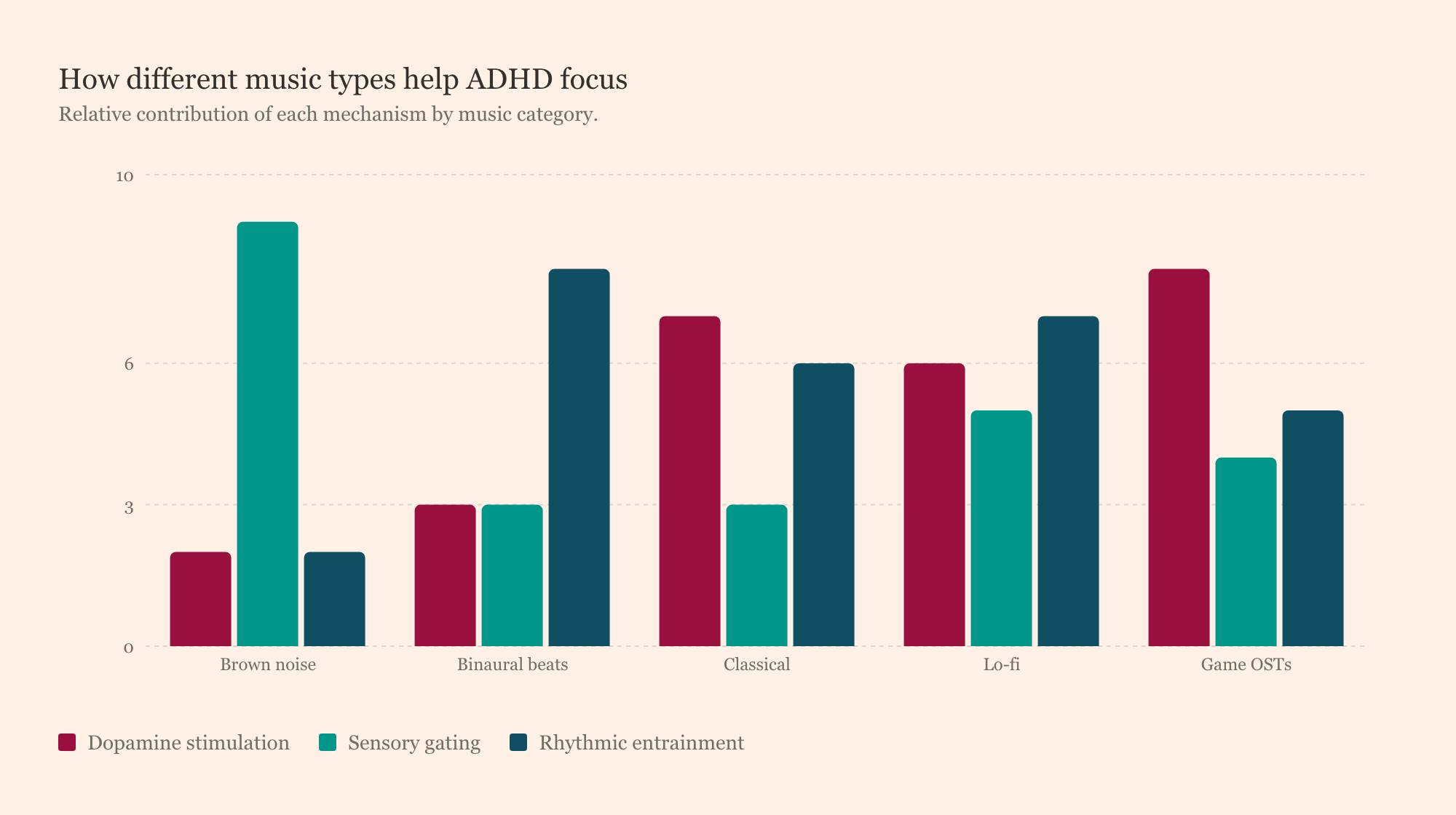
Research points to three distinct mechanisms by which sound improves focus for people with ADHD. Different kinds of music lean on different mechanisms, which is why "what works" is genuinely task-dependent.
1. Dopamine Stimulation
Listening to music you find pleasurable triggers dopamine release in the striatum, the same reward pathway stimulant medication targets. For ADHD brains running low on baseline dopamine tone, even modest music-induced dopamine release can push focus into a usable range. This is why personally-preferred music, not some universal "optimal" genre, often beats scientifically-designed focus tracks in uncontrolled settings. Enjoyment is doing mechanistic work.
2. Sensory Gating and Stochastic Resonance
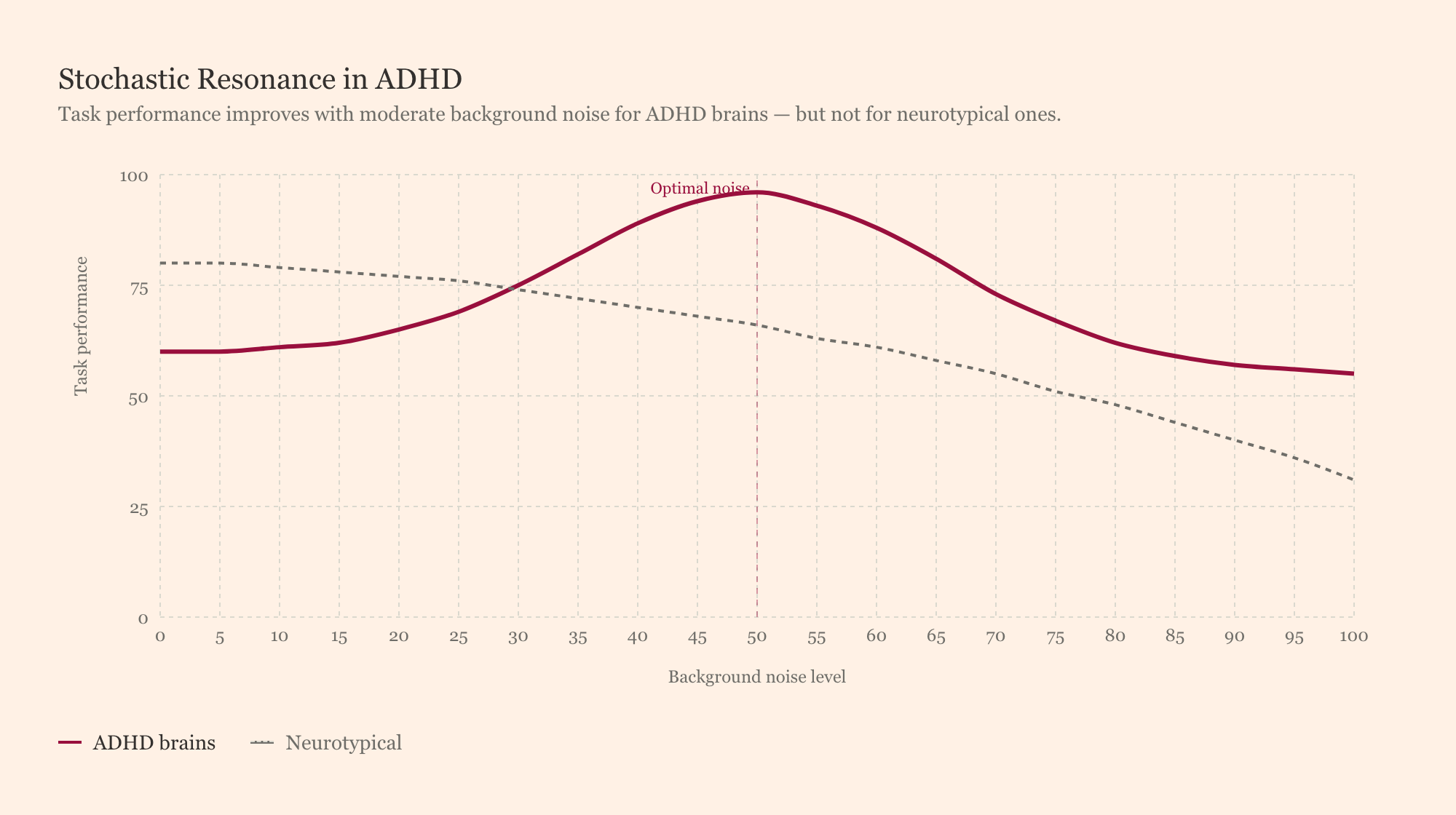
This is the most interesting mechanism, and the one most specific to ADHD. In a 2007 study published in Behavioral and Brain Functions, Göran Söderlund and colleagues showed that moderate levels of white noise actually improved cognitive performance in inattentive children, while decreasing performance in typically attentive children. The theory is called stochastic resonance: in systems with weak signal detection (ADHD attention), adding a specific amount of noise improves signal-to-noise ratio. Too much noise is disruptive for everyone. But the right amount paradoxically sharpens attention only in the ADHD group.
This is a big deal. It means noise-based focus audio isn't just a vague "ambient background" thing. It's doing something mechanistically specific to ADHD neurophysiology.
3. Rhythmic Entrainment
The brain's neural oscillators naturally synchronise to external rhythms. This is called neural entrainment. Music with steady tempo and consistent rhythmic structure gives the attention system something to lock onto, which stabilises the kind of wandering oscillation patterns seen in ADHD EEG studies. This is why drum-driven, beat-driven tracks often feel more focus-inducing than arrhythmic ambient music, even when the ambient music is objectively "calmer." The rhythm is doing work.
What the Research Says About Specific Types of Focus Music
Not all music for ADHD focus is equal. Here's what the evidence supports for each major category.
Brown Noise
Brown noise, the deep, bass-weighted cousin of white noise, has the strongest recent evidence base for ADHD focus. The stochastic resonance effect applies to all coloured noise, but brown noise's lower-frequency emphasis is less fatiguing for long sessions than white or pink noise, which is why it's become the default recommendation on ADHD forums in the last few years.
Use for: deep focus work, reading, tasks requiring sustained attention. Caveats: effects are modest. Not a substitute for medication, behavioural strategies, or sleep. And stochastic resonance predicts an inverted-U: too loud stops working.
Binaural Beats
Binaural beats, two slightly different frequencies played in each ear producing a perceived beat at the frequency difference, claim to entrain specific brain states (alpha for relaxation, beta for focus). The evidence is mixed but cautiously positive: some studies show small improvements in attention tasks, others find no effect. For ADHD specifically, research is limited but the proposed mechanism (entrainment in the beta range, 13-30 Hz) is theoretically well-founded.
Use for: medium-to-deep focus, especially paired with steady background instrumentation. Caveats: requires headphones (the effect doesn't work through speakers). Not a silver bullet.
Classical Music for Focus
The "Mozart effect", the 1993 claim that listening to Mozart improves cognition, was largely debunked in replication studies. That doesn't mean classical music for focus is useless; it means the specific "Mozart makes you smarter" version of the story was wrong. What remains true is that complex instrumental music without lyrics, played at moderate tempo, tends to help sustained attention for many people. Baroque in particular (Bach, Vivaldi, Handel) has steady rhythmic structure that fits the entrainment mechanism well.
Use for: reading, analytical work, writing. Caveats: individual response varies hugely. Some ADHD-ers find the dynamic range distracting; others find it perfect.
Lo-fi Hip-Hop
Lo-fi works for a specific structural reason: the genre is deliberately designed around repetitive, mid-tempo rhythmic loops with minimal melodic variation and no lyrics. That checks all three focus-music boxes (mild dopamine stimulation, broadband textural noise, and steady rhythmic entrainment) without any single element demanding active attention. It's been running a ten-year natural experiment with millions of listeners precisely because it hits this sweet spot.
Use for: most focus work, particularly creative tasks and coding. Caveats: can become too comfortable; some listeners report drifting after long sessions.
Video Game Soundtracks
An underrated category with strong empirical support, mostly because game composers are trained to write music that keeps the listener focused without distracting them. That's literally their brief. Orchestral OSTs from long-form RPGs (games you'd play for 50+ hours) tend to follow the same rules as good focus music: instrumental, moderate tempo, dynamic but not melodramatic.
Use for: writing, coding, design work. Caveats: can be emotionally charged; match the track's mood to the task.
Matching Music to Task
Different tasks benefit from different acoustic properties. A rough framework:
| Task Type | Best Match | Why |
|---|---|---|
| Reading / comprehension | Brown noise OR instrumental classical | No lyrics; steady rhythm doesn't compete with inner voice |
| Writing | Lo-fi or video game OSTs (low variance) | Enough stimulation to calm default mode; not so complex it hijacks language processing |
| Coding / technical work | Binaural beats + ambient pads | Entrainment in the beta range; minimal distraction |
| Repetitive / mechanical | Higher-energy music, personally enjoyable | Dopamine stimulation dominates; novelty and tempo matter more |
| Creative / brainstorming | Familiar music you love | Mood and dopamine, not suppression of distraction |
The most common mistake is using the same music for everything. ADHD brains benefit from acoustic variety across tasks, not within a task but between them.
A Practical Listening Protocol
If you want the benefits without drifting into "music as a second distraction," a few practical rules:
- Volume matters. Stochastic resonance is inverted-U: too loud actively impairs attention. Keep noise tracks around 40-50% of comfortable listening volume.
- Switch when you hit diminishing returns. If you notice the music becoming more interesting than the task, change tracks or take a short break.
- Separate task-music from enjoyment-music. Brains habituate. If you play your favourite Bach cello suite during deep work, it stops being your favourite and stops helping.
- Headphones for binaural beats; speakers or headphones for everything else. Binaural beats literally do not work on speakers.
- Pair with structure. Music helps most when combined with time-boxed work sessions (Pomodoro or similar). The structure scaffolds attention; the music sustains it.
How Tomatoes Fits In
Tomatoes was designed from the ground up around this research. The default stations layer brown-noise-style broadband texture, rhythmic entrainment at beta-range frequencies, and ambient pads that occupy sensory bandwidth without demanding attention. The app pairs the audio with Pomodoro timing so the structure-and-sound pairing is automatic. If you want to dig into the neuroscience behind the specific sound design choices, the ADHD-focused station and the frequency research page go deep on the implementation.
You can get Tomatoes for $39 and try the ADHD focus station with your next working block. One-time payment, no subscriptions, no accounts.
A Note on Expectations
Music is a mild intervention. It helps. It can measurably improve sustained attention in ADHD brains. But it's not a replacement for the things that move the needle most: sleep, exercise, appropriate medication under a doctor's supervision, and structural changes to your work environment. Treat focus music the way you'd treat a good pair of headphones: useful infrastructure, not the main lever.
Used well, with intent, alongside the fundamentals, it closes the gap between what your attention wants to do and what the task needs it to do. Which, for ADHD brains, is often exactly the help that was missing.