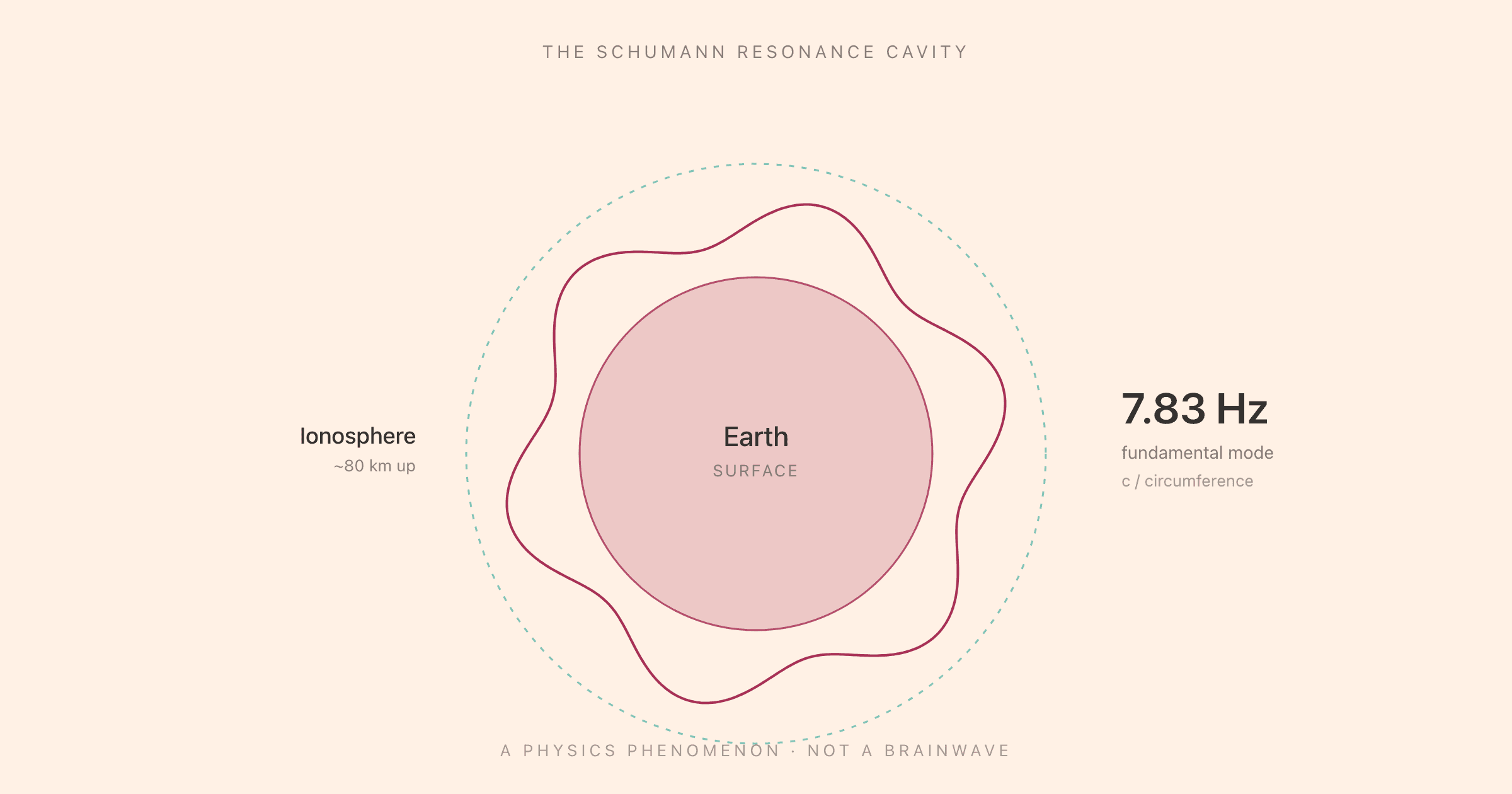
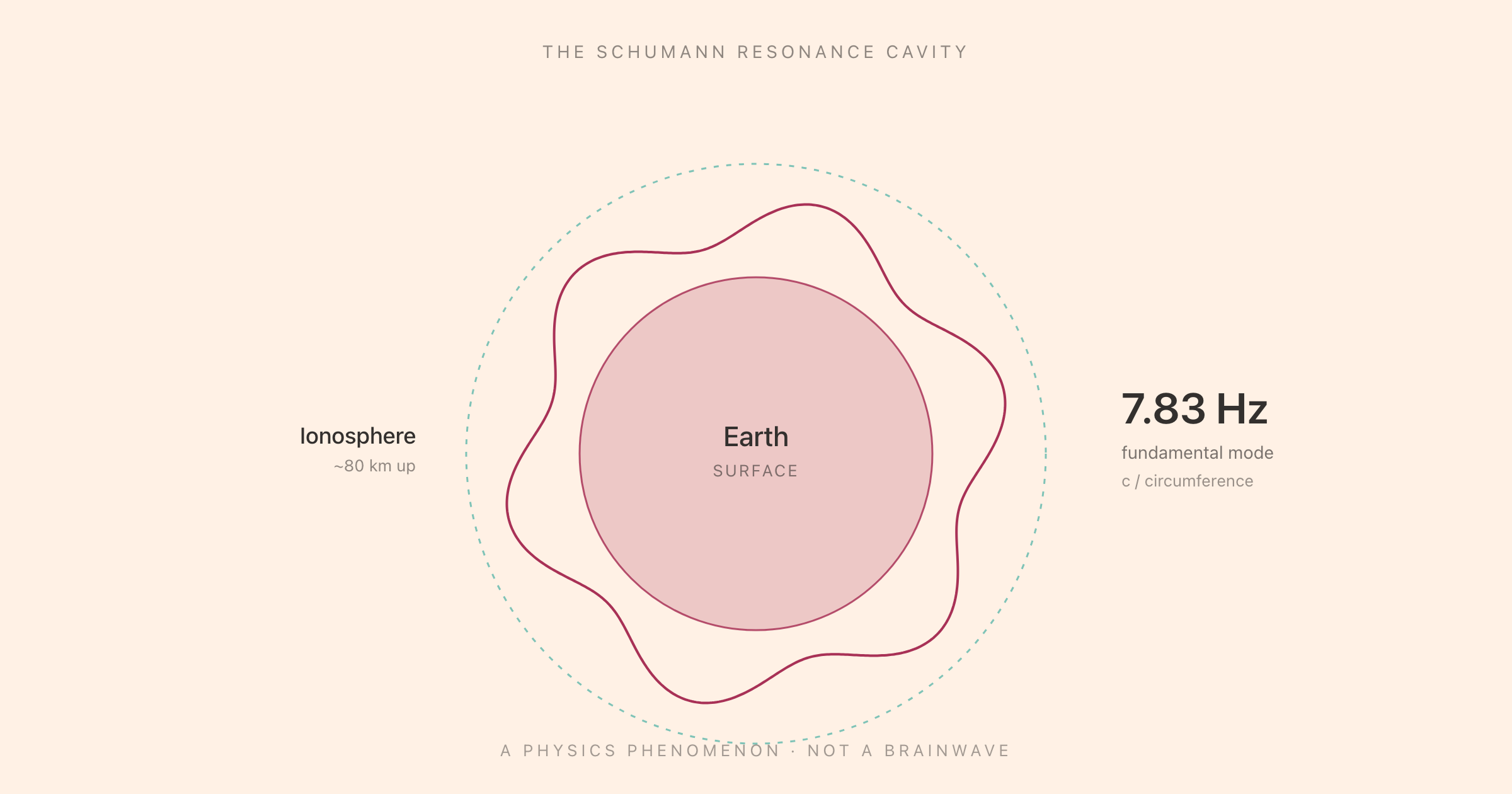
The Schumann resonance is the electromagnetic standing wave that fits, almost exactly seven times around the planet, between the surface of the Earth and the underside of the ionosphere. Its fundamental frequency is 7.83 Hz, give or take small daily and seasonal drifts. It is a well-attested fact of atmospheric physics, predicted by Winfried Otto Schumann in 1952 and first measured by Schumann and Herbert König in 1954. None of that is controversial. What is controversial is the second sentence in most blog posts about it: that 7.83 Hz is "the Earth's heartbeat" and that listening to it puts your brain into an alpha state, balances your nervous system, or aligns you with the planet.
This article works through what the Schumann resonance actually is, where the brainwave connection comes from, what the actual research on listening to 7.83 Hz tones shows, and where it fits in the broader picture of brainwave entrainment. The honest answer is more interesting than the marketing version. If you want focus music built on the brainwave-entrainment frequency that does have strong peer-reviewed support (40 Hz gamma, not 7.83 Hz), Tomatoes does that. The rest of the article explains why we picked 40 Hz and not Schumann.
What the Schumann Resonance Actually Is
Strip out the marketing and the Schumann resonance is a physics phenomenon with two parts. The cavity, and the source of energy that excites it.
The cavity. Earth's surface is a fairly good conductor. The lower edge of the ionosphere, about 60 to 90 kilometres up, is also a conductor (because solar radiation ionises the gas at that altitude). Between them is a thin shell of insulating air. This is, electromagnetically speaking, a closed waveguide. Like any closed waveguide it has resonant modes, frequencies at which a standing wave fits cleanly into the geometry.
The source. Lightning. There are roughly 50 lightning strikes per second worldwide, almost all in three tropical hotspots (the Amazon, central Africa, the Maritime Continent in southeast Asia). Each strike is a broadband electromagnetic pulse. Most of the energy radiates away into space or dissipates, but some of it gets trapped in the cavity and rings at the cavity's resonant modes.
The fundamental mode, the lowest frequency that fits one full wavelength around Earth's circumference, is at about 7.83 Hz. It is just c (the speed of light) divided by Earth's circumference. Higher harmonics sit at 14.3 Hz, 20.8 Hz, 27.3 Hz, 33.8 Hz, and so on, slightly higher than simple integer multiples because of the cavity geometry.
This is real, measurable, and used in serious research. Schumann resonances are how geophysicists track global lightning activity. They are used to detect upper-atmosphere disturbances. The amplitude of the fundamental varies on a daily and seasonal cycle. Solar flares perturb it. None of this is woo. It is a genuine global electromagnetic resonance.
Where the Brainwave Connection Comes From
The Schumann resonance fundamental at 7.83 Hz happens to sit at the lower edge of the alpha brainwave band (8 to 13 Hz) and the upper edge of the theta band (4 to 8 Hz). Alpha is the brainwave state associated with relaxed wakefulness, the state you produce when you close your eyes and stop concentrating. Theta is associated with light meditative states and the boundary of sleep.
The argument made in popular brainwave-entrainment writing goes roughly like this: human brains evolved on Earth, surrounded by an ambient 7.83 Hz electromagnetic field, so the brain's alpha rhythm is "tuned to" the Schumann resonance, and re-exposing yourself to a 7.83 Hz signal restores some natural alignment. The implication is that listening to a 7.83 Hz binaural beat or an isochronic tone at 7.83 Hz produces the same relaxed-alert state as natural alpha.
The argument has three problems and one redeeming feature.
Problem one: amplitude. The natural Schumann field is extraordinarily weak. The magnetic component is on the order of picotesla (a trillionth of a tesla), the electric field a fraction of a millivolt per metre. Sensitive equipment is needed to measure it at all. The brain is bathed in much stronger electromagnetic noise from every electrical device in a building, every wireless signal, even the geomagnetic field itself (which is orders of magnitude larger). The idea that the brain "evolved tuned to" a signal it could barely register, and would be drowned out by ambient noise in any built environment, is a stretch.
Problem two: mechanism. For an external rhythmic signal to produce a measurable cortical response, it has to drive sensory receptors. Sound at 7.83 Hz binaural-beat modulation drives the auditory system, which is fine and which we know works for certain frequencies. But the original "evolved to the Earth field" claim is about electromagnetic exposure, not sound. There is no good evidence the brain phase-locks to atmospheric electromagnetic fields at the energies they exist at.
Problem three: causal direction. The fact that 7.83 Hz happens to sit near the alpha range is a coincidence of physics (the Earth's circumference) and biology (the typical thalamocortical resonance frequencies). One did not cause the other. Brains in the lab still produce alpha at 8 to 13 Hz with no exposure to a Schumann signal.
The redeeming feature. Sound at 7.83 Hz, presented as a binaural beat or isochronic pulse, is in the alpha-theta border range, which is a range that does have entrainment evidence. Just not because of the Schumann resonance. Because the auditory system can drive cortical entrainment to rhythmic stimuli in the 4 to 14 Hz range with measurable EEG effect. The Schumann frequency is incidental. The frequency is in a useful range; the planetary association is decoration.
What the Actual Research Shows About Listening to 7.83 Hz
There are not many peer-reviewed studies that test 7.83 Hz auditory stimulation specifically. The brainwave-entrainment literature is broader and tests a range of frequencies in the alpha-theta band, with mixed but generally positive results for relaxation and modest results for cognitive measures.
The pattern in the literature is roughly:
-
Alpha-band auditory entrainment (8 to 13 Hz) produces measurable EEG alpha increases and subjective relaxation in most studies that try it. The effect is real but modest. Effect sizes are typically small to medium. The clinical applications (anxiety reduction, mild insomnia improvement) have early-stage evidence.
-
Theta-band entrainment (4 to 8 Hz) is less studied for cognitive effects and more studied as a meditative aid or for hypnagogic states. Some evidence for memory consolidation effects when used during specific sleep stages. Less evidence for waking-state cognitive benefits.
-
7.83 Hz specifically has a small handful of studies. A 2014 study by Saroka and Persinger explored simulated Schumann-like signals (electromagnetic, not auditory) and reported correlations with EEG measures, but the work has been criticised for small samples and lack of replication. A few practitioner-led studies have measured subjective relaxation after 7.83 Hz audio sessions; these lack the controls to separate the frequency-specific effect from generic relaxation-music effects.
The honest summary: there is no strong evidence that 7.83 Hz auditory stimulation does anything that 8 Hz, 10 Hz, or any other alpha-band frequency would not also do. The unique status of 7.83 Hz is mainly a marketing artefact based on the planetary-resonance association. The audio entrainment effect, to the extent it exists, is probably the same alpha-band effect found in broader entrainment research.
Why 7.83 Hz Is Not the Best Choice for Focus
If your goal is focus and not relaxation, the Schumann frequency is a poor target on theoretical grounds and a poor target on the available evidence. Focus is a beta-and-gamma state, not an alpha-theta state.
The brainwave bands sort roughly as follows:
- Delta (1 to 4 Hz): deep sleep
- Theta (4 to 8 Hz): drowsiness, light meditation, boundary of sleep
- Alpha (8 to 13 Hz): relaxed wakefulness, eyes closed, idling
- Beta (13 to 30 Hz): active thinking, problem solving
- Gamma (30 to 100 Hz): focused attention, sensory binding, working memory
Alpha is what you produce when you stop concentrating. It is not what you produce when you concentrate. So entraining to an alpha-band frequency, including 7.83 Hz at the alpha-theta border, is more likely to relax you than to focus you. For some people the relaxation is useful as a focus prerequisite (calmer baseline, then focus follows), but the entrainment itself is not driving the focus.
The frequency that does have strong evidence for focus-related entrainment is 40 Hz, sitting in the gamma band. The auditory steady-state response (ASSR) peaks sharply at 40 Hz, much more strongly than at neighbouring frequencies. Forty-decade-old EEG research consistently finds that 40 Hz is the frequency the cortex tracks most reliably. Two recent peer-reviewed studies (one in Nature in 2020, one in Current Psychology in 2023) have specifically linked 40 Hz auditory stimulation to improved sustained attention. We covered the full case for 40 Hz in the gamma waves article and the ASSR research in detail in the gamma waves focus piece.
7.83 Hz has none of this evidence behind it for focus-relevant outcomes. What evidence exists points toward relaxation, not concentration.
How to Listen if You Want to Try It Anyway
If you are curious about 7.83 Hz despite the caveats above, the format and the use case matter.
For relaxation, before sleep, or as a meditation aid. A binaural beat at 7.83 Hz (carrier 200 to 400 Hz, beat 7.83 Hz, played through headphones) is a reasonable thing to try. Sessions of 15 to 30 minutes, eyes closed, in a quiet room. The frequency is not magic but it is in a band where alpha-theta entrainment effects are documented. Generic alpha-band entrainment audio (anywhere from 8 to 12 Hz) would probably work the same.
For focus during work. Skip it. Use a gamma-band entrainment track instead. 40 Hz auditory stimulation embedded in something musically tolerable (not a pure tone) works for sessions of 30 to 90 minutes with measurable subjective focus improvements for most people who try it.
For anxiety or general winding-down. 7.83 Hz at low volume as a background through wireless speakers (so not a binaural beat per se) probably does little beyond what any quiet ambient track would do. The entrainment effect requires controlled headphone listening; ambient speaker exposure does not produce the same EEG response.
Avoid the EMF-exposure devices. A whole sub-industry sells "Schumann frequency generators" that produce a weak electromagnetic field at 7.83 Hz, often marketed for sleep, jet lag, or pet anxiety. The amplitude these produce is comparable to or below ambient electromagnetic noise in any building. There is no plausible mechanism by which they would do anything, and the human-trial evidence is essentially zero.
What Tomatoes Uses Instead, and Why
Tomatoes is built on 40 Hz gamma modulation, not on Schumann-resonance frequencies. The reasoning is exactly the case made above: the goal is focus, focus is a gamma-band state, and 40 Hz is the frequency with the strongest auditory steady-state response.
We layer 40 Hz amplitude modulation underneath musically listenable sound (drones, pink noise, granular textures, chimes), so the modulation is doing entrainment work without being audible as a pure pulse. Sessions can run for an hour or more without the listener noticing the underlying pulse, which matters because pure-tone entrainment becomes intolerable fast.
If you want to feel the difference between alpha-band and gamma-band entrainment audio, try a 7.83 Hz binaural beat for 20 minutes (eyes closed, low light, no work). Then try Tomatoes for a focused work session. The two states are not the same. One is relaxation, one is concentration. The Schumann resonance, for all its physics interest, lives in the wrong band for the focus job.
In Summary
The Schumann resonance is a real physics phenomenon: a global electromagnetic standing wave at 7.83 Hz, excited by lightning, sustained by the Earth-ionosphere cavity. It is not a brainwave. It is not the planet's heartbeat. The brain did not evolve "tuned to" it in any meaningful sense, because the natural field is too weak to drive cortical activity.
The auditory analogue (a 7.83 Hz binaural beat or isochronic tone) sits in the alpha-theta border range and probably produces the same modest entrainment effects that broader alpha-band audio produces. That can be useful for relaxation. It is not useful for focus, where the frequency that actually matters is 40 Hz gamma. If you are after relaxation, 7.83 Hz is fine. If you are after focus, listen to 40 Hz instead. Tomatoes is built on the latter, and the pricing page has a 3-day free trial if you want to feel the difference.