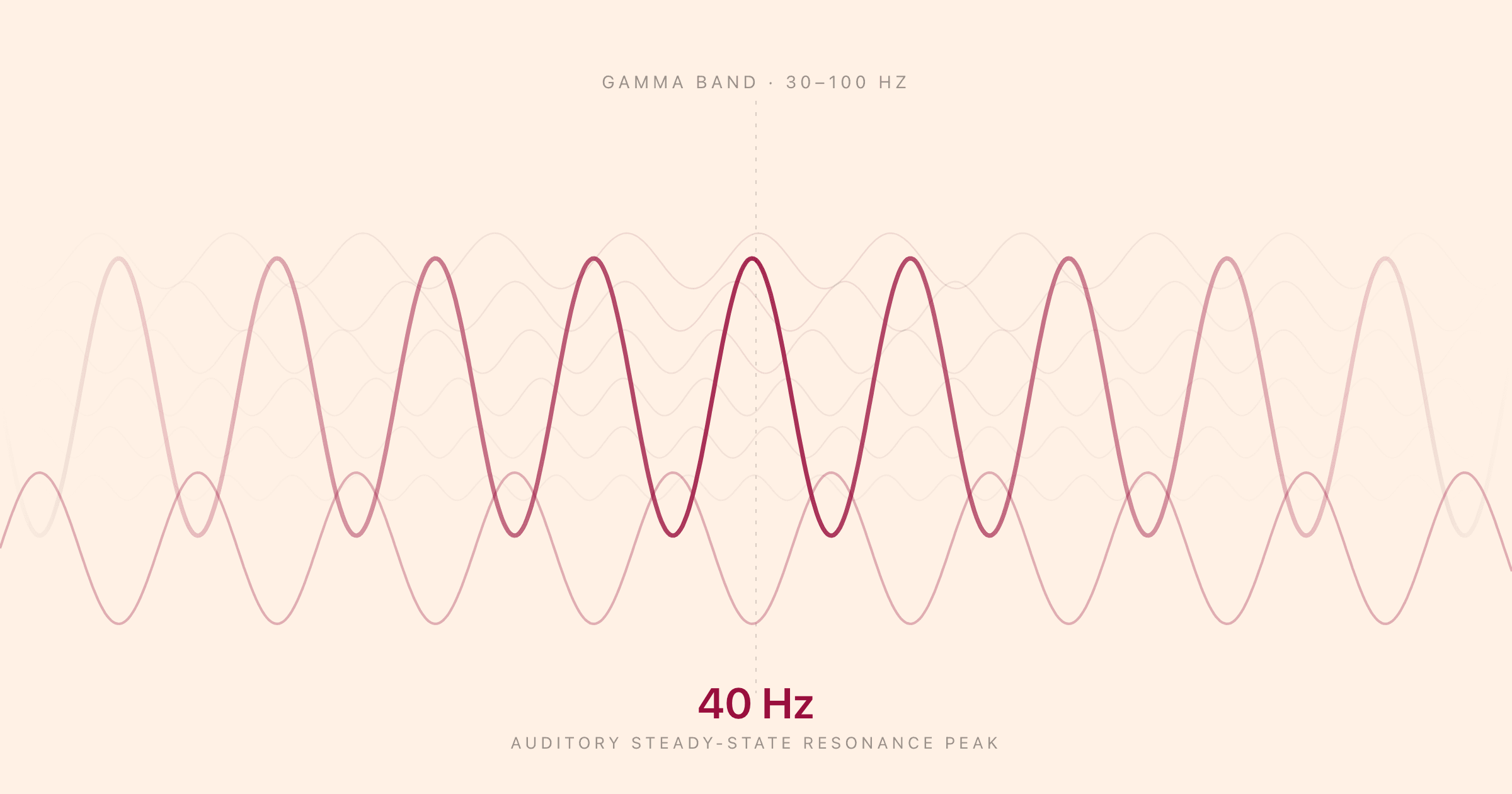
Of all the frequencies inside the gamma band, 40 Hz is the one the brain notices. Present it as an auditory stimulus and cortical EEG tracks it with a sharp resonance peak. Present it as rhythmic visual flicker and the same thing happens in visual cortex. Present other gamma frequencies, 30, 35, 45, 60, and the response is lower. This is not folklore, it is the auditory steady-state response, first characterised by Galambos and colleagues in 1981 and replicated across four decades of EEG and MEG work.
This post unpacks what 40 Hz gamma waves actually are, why the brain singles out this particular frequency, what the cognitive and clinical research does and doesn't show, and the three practical ways to listen if you want to use 40 Hz for focus. All of this is what Tomatoes is built on: a focus-music engine that weaves 40 Hz modulation into musically listenable soundscapes rather than dropping you into a medical tone.
What 40 Hz Gamma Waves Are
Brainwave bands are conventions, not hard boundaries. Gamma is everything from roughly 30 Hz to 100 Hz, a very wide range, and the cortex produces gamma activity during attention, working memory, sensory binding, and conscious perception. Within that band, 40 Hz occupies a special position.
40 Hz is:
- A resonant frequency of thalamocortical loops. The circuits that gate sensory information and route it through cortex oscillate naturally in this range. When you present a 40 Hz stimulus, those circuits entrain more readily than they do to neighbouring frequencies.
- The peak of the auditory steady-state response (ASSR). When rhythmic auditory stimuli are delivered across a sweep of modulation rates, cortical EEG power peaks sharply at about 40 Hz. Not 30 Hz, not 50 Hz. This was the central finding of Galambos and colleagues and has been replicated many times with both EEG and MEG.
- Candidate for the cognitive binding rhythm. The hypothesis, proposed by Wolf Singer and Francis Crick among others in the 1990s, is that 40 Hz gamma activity is how cortex binds features like colour, motion, and shape into a single perceived object. The hypothesis is not settled, but 40 Hz keeps coming up in the experimental record.
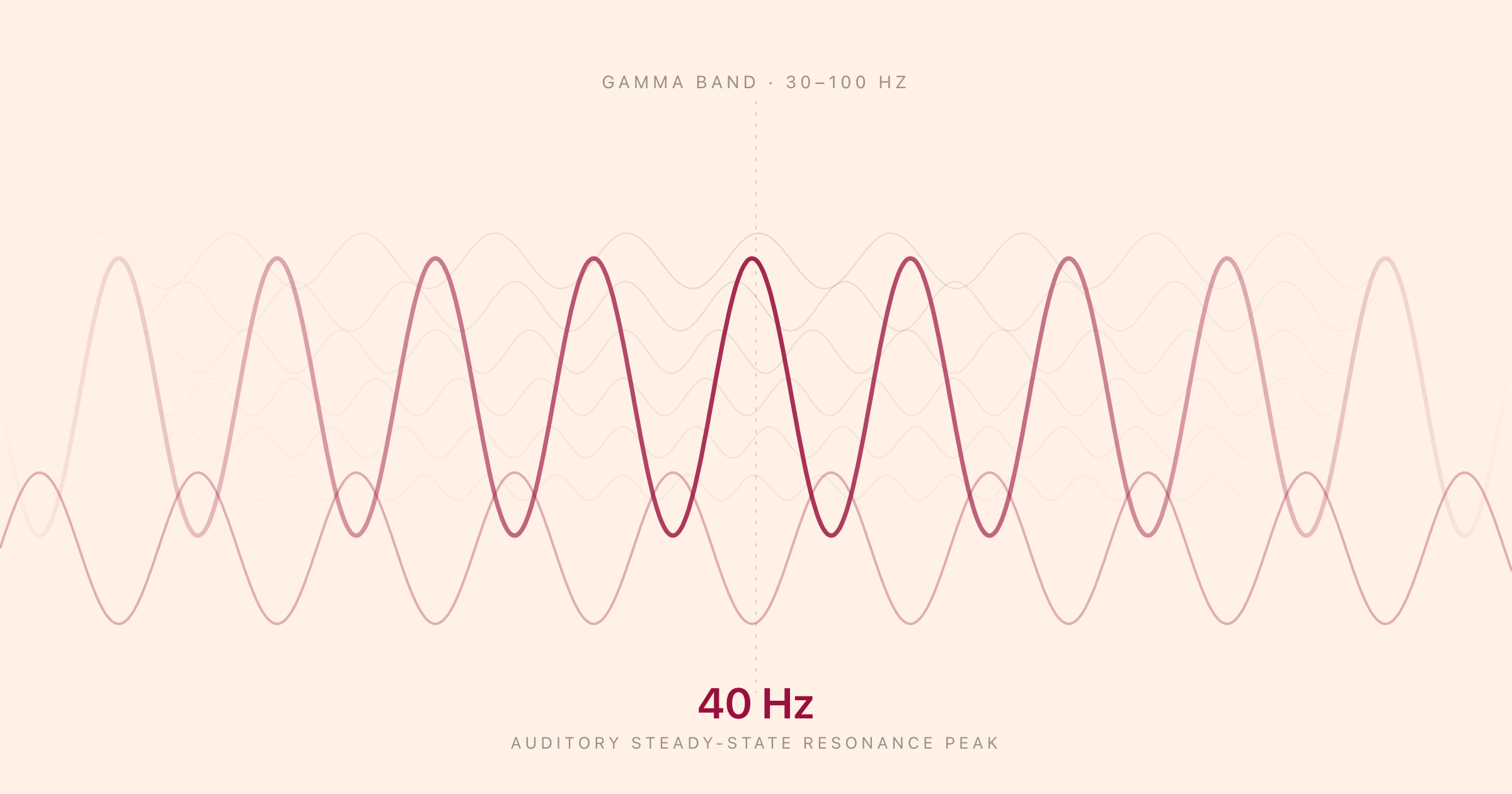
The practical point: 40 Hz is not magic, it is a frequency the brain is particularly good at tracking. That alone makes it interesting for anyone trying to use sound as a focus tool.
The ASSR Tuning Curve, Explained
The single most useful image for understanding why 40 Hz matters is the auditory steady-state response tuning curve. It looks like this:
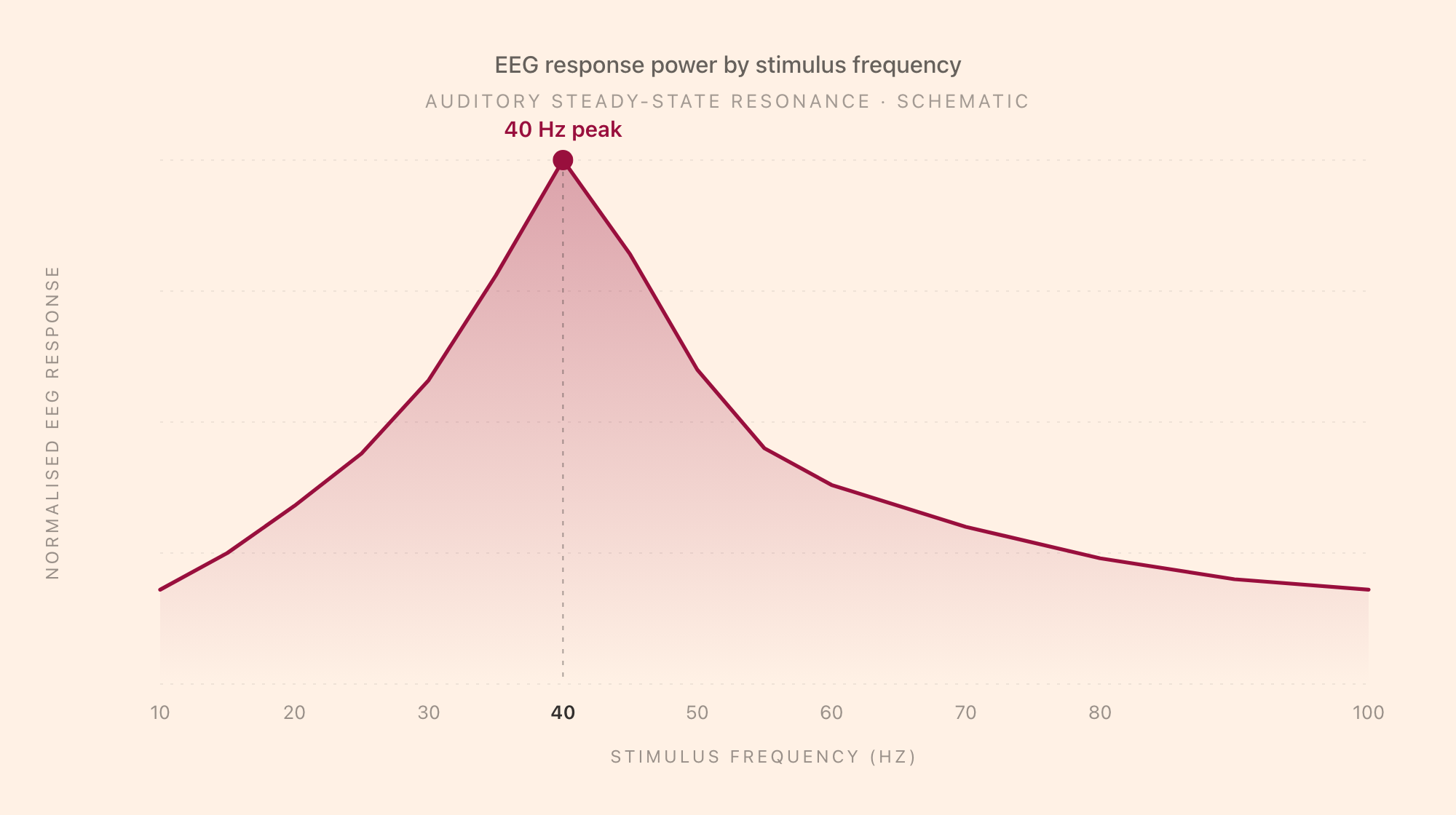
Three things to notice about this schematic, which reflects the shape of the classic Galambos and Pantev data, without being an exact dataset:
- The peak is sharp. Move the stimulus up or down by 5-10 Hz and the response drops off. The brain is not broadly tuned to gamma, it is specifically tuned near 40 Hz.
- The rise is asymmetric. Response climbs steadily from 20 Hz upwards. Between 30 and 40 Hz the curve steepens. Above 40 Hz it falls faster.
- It's auditory-centric. The curve was mapped for auditory stimuli. Visual 40 Hz entrainment produces a similar tuning in visual cortex but the exact peak is not always at 40 Hz.
The existence of this tuning curve is the single strongest argument for 40 Hz being a useful stimulus frequency. It is also the reason a 40 Hz gamma binaural beat, a 40 Hz isochronic tone, and a 40 Hz amplitude-modulated sound all work: they all share the same modulation rate that the cortex is optimally locked to.
The Cognitive Binding Hypothesis
The brain can distinguish a red ball rolling left from a blue ball rolling right. That is trivial to do. What is not trivial is that "red", "ball", "rolling", and "left" are processed in different cortical areas, and yet we perceive them as one integrated object. The cognitive binding hypothesis asks: what mechanism glues those features together?
One influential answer, proposed by Singer, Crick, Koch, and others in the early 1990s, is that neurons coding the same object synchronise their firing at around 40 Hz. The synchrony, not the firing rate, is the binding signal.
Key observations consistent with the hypothesis:
- In cat visual cortex, neurons responding to the same moving object oscillate together in the 35-45 Hz range.
- In human EEG, gamma-band coherence across scalp regions increases during conscious perception and drops during anaesthesia.
- Patients with disorders of binding (schizophrenia, autism spectrum) show altered gamma synchrony in laboratory tasks.
The hypothesis is not universally accepted. Alternative accounts suggest gamma is a byproduct of cortical computation rather than its mechanism. For a careful discussion of the evidence, see our piece on neural phase locking, which covers the phase-alignment side of the story.
Either way, the 40 Hz peak in the ASSR curve tells us the cortex is already very good at following a 40 Hz driver. Whether external 40 Hz stimulation reliably improves cognition is a separate question, and the answer is more modest than headlines suggest.
The Alzheimer's Research: Promising, Not Settled
The single highest-profile 40 Hz result of the last decade came out of Li-Huei Tsai's lab at MIT. In 2016, Iaccarino and colleagues showed that exposing Alzheimer's-model mice to 40 Hz visual flicker reduced amyloid-beta plaques in visual cortex and altered microglial activity. Subsequent papers from the same group extended the result to auditory 40 Hz stimulation and to combined audio-visual protocols.
In 2019, the group launched human trials through a spin-out (Cognito Therapeutics, the GENUS protocol). Early results in small cohorts of Alzheimer's patients suggested slowed cognitive decline and preserved brain volume in treated groups, though larger trials are ongoing and the effect sizes, mechanisms, and generalisability are still being debated.
What this research does and doesn't tell healthy adults who want to use 40 Hz for focus:
- Does: The brain is entrainable at 40 Hz in humans, not just mice, and the entrainment reaches deep enough to alter measurable biomarkers in patient populations.
- Doesn't: It does not tell us that healthy working-age adults listening to 40 Hz gamma beats for thirty minutes get measurably better focus, memory, or problem-solving. That claim is much weaker and rests on small, mixed studies.
If you encounter marketing copy that invokes the Tsai lab's Alzheimer's research to sell a focus product, treat it the way you would any citation borrowed across contexts. The underlying science is real, but the therapeutic context is clinical, not productivity.
Three Ways to Listen to 40 Hz Gamma Waves
If you want to actually try 40 Hz as a focus stimulus, there are three distinct methods. They produce different cortical responses and have different practical constraints.
1. 40 Hz Binaural Beats
A binaural beat is generated when you present slightly different frequencies to each ear. The brain perceives a pulsing at the difference frequency. For 40 Hz gamma, you might hear 200 Hz in the left ear and 240 Hz in the right. The perceived 40 Hz pulse exists only in the brain, not in the audio file itself.
- Pros: Musically unobtrusive. Can be layered under ambient pads or nature sounds.
- Cons: Strictly requires stereo headphones. Speakers mix the left and right signals before they reach your ears, which destroys the binaural illusion. The ASSR response to binaural beats is also measurably weaker than to isochronic tones at the same modulation rate.
- When to use: Desk work with headphones on, low-distraction environment, where you want the 40 Hz effect without an obvious pulsing sound.
For a deeper comparison of binaural against competing modulation techniques, see binaural beats versus solfeggio frequencies and isochronic tones versus binaural beats.
2. 40 Hz Isochronic Tones
An isochronic tone is a single tone amplitude-modulated at your target frequency. For 40 Hz, you take (say) a 400 Hz sine tone and pulse it on and off 40 times per second. The ASSR response to this is stronger than to binaural beats.
- Pros: Works through speakers, stronger cortical entrainment, no headphones required.
- Cons: The 40 Hz pulsing is audible as a buzz or hum. Most people can't listen to it for hours without fatigue.
- When to use: Short focus blocks (20-40 minutes), tolerant of audible pulsing, speakers-only environment.
3. 40 Hz Amplitude-Modulated Music
The third option, and what Tomatoes leans into, is to take musically listenable source material and apply a 40 Hz amplitude envelope to it. Strings, pads, and percussive elements can be modulated at 40 Hz without the result being unpleasant, because the modulation tracks the music's existing rhythmic structure rather than imposing a raw pulse on top.
- Pros: Musically rich, sustainable over long sessions, still carries the 40 Hz envelope the cortex locks onto.
- Cons: Requires careful audio engineering. The modulation depth has to be strong enough for ASSR entrainment without being audibly disruptive.
- When to use: Long focus blocks, music-over-silence preference, headphones or speakers.
Safety: Who Should Avoid 40 Hz Exposure
Gamma-band audio is not dangerous for the large majority of listeners, but there are specific groups who should treat 40 Hz (and especially visual 40 Hz flicker) with caution.
- Photosensitive epilepsy. Flickering 40 Hz visual stimuli can trigger seizures in photosensitive individuals. Audio 40 Hz entrainment is much lower risk, but anyone with a seizure history should speak to their neurologist before using gamma entrainment products.
- Migraine with aura. Some migraineurs report aura triggered by rhythmic flicker at gamma rates.
- Active tinnitus. Any narrowband tonal stimulus, including 40 Hz isochronic tones and binaural carriers, can exacerbate perceived tinnitus in some people.
- Pregnancy. There is no evidence of harm, but no positive safety trial data either. When in doubt, don't.
For a comprehensive treatment of auditory entrainment safety, including volume guidelines and session-length research, see can binaural beats damage your brain.
How Tomatoes Uses 40 Hz
Tomatoes is a focus-music engine built on real-time DSP, not a library of pre-rendered MP3s. The 40 Hz layer in Tomatoes is an amplitude-modulation envelope applied to the melodic and textural voices, not a separate tone dropped on top. The modulation depth is set to produce a measurable ASSR response at laboratory volumes without making the pulsing audibly obvious to the listener.
Three technical choices that matter:
- The 40 Hz envelope tracks musical events. When a note's amplitude rises, the 40 Hz modulation rides that rise. This keeps the cortical entrainment signal strong during the parts of the track where your attention is most engaged with the music.
- Carrier frequencies sit in the mid-range (200-800 Hz). Lower carriers produce weaker ASSR responses; higher carriers interact with the cochlear filter in a way that degrades the 40 Hz envelope.
- No stacked binaural layers. Mixing binaural beats with isochronic modulation at the same frequency produces cancellation patterns that weaken the net cortical response.
If you want to try focus music that actually does something to the gamma band rather than just calling itself "gamma", Tomatoes is a one-time purchase of $39 with no subscription and no account. You can buy it here.
FAQ
Is 40 Hz the same as gamma waves?
No. Gamma is the whole band from roughly 30 Hz to 100 Hz. 40 Hz is one specific frequency inside gamma, notable because the brain's auditory steady-state response peaks there.
Do 40 Hz binaural beats actually work?
They produce measurable cortical entrainment in laboratory EEG, but the cognitive-performance evidence in healthy adults is mixed. They are most useful as one component of a broader focus routine, not a standalone intervention.
Can I listen to 40 Hz gamma through speakers?
Isochronic tones and amplitude-modulated music at 40 Hz work through speakers. True binaural beats need stereo headphones because the effect depends on each ear receiving a different frequency.
Is 40 Hz safe to listen to for long periods?
For the general population, yes, at moderate volumes. People with photosensitive epilepsy, migraine with aura, or active tinnitus should consult a clinician first. Keep session volume at conversational levels, not loud.
What's the difference between 40 Hz and 432 Hz?
432 Hz is a proposed alternative reference pitch for tuning musical instruments. It has nothing to do with gamma-band entrainment. 40 Hz is a modulation rate that targets the auditory steady-state response. They live in different musical and neuroscientific categories.
The Short Version
40 Hz gamma waves are the frequency at which the auditory cortex shows its strongest steady-state response. That makes 40 Hz the natural target rate for auditory entrainment, and it is why binaural beats, isochronic tones, and amplitude-modulated music at 40 Hz all produce stronger EEG responses than the same techniques at neighbouring frequencies. The cognitive benefits for healthy adults are real but modest, the Alzheimer's research is promising but still clinical, and the safety profile is good for most listeners.
If you want a focus-music tool that takes 40 Hz seriously, Tomatoes is available for a one-time $39. For more on the full gamma band and related brainwaves, see the gamma waves and peak performance deep-dive.