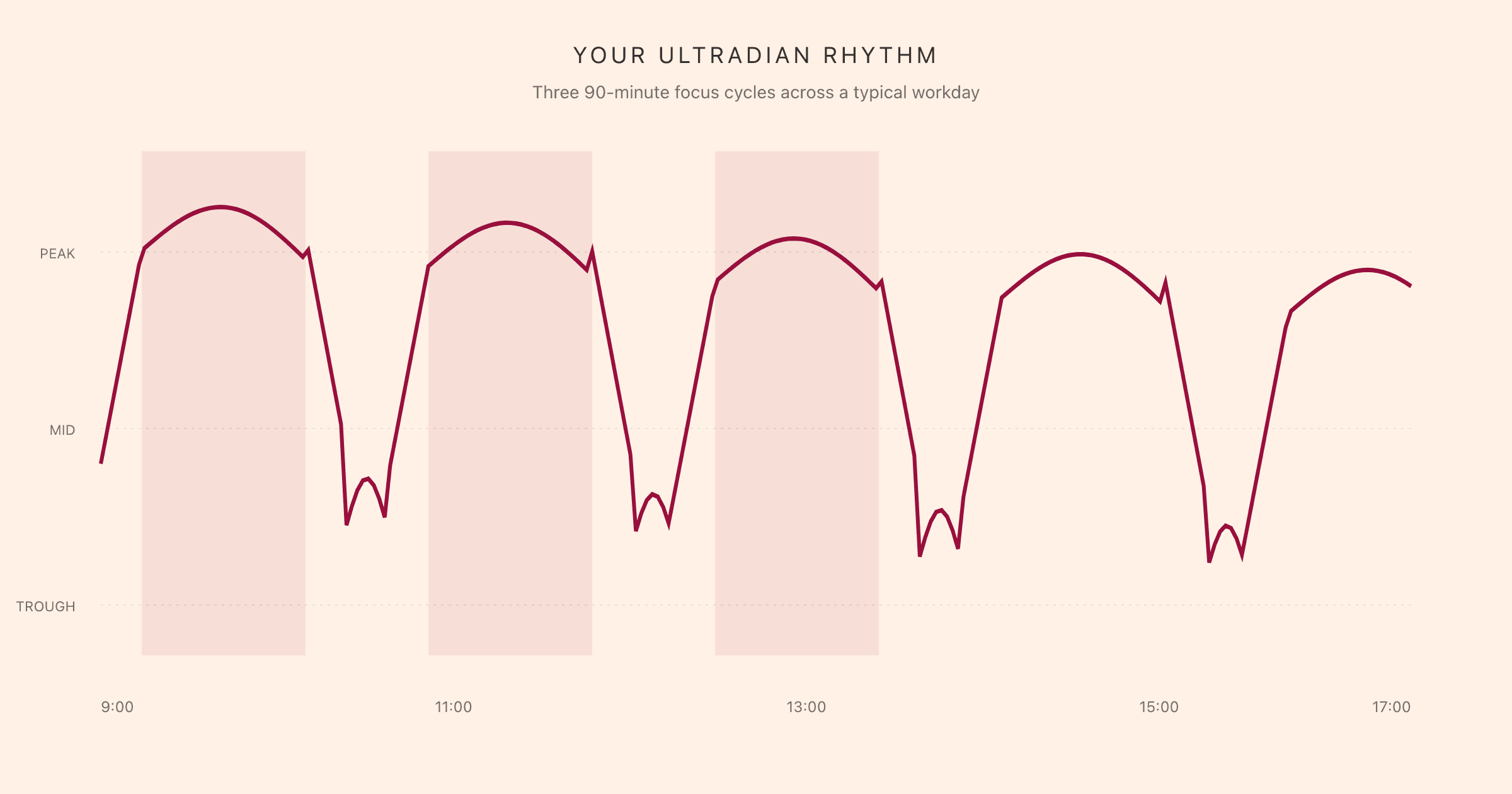
Your brain does not run at a constant level of alertness. It cycles. Roughly every 90 to 120 minutes, your cognitive system climbs into a peak of focused attention, stays there for a window, then drops into a trough where concentration genuinely is not available. That cycle is called your ultradian rhythm, and if you have ever wondered why you can't seem to force yourself into a fourth straight hour of deep work no matter how disciplined you are, it's because you're working against a hard biological limit, not a character flaw.
This article is the practical neuroscience guide: what an ultradian cycle actually is, where the 90-120 minute figure comes from, how to read your own rhythm, what the Pomodoro technique gets right about it (and what it gets wrong), and how to structure a workday around the cycle instead of fighting it.
What Is an Ultradian Rhythm?
An ultradian rhythm is any biological cycle shorter than 24 hours (shorter than circadian). We have dozens. Your heart rate cycles. Your hormone pulses cycle. Your hunger cycles. Your sleep cycles through roughly 90-minute REM/non-REM waves through the night.
The one that matters for focus work is the waking equivalent of those sleep cycles. In 1961, sleep researcher Nathaniel Kleitman proposed the basic rest-activity cycle (BRAC): a continuous 90-120 minute cycle of alternating high-arousal and low-arousal states that runs through your entire day, not just your night. During high-arousal phases you're alert, attentive, capable of sustained focus. During low-arousal phases, your brain is forcing a recovery window: concentration drops, errors rise, and attempts to push through produce frustration more than output.
Kleitman's BRAC was speculative when he proposed it. Fifty years of research since has mostly backed it up, with some refinements. The exact period varies person to person (anywhere from 75 to 130 minutes), it drifts with sleep quality and stimulants, and the amplitude (how dramatic the peaks and troughs are) varies too. But the basic shape is consistent: you are not capable of uniform focus for eight hours a day, and neither is anyone else.
What the 90-Minute Cycle Actually Looks Like
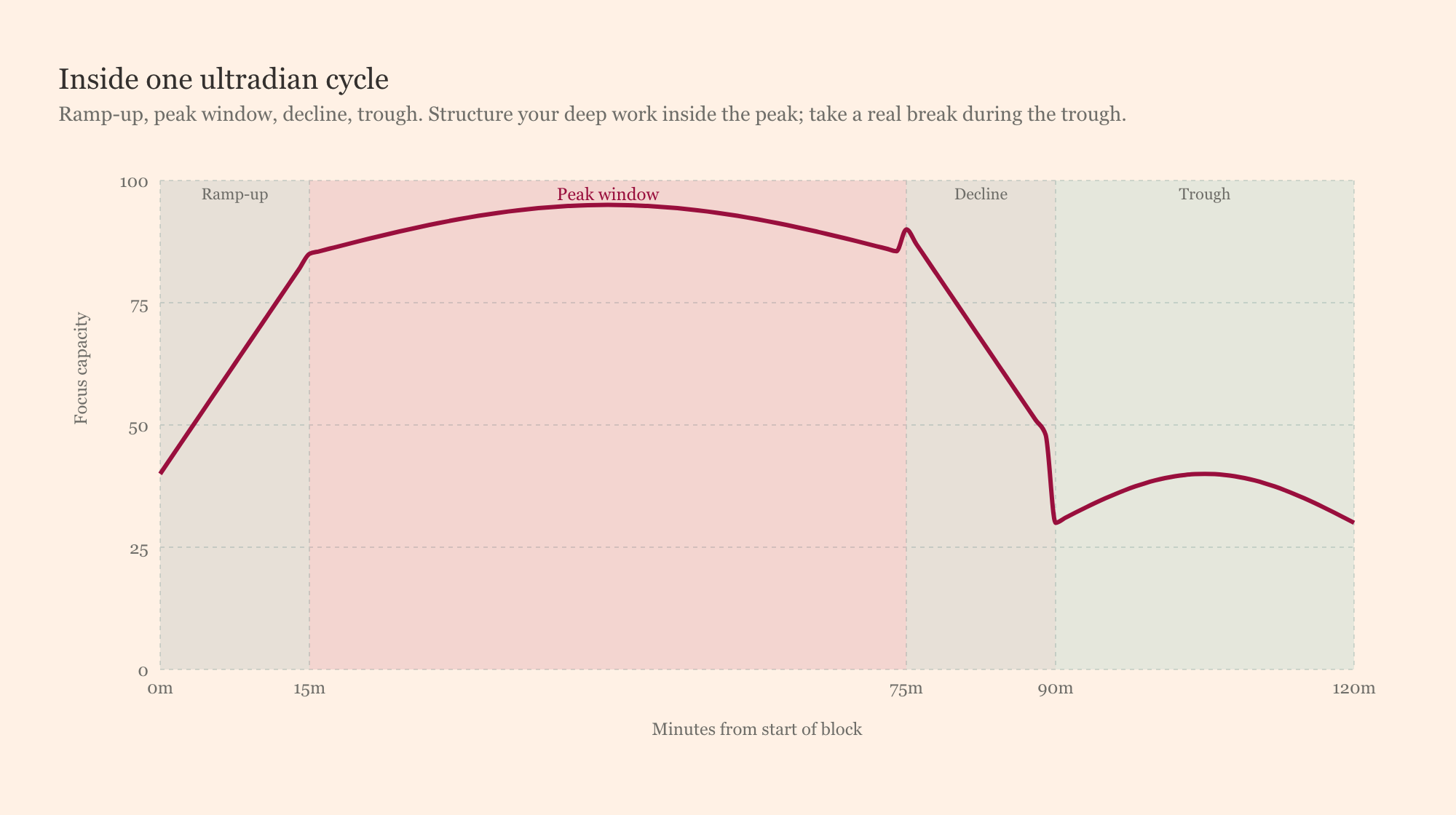
The classic shape, expressed in minutes from the start of a work block:
- 0-15 min: ramp-up. Your brain is re-engaging with the task after a break or a context switch. Effort feels higher than output.
- 15-75 min: peak window. You are in the zone. This is where 80% of your useful work happens.
- 75-90 min: slow decline. Focus is still available but starting to fray.
- 90-105 min: trough. Mental fatigue, distractibility, minor errors. Your brain is telling you to rest.
- 15-20 min recovery: a genuine break (movement, daylight, water, no screen), and you can start a new cycle.
- Next cycle begins. Two or three strong cycles in a row is a very good day for most people.
What this means practically: a workday of two or three 90-minute focus blocks with 15-20 minute recovery breaks between them will usually produce more output than an eight-hour slog, and you will feel less destroyed at the end.
Where the Research Comes From
The key pieces, without over-claiming:
- Kleitman (1961, 1963): original BRAC proposal, derived from his sleep-cycle research.
- Peretz Lavie and colleagues (1980s-90s): showed BRAC-consistent patterns in waking vigilance, microsleeps, and task performance across a normal day.
- K. Anders Ericsson's deliberate-practice research (1993 onwards): found that world-class performers across fields (musicians, athletes, scientists) cluster their practice into blocks of roughly 90 minutes, with breaks between, and almost no one sustains more than 4-5 hours of deliberate practice per day even at the top of the field.
- Modern neuroscience: links the rhythm to cycles of the prefrontal cortex's glucose consumption and the rise-and-fall of dopamine and norepinephrine.
It's not a complete picture. The underlying neurochemistry is still being worked out. But the practical implication (work in 90-minute blocks, rest between them, don't try to grind past your trough) is robust enough to build a workday around.
What Pomodoro Gets Right and Wrong
The classic Pomodoro technique uses 25-minute focus blocks with 5-minute breaks. It's not aligned with the ultradian cycle. So why does it work at all?
Three honest answers.
What Pomodoro gets right. The structure. The short block is small enough to start (no activation-energy problem), the timer creates a visible commitment, and the enforced break prevents you grinding straight into a trough without noticing. For most people, most of the time, four Pomodoros in a row approximate one ultradian cycle with built-in micro-breaks. Empirically, people get work done.
What Pomodoro gets wrong. 25 minutes is often shorter than your true peak window. If you're in flow at minute 25, stopping is destructive. The traditional Pomodoro recommendation to stop exactly when the timer rings is bad advice when you're inside a deep-focus stretch.
The modern adjustment. Use Pomodoro as scaffolding during ramp-up and in contexts where you're prone to drift (admin work, email, shallow tasks). Use ultradian-length blocks (60-90 minutes) for deep work where you have flow available. Different block lengths for different work.
This is part of why Tomatoes ships with both Pomodoro blocks and longer Flowmodoro sessions: the right block length depends on what you're trying to do, and both patterns have legitimate biological support.
How to Read Your Own Ultradian Rhythm
The rhythm is real but personal. Your cycle might be 85 minutes, might be 115. Finding it is a one-week exercise, not a science experiment.
- For five working days, every hour, rate your focus from 1 to 5. No judgement, no overthinking, just a quick mark in a notebook or a phone note.
- Plot the numbers. You will almost certainly see two or three peaks and two or three troughs across the day.
- Measure the distance between peaks. That's your cycle length.
- Note your peak window within each cycle. For most people, it's around 60-75 minutes into the cycle.
Once you have a personal cycle length, you schedule deep work inside the peak windows and schedule calls, admin, and recovery inside the troughs. You stop apologising to yourself for losing focus at minute 93; you just take the break.
A Sample Ultradian Workday
For a typical 8-hour working day with a cycle of ~100 minutes:
- 09:00-10:30: Deep work block 1. Hardest problem of the day. No meetings, no Slack.
- 10:30-10:50: Recovery. Walk, water, daylight. Not email.
- 10:50-12:20: Deep work block 2. Second hardest problem.
- 12:20-13:30: Lunch. Real break.
- 13:30-15:00: Deep work block 3. Usually the day's least-fresh block; put medium-hard work here.
- 15:00-15:20: Recovery.
- 15:20-17:00: Administrative work, meetings, inbox. Low-focus tasks that fit the afternoon trough.
Three real deep-work blocks, four-and-a-half hours of peak output, and the rest is mid-focus work that runs inside or around your natural troughs. Sustainable. Repeatable.
Common Mistakes
Patterns we see when people try to adopt ultradian-style workdays.
- Forcing a fourth block. Three 90-minute peaks is typical. A fourth is rare and a fifth is rarer still. If you consistently need four, you probably have one that's actually medium-focus work.
- Ignoring the ramp-up. The first 15 minutes of a block feel unproductive. They are not. They are the brain re-engaging. Don't switch tasks during ramp-up.
- Shortening recovery breaks. Five minutes is enough for Pomodoro, not enough for ultradian. You need 15-20 minutes of real break between deep-work blocks.
- Filling recovery with email. Email is a shallow attention task. It prevents cognitive recovery. Walk, water, daylight, music, nap. Not your inbox.
- Pushing through the trough. The research is clear: work produced inside the trough is worse in quality, and the attempt itself delays the next peak. Take the break.
How Tomatoes Fits In
Tomatoes is built around the same basic observation that motivates the Pomodoro technique (structure helps) but lets you pick the block length that fits your cycle and task. The default Deep Focus station layers rhythmic ambient music tuned to support sustained attention within a block; the menu-bar timer handles the structure so you're not eyeing a clock. You can set 25/5 for admin mornings, 50/10 for standard deep work, or 90/20 to match your full ultradian cycle.
You can get Tomatoes for $39 and run tomorrow's deep-work block against your actual cycle instead of against willpower. One-time purchase, no subscriptions, no accounts.
A Note on Expectations
Working with your ultradian rhythm is a 10-20% productivity uplift, not a magic doubling. The effect size in the research is modest but consistent. What changes dramatically is how the day feels: less grind, less self-blame about "lost focus," more predictable flow, more energy left at the end of the day. Over months, the sustainable version of deep work beats the grind version, not on any single day but on the shape of the career.
Your brain was going to cycle whether you scheduled around it or not. You might as well use the cycle instead of fighting it.