Decide between white vs pink noise the way you'd pick a wine with a meal: not by which one is "best," but by what it's pairing with. All three of the common colored noises (white, pink, brown) are broadband sounds that mask distractions and help focus. But they have genuinely different spectral shapes, measurably different effects on attention and sleep, and modestly different evidence bases behind them. Picking the wrong one costs you some of the benefit, not all of it.
This article is the deeper comparison. We cover what each color actually is at the acoustic level, what the research says (including the ADHD-specific stochastic resonance findings that have made brown noise a trending term in the last two years), how to match a color to a task, and why mixing colors, layered with rhythm, often outperforms any single color alone.
What Actually Separates White, Pink, and Brown Noise
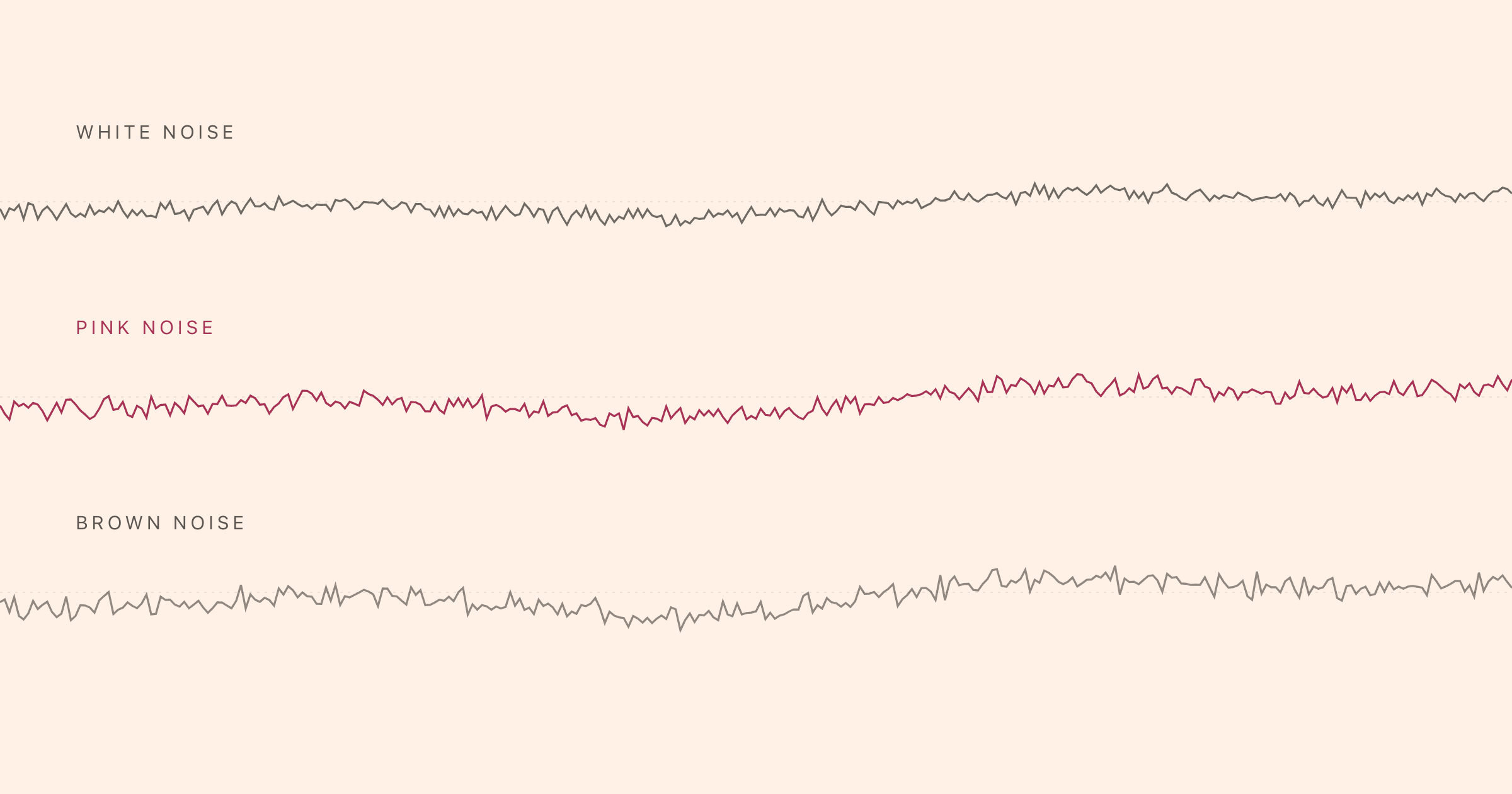
Noise "color" is a reference to the spectral shape of a broadband sound: how much energy sits at each frequency. All three colors span the full audible range; they just distribute energy differently.
White Noise
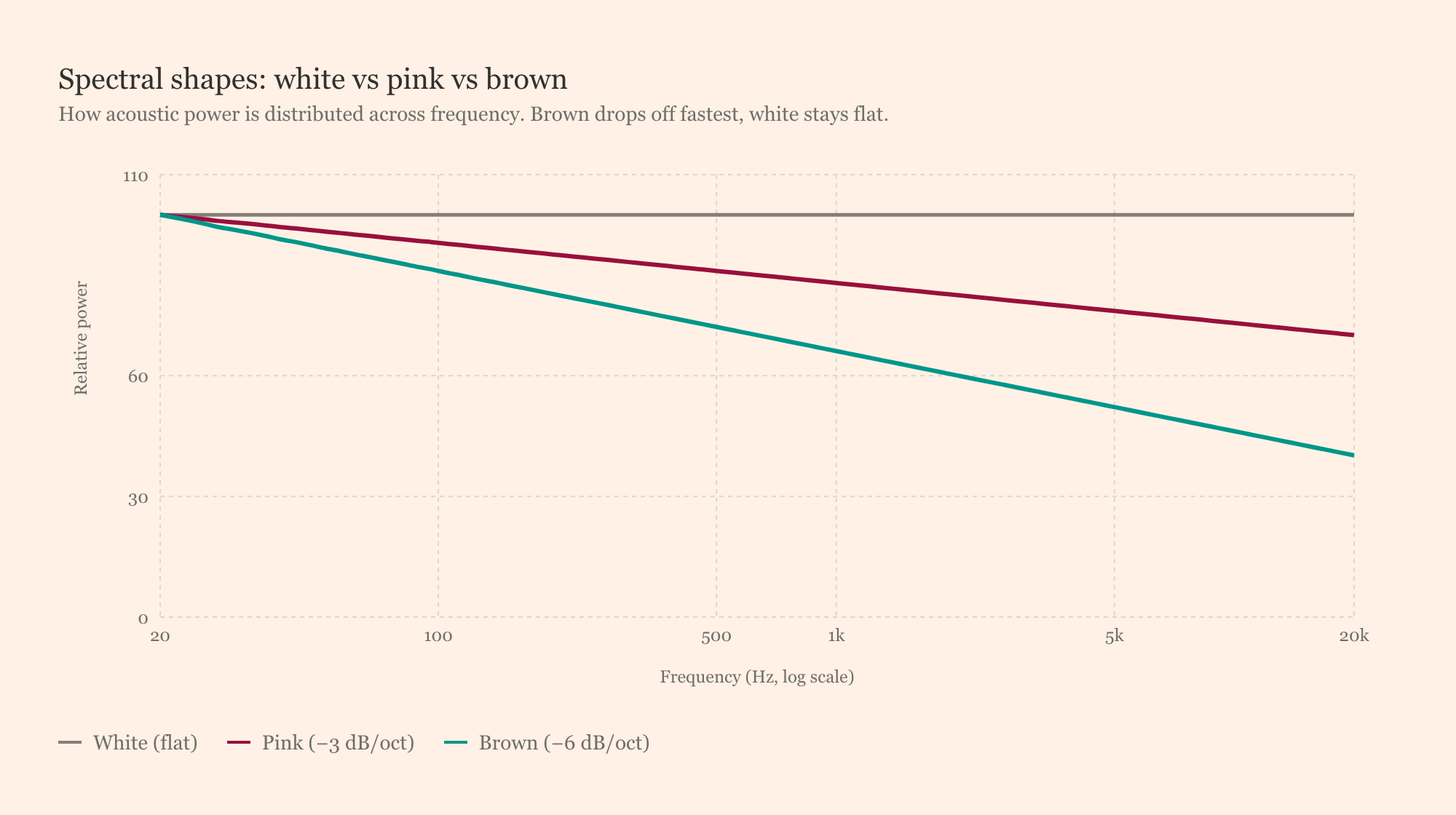
White noise has equal power across every frequency. Every Hz from 20 Hz to 20,000 Hz carries the same acoustic energy. In spectral terms, the curve is flat.
Because human hearing is not flat (we perceive higher frequencies as louder for the same acoustic power), white noise sounds bright, hissy, and slightly harsh. It is the "TV static" sound. For masking purposes, its high-frequency energy is excellent at drowning out sibilance, keyboard clicks, and sharp environmental noises.
Pink Noise
Pink noise drops off at 3 dB per octave as frequency rises. Halving the power density with each doubling of frequency means the low end has much more energy than the high end. Spectrally, this matches how many natural sounds (rainfall, wind, distant traffic) actually look.
Because pink noise is weighted toward lower frequencies, it sounds fuller and less harsh than white. It is the sound people most often describe as "like rain" or "like a waterfall." It masks a broader range of distractions without fatiguing the listener on long sessions.
Brown Noise
Brown noise (sometimes called Brownian or red noise) drops off at 6 dB per octave. The low end dominates so strongly that the sound becomes bass-heavy and cloud-like. Think of a deep waterfall, a large HVAC rumble, or the inside of an aircraft cabin.
Brown noise carries the least high-frequency energy of the three, which makes it the least fatiguing for multi-hour listening. It masks rumble well but lets some sharp distractions through (a phone notification at 2 kHz will still cut through). Its low-frequency emphasis is exactly why it has become the default ADHD-forum recommendation: lower frequencies seem less attention-grabbing, letting the broadband texture do its work in the background.
White vs Pink Noise: The Practical Difference
If you've ever tried to compare them back-to-back, the difference is obvious within ten seconds. White noise feels "brighter" and "harder." Pink feels "fuller" and "softer."
Acoustically, here's the same point: pink noise has roughly 10x more energy in the bass range (below 100 Hz) than white does for the same overall loudness. That's a perceptual gap, not a subtle one.
The practical implications:
- For sleep: pink noise tends to win. Its lower-frequency weighting is less likely to keep your auditory cortex engaged, and a 2017 study in the Frontiers in Human Neuroscience journal suggested that pink noise pulsed at slow-wave rhythms improved deep sleep quality and memory consolidation.
- For focus on short tasks: white noise can work better, because its brightness keeps you from drifting into drowsiness.
- For focus on long sessions: pink noise is usually the better choice because white starts to feel fatiguing after an hour.
This is the first-order answer to "pink vs white noise": pink for length and sleep, white for brightness and short bursts.
Where Brown Noise Changed the Conversation
The reason you've started hearing about brown noise so much in the last two years is specific: stochastic resonance research, and especially how it applies to ADHD.
In a 2007 study in Behavioral and Brain Functions, Göran Söderlund and colleagues showed that moderate levels of broadband noise improved cognitive performance in inattentive children while decreasing it in typically attentive children. The theory is called stochastic resonance: in systems with weak signal detection (such as ADHD attention), adding a specific amount of noise paradoxically improves signal-to-noise ratio.
The ADHD-specific effect shows up across white, pink, and brown noise, but brown is usually the listener's preferred color for long sessions because of the fatigue argument above. The result is that brown noise has become the practical default recommendation on ADHD forums, not because the underlying mechanism is brown-specific, but because the listening ergonomics are better.
If you want the full picture on the ADHD angle, we go deeper in the ADHD focus music article. For the rest of this piece, the short version is: brown noise is broadband noise optimized for long listening sessions.
Which Color Fits Which Task
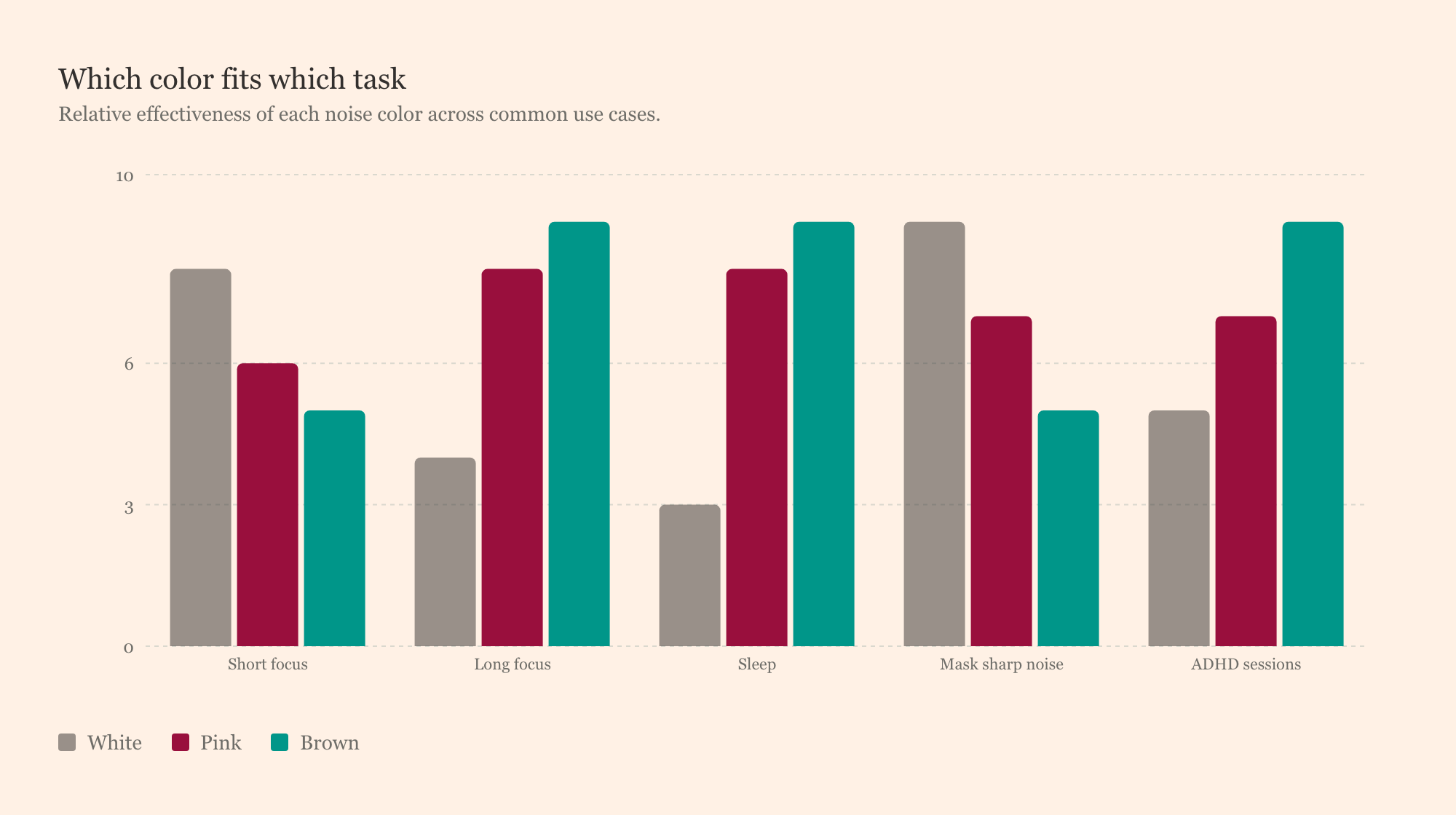
The research is clearest on that there is a benefit from broadband noise for sustained attention. It is less clear on which color is optimal for which specific task. Here's our best practical synthesis, which you should calibrate to your own ear.
Use White Noise For
- Short focus sprints (30–60 minutes)
- Masking sharp, sudden office distractions (keyboard, phone chimes)
- Situations where you need bright, alert attention
Use Pink Noise For
- Multi-hour focus sessions
- Reading, writing, analytical work
- Sleep and winding down
- Masking a mix of distractions without fatiguing your ears
Use Brown Noise For
- Long deep-work sessions (2+ hours)
- Reducing rumble in noisy environments (air conditioning, traffic, trains)
- ADHD focus (per stochastic resonance and practical listener preference)
- Sessions where you want the least auditory fatigue
Why You Probably Don't Want Pure Noise, Even If It Works
There's an honest caveat to all of the above. In blind tests, most listeners find pure noise (any color) monotonous within about 20 minutes. Completion rate and self-reported engagement drop, even when measured attention holds up.
The modern, research-informed way to deliver noise benefits is to layer noise into ambient music rather than present it raw. You get:
- The masking and stochastic resonance effects of broadband noise (because the noise is still there underneath).
- The rhythmic entrainment benefits of structured sound (which pure noise can't provide).
- Much better compliance: people keep listening instead of turning it off after 20 minutes.
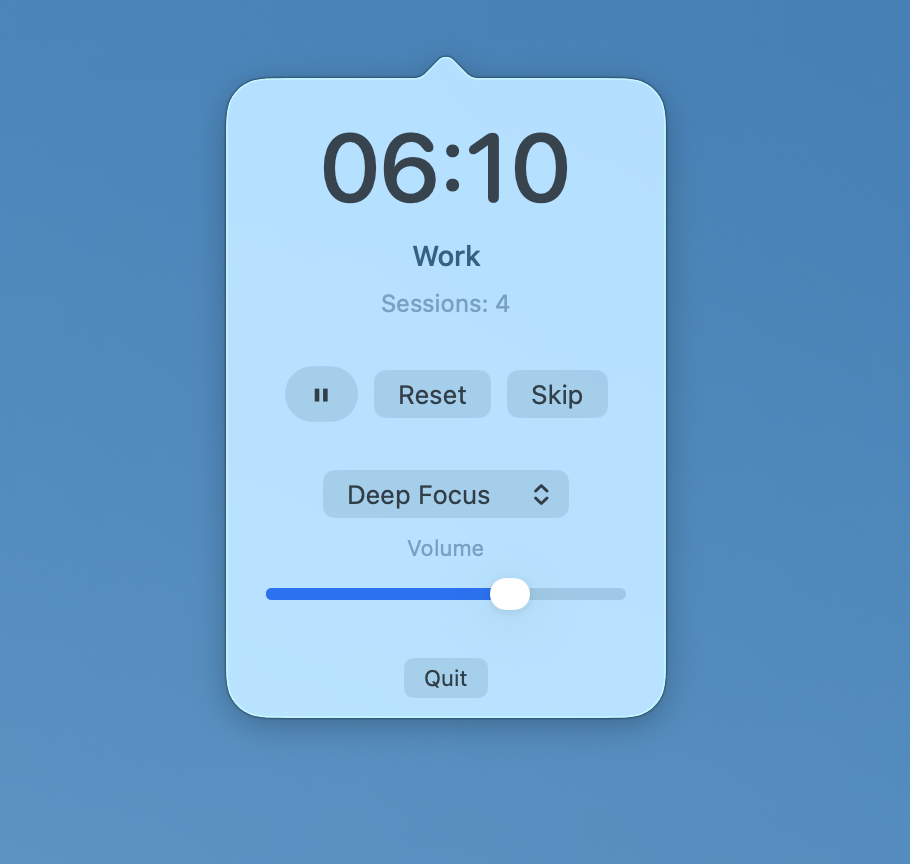
This is how Tomatoes is built. The default Deep Focus station layers brown-noise-style broadband texture under rhythmic ambient pads at beta-range frequencies, combining the strongest elements of each approach rather than forcing you to pick one.
Practical Listening Protocol
If you're building your own focus-sound stack, the rules are:
- Volume matters more than color. Keep broadband noise at 40–60% of comfortable listening volume. Too loud actively impairs attention via the inverted-U in stochastic resonance. Too quiet loses the masking benefit.
- Pick one color per session. Switching mid-session is disruptive. Pick at the start, stick with it.
- Use headphones for consistency, speakers if you want ambient presence. Both work; headphones give more control.
- Give your ears breaks. Even with the softest color (brown), an hour of continuous listening followed by a quiet five is better than three straight hours.
- Layer with music when possible. Raw noise is a blunt instrument; ambient music with embedded noise textures is the sharper tool.
Frequently Asked Questions
Is pink noise or white noise better for focus?
For most tasks longer than an hour, pink noise. It is less fatiguing and masks a broader distraction spectrum. White is a reasonable choice for short, alert focus bursts (30–60 minutes) or when you need to mask specifically high-frequency noises.
What about brown noise for ADHD?
Brown noise is the most listener-friendly color for long ADHD focus sessions. The underlying mechanism (stochastic resonance) applies to all broadband colors, but brown's bass-heavy profile is less fatiguing, which means you keep listening, which means you keep benefiting. See the ADHD focus music guide for the full picture.
Does the noise color matter for sleep?
Yes. Pink and brown are generally better than white for sleep, because the lower-frequency weighting is less likely to keep auditory attention engaged. White is more likely to feel bright and alert, which is exactly what you don't want at bedtime.
Can I play noise on speakers, or does it need headphones?
Either works. The benefits of broadband noise (unlike binaural beats) do not require headphones. Speakers at a moderate volume are fine and often feel more natural for long sessions. Headphones give you more control over what leaks in from the room.
What's the difference between pink noise and ambient music?
Pink noise is pure broadband sound with no rhythmic structure. Ambient music adds rhythm, melody, and texture that the brain can engage with at a background level. Both help focus; layered together they tend to outperform either alone.
Ship Your Next Focus Session With the Right Color
The short answer if you just want to start:
- Default to pink for most focus work.
- Switch to brown for long deep-work sessions and for ADHD.
- Switch to white for short, alert sprints and sharp-distraction environments.
- Layer whichever color you pick into ambient music for better compliance over long sessions.
Tomatoes combines Pomodoro timing with ambient stations that embed broadband noise textures at the right intensity, tuned to the target cognitive state of each session. You can get Tomatoes for $39 and run your next focus block with the color that fits the task, without thinking about it. One-time payment, no subscriptions, no accounts.