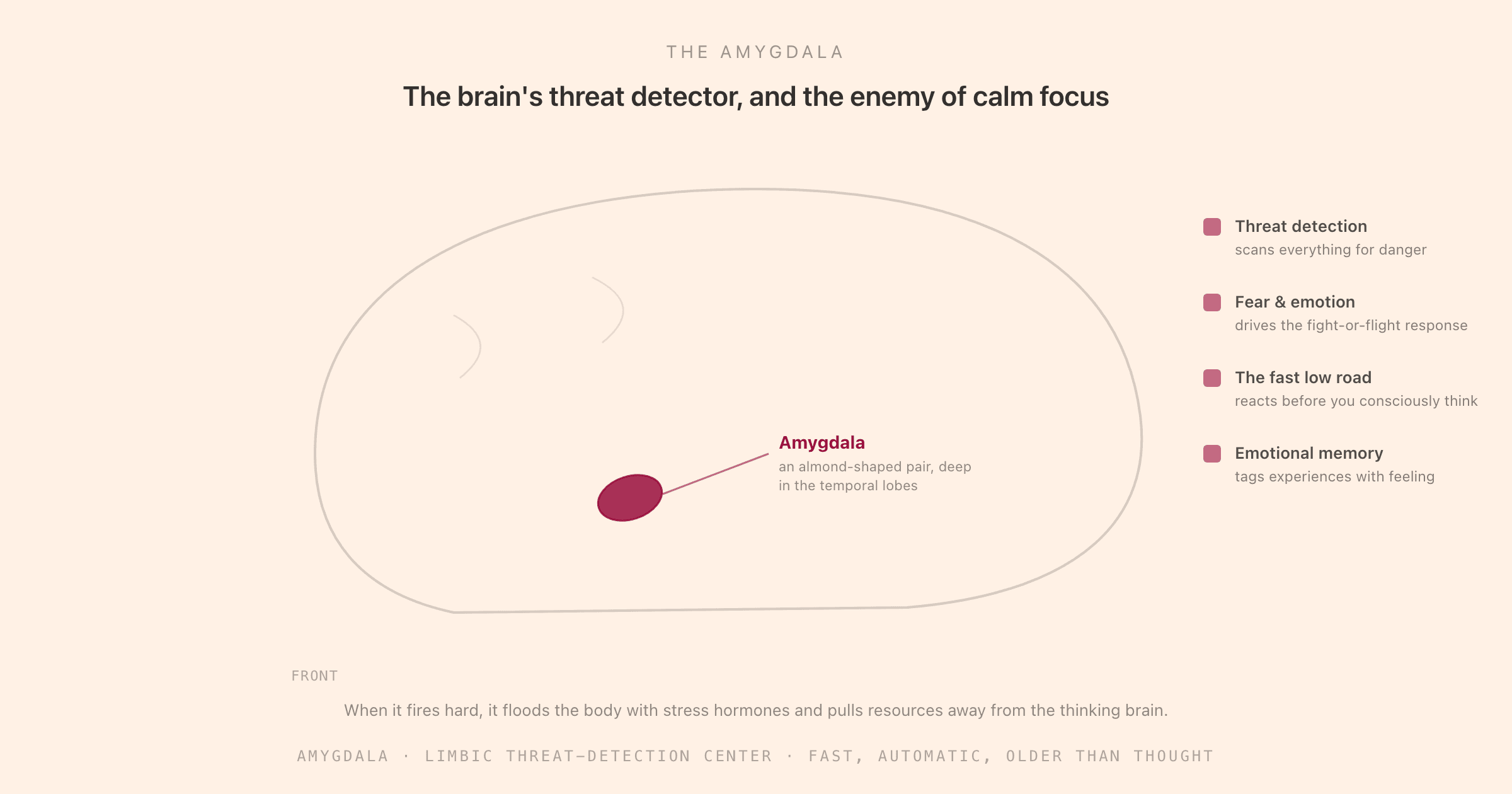
The amygdala is the part of your brain that decides, faster than thought, whether something is a threat. It is a tiny almond-shaped structure (two of them, one in each hemisphere) buried deep in the temporal lobes, and it is one of the oldest and most powerful parts of the brain. When it works well, it keeps you safe and tags experiences with the emotion that helps you remember them. When it fires too hard or too often, it floods your body with stress hormones, hands control to your reflexes, and makes sustained focus almost impossible. If yesterday's piece on the prefrontal cortex was about the brain's deliberate control center, this is about its opponent: the alarm system that can override it. This is what the amygdala does, why the "amygdala hijack" wrecks concentration, and how to keep it calm.
Understanding the amygdala reframes a lot of focus struggles. When you cannot concentrate because you are anxious, stressed, or rattled, that is not weakness; it is an ancient survival system doing exactly what it evolved to do, at the expense of the work in front of you. Tomatoes is a focus tool built around calm, protected, low-distraction work blocks, the kind of environment that keeps the alarm quiet. The app is free for 3 days, then $4.99/week, $29.99/year, or $39 lifetime.
What Is the Amygdala?
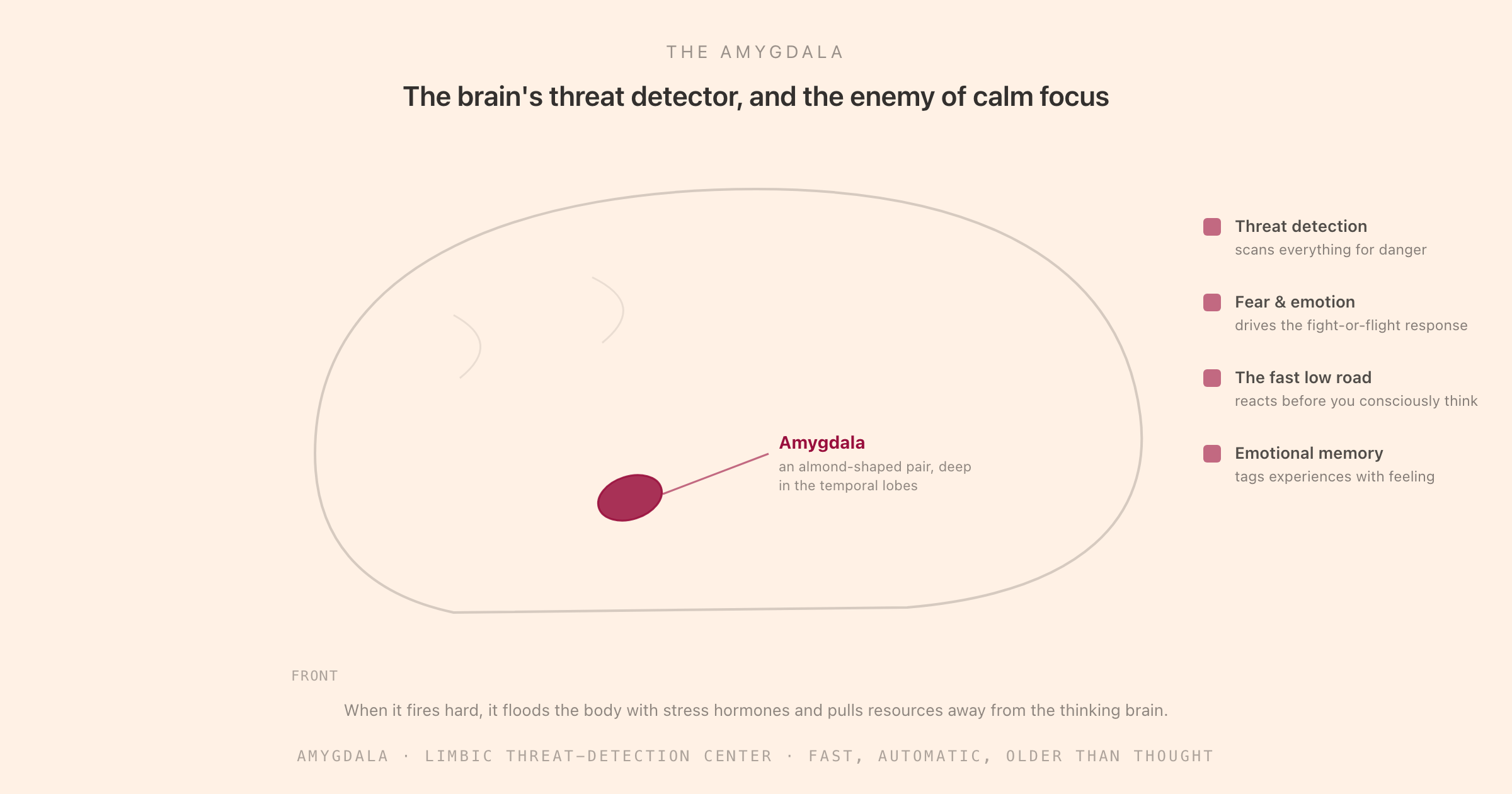
The amygdala (from the Greek for "almond," which it resembles) is a small cluster of nuclei in the brain's limbic system, the set of structures that handle emotion, motivation, and memory. You have two, one deep within each temporal lobe, roughly level with your ears and a few centimeters in. Despite its size, it is one of the most influential structures in the brain, because of what it does and how fast it does it.
Its central job is threat detection and emotional processing. The amygdala continuously evaluates incoming information for anything that matters emotionally, especially danger, and when it finds it, it triggers a cascade of responses: the release of stress hormones, the acceleration of heart rate and breathing, the sharpening of the senses, the readiness to fight or flee. This is the fight-or-flight response, and the amygdala is its trigger. It also does the opposite of forgetting: by tagging experiences with emotional significance, it makes emotionally charged events far more memorable than neutral ones, which is why you remember the moment of a fright or a triumph in vivid detail.
The Fast Low Road: Why You React Before You Think
The most important thing about the amygdala for understanding focus is its speed. The neuroscientist Joseph LeDoux described the brain as having two routes for processing a potential threat. The slow, accurate "high road" sends sensory information up to the cortex to be analyzed properly: what is that, really? The fast, crude "low road" sends a rough version of the signal straight to the amygdala, which can trigger a full alarm response before the conscious, thinking brain has even identified what happened.
This is why you flinch at a stick that might be a snake before you realize it is a stick, and why your heart is already pounding at a sudden noise before you know what made it. The low road is a feature, not a bug: in genuine danger, the fraction of a second it saves can matter. But it also means the amygdala can hijack your physiology over things that are not real threats at all, a critical email, a looming deadline, a confrontational message, because to an ancient alarm system, a social or psychological threat looks a lot like a physical one.
The Amygdala Hijack
The term amygdala hijack, popularized by Daniel Goleman, describes what happens when the amygdala's alarm response overwhelms the rest of the brain: an immediate, intense emotional reaction that is out of proportion to the situation, where you act (or freeze, or lash out) before the thinking brain can intervene. In the moment of a hijack, the prefrontal cortex, the seat of reasoning, planning, and impulse control, is effectively sidelined.
This is not a metaphor. Under acute stress, the surge of cortisol and norepinephrine that the amygdala helps trigger physically impairs prefrontal function, shifting control toward faster, more habitual, more reflexive circuits. The brain is doing this deliberately: in a true emergency, careful deliberation is too slow, so evolution wired the system to demote the thinking brain and let the fast alarm take over. The problem is that modern life sets off the alarm constantly over things that are stressful but not dangerous, and every time it does, your capacity to focus, plan, and choose your response drops.
The Amygdala and the Prefrontal Cortex: A Tug-of-War
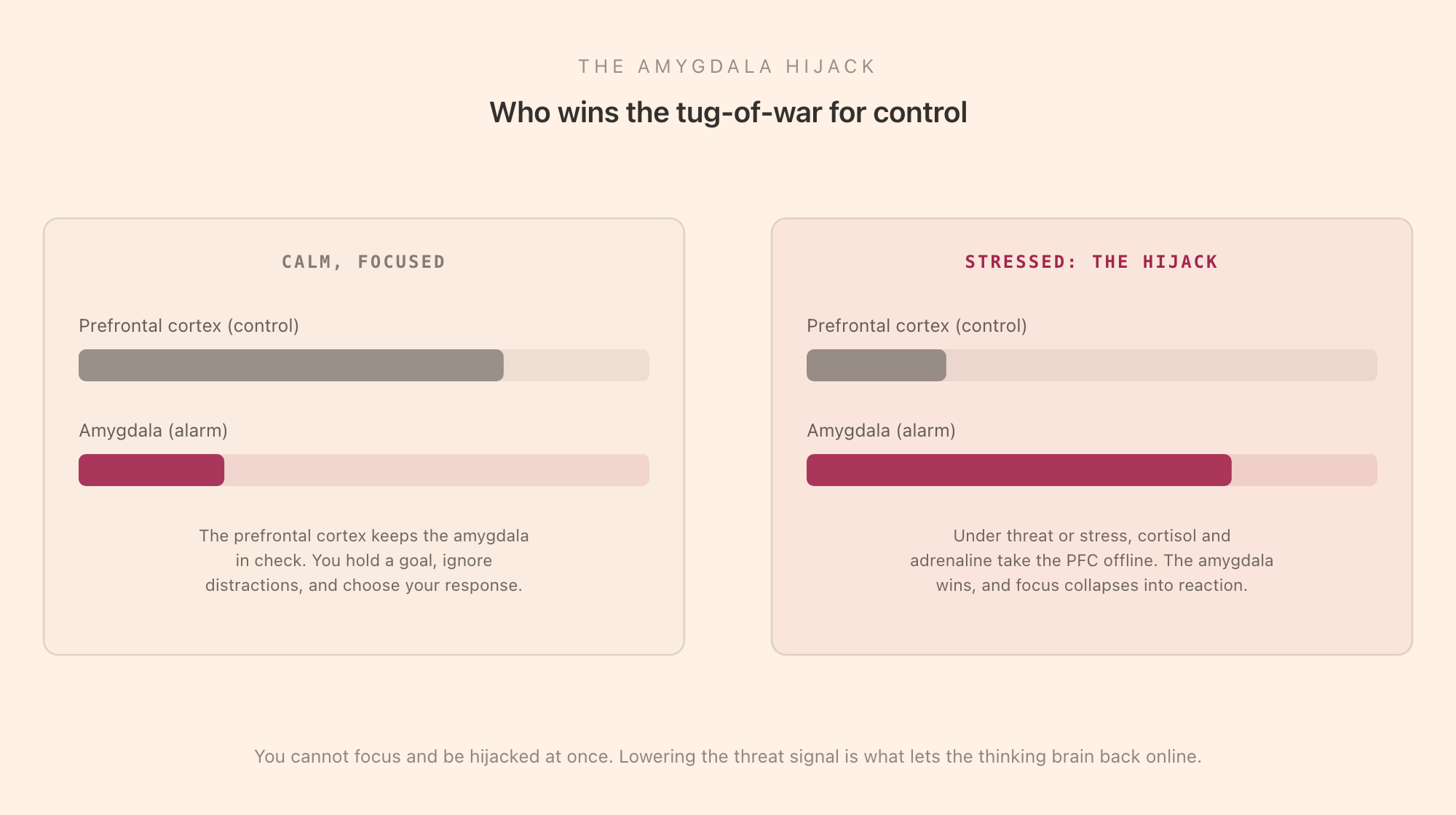
The relationship between the amygdala and the prefrontal cortex is the central drama of self-control. In a calm state, the prefrontal cortex regulates the amygdala from the top down, keeping its reactions in proportion and allowing you to hold a goal, ignore distractions, and decide how to respond. The two are in balance, with the thinking brain in charge.
Stress tips that balance. As threat signals rise and stress hormones flood the system, the prefrontal cortex weakens and the amygdala strengthens, until the alarm wins and behavior collapses into reaction. You cannot be deeply focused and amygdala-hijacked at the same time, because they draw on opposite modes of the brain: one deliberate and goal-directed, the other automatic and defensive. This is the neuroscience behind a simple, frustrating truth: it is nearly impossible to do good focused work while you are anxious, frazzled, or on edge. The work requires the prefrontal cortex, and the amygdala has taken it offline.
Why This Matters for Focus
Most advice about focus assumes the thinking brain is available and just needs discipline. The amygdala explains why that assumption so often fails. A workday full of pings, urgent messages, context-switching, and low-grade anxiety is a workday full of small threat signals, each one nudging the amygdala up and the prefrontal cortex down. You are not lazy or undisciplined when you cannot settle into deep work in that environment; your alarm system is being tripped on a loop, and it keeps demoting the part of your brain you need.
This also explains the particular awfulness of trying to concentrate while worried about something. The worry is not a distraction in the ordinary sense, a competing piece of information; it is a sustained low-level threat signal keeping the amygdala active and the prefrontal cortex suppressed. Until the threat signal comes down, the focus machinery cannot fully come back online.
How to Calm the Amygdala
You cannot switch the amygdala off, and you would not want to. But you can lower the threat signal so the thinking brain comes back online. The evidence points to a few reliable levers.
- Slow your breathing. Long, slow exhales activate the parasympathetic nervous system through the vagus nerve, directly counteracting the fight-or-flight response. Extending the exhale is one of the fastest ways to bring an activated amygdala down in real time.
- Name the feeling. Studies by Matthew Lieberman found that putting emotion into words ("affect labeling") reduces amygdala activity and increases prefrontal engagement. Simply naming "I am anxious about this deadline" measurably calms the alarm. The act of labeling hands control back to the thinking brain.
- Protect sleep. A sleep-deprived brain shows an amplified, more reactive amygdala and weaker prefrontal regulation of it, the exact recipe for being on edge and unfocused. Sleep is amygdala maintenance.
- Reduce the stream of micro-threats. Every notification, unexpected message, and abrupt context switch is a small ping to the threat system. Working in a protected, low-distraction block is not just about avoiding distraction in the informational sense; it is about denying the amygdala the steady trickle of small alarms that keep it active.
- Lower the baseline. Regular aerobic exercise, time away from constant connectivity, and managing chronic stress all reduce resting amygdala reactivity over time, so it takes more to set it off in the first place.
The unifying principle is that focus is downstream of safety. The brain will not commit its deliberate, goal-directed resources to a task while its alarm is ringing. Quiet the alarm, and the focus returns.
Working With Your Alarm System
The amygdala is not your enemy, even though it can feel like it when you are trying to concentrate. It is a fast, ancient, protective system that evolved to keep you alive, and it is doing its job. The trouble is that it cannot tell the difference between a predator and a pile of overdue work, so it sounds the alarm either way and pulls your thinking brain offline in the process. The skill is not to fight it but to give it less to react to: a calmer environment, slower breathing, enough sleep, and fewer of the small threats that keep it lit up. Do that, and the prefrontal cortex regains control, and focus becomes possible again.
That is the principle Tomatoes is built on. A protected focus block is, at the level of the brain, a stretch of time with the alarm turned down: no pings, no abrupt switches, no stream of micro-threats keeping the amygdala active, so the thinking brain can stay in charge of the work. If you want a focus tool designed around calm, protected work, Tomatoes is free for 3 days, then $4.99/week, $29.99/year, or $39 lifetime.