
Cortisol is the hormone that sets the arousal level your attention runs on. It is the body's main glucocorticoid, released from the adrenal glands on a daily clock and again whenever the brain registers a demand, and it does far more than the "stress hormone" label suggests: it mobilises glucose, tunes the immune system, and, most relevant for focus, it adjusts the gain on the prefrontal circuits that hold a task in mind. A short, well-timed pulse of cortisol sharpens attention and helps lock in memory. A high, sustained level does the opposite. Understanding cortisol is understanding why the same physiological signal can be the thing that gets you locked in by mid-morning and the thing that leaves you scattered and wired by the end of a stressful week.
This is the focus-science version of cortisol: what it is, the HPA axis that produces it, the daily rhythm and the cortisol awakening response, the receptors that make it act so differently at different doses, the inverted-U relationship between cortisol and cognitive performance, and what genuinely moves chronically elevated cortisol levels. Tomatoes is a focus tool built around protected, low-arousal work blocks, the kind of practice that keeps you on the productive part of the curve. The app is free for 3 days, then $4.99/week, $29.99/year, or $39 lifetime.
What Cortisol Is
Cortisol is a steroid hormone, specifically a glucocorticoid, synthesised from cholesterol in the cortex (the outer layer) of the adrenal glands that sit on top of the kidneys. As a steroid it is lipid-soluble, which has a crucial consequence: it crosses cell membranes freely and acts inside the cell, on receptors that change which genes a cell transcribes. That is why cortisol's effects are broad and relatively slow compared with a fast neurotransmitter. It is reprogramming cellular activity, not flipping a switch at a synapse.
The textbook description of cortisol as the stress hormone is true but incomplete. Cortisol is a metabolic and arousal signal that the body uses constantly, not only in emergencies. Its baseline job is to make energy available: it raises blood glucose (by promoting gluconeogenesis in the liver), mobilises fatty acids, and shifts the body toward an alert, energy-mobilising state. It also restrains the immune system (which is why synthetic glucocorticoids are prescribed as anti-inflammatories), influences blood pressure, and feeds back on the brain to regulate mood, appetite, and the sleep-wake cycle. People searching for cortisol function often expect a single answer; the honest one is that cortisol is a systemic "prepare for demand" signal that touches nearly every tissue.
The HPA Axis: How Cortisol Gets Made
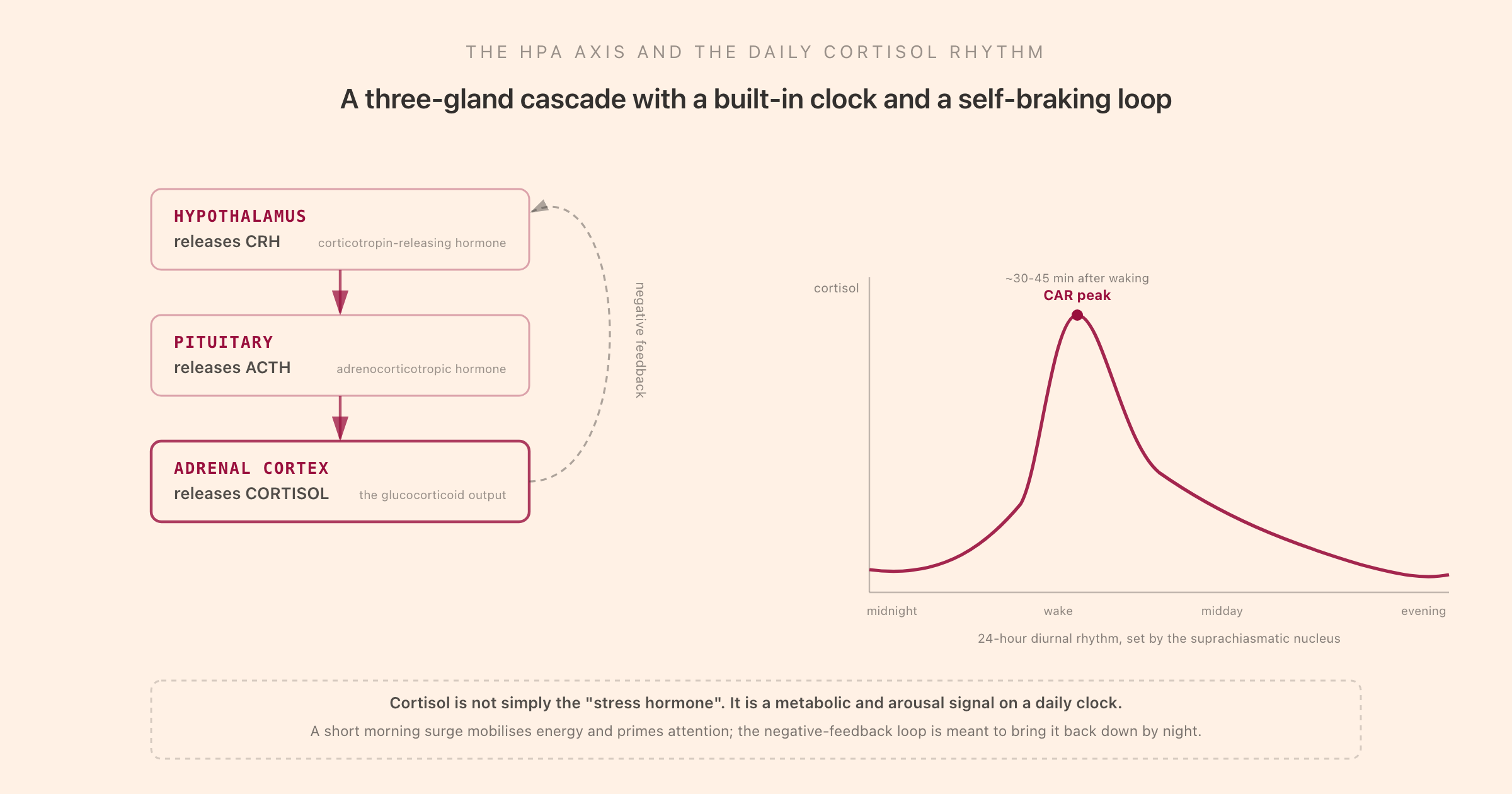
Cortisol release is governed by a three-stage hormonal cascade called the HPA axis (hypothalamic-pituitary-adrenal axis). It works like a chain of command with a built-in brake.
When the brain registers a demand (a stressor, or simply the scheduled morning ramp-up), the hypothalamus releases corticotropin-releasing hormone (CRH). CRH travels a short distance to the pituitary gland, which responds by releasing adrenocorticotropic hormone (ACTH) into the bloodstream. ACTH reaches the adrenal cortex and triggers the synthesis and release of cortisol. Cortisol then circulates and produces its wide-ranging effects.
The elegant part is the feedback. Cortisol itself acts back on the hypothalamus and pituitary to suppress further CRH and ACTH release, a negative-feedback loop that is supposed to switch the system off once enough cortisol is circulating. This is the same logic a thermostat uses. When the loop works, a stressor produces a clean pulse of cortisol that rises and then resolves. When chronic stress keeps the system activated, the feedback loop becomes less sensitive, and that loss of braking is a large part of what "high cortisol" actually means at the level of physiology.
The Daily Rhythm and the Cortisol Awakening Response
Cortisol is not released at a constant level. It follows a strong diurnal rhythm orchestrated by the brain's master clock, the suprachiasmatic nucleus, the same clock that runs your circadian rhythm. Cortisol is lowest in the first half of the night, begins rising in the early morning hours while you are still asleep, and reaches its daily peak shortly after you wake.
That post-waking surge has a name: the cortisol awakening response (CAR). Within about 30 to 45 minutes of waking, cortisol jumps a further 50 percent or so above the already-rising morning level, then falls back. The CAR is thought to be the body's way of mobilising energy and priming the brain for the cognitive demands of the day ahead, and a healthy, robust CAR is associated with better daytime alertness. Across the rest of the day cortisol declines in a long taper, reaching its trough again around midnight. This is why "cortisol levels" can never be read from a single number: a value that is perfectly normal at 8am would be alarming at 11pm. The shape of the curve matters more than any one point on it.
A flattened curve, low morning peak and elevated evening trough, is the pattern most associated with chronic stress, poor sleep, and burnout. It is also why cortisol and the sleep-wake cycle are so tightly coupled: the same clock drives both, and disrupting one (through shift work, jet lag, or a scrambled schedule) disrupts the other.
Glucocorticoid Receptors: Why Dose Changes Everything
Cortisol acts on two different receptor types in the brain, and the balance between them is the key to its dose-dependent behaviour. The brain expresses mineralocorticoid receptors (MRs), which have a high affinity for cortisol and are largely occupied even at low, resting levels, and glucocorticoid receptors (GRs), which have a lower affinity and only become substantially occupied when cortisol rises, during the morning peak or a stress response.
This two-receptor system means cortisol does qualitatively different things at different concentrations. At low to moderate levels (MRs occupied, GRs only partly engaged), cortisol supports stable, alert functioning and helps consolidate memory. As cortisol climbs and GRs fill, the effects shift, and at high, sustained occupancy the same hormone begins to impair the very prefrontal functions it helped at lower doses. The receptor biology is the mechanism behind the inverted-U you are about to see: it is not that cortisol is good or bad, but that the brain has built two thresholds into the system, and crossing the second one flips the sign of the effect.
The Inverted-U: Cortisol and Cognitive Performance
The relationship between cortisol and cognition is not a straight line. It is an inverted-U, the same shape captured a century ago in the Yerkes-Dodson law relating arousal to performance, and refined by modern stress-and-cognition research.
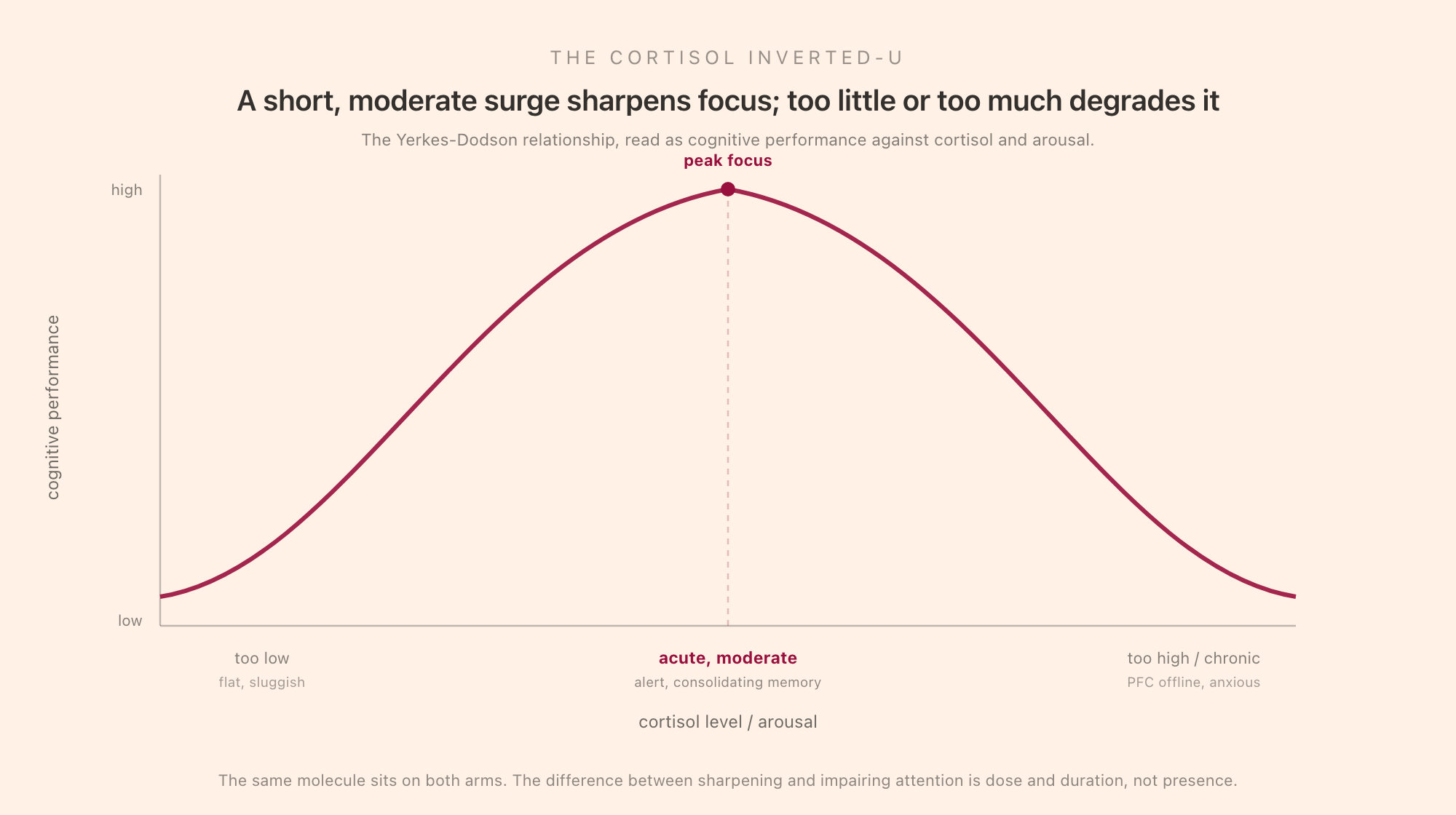
On the left arm, too little cortisol and arousal leaves you flat, under-motivated, and sluggish, the way the trough of the daily rhythm feels. In the middle sits the productive zone: an acute, moderate rise in cortisol increases alertness, improves the encoding and consolidation of memory, and supports focused attention. This is the physiological state behind "a little pressure helps me concentrate," and it is genuinely real. A meta-analysis by Het and colleagues found that acute cortisol elevations can enhance memory consolidation while the same elevations impair memory retrieval, a nuance that fits the curve: the timing and the task matter.
On the right arm, too much or too prolonged cortisol degrades performance. The prefrontal cortex, the seat of working memory and top-down attention, is densely populated with glucocorticoid receptors and is unusually sensitive to high cortisol. Amy Arnsten's work on the molecular effects of stress shows that high levels of stress catecholamines and cortisol activate signalling pathways (including cAMP-PKA) that rapidly weaken prefrontal network connectivity, effectively taking the PFC "offline" and shifting control toward faster, more habitual, amygdala-driven responses. That is adaptive in a genuine emergency and counterproductive when you are trying to hold a complex problem in mind. It is the neural basis of going blank under pressure.
The practical reading of the curve: you want the acute, moderate, time-limited cortisol of an engaged morning, and you want to avoid the sustained high cortisol of chronic stress. Same molecule, opposite effects, decided by dose and duration rather than by presence.
Chronic Stress and the Prefrontal Cortex
The damage from cortisol is not in the spikes; it is in the failure to come back down. Chronic stress keeps the HPA axis activated, blunts the negative-feedback loop, and exposes the brain to elevated cortisol for long stretches. The structures that suffer most are the ones richest in glucocorticoid receptors: the prefrontal cortex and the hippocampus.
Conrad Liston and colleagues showed, in both rodents and humans, that chronic stress is associated with reduced functional connectivity in prefrontal attention networks and with measurable deficits in attentional control, changes that reversed after the stressor was removed. The hippocampus, central to forming new memories, is similarly vulnerable: prolonged cortisol exposure impairs hippocampal function and, in extreme and sustained cases, is associated with reduced hippocampal volume. Sonia Lupien's research across the lifespan has tied chronically dysregulated cortisol to memory and attention problems from childhood through ageing.
This is the bridge between cortisol and the everyday experience of brain fog, where chronic stress and the cortisol it drives sit among the main causes of a working-memory slowdown. It is also why cortisol and working memory are so tightly linked: the PFC circuits that hold information in mind for seconds are exactly the circuits that high cortisol disrupts first.
Cortisol and Norepinephrine: Two Arousal Systems
Cortisol does not act alone. It works alongside the brain's other major arousal system, the locus-coeruleus norepinephrine system, and the two are deeply intertwined. A stressor activates both: norepinephrine fast (within seconds, via direct neural firing) and cortisol slow (over minutes, via the hormonal HPA cascade). The fast norepinephrine response sharpens attention to the threat; the slower cortisol response sustains the mobilised state and then, ideally, helps shut it down.
Both systems follow inverted-U dose-response curves over arousal, and they reinforce each other. Moderate, coordinated activation of the two produces the alert, locked-in state that supports focused work. Excessive, sustained co-activation produces the wired-but-scattered state of acute stress, where the prefrontal cortex is suppressed and attention is yanked toward whatever feels most salient. Reading cortisol purely as a hormone misses this: in the brain it is one half of a two-part arousal control system, and focus depends on keeping that system in its middle range.
What Actually Lowers Cortisol
Searches for how to lower cortisol return a flood of supplements and detoxes. Most of that is noise. The interventions with real evidence are unglamorous and free, and they work by restoring the daily rhythm and strengthening the feedback loop rather than by "flushing" anything.
- Sleep. Sleep is the single strongest lever. Sleep deprivation raises evening cortisol and flattens the daily curve; consistent, adequate sleep restores it. Protecting sleep is the highest-yield cortisol intervention there is, and it loops back through the circadian rhythm that governs the whole system.
- Aerobic exercise. Regular moderate aerobic exercise lowers resting cortisol over time and improves the HPA axis's ability to switch off after a stressor, even though any single hard session raises cortisol acutely. The chronic adaptation is what matters.
- Slow breathing and vagal tone. Slow, extended-exhale breathing activates the parasympathetic nervous system and has been shown to reduce cortisol and perceived stress. This is the mechanism behind the calming effect of paced breathing, and it is one of the few interventions that works within minutes.
- Morning light. Bright light early in the day reinforces a robust cortisol awakening response and a clean diurnal decline, anchoring the rhythm the way the clock intends.
- Limiting late caffeine and alcohol. Caffeine raises cortisol, an effect that is largest in people who do not consume it regularly, and late-day caffeine compounds with poor sleep to keep evening cortisol elevated. Alcohol disrupts sleep architecture and elevates overnight cortisol. Both push the curve in the wrong direction.
What does not have good evidence: most "cortisol-blocking" supplement stacks and 24-hour detox protocols. The body does not need to be flushed of cortisol; it needs the rhythm restored and the feedback loop working, and that is a matter of sleep, movement, light, and recovery, not pills.
The Bottom Line for Focus
Cortisol is the arousal dial behind attention. Produced by the HPA axis on a daily clock, peaking in the cortisol awakening response shortly after you wake and tapering to a midnight trough, it acts through two receptor types that give it a dose-dependent, inverted-U effect on cognition. An acute, moderate, time-limited rise sharpens attention and consolidates memory; chronic elevation weakens prefrontal connectivity, impairs working memory, and produces the scattered, foggy state that chronic stress is known for. It works in concert with the norepinephrine system, and it responds not to detoxes but to sleep, aerobic exercise, slow breathing, morning light, and keeping late caffeine and alcohol in check.
The focus implication is to spend your demanding work in the middle of the curve: do your hardest cognitive work in the morning when the rhythm puts cortisol where it is useful, keep work blocks bounded so acute arousal does not tip into sustained stress, and protect the sleep that resets the whole system overnight. Tomatoes is built for exactly that kind of bounded, low-friction focus session. If you want a tool that structures your deep work into protected blocks, Tomatoes is free for 3 days, then $4.99/week, $29.99/year, or $39 lifetime.