Your circadian rhythm is the 24-hour internal clock that decides when you are alert, when you are sleepy, when your core body temperature is at its lowest, and when your prefrontal cortex is actually capable of writing the most important paragraph of your day. It runs whether you sleep or not. It is driven by a clump of about 20,000 neurons sitting above the optic chiasm in your hypothalamus, called the suprachiasmatic nucleus (SCN), and it is entrained to the 24-hour solar day primarily by the light that hits your retina in the first hour after you wake up. Get the entrainment right and your peak focus windows arrive on schedule. Get it wrong (jet lag, shift work, three weeks of looking at a phone in bed) and the rhythm desynchronises from the clock on the wall, which is the technical version of why nothing feels right.
This article is the practical neuroscience of the circadian rhythm: what the SCN actually does, how light entrainment works, where the cortisol awakening response and the post-lunch dip come from, the five chronotypes the Horne-Ostberg questionnaire identifies and the percentages of the population in each, the most common circadian rhythm disorder presentations, and a reset protocol that uses morning light, meal anchoring, and sleep timing to pull a drifted clock back into phase. The article also covers how to align your focus blocks with your two daily alertness peaks instead of fighting them, which is the highest-leverage productivity move most people never make.
What Is a Circadian Rhythm?
The circadian rhythm definition is a biological cycle that completes once every roughly 24 hours and persists even in the absence of external time cues. The word comes from the Latin circa diem (about a day). Almost every organism on the planet that has been tested for it (mammals, insects, plants, fungi, single-celled cyanobacteria) runs on a circadian rhythm. The presence of an internal clock that keeps running through total darkness was demonstrated experimentally in 1729 by the French astronomer Jean-Jacques d'Ortous de Mairan, who put a mimosa plant in a dark cupboard and noticed it kept opening and closing its leaves on a daily schedule with no light cues at all.
In humans, the circadian rhythm is one tier of a broader timing system. Above it sits the infradian rhythm (any cycle longer than 24 hours: the menstrual cycle is the most studied infradian rhythm). Below it sits the ultradian rhythm (any cycle shorter than 24 hours: the 90-minute REM/non-REM sleep cycle and the daytime basic rest-activity cycle are both ultradian). The circadian rhythm is the master rhythm because it sets the phase that the others lock onto. For a guide to the 90-minute waking ultradian cycle and how it produces your focus windows, see the ultradian rhythm article on this blog.
The Suprachiasmatic Nucleus: The Master Clock
The suprachiasmatic nucleus is the clock that runs the whole system. It sits in the hypothalamus, directly above the point where the two optic nerves cross (the optic chiasm, which gives the SCN its name). It is small: about 20,000 neurons per side, two SCNs total, roughly the size of a grain of rice each. Despite the size, ablating both SCNs in laboratory animals abolishes the circadian rhythm completely, while transplanting an SCN from another animal into an SCN-lesioned host restores the rhythm at the donor's frequency. The SCN is sufficient. Nothing else in the brain runs the clock for it.
The clock is built from a transcription-translation feedback loop. The core genes (CLOCK, BMAL1, PER1, PER2, PER3, CRY1, CRY2) produce proteins that loop back and inhibit their own transcription on a cycle that, in isolation, runs about 24.2 hours. The 0.2-hour drift is the reason the clock has to be reset every day; without entrainment, your sleep would slide later by about 12 minutes per day until it was completely out of sync with the solar day.
The SCN sends timing signals to almost every system in the body through a combination of direct neural projections (to the pineal gland for melatonin release, to the hypothalamic-pituitary-adrenal axis for cortisol release, to the autonomic nervous system for heart rate and digestion) and humoral signals carried in the bloodstream. Every major organ also contains its own peripheral clock, all running the same gene-set as the SCN. The SCN's job is to keep them all in phase.
Light Entrainment: Why Morning Light Matters So Much
The SCN does not see light directly. It receives light input through a small population of cells in the retina (intrinsically photosensitive retinal ganglion cells, ipRGCs) that contain the pigment melanopsin. Melanopsin is most sensitive to blue-spectrum light around 480 nanometres, which is exactly the dominant wavelength in midday sunlight. ipRGCs project to the SCN via the retinohypothalamic tract.
The practical consequence of this wiring is that the timing of the first bright light your eyes see in the morning is the single biggest input to your circadian phase. The phase response curve (PRC) for human circadian entrainment was mapped most rigorously by Czeisler and Khalsa in the early 2000s. The shape of the PRC:
- Bright light in the first 1-2 hours after waking: advances the clock (shifts everything earlier).
- Bright light in the late evening / early subjective night: delays the clock (shifts everything later).
- Bright light in the middle of the subjective night: large delay (the reason a 3am bathroom light snap is more disruptive than a 1am one).
- Dim light between roughly 9pm and 7am: no phase shift in either direction.
The reason morning light is the protocol-grade reset for circadian disruption is that the phase advance from 30-60 minutes of bright morning light is large (typically 30-90 minutes of shift), and the response is dose-dependent. Direct sunlight is approximately 10,000 lux. A bright indoor environment is 300-500 lux. The phase response curve is built around the 1,000-10,000 lux range, which means a 30-minute walk outside in the first hour after waking is a higher-fidelity entrainment signal than two hours under indoor lighting will ever be.
The Cortisol Awakening Response
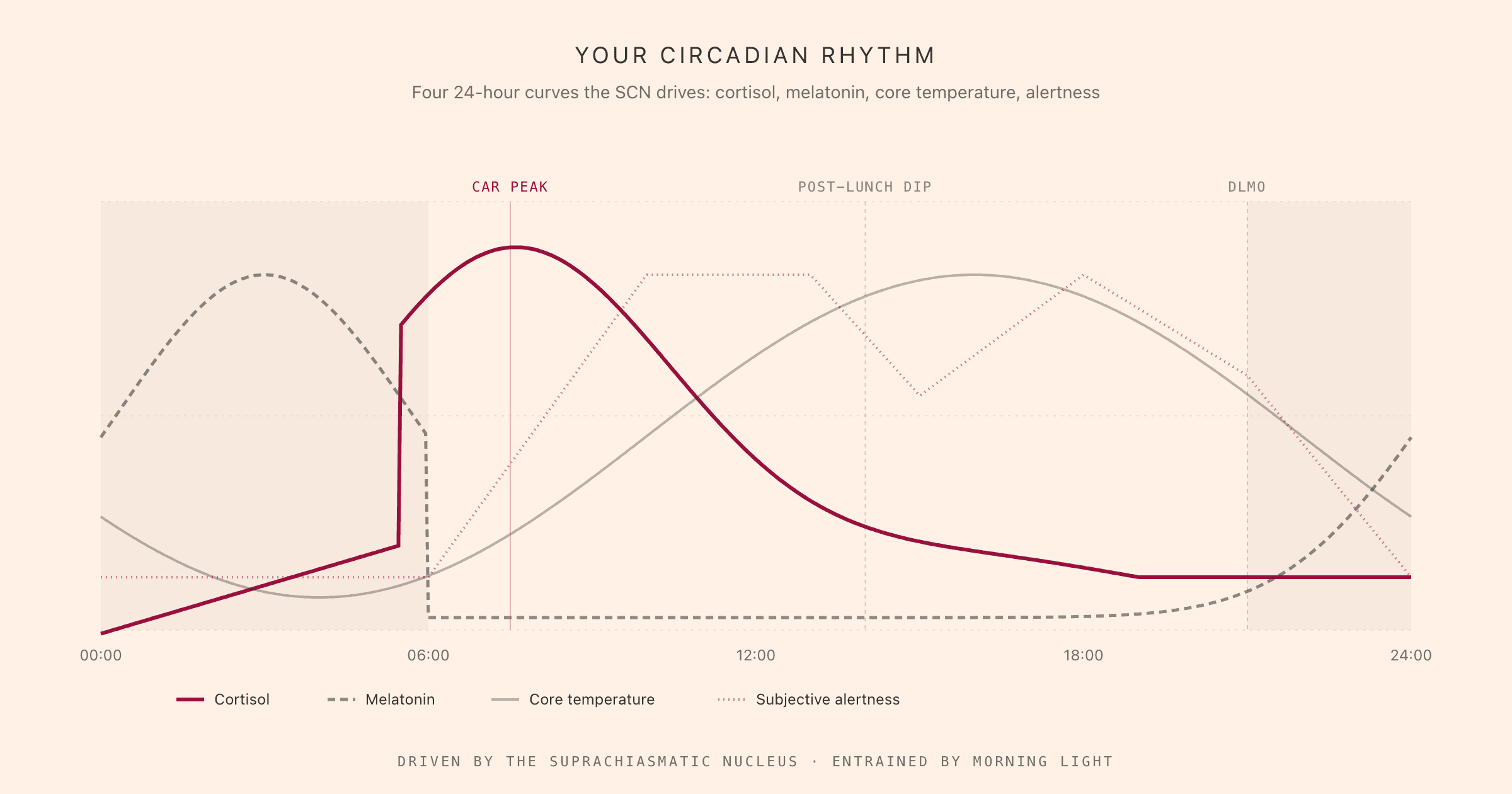
Cortisol is the morning ramp-up hormone. Its 24-hour curve is dramatic: it sits near baseline through most of the night, rises sharply in the hour before natural waking, peaks 30-45 minutes after waking, then declines through the rest of the day to a midnight nadir. The peak is called the cortisol awakening response (CAR), and it is the single biggest endocrine event of the day.
The CAR is what flips you from sleeping to awake-and-alert. It mobilises glucose, raises blood pressure, sharpens attention, and primes the prefrontal cortex for executive function. People with a flattened CAR (chronic stress, depression, burnout) report exactly the symptoms you would predict from missing the morning kick: morning grogginess that does not lift, slow ramp-up, mid-morning brain fog before the second cup of coffee.
The CAR is also why the first 60-90 minutes after waking is, for most chronotypes, the highest-quality focus window of the entire day. The prefrontal cortex is at its freshest, cortisol is peaking, sleep inertia has just lifted, and the day's interruptions have not yet started. The productivity protocol that drops out of the CAR is: protect the first 90 minutes of your day for the single highest-leverage piece of work you need to do, and do not open email, Slack, or any reactive surface until it is done. Cal Newport built much of his deep-work argument around this window.
The Daily Alertness Curve and the Post-Lunch Dip
Subjective alertness through a normal day follows a two-peak, one-dip pattern that is reproducible across studies:
- First peak: 09:00 to 12:00. Cortisol is high, core body temperature is rising, prefrontal-cortex glucose availability is good. This is the window most people get their best deep work done in.
- Post-lunch dip: 13:00 to 15:00. A genuine dip in alertness, attention, and cognitive performance. The dip is biological, not caloric: it happens whether you eat lunch or not, though a heavy carbohydrate-rich lunch deepens it. The dip lines up with the bottom of the circadian alertness curve and the first 12-hour harmonic of the SCN signal.
- Second peak: 16:00 to 19:00. Core body temperature peaks around 18:00, which correlates with peak motor coordination, reaction time, and physical performance. This is why most sports records are set in late afternoon and why the second peak is the right window for collaborative work, communication, and tasks that need energy more than they need stillness.
- Evening drop: 21:00 onwards. Dim-light melatonin onset (DLMO) kicks in around 21:00-22:00 for most chronotypes, and alertness drops sharply through the next 1-2 hours.
The post-lunch dip is the most-misunderstood part of the curve. It is not laziness, it is not the carbs, and it is not solved by another coffee. The dip is the rhythm doing its job, and the highest-leverage move is to schedule the lowest-value work of the day into the dip and use the second peak (the 16:00-19:00 window) for the next-most-important block of focused work. People who treat the dip as a defect to power through tend to produce mediocre work for two hours and then crash through the second peak. People who let the dip happen tend to get a clean recovery and a strong second block.
Chronotype: Why the Curve Is Not the Same for Everyone
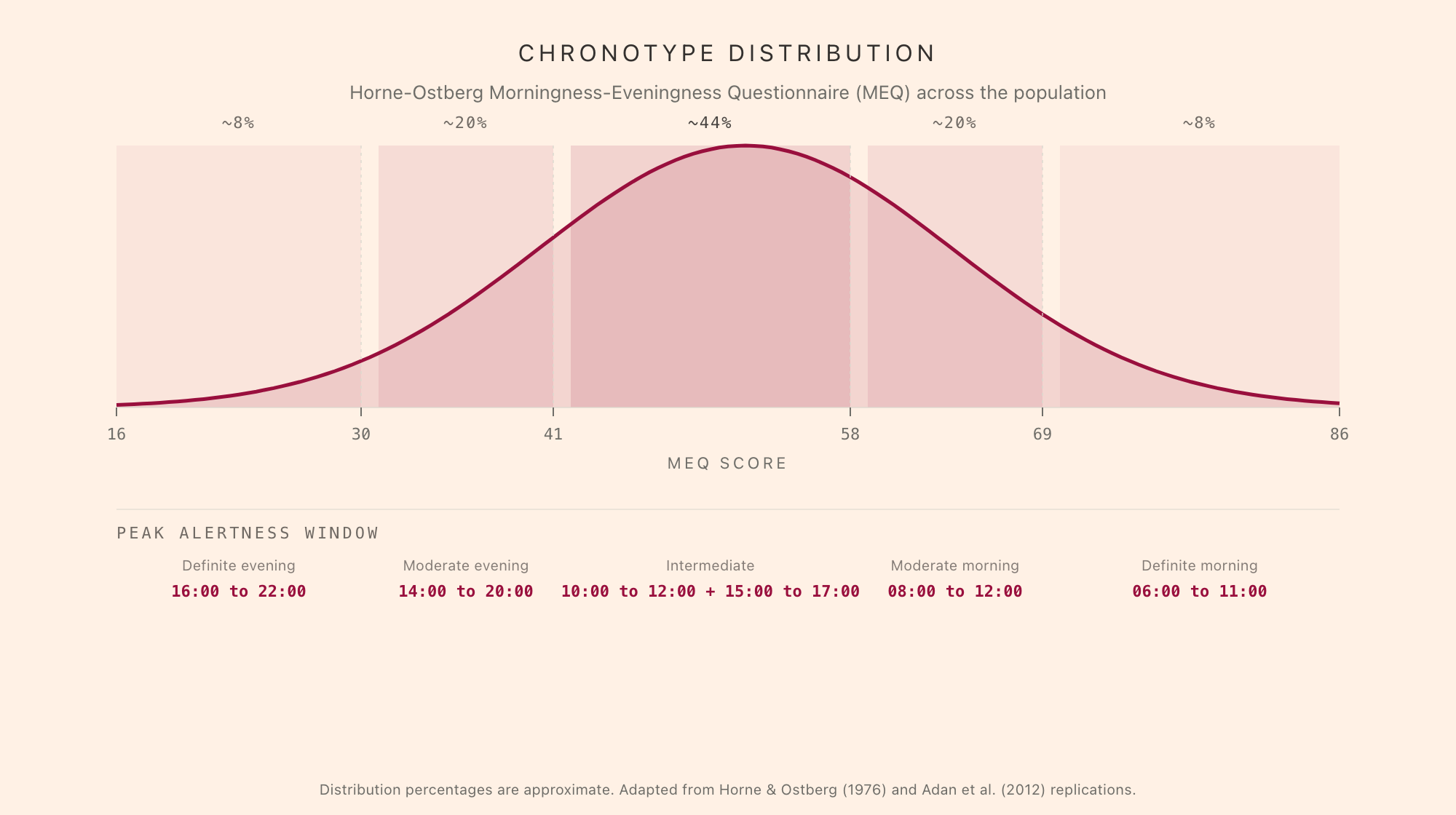
The 09:00 first peak in the alertness curve above is the average. Your personal peak is shifted earlier or later depending on your chronotype, the individual variation in circadian phase that runs roughly normally distributed across the population. The dominant chronotype questionnaire is the Horne-Ostberg Morningness-Eveningness Questionnaire (MEQ), first published in 1976 and validated in dozens of replications since (the cleanest is Adan et al. 2012).
The MEQ runs 19 questions, produces a score from 16 to 86, and categorises into five chronotypes:
- Definite evening (MEQ 16-30, ~8% of the population). Peak alertness 16:00-22:00. Natural bedtime past midnight. Forced early starts produce significant cognitive cost, often called "social jet lag" when sustained.
- Moderate evening (MEQ 31-41, ~20%). Peak 14:00-20:00. Natural bedtime 23:00-01:00. The most common "I am not a morning person" report.
- Intermediate (MEQ 42-58, ~44%). Peak 10:00-12:00 plus a second 15:00-17:00. Bedtime 22:30-23:30. The plurality chronotype that most workday norms are built around.
- Moderate morning (MEQ 59-69, ~20%). Peak 08:00-12:00. Bedtime 21:30-22:30. The early-rising professional class.
- Definite morning (MEQ 70-86, ~8%). Peak 06:00-11:00. Natural bedtime by 22:00. Most likely to be awake at 05:00 by choice.
The 8/20/44/20/8 distribution is approximate and varies slightly across populations, but the general shape (a bell curve with intermediate at the centre) holds. Chronotype is heritable (twin studies put it around 50% genetic, with the rest from age, light exposure history, and lifestyle), it drifts with age (children skew morning, teenagers skew strongly evening, adults regress toward intermediate, older adults skew morning again), and it is not the same as a sleep preference. A definite-evening chronotype forced to wake at 06:00 every weekday does not become a morning person; they become a chronically-sleep-deprived evening person.
The practical move is to take a 10-minute MEQ (the questionnaire is in the public domain and several validated online versions exist), confirm your chronotype, and then map your hardest work into your actual peak windows. An intermediate chronotype using the 09:00-12:00 first peak for deep work and the 16:00-18:00 second peak for collaboration is following the textbook. A moderate-evening chronotype trying to write at 09:00 is fighting their SCN; their textbook window for deep work is 14:00-19:00 and the morning is for shallow tasks.
The Sleep-Wake Cycle: The Circadian Component
The sleep-wake cycle is one consequence of the circadian rhythm, not the same thing. The Borbely two-process model (1982) decomposes sleep timing into two independent drivers:
- Process C (circadian). The SCN signal. Drives the timing of melatonin release, core body temperature drop, and the alerting/sleepiness rhythm. Independent of how long you have been awake.
- Process S (homeostatic sleep pressure). Builds linearly with hours awake. Driven by adenosine accumulation in the basal forebrain. Resets only with sleep.
You feel sleepy when both processes line up: when Process C says "the alerting signal is low" and Process S says "sleep pressure is high." Adenosine is the molecule caffeine antagonises, which is why coffee delays sleepiness (it blocks the Process S signal) without changing the underlying circadian rhythm.
The two-process model also explains the wake-maintenance zone, the surprising late-evening window (typically 19:00-21:00 for an intermediate chronotype) where most people are unable to sleep even if they are tired. The circadian alertness signal peaks just before melatonin onset; the body is pushing you to be awake at exactly the moment Process S is screaming at you to sleep. The wake-maintenance zone resolves once DLMO arrives and the C signal drops.
Circadian Rhythm Disorder
A circadian rhythm disorder is a sustained, clinically significant misalignment between the internal clock and the desired or required sleep-wake schedule. The International Classification of Sleep Disorders (ICSD-3) lists six:
- Delayed sleep-wake phase disorder (DSWPD). Sleep timing chronically shifted late (sleep onset after 02:00, wake after 10:00) with normal sleep architecture once asleep. The clinical extreme of definite-evening chronotype. Prevalence ~0.2% of adults, much higher in teenagers (where it overlaps with normal developmental phase delay).
- Advanced sleep-wake phase disorder (ASWPD). Sleep timing chronically shifted early (sleep onset before 21:00, waking around 04:00). The clinical extreme of definite-morning chronotype. More common in older adults.
- Irregular sleep-wake rhythm disorder. No consolidated sleep period; sleep fragmented across multiple naps. Most common in dementia and in severe SCN dysfunction.
- Non-24-hour sleep-wake rhythm disorder. The clock free-runs at its natural 24.2-hour period and never re-entrains. Common in totally-blind individuals who do not receive light entrainment.
- Shift work disorder. Symptoms produced by working outside the 06:00-22:00 phase. Affects roughly 10-30% of shift workers, with measurable cognitive and metabolic consequences.
- Jet lag disorder. Acute misalignment after crossing 2+ time zones. Resolves at roughly one zone per day with morning light entrainment in the new zone.
The protocol-grade treatment for the chronic disorders is timed bright light (morning light for delayed phase, evening light for advanced phase) combined with timed low-dose melatonin (evening for delayed phase, morning for advanced phase). The lay-press idea that you can "reset" your circadian rhythm with a one-night intervention is wrong; the SCN's phase advance per day is bounded at about 1-2 hours under aggressive protocol, and most real-world resets take 4-10 days.
How to Reset Your Circadian Rhythm
The reset circadian rhythm protocol for someone whose clock has drifted (post-travel, post-illness, post-three-weeks-of-bad-sleep-hygiene) sits on six practical levers in rough order of impact:
- Morning bright light, every day, within 60 minutes of waking, for 20-30 minutes. Direct sunlight is best. A 10,000-lux light therapy lamp at arm's length is the indoor approximation. The single highest-leverage move.
- Fixed wake time, including weekends. Wake time matters more than bedtime for entrainment. A fixed wake time forces the SCN to lock onto a stable phase. Sleeping in by two hours on Sunday undoes most of a week's morning-light work.
- Dim, warm-spectrum light in the 2-3 hours before bed. Below 50 lux is the rough threshold for not delaying DLMO. Practical implementation: lamps not overhead lights, screen brightness low or off, blue-light filtering on devices if you must use them. Salt lamps and 2700K bulbs both work.
- Meal timing as a phase anchor. Eat the first meal of the day in the first 1-2 hours after waking. Eat the last meal at least 2-3 hours before bed. Meal timing is the second-strongest entrainment cue after light, particularly for peripheral organ clocks.
- Exercise in the morning or early afternoon. Vigorous exercise within 3-4 hours of bedtime can phase-delay the clock and suppress sleep onset. Morning or midday exercise reinforces the entrainment.
- Low-dose melatonin, 30-60 minutes before target bedtime, only when shifting phase. 0.3-0.5 mg is the dose with the cleanest phase-shifting evidence; the 3-5 mg doses common in over-the-counter products are pharmacological doses that act as sleep aids but do not phase-shift more effectively. Not a chronic intervention.
A complete reset for a 3-hour drift (a transcontinental US trip, a stretch of 02:00 bedtimes) typically takes 5-7 days under this protocol. Faster shifts are possible (the Argonne anti-jet-lag diet claims 1-2 day shifts) but the evidence base is thin and the cost is significant disruption during the reset.
Aligning Focus Work With the Circadian Curve
The single highest-leverage productivity move that drops out of circadian science is: align your hardest work with your peak windows and your easiest work with your dip. For an intermediate chronotype that means:
- 08:00-10:00. Sleep inertia is lifting and cortisol is peaking. Good for: orientation, planning the day, mid-difficulty cognitive tasks. Not the deep-work peak yet.
- 10:00-12:00. First peak window. The 25-minute Pomodoro interval lands clean here: four pomodoros across two hours gives one ultradian cycle of deep work inside the circadian peak. This is the window for the single most important piece of writing, coding, or analytical work of your day.
- 12:00-13:00. Lunch. Light, protein-skewed. Avoid heavy carbohydrate loads that deepen the post-lunch dip.
- 13:00-15:00. The dip. Schedule low-cognitive-cost work: email, meetings, admin, calls, anything reactive. Caffeine helps but does not eliminate the dip.
- 15:00-18:00. Second peak. Slightly different character: more energetic, better for collaboration, communication, creative ideation. A second pomodoro block here lands the second-most-important work of the day inside the second peak.
- 18:00-21:00. Wind-down. Light cognitive work, exercise, social time. Avoid starting anything new that requires deep focus.
- 21:00 onwards. DLMO and falling alertness. Reading, reflection, prep for the next day. Not the window for new content creation.
The pattern that drops out is the same shape the Pomodoro Technique embeds at the 25-minute level: ramp, peak, brief recovery, peak again. Pomodoro is the ultradian-scale tool; the circadian rhythm tells you which two hours of the day to point the Pomodoro blocks at. Tomatoes runs binaural-beats focus audio in the background to help hold attention inside each 25-minute block when the circadian alertness signal is already pulling the same direction. The combination of the two (circadian-aligned timing plus binaural-beat audio inside the block) is the highest-fidelity version of structured focus work most people can practically run, and you do not need to read another study to install it. Tomatoes is a one-time $39, no subscriptions, no accounts, and the macOS menu-bar app holds the Pomodoro structure for you while the focus audio holds the attention inside each block.
The Connection to Working Memory, the DMN, and Procrastination
Circadian phase modulates every cognitive system that has been measured under within-subject crossover designs. The cleanest results:
- Working memory. Capacity follows the alertness curve closely. The 4-slot working-memory bottleneck (see the working memory article) is at its full capacity during the two peaks and reduced during the dip. Trying to hold a complex argument together in working memory at 14:00 is genuinely harder than the same task at 10:00.
- Default mode network. The DMN is more active during low-arousal windows. The post-lunch dip is the most reliable daytime period for default-mode-network engagement, which makes it a counterintuitively-good window for the kind of diffuse, idea-generating thinking that the default mode network article covers. Use it for thinking, not executing.
- Procrastination and reward discounting. The hyperbolic-discount rate (see the procrastination article) is steeper during low-arousal windows; the same task that feels do-able at 10:00 feels not-worth-it at 14:00. The fix is not willpower; it is to schedule the task into the window where the discount rate is flatter.
The general principle: every focus-related cognitive function has a circadian envelope. Stacking your day to push the function-specific work into the function-specific window is not optimisation theatre; it is using the rhythm the SCN is running anyway.
When to See a Sleep Doctor
A circadian rhythm complaint is worth a sleep-medicine workup when at least one of three things is true. First, the misalignment has been present for more than three months and you cannot self-correct with the reset protocol above. Second, the sleep timing is producing measurable daytime impairment (work, school, driving, mood). Third, you have a family history of a defined circadian disorder, particularly familial advanced sleep-phase syndrome, which is heritable through specific PER2 mutations and responds to specific interventions.
For most healthy adults with a normally drifted clock, the morning-light-plus-fixed-wake-time protocol resolves things within a week. The point is to stop treating circadian misalignment as a willpower problem and start treating it as the entrainment problem it actually is, which is exactly what the SCN has been waiting for you to figure out for the last 200,000 years.