Procrastination is the universal cognitive phenomenon that costs an estimated 25% of self-reported productive time and shows up in some form across every population that has been measured. It is the topic on which more self-help books have been published than any other, and it is the topic on which the gap between the popular literature and the cognitive-neuroscience literature is the widest. Procrastination is not a willpower deficiency, a moral failing, or a sign of insufficient passion. It is a measurable consequence of how the brain discounts delayed rewards, weights effort costs, and resolves competition between salient short-term stimuli and abstract long-term goals. Once you have the equation, the interventions stop being motivational posters and start being levers on specific terms.
This piece is the cognitive-science version. The Steel temporal motivation theory equation that ties expectancy, value, impulsiveness, and delay together. The hyperbolic discounting curve that explains why a small immediate reward beats a large delayed one until the deadline pulls the curve back. The neuroscience of why limbic salience wins over prefrontal goal-maintenance more often than the other way around. The five interventions that have actually moved the needle in the literature. Tomatoes is built around one of them, the audio-anchor lever; the app is a one-time $39 with no subscription. The rest of this article is the science of why that lever works and what the other four are.
What Procrastination Actually Is (and What It Is Not)
The clinical and academic definition that has held up best across forty years of research comes from Steel (2007), who synthesised 691 procrastination studies into a single meta-analysis. Procrastination is "to voluntarily delay an intended course of action despite expecting to be worse off for the delay". The three terms in that definition are doing all the work.
Voluntarily. A delay because you literally cannot do the task is not procrastination. A child who cannot do calculus is not procrastinating; an adult who can but does not is.
Intended course of action. You have decided to do the task. The internal conflict is real, not a matter of competing priorities you have not yet resolved.
Expecting to be worse off. You know it will cost you. The delay is irrational from your own self-described perspective. This is what separates procrastination from wise patience or strategic deferral.
What procrastination is not:
- Laziness. Lazy people do not feel bad about not doing things. Procrastinators do; the gap between "what I am doing" and "what I have decided I should be doing" is the source of the characteristic emotional cost.
- Perfectionism. Perfectionism is a sometimes-correlated factor, but the meta-analytic correlation is weak and bidirectional, and many procrastinators are not perfectionists at all.
- A character flaw. The cross-cultural and cross-developmental data make clear that procrastination is a near-universal feature of human cognition under specific conditions, not a property of bad people. Roughly 20% of adults self-identify as chronic procrastinators; an estimated 80% to 95% of college students procrastinate; and the rates rise in roles where rewards are delayed and feedback is sparse.
The thing that procrastination is, mechanistically, is a temporal-motivation problem: a mismatch between the reward structure of available actions in the present moment and the reward structure of the actions that would maximise long-term outcome. The literature has converged on this framing, and the next section is the equation.
The Steel Equation: Procrastination as a Solvable Math Problem
In 2007, Piers Steel synthesised the existing motivation theories into a single equation, the Temporal Motivation Theory (TMT). The equation is:
Motivation = (Expectancy × Value) / (Impulsiveness × Delay)
Each term is a measurable construct. Each term is something the literature has shown can be moved in either direction.
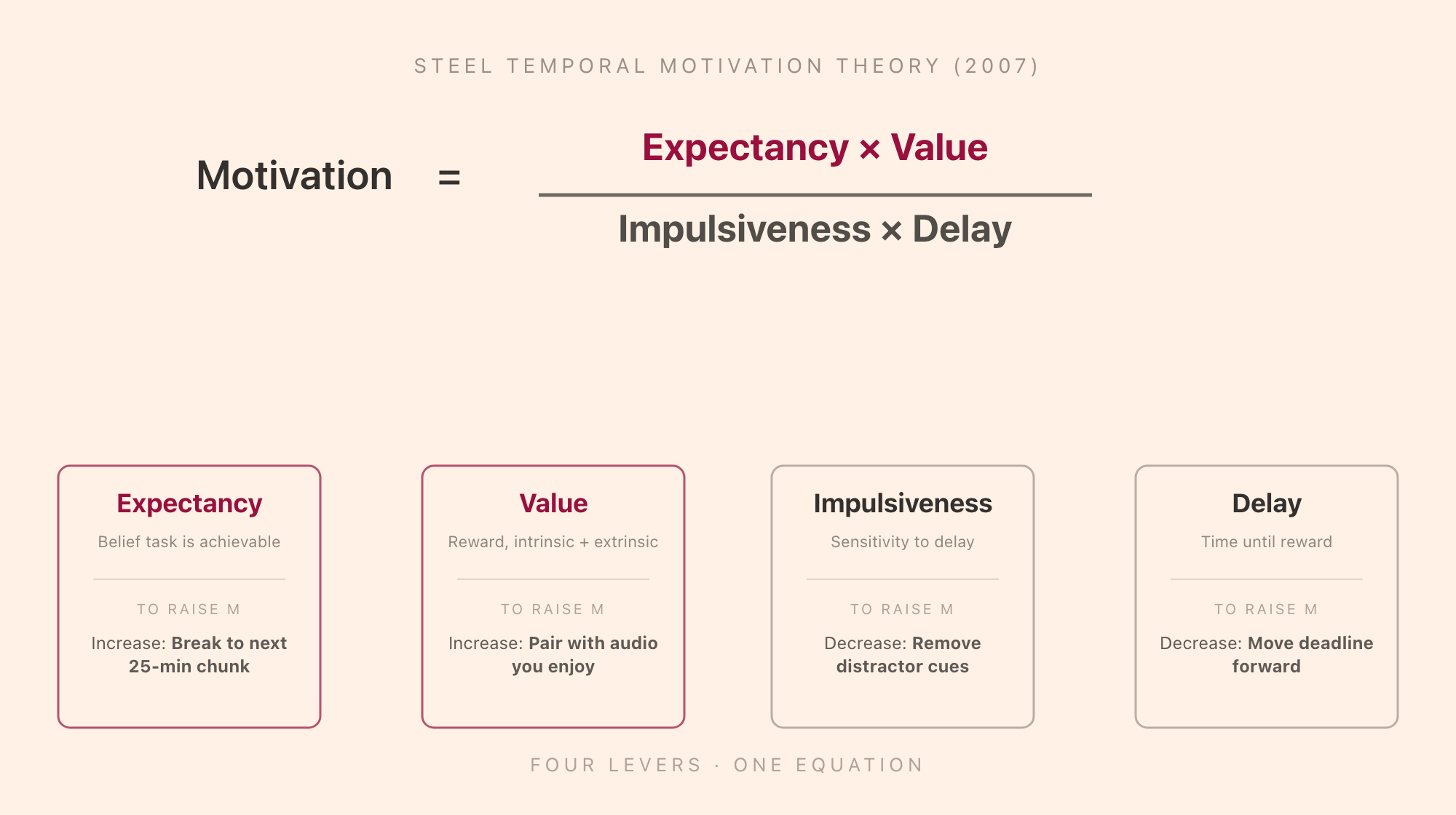
Expectancy is the believed probability of successfully completing the task. Low expectancy ("I won't be able to do this anyway") collapses motivation regardless of how valuable the task is. The literature on self-efficacy (Bandura) is the classic source. Procrastination is most acute on tasks where expectancy is low and the person is preserving self-image by not trying.
Value is the size of the reward, intrinsic and extrinsic combined. Boring tasks have low intrinsic value; tasks with no immediate visible payoff have low extrinsic value. The interaction matters: a tedious task with a high paycheck attached has a workable value score; a tedious task with the only payoff being "the manager will not be unhappy" has a value score that struggles to clear the denominator.
Impulsiveness is the trait-level sensitivity to delay. People high in impulsiveness discount delayed rewards more steeply than people low in impulsiveness. The construct overlaps substantially with executive function and with the inattention dimension of ADHD; we will come back to that.
Delay is the time between now and the reward. The denominator term is what makes TMT a temporal theory: as delay rises, motivation falls, and the rate at which it falls is determined by impulsiveness.
The equation predicts every robust finding in the procrastination literature. Tasks with vague success criteria (low expectancy) get put off. Tasks with delayed extrinsic rewards (long delay) get put off. People with high trait impulsiveness or untreated ADHD (high impulsiveness) procrastinate more. Tasks that are intrinsically dull (low value) get put off. The contribution of TMT is not the existence of any one of those facts; it is the integrated equation that says all four levers are in the same maths and you can move any of them.
Hyperbolic Discounting: Why the Small Immediate Reward Wins
The deeper reason the denominator behaves the way it does comes from the hyperbolic-discounting literature, which goes back to George Ainslie (1975) and was formalised quantitatively by James Mazur (1987). The classic finding is that humans (and animals) do not discount future rewards exponentially, the way a financial discount rate would. They discount hyperbolically.
The Mazur formula is:
V = A / (1 + k × D)
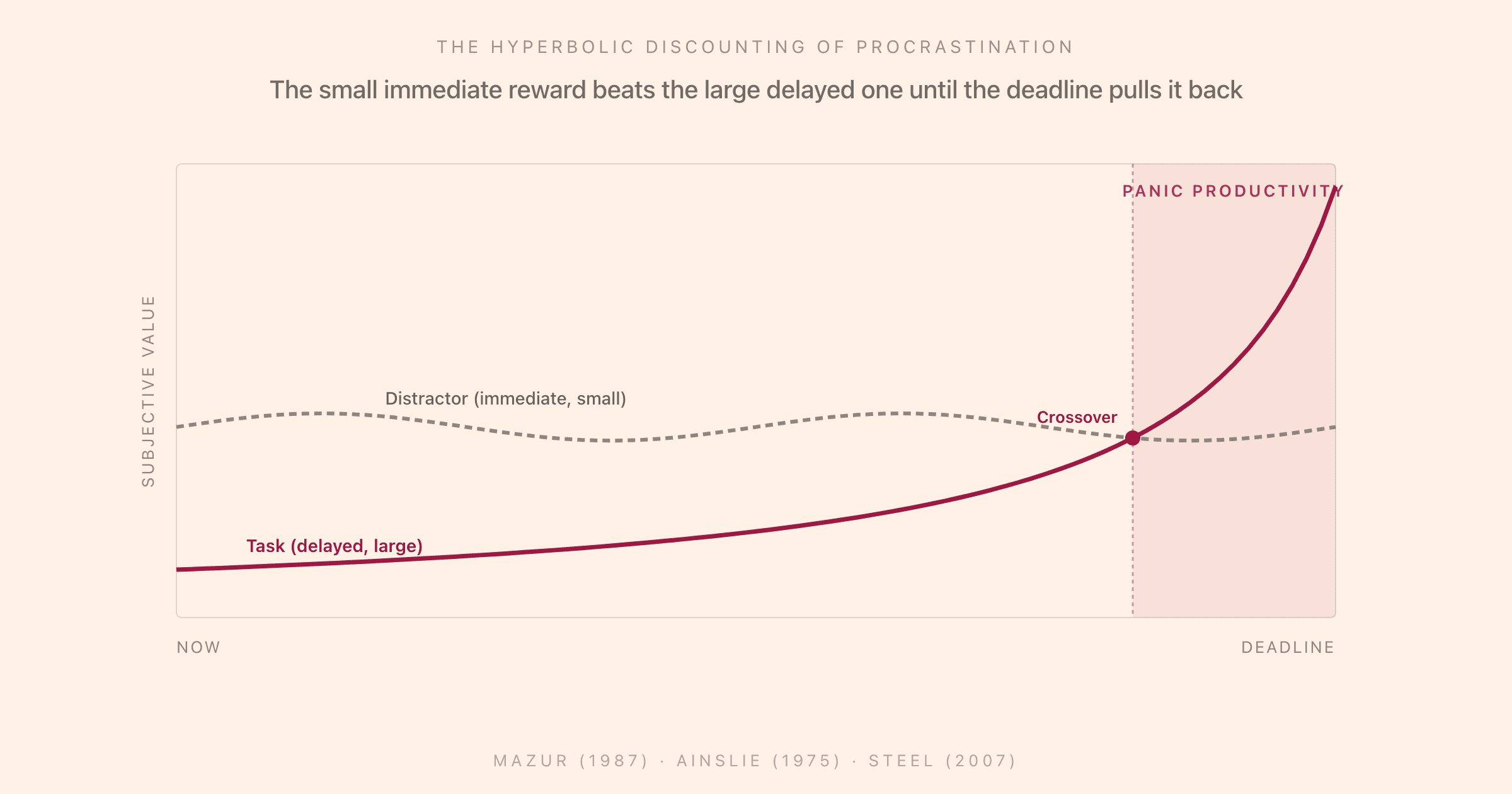
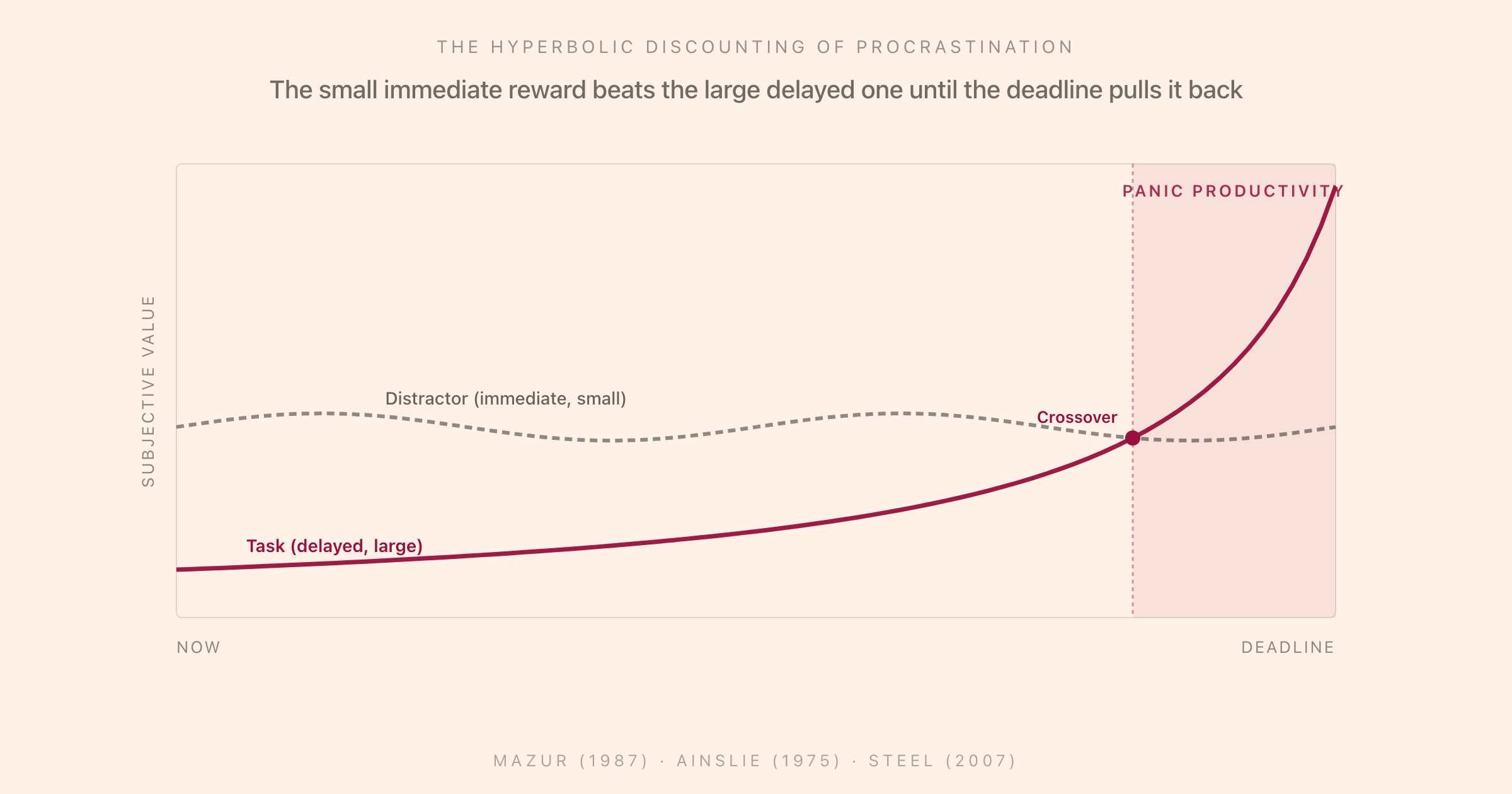
V is the present value, A is the amount of the reward, D is the delay, and k is an individual's discount-rate parameter. The geometry of this equation produces a characteristic "preference reversal": at long delays, the larger-later reward is preferred over the smaller-sooner one; as the delay shrinks toward zero, the smaller-sooner crosses over and is preferred. The crossover is the moment procrastinators recognise immediately. It is the mid-afternoon when the report due tomorrow finally feels more rewarding than scrolling, and you start actually working. It is also the late-night panic when the report due in eight hours finally clears the crossover and the all-nighter begins.
The hyperbolic discount curve in the hero figure above shows exactly this dynamic. The distractor sits at a small but constant subjective value. The task sits at a low value when the deadline is far away, because hyperbolic discounting is steepest near zero. Only as the deadline approaches does the task curve climb above the distractor, and the climb is sharp. The shaded "panic productivity" zone after the crossover is where most procrastinators do most of their work.
Two implications fall out of this geometry.
First, willpower is not the binding constraint. The choice you are making at any moment is not a moral one between virtue and vice; it is the brain selecting whichever option has the higher subjective value at this instant. If you want to choose the task, you have to change which curve is higher.
Second, you can move the crossover. If you can make the task curve start higher (raise A), shrink the discount steepness (lower k), or shorten the delay (lower D), the crossover moves earlier and panic productivity becomes voluntary productivity. This is what every effective procrastination intervention is doing, even when it is not described in these terms.
The Limbic-vs-Prefrontal Tug of War
The neural implementation of TMT and hyperbolic discounting maps onto two well-characterised brain systems. The McClure et al. (2004) fMRI study is the cleanest demonstration. Participants choosing between immediate and delayed rewards showed activation in two competing networks: a "limbic" network (ventral striatum, medial prefrontal cortex, posterior cingulate) that responded preferentially to immediate rewards, and a "lateral prefrontal" network (dorsolateral PFC, lateral orbitofrontal cortex, posterior parietal cortex) that responded similarly to all rewards regardless of timing.
The interpretation has been refined since 2004 (Kable and Glimcher, 2007, and others have argued for a single valuation system rather than two competing ones), but the practical shorthand is useful. Limbic salience drives the immediate; prefrontal goal-maintenance drives the delayed. When the limbic signal wins, the smaller-sooner is chosen; when the prefrontal signal wins, the larger-later survives. Procrastination is, in this framing, the limbic system winning a tug of war that the prefrontal system was not configured to fight.
This maps onto the default mode network literature in a useful way. The DMN is heavily involved in mind-wandering and self-referential thought, and one of the things mind-wandering does is generate present-moment alternatives ("what if I just checked one thing first?"). DMN activity correlates with off-task attention. Procrastination is what mind-wandering produces when the most-available alternative is rewarding enough to capture engagement. We covered the broader flow state and hyperfocus cases in their own articles; procrastination is the failure mode that lives between them.
The ADHD-procrastination link is also clean here. ADHD involves atypical dopamine signalling and weaker phasic locus-coeruleus engagement, both of which steepen hyperbolic discounting. The colloquial concept of "time blindness" in ADHD is the experiential side of the same coin: future events feel further away than they are, which mathematically increases D and crashes motivation for anything that is not immediate. This is also why the relationship between procrastination and executive function is so tight; the cognitive control machinery that would otherwise hold the prefrontal signal active against limbic competition is exactly the machinery that is weaker in ADHD.
The Five Interventions That Actually Re-Tilt the Equation
Most procrastination advice does nothing because most procrastination advice targets the wrong term. "Just start" is not an intervention; it is a description of the desired outcome. The five interventions below have meta-analytic support and target specific terms in the TMT equation.
1. Implementation Intentions (Lowers Delay)
Peter Gollwitzer's implementation-intention research (1999, and dozens of follow-ups) is the most replicated procrastination intervention in the literature. The format is a single sentence: "When situation X occurs, I will perform behaviour Y." The intervention works by binding the task to a specific environmental cue, which collapses the decision-to-act delay to zero (the cue arrives, the action fires). Effect sizes are medium to large across hundreds of studies and dozens of domains.
The practical move: do not write "I will work on the report tomorrow". Write "When my coffee finishes brewing at 9am, I will open the report and write for 25 minutes". The cue (coffee finishing) is concrete; the action (open and write) is concrete; the duration (25 minutes) is a cap that protects expectancy.
2. Time-Boxing With Short Blocks (Raises Expectancy, Lowers Delay)
The pomodoro technique (25 minutes of focused work, 5 minutes of break, repeat) and its variants (Flowmodoro, Ultradian-aligned blocks) are time-boxing interventions. They raise expectancy because finishing a 25-minute block is plausible in a way that finishing the whole report is not, and they lower the perceived delay because the next reward (the break) is 25 minutes away, not 4 hours away. The reduction in mental fatigue from periodic recovery is a smaller secondary mechanism.
We covered the pomodoro vs flowmodoro and ultradian rhythm cases separately; the procrastination-specific point is that the block does not have to be 25 minutes. It has to be short enough that expectancy is high and short enough that the reward feels close. For chronic procrastinators starting cold, 10-minute blocks beat 25-minute blocks until expectancy is rebuilt.
3. Distractor Pruning (Lowers Impulsiveness Sensitivity)
Impulsiveness as a trait is largely heritable and stable, but the practical impulsiveness of any given moment is a function of how many high-saliency distractors are present in the environment. Removing distractors does not change the trait; it changes the local choice set. If the only options at the desk are "write the report" or "stare at the wall", staring at the wall has a low-enough subjective value that even the discounted task wins.
The literature on attentional capture (Theeuwes 1992, Yantis and Jonides 1984) is the basis for this. Notification cues, open browser tabs, and a phone within reach all act as cued attention captures that win the limbic-vs-prefrontal tug of war by raising the saliency of the distractor. Pruning is the cheapest single intervention available. Every notification turned off, every tab closed, every device put face-down is a percentage point off the local impulsiveness.
4. Reward Bundling (Raises Value)
Katherine Milkman's "temptation bundling" research (2014) is the cleanest formulation. Pair an instrumentally important but low-intrinsic-value task with a high-intrinsic-value reward that you only allow yourself during the task. Audiobooks while exercising. Coffee shop while writing. A specific kind of music while doing the boring spreadsheet. The bundle raises the value term in TMT because the task now carries the intrinsic reward of the bundle along with the extrinsic reward of completion.
Audio is one of the cheapest bundles because it is portable, stable, and does not compete attentionally with knowledge work the way visual entertainment does. This is the lever that focus-music apps work on. The audio is not making your brain better; it is raising the value of the present moment of doing the task, which on the TMT equation is a direct multiplier on motivation.
5. Pre-Commitment (Reduces the Discount Window)
Schelling's classical pre-commitment theory (1984) and the modern behavioural-economics literature (Ariely, Thaler, others) document a class of interventions that bind the future-self by altering the present choice set. Tell a friend you will send them the draft by Friday and pay them £20 if you do not. Use a website blocker that is non-trivial to disable. Schedule the meeting that requires the work to be done, before the work is done.
Pre-commitment is the most psychologically uncomfortable lever because it requires acting on the knowledge that future-you will be a worse decision-maker than present-you, and it requires giving up the optionality of changing your mind. It is also the lever with the largest evidence base for chronic procrastinators, because it does not require future-you to win the tug of war; it removes the tug of war from the decision space.
Why Audio Is the Cheapest Lever for the Knowledge Worker
Of the five levers, the one a focus-music app like Tomatoes is built around is the reward-bundling lever, with secondary effects on the distractor-pruning and time-boxing levers. The mechanism is concrete.
Continuous music with stable spectral characteristics (binaural beats, brown noise, ambient textures) acts as a passive auditory anchor. It does three things at once. It raises the value term by making the present moment of working more pleasant. It lowers practical impulsiveness by masking external acoustic distractors that would otherwise pull attention. And, when paired with a pomodoro or ultradian block structure, it lowers the perceived delay by binding the work session to a recognisable audio shape that signals start and end.
The audio is not magic, and the music itself is not changing your brainwaves in any clinically meaningful way. The literature on audio entrainment is mixed and the effect sizes are small (we covered this in the binaural beats safety piece). What audio does cleanly is the bundling. Bundling is a TMT lever. TMT is the equation. Procrastination is the equation losing.
What to Stop Doing
A short list of common procrastination interventions that the literature does not support, organised by the term they fail to move:
- Generic "just push through" advice (no term moved, requires the prefrontal signal to win unaided)
- Long, abstract daily plans (low expectancy, high delay; the to-do list itself becomes a distractor)
- Punishing yourself for procrastinating (lowers expectancy, no other lever moved; the literature on self-compassion shows the opposite intervention has medium effect sizes)
- Working only when you feel motivated (motivation is what the equation outputs, not what it inputs; waiting for motivation to arrive is waiting for the crossover)
- Caffeine as a willpower replacement (caffeine raises arousal, which can sharpen the prefrontal signal briefly, but it does nothing structural; we have a longer note in the 40 Hz gamma waves piece on what arousal does and does not do)
The single most useful diagnostic question, when stuck on a task, is which of the four TMT terms is the binding constraint right now. Low expectancy on this specific task? Break it smaller. Low value? Bundle it. High impulsiveness? Prune the distractors. High delay? Pre-commit or move the deadline. The answer is almost never "willpower".
The Closing Move
Procrastination is the predictable output of a system that has known mathematical properties. You do not have a procrastination problem; you have an equation whose terms are not configured well for the task in front of you. The five levers above are the ones the literature actually supports. They are also the ones that are cheap to apply.
If you want to put the audio-bundling lever into rotation today, Tomatoes generates DSP-driven focus audio (binaural beats, granular ambient textures, brown noise variants) tuned for the pomodoro and ultradian block structures. It is a one-time $39 with no subscription and works locally on your machine.
The brain is a hyperbolic discounter. The equation is solvable. The levers are knowable. The work, finally, is the work.