Flow state is the cognitive condition in which attention, action, and ability collapse into a single self-reinforcing loop. The work feels effortless. Time seems to bend. The internal monologue goes quiet. The output is some of the best work the person is capable of producing. Mihaly Csikszentmihalyi spent thirty years measuring it across rock climbers, surgeons, chess masters, and assembly-line workers, and what he kept finding was the same shape: a narrow corridor where a challenge sits exactly at the height of the worker's skill, and where every other condition in the environment lines up to keep them inside it.
This article is the practical version of that body of research. What flow state is in measurable terms. The eight characteristics Csikszentmihalyi documented across thousands of subjects. The neurochemistry that turns into the felt experience. The five conditions that gate entry. And the protocols for re-entering flow on a normal workday, which is where the audio side of focus enters the picture. Tomatoes is built around the audio half of that protocol, and is a one-time $39 with no subscription. The rest of this piece is the science of what the audio is supporting.
What Flow State Actually Is
Flow state is a cognitive and emotional condition characterised by complete absorption in a task, where the perception of effort drops to near zero and performance rises to near the upper limit of the person's current capability. It is a state, not a trait. It comes and goes during a working day. It is reproducible under specific conditions. It is measurable both subjectively (Flow State Scale, Experience Sampling Method) and physiologically (changes in heart rate variability, prefrontal activation patterns, neurotransmitter profiles).
Three things define flow consistently across the literature. They show up whether the subject is a surgeon mid-operation, a programmer mid-feature, a violinist mid-recital, or a person solving a crossword.
- Action and awareness merge. The task and the attention paid to the task become indistinguishable. The person is not "concentrating on" the work; they are simply doing it.
- The sense of self recedes. The internal narrator (what cognitive scientists call the Default Mode Network) goes quiet. Self-monitoring drops. The familiar rumination loop ("how am I doing? am I doing well enough?") falls away.
- Time perception distorts. Most flow subjects report time speeding up (an hour feeling like ten minutes). A minority report time slowing down (the high-stakes-decision case, more common in surgery and professional sport). Either way, normal time perception breaks down.
The deepest flow states are rare. The shallow versions of the same state are common. Almost everyone has experienced the partial form (the absorbed-in-a-novel state, the exercise-zoneout state, the difficult-puzzle state). The deep, transformative version that Csikszentmihalyi described in his rock-climber subjects is harder to come by, but the same mechanism gates both.
The Eight Characteristics Csikszentmihalyi Documented
Across decades of Experience Sampling research, Csikszentmihalyi found the same eight features showing up in subject reports of flow. They are not a checklist; they are the convergent description that emerged from the data.
- Clear goals at every moment. The person always knows what they are trying to do next. The goal is not abstract ("write the chapter") but immediate ("finish this paragraph cleanly"). The goal stays present without effort.
- Immediate, unambiguous feedback. The activity reports back continuously. The next note sounds wrong, the climb goes off-route, the line of code does not compile. Flow does not happen in feedback-poor activities (writing a quarterly report someone reads next month) without explicit instrumentation that creates feedback.
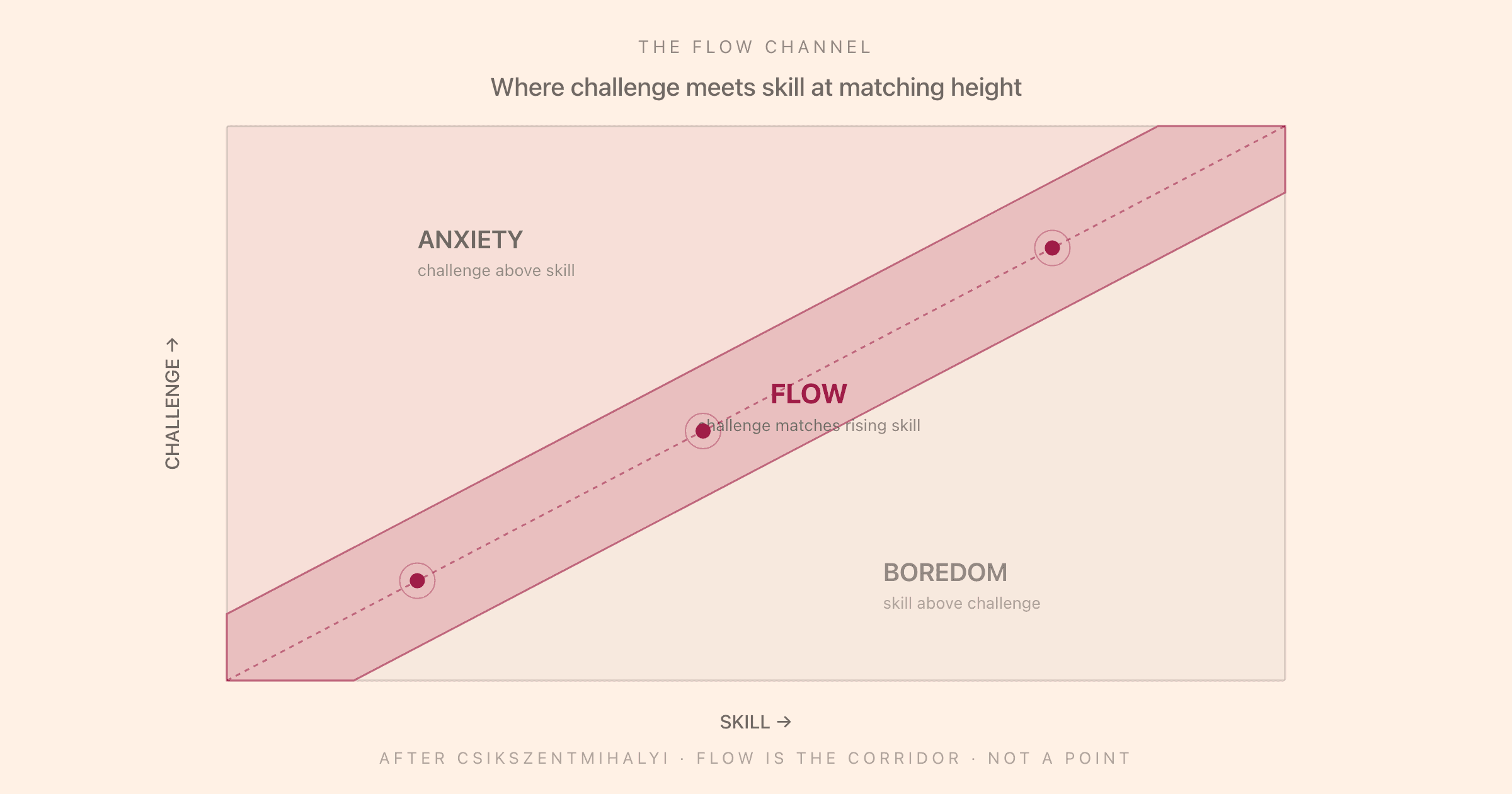
- A challenge-skill match. The challenge is at the upper edge of current skill, but not beyond it. This is the core condition. The flow channel diagram is the visualisation of this match.
- Concentration on the task at hand. Attention narrows to the immediate work. Distractors stop registering. The phone going off across the room becomes ambient.
- A sense of control. Not control in the dictatorial sense, but a felt confidence that one's actions are producing the intended results. The activity feels manageable even at its hardest.
- A loss of self-consciousness. The narrator goes quiet. Performance anxiety drops. The "what will they think" loop stops running.
- A distorted sense of time. Hours pass like minutes. Or, in high-stakes-decision contexts, seconds stretch into perceptible chunks.
- An autotelic experience. The activity becomes its own reward. The work no longer needs an external motivator (deadline, payment, praise) to continue. The doing of it is the reason.
The first three are conditions. The next four are descriptions of what happens when the conditions are met. The eighth is the consequence. Flow is engineered by setting up the first three, and the rest follows.
The Flow Channel Explained
The flow channel is the band of states where challenge and skill rise together. Csikszentmihalyi originally drew it as a 2D plot: skill on the x-axis, challenge on the y-axis, flow as the diagonal corridor between the two extremes.
Above the corridor: anxiety. The challenge exceeds current skill. The work feels frightening. Cognitive resources go into managing the threat rather than executing the task. Performance drops. The person either escalates (asks for help, breaks the work into smaller pieces) or flees.
Below the corridor: boredom. The skill exceeds the challenge. The work feels trivial. Attention starts wandering because there is nothing for it to lock onto. The Default Mode Network re-engages. The person either disengages (mind wanders, scrolls) or escalates the challenge to climb back into the corridor.
Inside the corridor: flow. Challenge and skill match. Attention has somewhere to go. The feedback loop is tight. The work pulls the person along.
The crucial point is that the corridor is not a fixed location. It moves as skill develops. A challenge that produced flow last month produces boredom this month, because the worker's skill has risen. To stay in flow over time, the challenge has to rise too. This is why Csikszentmihalyi called flow the engine of skill development: it is not just a pleasant state, it is the felt signal that one is operating at the upper edge of current ability, which is exactly the regime in which skill grows.
The implication for working life: a job that produces sustained flow is a job in which the difficulty of the work tracks the worker's growth. A job that does not is one in which either the work outpaces the worker (chronic anxiety) or the worker outpaces the work (chronic boredom and disengagement).
The Neuroscience Behind the Felt Experience
Flow is not metaphysics. It corresponds to specific, measurable changes in brain activity, autonomic state, and neurotransmitter dynamics. Three findings hold up consistently across the cognitive-neuroscience literature on flow.
1. Transient Hypofrontality
During deep flow, prefrontal cortex activity drops. Specifically, parts of the dorsolateral prefrontal cortex (the seat of explicit self-monitoring, working memory rehearsal, and abstract planning) show reduced activation. The phenomenon is called "transient hypofrontality" and is the leading neural account of why the inner critic goes quiet during flow.
This is counter-intuitive. The prefrontal cortex is the "thinking" part of the brain, and flow is supposed to be peak performance. Why would prefrontal activity drop? Because at the edge of one's skill, the work has been rehearsed enough that the procedural systems (basal ganglia, cerebellum, motor cortex) can run it without supervision. The prefrontal cortex's job is to plan and check, and during deep flow, it is not needed. When it goes quiet, the second-guessing goes with it.
2. The Neurotransmitter Cocktail
Flow corresponds to a specific neurochemical profile, not a single chemical. The combination is what produces the felt experience.
- Dopamine rises with the challenge-skill match and the immediate-feedback condition. It signals "the prediction was right; do that again". It is the chemical correlate of the engaged-and-tracking sensation.
- Norepinephrine rises with the increased focus and arousal. It sharpens attention and reduces the responsiveness of the brain to irrelevant stimuli.
- Endorphins rise with the sustained engagement and effort. They are part of why flow is felt as pleasurable rather than effortful.
- Anandamide (an endocannabinoid) rises during sustained flow and is associated with lateral thinking and idea-association. This is part of why creative breakthroughs cluster around flow states.
- Serotonin rises in the post-flow state, contributing to the calm-and-satisfied feeling that follows a deep work session.
This combination is why flow is described both as "intensely focused" and "deeply pleasurable" by subjects who experience it. The same chemicals that sharpen attention also produce the felt reward.
3. Brain Network Dynamics
Flow corresponds to a specific configuration of brain networks. The Task Positive Network (the systems for engaged, externally-directed work) is highly active. The Default Mode Network (the systems for internal narration, self-reference, and mind-wandering) is suppressed. The two networks normally toggle: they cannot both be highly active at once. Flow is the state in which the toggle is held firmly in the "engaged" position for an extended period.
This is why mind-wandering and flow are mutually exclusive. The neural circuitry literally does not allow both at the same time. It is also why interventions that reduce mind-wandering (focused-attention meditation, certain audio entrainment protocols, sustained challenge-skill matching) tend to lengthen flow durations.
The Five Conditions That Gate Entry
Flow does not arrive on demand. It arrives when the right conditions are present. Five gating conditions show up in almost every protocol that reliably triggers flow.
1. A challenge calibrated to skill. The single most important condition. The work has to be at the upper edge of current ability. Too easy and the brain disengages. Too hard and it shifts into threat mode. The calibration is rarely intuitive: most workers under-pitch difficulty (giving themselves work that is too easy) and lose flow on the boredom side.
2. Clear, immediate feedback. The work has to talk back. Writing, coding, music, sports all have intrinsic feedback. Slower-loop work (research, strategy, design) needs explicit instrumentation: a draft to react to, a prototype to test, a target to hit.
3. A protected attention window. Flow cannot start in a fragmented attention environment. Notifications, frequent meetings, open chat windows, and ambient interruption all sabotage entry. The minimum window is 25-45 minutes of uninterrupted work; deeper flow needs 90-120 minutes.
4. A reduced cognitive load on everything that is not the task. Decision-making outside the task drains the cognitive resources flow needs. This is why flow correlates with environmental simplicity: a quiet room, a single task, a clean workspace. The brain enters flow more easily when nothing else is asking for attention.
5. A pre-loaded attention anchor. This is the audio-environment side. A consistent sound environment (binaural beats, brown noise, focus music, near-silence) reduces the activation cost of entering flow because it eliminates the moment-to-moment surprise of new auditory input. The brain has one less thing to monitor. See the focus music guide for how each audio family works.
The five conditions are why flow is rare in modern knowledge work without explicit engineering. Open-plan offices fail condition 4. Constant Slack pings fail condition 3. Vague long-running projects fail condition 2. Mismatched sprint planning fails condition 1. Unstructured audio environment fails condition 5. The moment one fails, the corridor closes.
The Audio Side of Flow
The fifth condition (a pre-loaded attention anchor) is where focus audio enters the picture. The mechanism is not that audio "produces flow"; it is that the right audio environment removes one of the obstacles to flow entry.
Three audio families show up consistently in flow-trigger protocols, each working by a different mechanism.
Binaural beats at the alpha (8-13 Hz) or low-beta (13-20 Hz) ranges produce a frequency-following response in the brain that is associated with relaxed-alert and engaged-cognition states respectively. The mechanism is auditory entrainment: the brain partially synchronises to the perceived beat frequency, and that frequency happens to be the one associated with the desired cognitive state. See how alpha waves improve focus and beta waves and focus for the deeper treatment.
Coloured noise (pink, brown, white) produces a constant, predictable auditory background that masks the irregular sounds in the environment. The brain stops attending to ambient input because the input has become uninformative. This frees attention for the task. Brown noise has the strongest evidence for sustained focus work; pink noise is closer to the spectrum the brain expects from natural environments. See white vs pink vs brown noise and brown noise for the evidence.
Wordless instrumental music at moderate tempos (around 60-80 BPM for relaxed flow, 90-110 BPM for engaged flow) provides a temporal scaffold without competing for the language network. Lyrics activate language processing and split attention; instrumentation does not. This is why lo-fi, ambient, classical, and certain types of electronic music all work for focus while pop music does not.
The audio is not the work. The audio is the absence of the auditory friction that keeps the brain partially distracted. When the audio environment is right, the brain has fewer obstacles between its current state and the flow corridor.
How to Engineer Flow Re-Entry
Flow is a state. States come and go. Most working days will have multiple flow entries and exits, separated by transitions, breaks, meetings, and the natural ebb of cognitive resources. The practical question is not "how do I enter flow once today" but "how do I make re-entry cheap enough to do it three or four times a day".
Three protocols make re-entry reliable.
1. Match the Cycle to the Brain's Ultradian Rhythm
The brain runs in roughly 90-minute ultradian cycles of high arousal followed by 20-minute troughs. Flow lives in the high-arousal phase. Trying to enter flow during the trough usually fails. The fix is to align deep work blocks to the cycle: 90 minutes of focused work, 20 minutes of recovery, repeat. Most working days have three to four flow-friendly windows in the morning and one to two in the early afternoon. See ultradian rhythm for the cycle in detail.
2. Use a Consistent Pre-Flow Routine
The brain enters states more easily when the entry is preceded by a consistent cue. A two-to-three-step pre-flow routine (close all browser tabs except the work, start the focus audio, write the next concrete sub-goal in one sentence) becomes a reliable trigger after about two weeks of repetition. The routine does not have to be elaborate; it has to be the same every time. The conditioning is what does the work.
3. Calibrate the Challenge Before Each Block
Most flow failures are challenge-calibration failures, and the most common one is starting a 90-minute block with a vague goal ("work on the doc") rather than a specific one ("draft the introduction section"). Vague goals produce boredom (because they are too easy in any moment) and anxiety (because the cumulative scope is overwhelming). The fix is one specific, scope-bounded sub-goal per block, written down before starting.
Tomatoes is the audio engine for this protocol. Real DSP-generated binaural beats, coloured noise, and focus music, paired with timer cycles tuned to ultradian rhythms. It is a one-time $39 and runs offline. It is not a flow generator. It is the audio half of the five-condition stack, which is the half most knowledge workers neglect because they assume audio is decoration rather than infrastructure.
What Flow State Is Not
Three confusions show up repeatedly in popular writing about flow. They are worth correcting because they lead to bad protocols.
Flow is not the same as deep work. Deep work is Cal Newport's framing for cognitively demanding, distraction-free work. It is a category. Flow is a state that happens during deep work when the conditions line up. You can do deep work without entering flow; flow without deep work conditions is rare.
Flow is not "the zone" in casual usage. Sports broadcasters use "the zone" loosely to mean any high-performance moment. Flow is the specific cognitive condition Csikszentmihalyi described, which is a tighter category. Most "the zone" descriptions are partial flow at best.
Flow is not a productivity hack. Flow is the experience of operating at the upper edge of one's skill. The point is the operating, not the productivity. Trying to maximise flow as a productivity technique reliably backfires because the necessary state (loss of self-consciousness, autotelic engagement) is incompatible with monitoring oneself for productivity.
The Bottom Line
Flow state is a real, measurable, reproducible cognitive condition. It corresponds to a specific neural and chemical configuration. It is gated by five conditions that can be engineered. It is accessible in a typical working day, several times a day, if the conditions are set up.
The conditions are not exotic. A challenge calibrated to skill. Clear feedback. A protected attention window. Reduced cognitive load on everything else. A pre-loaded attention anchor. The first four are organisational and self-management work. The fifth is the audio environment, and it is the one most workers ignore.
If you want the audio side of the protocol working from the next session forward, Tomatoes generates the binaural beats, coloured noise, and instrumental focus music that pre-load attention. Pair it with a 90-minute work block, a specific sub-goal, and a quiet hour, and the corridor opens.
The corridor closes again. The work is in opening it reliably enough that opening it stops feeling like work.