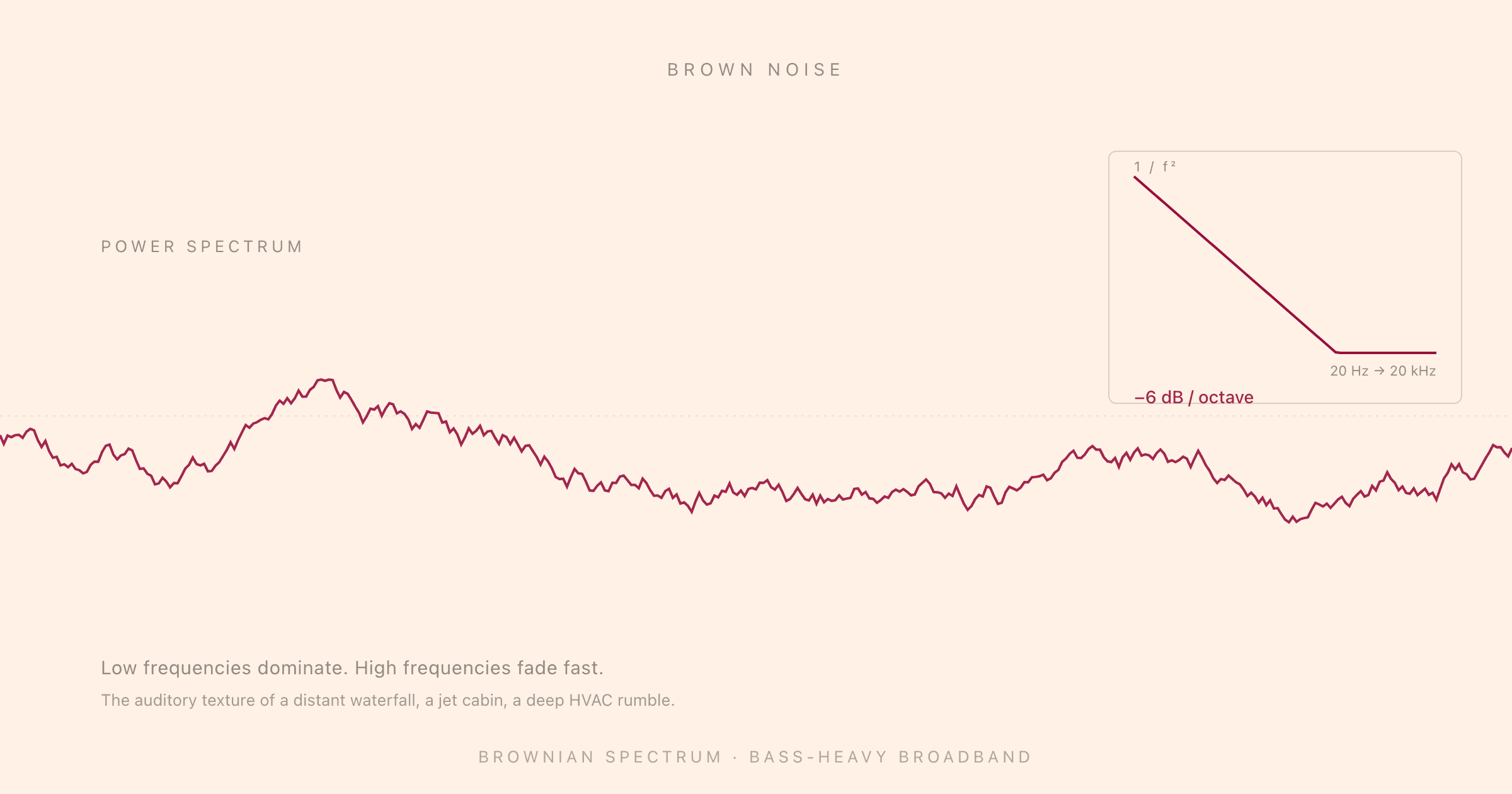
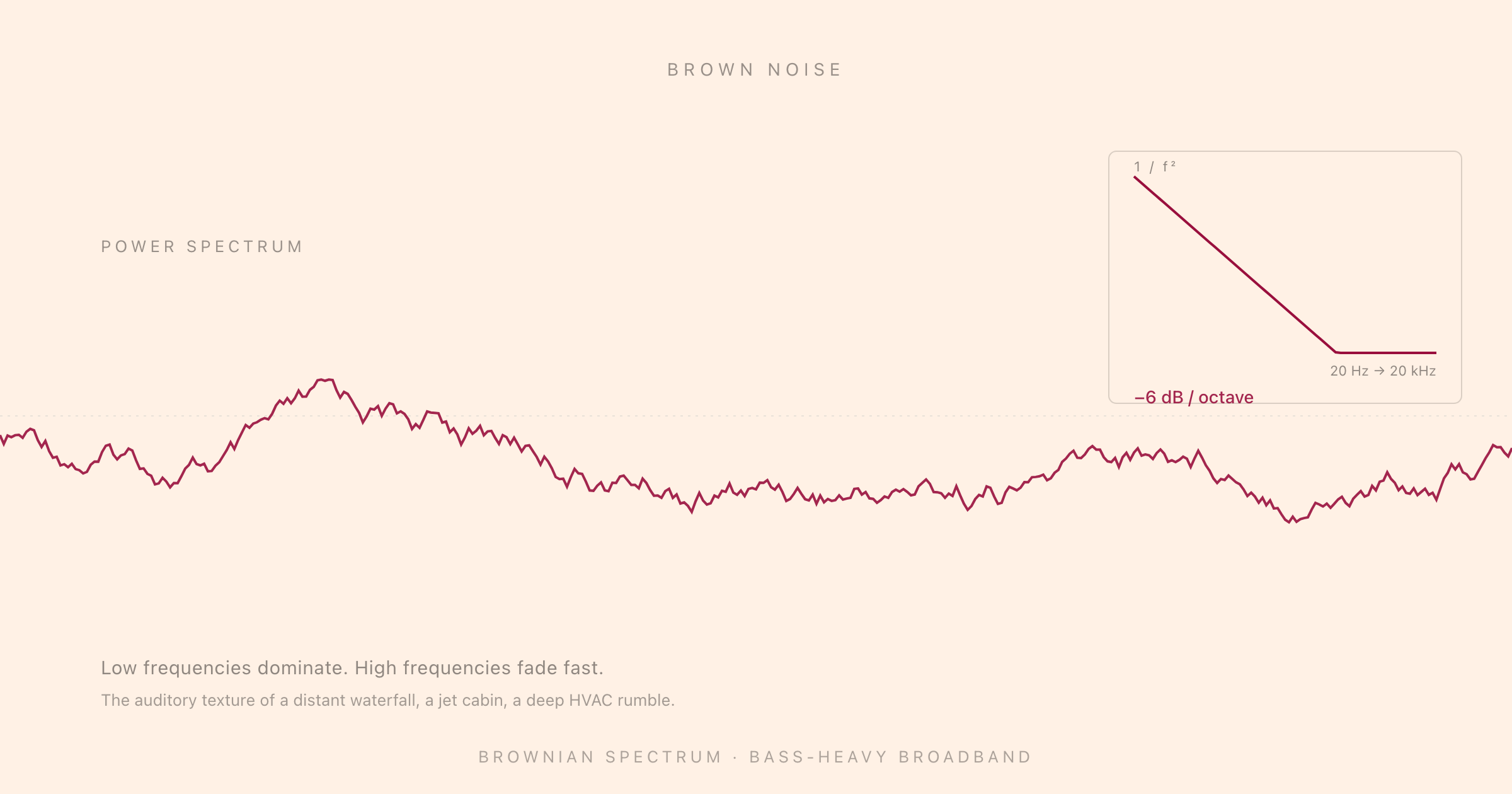
Brown noise is the broadband sound whose power spectrum decays at 6 decibels per octave. Every time you double the frequency, the acoustic power drops by a factor of four. That one specification, the 1/f² rule, explains why brown noise sounds like the inside of a jet cabin, why it has become the default ADHD-forum recommendation, and why it is sometimes a poor substitute for white or pink noise depending on what you are actually trying to do. This article is the deeper dive on brown noise: the acoustic mechanism, what the research actually shows (including the stochastic-resonance ADHD work that drove the 2023-2024 TikTok surge), when brown beats pink and white, and when it does not.
If you already know the theory and want a focus-music app that uses real DSP for broadband textures rather than YouTube loops, Tomatoes is a one-time $39 with no subscription. The rest of this piece is the science.
What Brown Noise Actually Is
Brown noise, also called Brownian noise or red noise, is a specific spectral shape. Three facts define it:
- Spectral slope. Power density falls at −6 dB per octave as frequency rises. Equivalently, power density is proportional to 1/f². This is the defining property.
- Statistical generation. The waveform is the integral of white noise, mathematically identical to one-dimensional Brownian motion (hence the name, from Robert Brown's pollen-grain observations, not the colour). Each sample is the previous sample plus a random step. Over long timescales, low-frequency wanderings dominate the trajectory.
- Auditory impression. Because human hearing is not flat, a −6 dB/oct spectrum sounds bass-heavy and cloud-like. The high-frequency crackle of white noise is gone. What remains is rumble, warmth, and broad low-mid texture.
The spectral shape is the thing worth focusing on, because every practical question about brown noise (is it safe, does it help, how long can I listen) traces back to the 1/f² curve.
Why "Brown" and Not a Colour You Would Pick
The name has nothing to do with the perceived timbre. "Noise colour" is an engineering convention where white has a flat spectrum, pink decays at −3 dB/oct, and a third name was needed for the −6 dB/oct curve. "Brown" was chosen because Brownian motion produces exactly that spectral shape as its integrated white-noise signal. The perception happens to be warm and bass-heavy, which coincidentally matches the colour name, but the naming is mathematical, not auditory.
The Spectral Shape in One Picture
The three colours exist on a continuum defined by how fast their power spectrum decays:
- White noise: 0 dB/oct. Flat.
- Pink noise: −3 dB/oct. 1/f.
- Brown noise: −6 dB/oct. 1/f².
At 20 Hz (the low end of human hearing) all three start at roughly the same relative power. At 20 kHz (the top of the audible range), white is still full strength, pink has lost about 30 dB, and brown has lost about 60 dB. That is the difference between a bright hiss and an enveloping rumble.
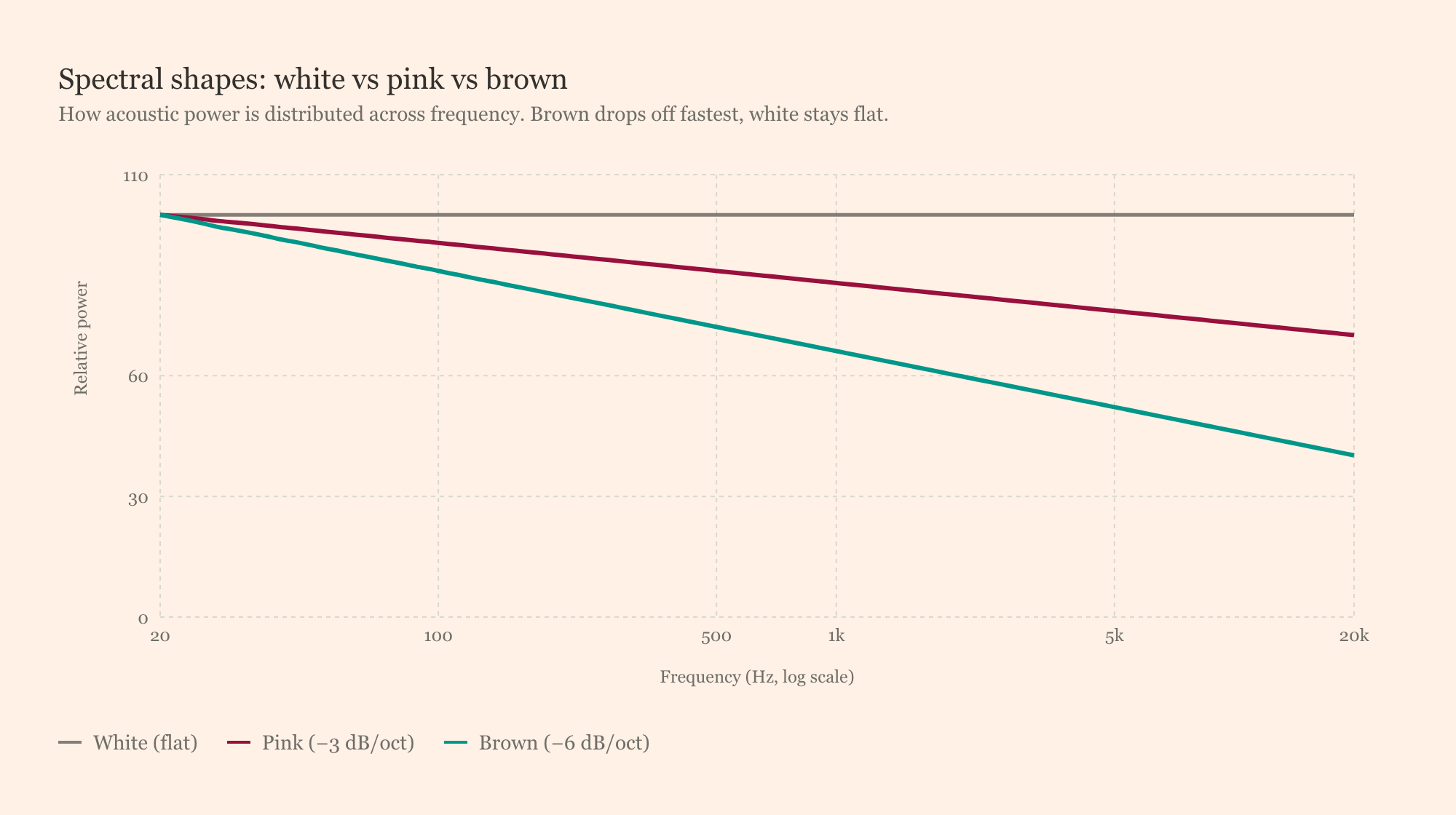
The sharper the decay, the more acoustic energy sits in the bass and low mids, and the less it sits in the treble. Two immediate consequences follow:
- Less listening fatigue on long sessions. Your high-frequency auditory nerve fibres are not being driven as hard. The steady bass rumble is more like a room tone than a signal.
- Less masking of sharp distractions. A colleague's keyboard at 3 kHz or a phone notification at 2 kHz cuts through brown noise more easily than through white. The masking energy simply is not there at those frequencies.
Both facts matter for picking the right colour. Long session and low fatigue: brown wins. Bright open-plan office with sharp interruptions: white masks better.
Where Brown Noise Came From and Why It Trended
The physics has been understood since the 19th century (Brown's pollen observations in 1827, Einstein's treatment in 1905, Wiener's formal process in 1923). The focus-music application is much newer. What drove the 2023-2024 TikTok surge was not the physics, but a specific claim about ADHD.
The claim: brown noise calms an ADHD-adjacent brain and sharpens focus. The research it leans on is real, but the claim is narrower than the viral version.
The Söderlund Stochastic-Resonance Studies
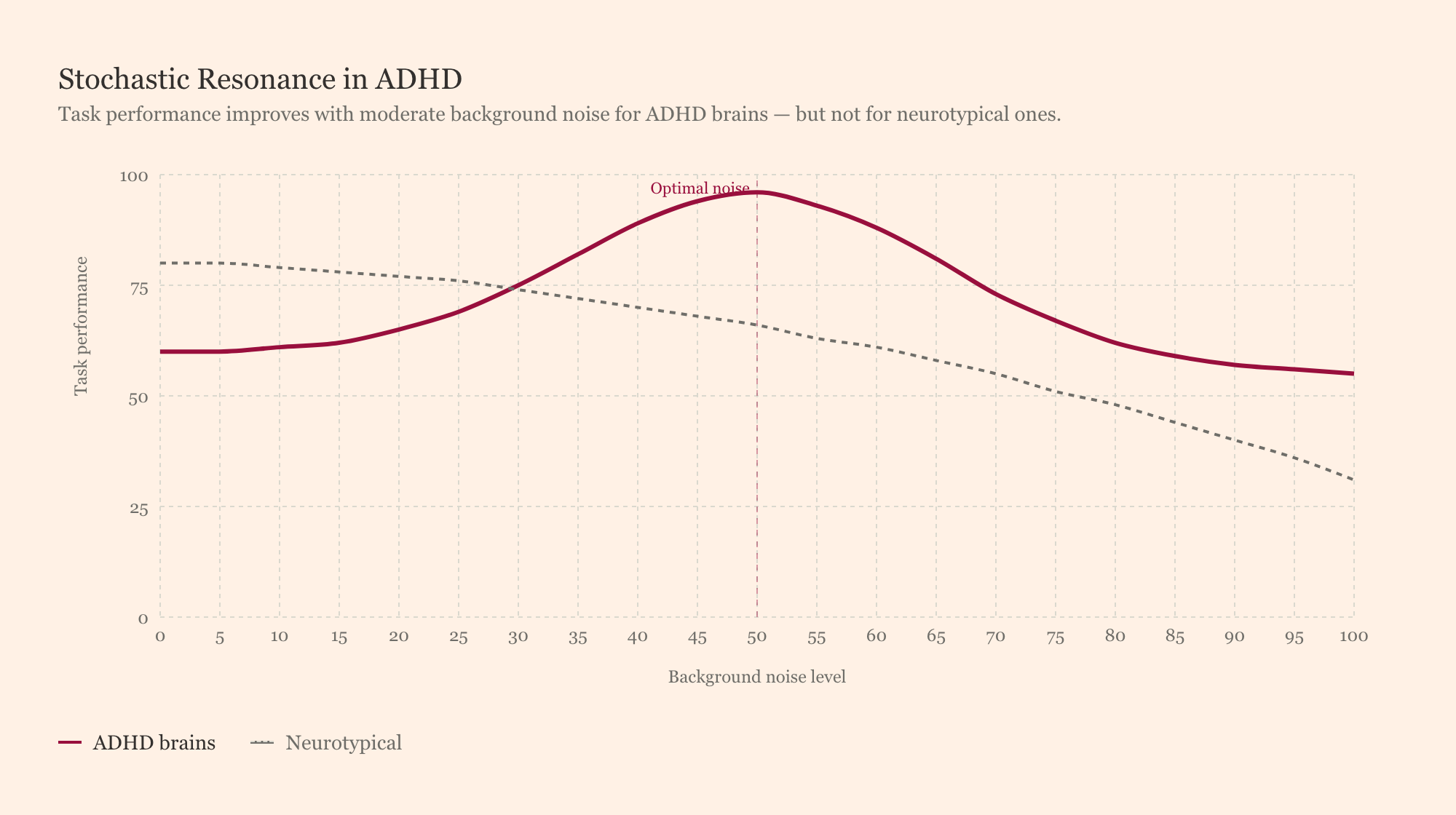
In 2007, Göran Söderlund and colleagues published a study in Behavioral and Brain Functions on white noise and inattentive schoolchildren. They found that moderate broadband noise improved memory performance in inattentive children, while the same noise degraded performance in attentive controls. The effect is called stochastic resonance: in neural systems with weak signal detection (one theoretical characterisation of ADHD), adding a controlled amount of broadband noise paradoxically improves the signal-to-noise ratio because the noise helps weak signals cross detection thresholds.
Later work, including Söderlund and Sikström's 2008 review and Helps et al. 2014 on moderate-noise environments, replicated and extended the basic finding. The Moderate Brain Arousal model proposes that dopaminergic tone in ADHD creates a signal-detection deficit that broadband noise partially compensates.
What the Evidence Does and Does Not Say
This is the important part, because the TikTok version flattened a careful finding into a universal claim.
The evidence supports:
- Broadband noise (not brown specifically) can improve attention-related performance in ADHD or subclinically inattentive populations.
- The effect is dose-dependent and reverses at high noise levels. The Söderlund curve is inverted-U shaped.
- The effect is population-dependent. Typically attentive adults tend to show worse performance with added noise, not better.
The evidence does not strongly support:
- Brown noise as uniquely effective compared to white or pink. The controlled comparisons mostly use white noise. The preference for brown in real-world use is about ergonomics (lower fatigue on long sessions), not about a brown-specific mechanism.
- Brown noise as a treatment. The effect sizes in the literature are modest and task-dependent. It is a listening strategy, not a substitute for clinical ADHD care.
- The universal "focus booster" framing. For typical adults without attentional difficulties, the research suggests broadband noise is at best neutral and can reduce performance on demanding tasks.
If you have an ADHD or inattentive-type pattern, brown noise is a reasonable thing to test on yourself. If you do not, the honest answer is that a rhythm-based or musical focus track is more likely to help you than any colour of broadband noise.
We cover the ADHD picture in more depth in the ADHD focus music article, and the full family of focus sounds in the focus music taxonomy.
Brown Noise vs Pink Noise vs White Noise
The back-to-back comparison is where brown, pink, and white separate cleanly. All three mask distractions. They do not mask the same distractions equally, and they do not fatigue the ear equally.
Brown vs White
- Brown wins for long sessions and sleep adjacency. Fewer high frequencies, lower listening fatigue.
- White wins for masking sharp high-frequency distractions (keyboards, phone chimes, sibilance). Energy is present where the distractions are.
- Use white for short sprints in bright noisy offices. Use brown for multi-hour deep work or study.
Brown vs Pink
- Pink sits between brown and white in both fatigue and masking. It is the generalist.
- Brown goes further toward bass-heavy comfort. Pink's −3 dB/oct slope still carries enough mid and high energy to mask a wider range of distractions than brown does.
- Use pink when you want a single colour that does most jobs reasonably. Use brown when low-fatigue multi-hour listening is the priority and your distractions are mostly low-to-mid frequency (HVAC, traffic, distant conversation).
White vs Pink
Covered in detail in our white vs pink noise guide, the short version: pink wins for length and sleep, white wins for brightness and short bursts.
The three colours are not interchangeable, and none is universally best. They are tools with different shapes.
When Brown Noise Is the Right Tool
Specific scenarios where brown noise is the clearest choice:
- Multi-hour deep work sessions. Two-to-four-hour stretches of writing, coding, reading, analytical work. White noise fatigues your ears after about 60-90 minutes; brown does not.
- Sleep onset or sleep maintenance. Especially useful for masking intermittent bass-range noises (neighbourhood traffic, distant construction, a partner's snoring). Pink can do this too; brown is more enveloping.
- ADHD or inattentive-type self-testing. If you meet the clinical or subclinical pattern, brown is an easy thing to trial. Do ten sessions with and ten without, and compare how much actual work got done. Personal data beats generic advice.
- Tinnitus masking. Low-frequency tinnitus benefits from brown's bass dominance. High-frequency tinnitus usually needs pink or white for effective masking.
- Hyperacusis or auditory sensitivity. Brown's absence of sharp high-frequency energy is easier on sensitised auditory systems.
When Brown Noise Is the Wrong Tool
Equally specific scenarios where another colour or a different approach beats brown:
- Open-plan offices with sharp distractions. Keyboards, phones, sudden laughter. White masks these; brown does not.
- Short focus sprints (30-60 minutes). White's brightness keeps you alert. Brown can feel drowsy on a 30-minute task where you need snap, not steadiness.
- Creative ideation. Ideation benefits from some auditory variety. A static broadband sound of any colour tends to narrow attention, which is exactly wrong for divergent thinking. Use music with dynamics, or silence.
- Any task where you are typically-attentive and want peak performance. The stochastic-resonance research suggests you may do worse with broadband noise than without. Test both and let your output decide.
- Speech-heavy environments where the distractor is another voice. Speech sits in the 300-3000 Hz range. Brown noise has little energy there. Pink or a speech-shaped masker is better.
Listening Practice: How to Actually Use Brown Noise
Four practical rules that make brown noise work better in real sessions:
- Calibrate the volume against your quietest task. Loud enough to sit below your attention floor, quiet enough that a colleague talking at a normal volume still gets through if it is a real interruption. A rough test: can you hear your own breath? If yes, the volume is roughly right. If the brown is drowning out your breathing, it is too loud.
- Run closed-back over-ear headphones. Brown's low-end energy needs headphones that can actually produce it without roll-off. Cheap earbuds will mute the below-200 Hz content, which is most of the point of brown noise.
- Set a session length and a break. Brown noise does not fatigue the ear, but your brain still does on sustained attention. The ultradian rhythm research suggests 90-minute sessions with a 15-20 minute break. Treat the brown track as a session boundary, not a permanent background.
- Don't mix brown with music. The whole point of brown is spectral consistency. Layering a melody on top reintroduces the dynamics brown is designed to smooth over. Pick one or the other per session.
Is Brown Noise Safe?
Yes, within the same volume rules that apply to any sustained audio.
The only real risks are cumulative sound exposure and low-frequency discomfort on extreme settings. The NIOSH occupational noise limits give you a rough benchmark: 85 dB(A) for eight hours, halving the safe duration for every 3 dB above. Focus-music listening at 60-70 dB is well within those limits for all-day use.
Low-frequency-specific concerns (vibrotactile sensation, nausea on very-low-frequency content) only become relevant with subwoofer-enabled setups at high volumes. At headphone-level listening in a typical mix, brown noise is acoustically benign.
If you want the deeper safety analysis for focus-audio generally, we cover it in the binaural beats safety article.
Brown Noise vs "Deep Focus" Playlists
If you search for brown noise on Spotify or YouTube, most of what comes back is a 10-hour loop of one static recording with a hiss. These are fine as a first test, but they have three practical issues:
- Generation quality. Many are simple filtered-white-noise renders that drift from true 1/f² over the session. A real DSP generator maintains the spectral slope continuously.
- Session structure. A 10-hour loop has no natural break points. Your brain does. You end up either listening past a natural stop or cutting the track at an awkward transition.
- No variation across tasks. If you want lower brown for writing and a crisper pink for short email-clearing sprints, a playlist forces one-size-fits-all.
Tomatoes generates brown and pink textures in real time with the right spectral slope, layered with a Pomodoro timer that sets the session structure for you. It is a one-time $39 purchase with no subscription and no account, and the full feature set is visible on the home page.
Brown noise is not a magic productivity switch. It is a spectral shape with specific listening ergonomics and a narrowly defined research base. Used in the scenarios where its shape fits, it earns its reputation. Used everywhere, it is one more thing on the desk that does not move the needle.