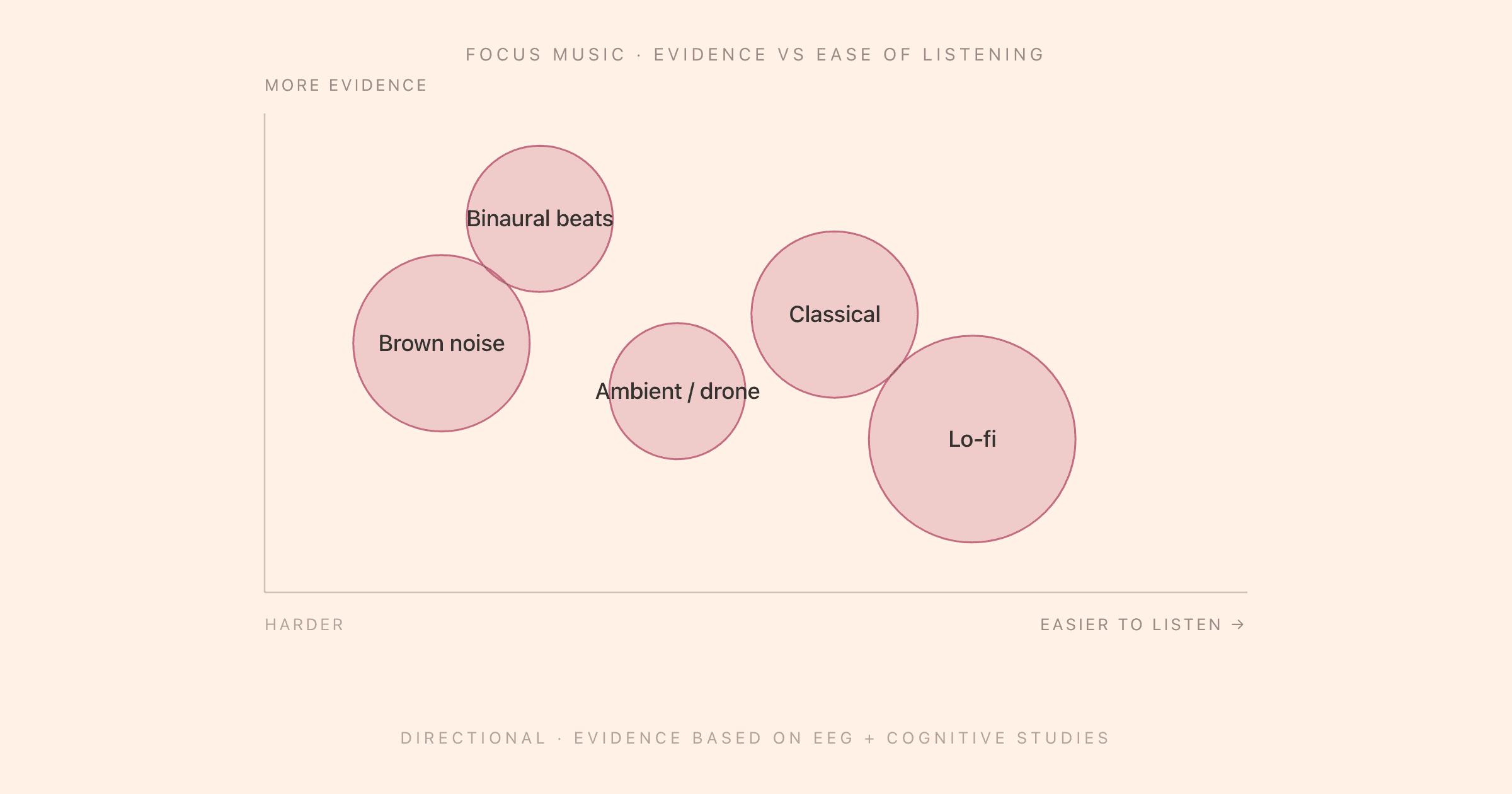
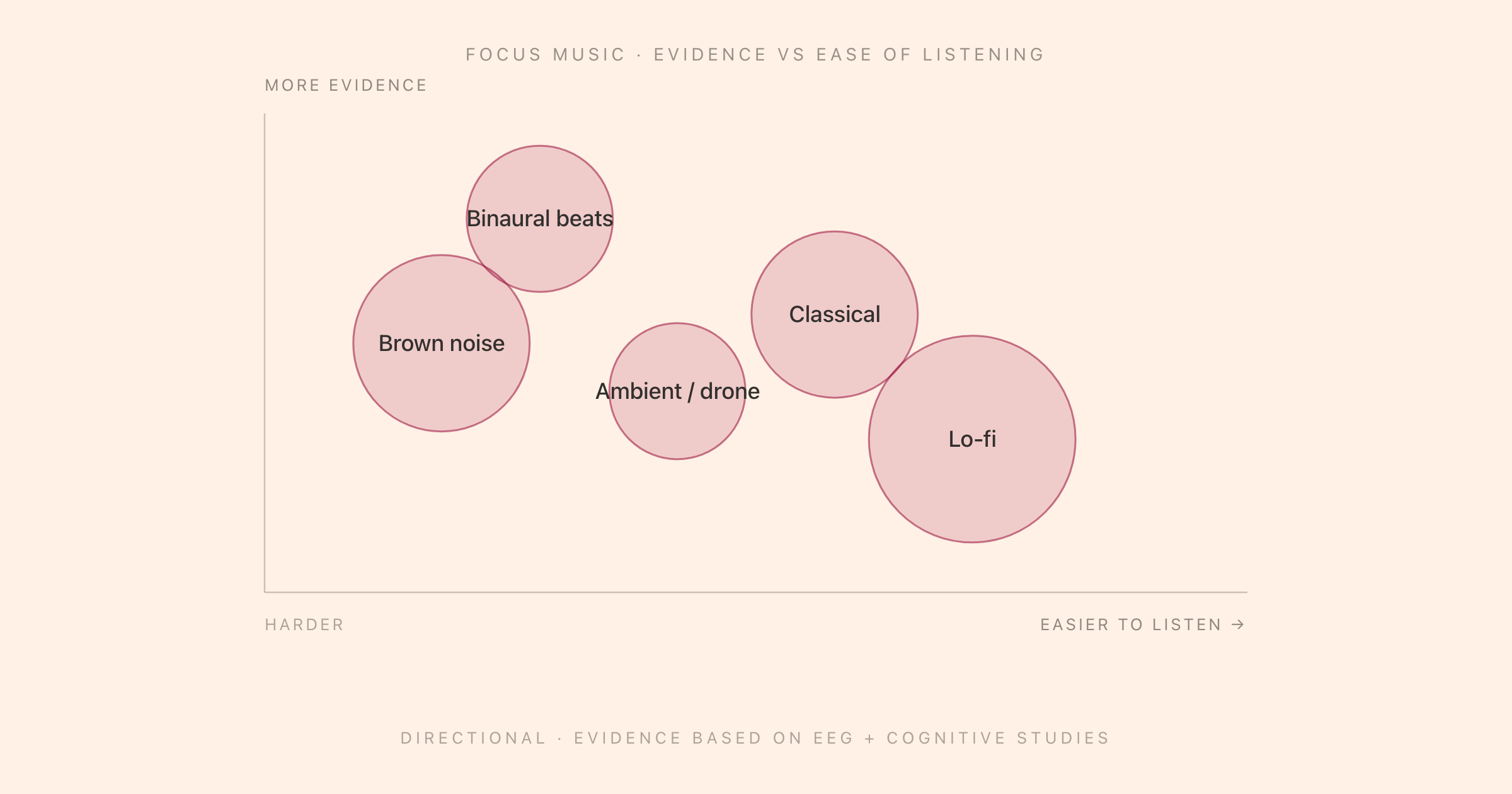
Focus music is the most-searched category of productivity audio, and it is also the most poorly defined one. Plug "focus music" into YouTube and the top results will range from a 10-hour lo-fi hip-hop livestream to a pure 40 Hz binaural tone to an ambient drone with forest sounds to a Bach piano partita. Each of those works on the brain through a completely different mechanism, has a different evidence base, and suits a different kind of cognitive task. Treating them as one interchangeable category is why most people's focus playlists stop working after a week. This guide is a scientific taxonomy of the five families of focus music, what each one actually does to the brain, and how to pick the right one for the task in front of you.
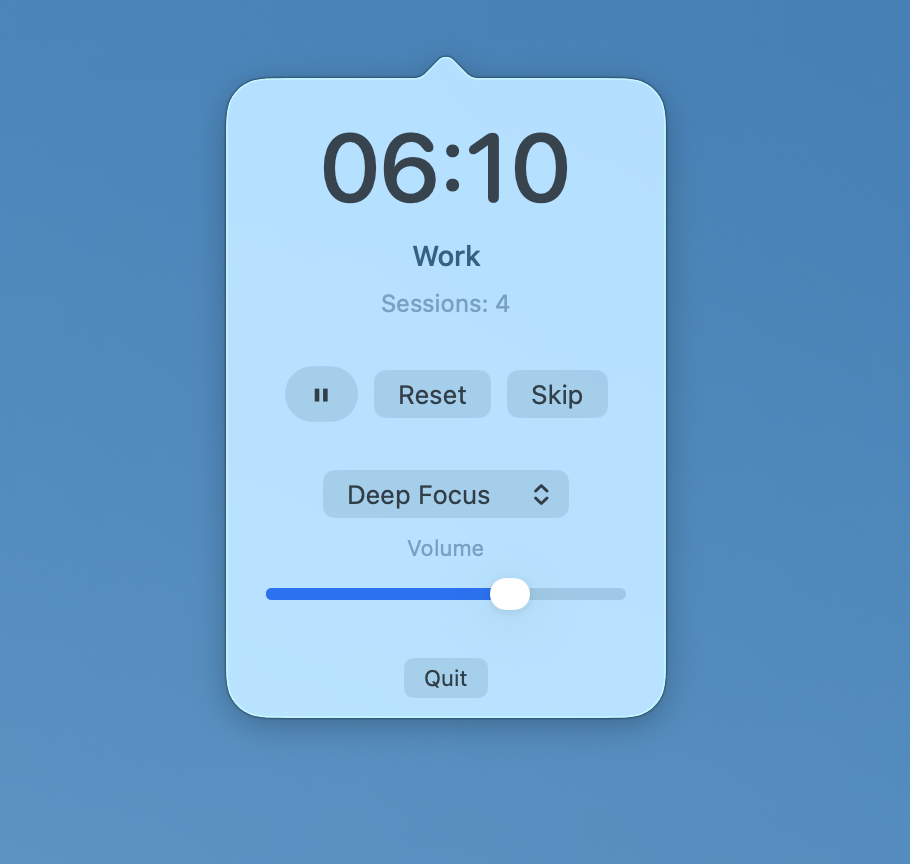
Tomatoes is built on exactly this kind of distinction: a real-time DSP engine that weaves the modulation patterns and noise spectra the research actually supports into music you can listen to for three hours without noticing. The rest of this article explains the science behind each family so you can decide which one fits what you are trying to do.
Why "Focus Music" Is Not One Thing
The reason the research on focus music is so often framed as "contradictory" is that most studies test one specific music type against silence on one specific task. When a meta-analysis tries to pool them, it ends up averaging across binaural beats, Mozart, lo-fi, and white noise as if they were the same intervention. They are not. Focus music works through at least four different neural mechanisms, and a given track usually leans on one of them.
The four mechanisms:
- Auditory masking. Broadband noise (white, pink, brown) masks intermittent environmental sounds that would otherwise capture attention. Your brain stops chasing the dog next door because there is now a continuous acoustic background pushing that dog below perceptual threshold.
- Entrainment. Rhythmic auditory stimuli at specific frequencies (binaural beats, isochronic tones, certain ambient pulses) nudge cortical oscillations towards that rate. This is the auditory steady-state response, and it peaks sharply around 40 Hz. We covered the underlying mechanism in the 40 Hz gamma waves article.
- Arousal regulation. Music with a moderate tempo, predictable structure, and mild emotional valence nudges you towards an optimal arousal state for cognitive work. This is the classic Yerkes-Dodson territory. Too low and you are sleepy, too high and you are anxious.
- Dopaminergic engagement. Music the listener enjoys triggers modest dopamine release in the nucleus accumbens. For some listeners, particularly those with under-aroused attention systems, that small dopamine lift makes boring tasks tractable. This is part of why ADHD-specific playlists work for some people (see the ADHD focus music deep-dive).
Each of the five families below leans on one or two of these mechanisms. None of them engage all four. Picking focus music well is the work of matching the mechanism to the task.
The Five Families of Focus Music
1. Binaural Beats
Binaural beats are the most research-dense family of focus music. They work by presenting two slightly different sine tones to the left and right ears, and the brain perceives a third "beat" frequency equal to the difference. Feed 240 Hz to one ear and 250 Hz to the other, and the perceived beat is 10 Hz, which sits in the alpha band.
The mechanism is entrainment. The auditory steady-state response, first characterised by Galambos and colleagues in 1981, shows that cortical EEG tracks rhythmic auditory stimuli most strongly at around 40 Hz in the gamma band. Similar, weaker effects occur in the alpha (8 to 13 Hz) and beta (13 to 30 Hz) bands.
What binaural beats are good for: sustained attention tasks, particularly ones where you want the brain locked into a specific state. Gamma binaurals (around 40 Hz) for deep cognitive work. Beta binaurals (15 to 20 Hz) for active problem-solving. Alpha binaurals (8 to 12 Hz) for calm ideation. For more on each band's role, see the gamma waves guide, the beta waves guide, and the alpha waves guide.
What they are not good for: listening through cheap laptop speakers (the stereo separation collapses), or tasks that involve language processing in any serious way (the left-right dichotic load can interfere).
2. Brown Noise (and the Other Colored Noises)
Brown noise sits at the other end of the taxonomy from binaural beats. It is not trying to entrain anything. It is trying to mask. Brown noise is broadband noise with a power spectral density that falls off at 6 dB per octave as frequency increases, giving it a deep, ocean-like quality that many listeners find less harsh than white noise. Pink noise falls off at 3 dB per octave and sits between the two.
The mechanism is auditory masking. Research on noise for focus leans heavily on two findings:
- Open-office studies. Broadband noise reduces the cognitive cost of intelligible speech in the background. This is the single most robust finding for noise-as-focus-tool.
- ADHD and low-arousal attention systems. A handful of studies suggest brown and pink noise improve working memory performance specifically in individuals with under-aroused attention systems, consistent with a stochastic resonance mechanism.
For the specifics of which noise suits which task, the white vs pink vs brown noise guide covers the spectral differences and the task-matching in detail. The short version: brown for deep work in noisy environments, pink for writing and reading, white for calculation-heavy tasks.
3. Classical and Baroque
The classical-music-for-focus tradition is partly urban legend (the "Mozart effect" has been roundly debunked as a general cognitive enhancer) and partly genuine. What the research actually supports is narrower:
- Baroque music with consistent tempo (roughly 60 to 70 BPM) correlates with moderate improvements in sustained attention. This is the tempo of Bach's slower concertos, Vivaldi's adagios, and Handel's keyboard works.
- Music without lyrics consistently outperforms music with lyrics for tasks involving language processing. Your language network cannot be simultaneously parsing a vocalist and drafting a document.
- Listener preference matters more than the specific composer. Someone who loves Shostakovich will get a larger arousal boost from Shostakovich than from Mozart, even though Mozart gets the name-recognition in the research.
Classical leans on arousal regulation and, for some listeners, dopaminergic engagement. It is a reasonable default for cognitive work that does not involve heavy auditory processing.
4. Lo-fi Hip-Hop
Lo-fi is the dark horse of the focus music taxonomy. It gets mocked because the chill-beats-to-study-to YouTube livestreams have become a meme, but the reason it works is not accidental. Good lo-fi is a carefully tuned mix of three things:
- Moderate tempo (70 to 90 BPM), consistent with the arousal-regulation research.
- Deliberate imperfection. Tape hiss, vinyl crackle, and pitch wobble add broadband noise in the background, giving you a weak version of the auditory-masking effect that brown noise produces more purely.
- Simple harmonic content and predictable loops. The music does not demand processing resources. It becomes acoustic wallpaper.
Lo-fi is the multi-mechanism option: it covers arousal regulation, partial masking, and mild dopaminergic engagement for listeners who enjoy the aesthetic. That makes it broadly useful but rarely the optimum for any one task.
5. Ambient and Drone
Ambient music is the minimalist end of the spectrum. Brian Eno's original conception ("music that is as ignorable as it is interesting") is almost the engineering spec for focus music. Ambient and drone work through arousal regulation alone: a slow, evolving texture that does not compete for attention but keeps arousal above the sleep-drift threshold.
Ambient is good for:
- Very long sessions where repetition becomes fatiguing (multi-hour reading, writing, editing).
- Tasks where any melodic content would be distracting (proofreading, close-reading, coding a tricky algorithm).
It is not good for low-arousal days where you actually need the dopamine lift of something more engaging. For those, lo-fi or classical is a better bet.
Matching Focus Music to the Task
The taxonomy is only useful if you can turn it into a decision rule. The rule, distilled from the mechanism list above:
- Deep focus on a well-defined task (writing, coding, analysis): binaural beats in the gamma band (around 40 Hz), or brown noise, or ambient. Pick whichever is less distracting in your environment.
- Creative ideation where you want a relaxed-alert state: alpha binaurals (8 to 12 Hz), or classical in the baroque tempo range, or a warm ambient texture.
- Working in a noisy environment where sound masking matters more than entrainment: brown noise, or pink noise, or lo-fi (because lo-fi's tape hiss provides partial masking).
- Low-arousal days where you cannot get started: classical or lo-fi you genuinely enjoy. The dopamine engagement does real work here.
- ADHD-specific under-arousal: see the ADHD focus music deep-dive for the stochastic-resonance angle.
If you are new to focus music, start with brown noise. It is the lowest-friction option: no headphones required, no music-taste filter, works on laptop speakers, and has the most directly applicable research. Graduate to binaural beats once you have good headphones and want to target specific brainwave bands.
What the Research Actually Says (Briefly)
The most honest summary of the focus-music literature is that almost every family shows small-to-moderate effects under tightly controlled conditions, and those effects evaporate when the conditions change. A few findings hold up robustly across studies:
- Silence is not the baseline. In most office and study environments, silence is outcompeted by any moderate background audio, because pure silence lets every ambient sound feel salient.
- Lyrics hurt for language tasks. This is the single most replicated finding.
- Listener preference matters. The largest focus-music effects in controlled studies tend to come when the listener gets to choose the music within a constrained category.
- Entrainment effects are real but modest. The ASSR is well-established. Whether that translates into measurable cognitive-task improvement depends heavily on the task and the individual.
What this means in practice: the question is not "what is the best focus music" but "what is the best focus music for this task, in this environment, on this day." Focus music is a tool, not a prescription.
The Tomatoes Approach
Tomatoes is built on the taxonomy above. Rather than being one of the five families, it is a real-time engine that weaves them together: broadband noise spectra for masking, 40 Hz gamma modulation for entrainment, granular ambient textures for arousal regulation, all rendered as music you can actually listen to for three hours without noticing a loop. No subscriptions, no accounts, no YouTube ads mid-session.
If you want a focus-music tool that treats the taxonomy above as a starting point rather than a marketing hook, Tomatoes is a one-time $39 purchase. It runs on a Mac and syncs with the macOS menu bar app for Pomodoro timers. For the underlying science in more depth, the 40 Hz gamma waves guide and the ADHD focus music guide are the two deepest dives on the blog.
Pick the family that matches your task. Run it for 90 minutes. See what the data says for you.