The default mode network is the brain circuit that runs when you are not running anything else. It is the network that fires when the eyes lose focus on the page, the network that hums during a shower or a long walk, the network that a meditation teacher is asking you to quiet, and the network that lights up the moment a task you were focused on becomes too easy or too hard. Marcus Raichle named it in 2001 after observing that one specific set of regions kept activating in PET-scan subjects who were doing nothing in particular, and the field of focus neuroscience reorganised around the finding. The default mode network is not a glitch in the focused brain. It is the focused brain's antagonist, and the difference between a productive working day and a scattered one is largely a question of which one is winning.
This article is the practical version of the research. What the default mode network is in measurable terms. Which brain regions make it up. What it actually does. The task-positive network that competes with it. The fMRI evidence that the two networks anti-correlate. And the focus protocols, including external audio, that suppress default mode network activity long enough for deep work to take hold. Tomatoes is built around the audio half of that suppression, and is a one-time $39 with no subscription. The rest of this piece is the science of what the audio is supporting.
What the Default Mode Network Actually Is
The default mode network (DMN) is a set of interconnected brain regions that show coordinated activity during rest and during inwardly directed cognition (mind-wandering, autobiographical memory, social cognition, future planning), and that show coordinated deactivation during attention to demanding external tasks. It is one of the most replicated findings in modern cognitive neuroscience, observable across thousands of fMRI studies, multiple species, and almost every age group from infancy onwards.
Three things define the network consistently across the literature.
- It is intrinsic. The DMN does not need an external trigger. It is the brain's baseline. Resting-state fMRI studies show the network humming whenever the participant is not actively engaged in a structured task. It is what your brain does when you do not give it anything specific to do.
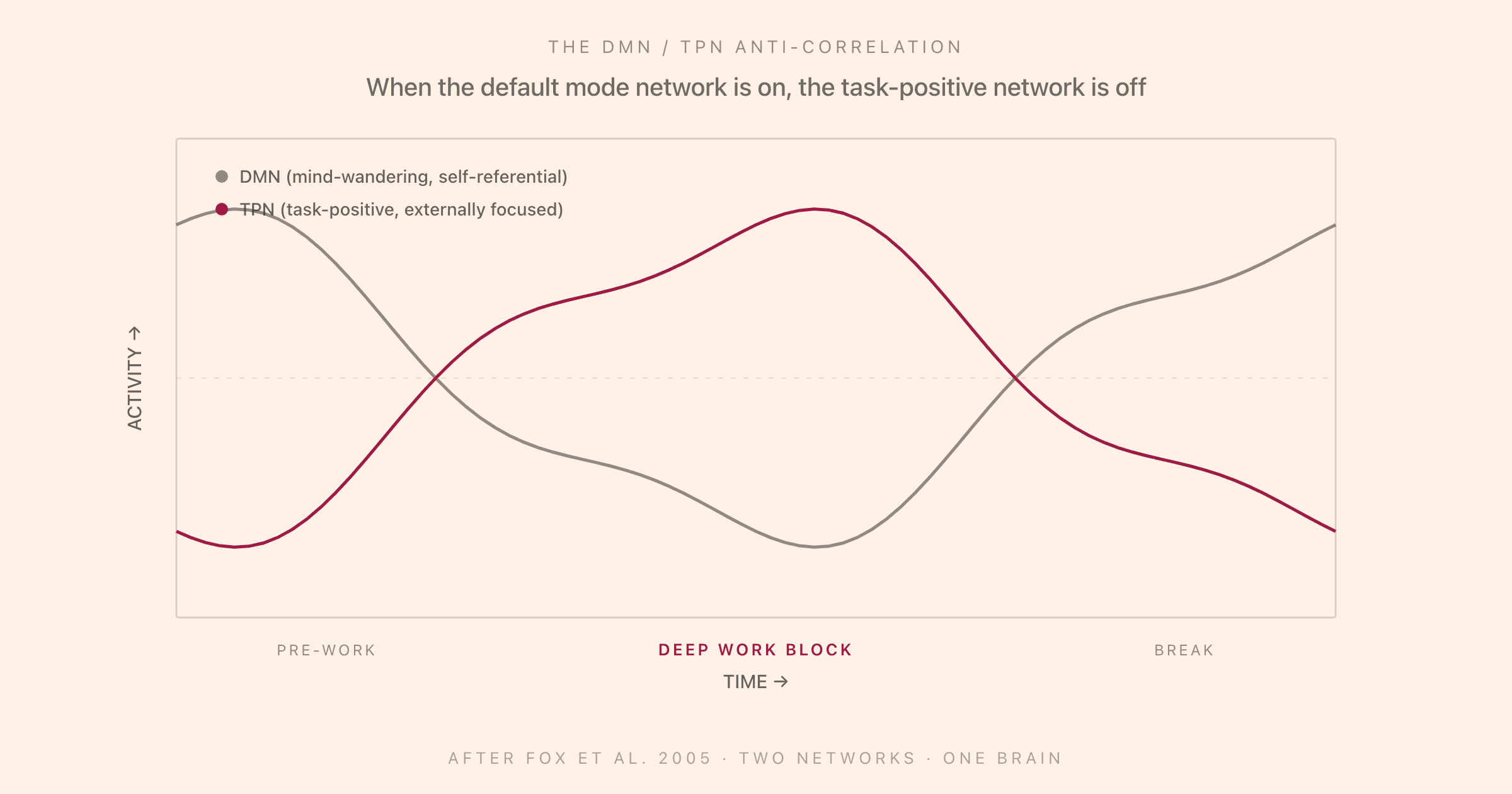
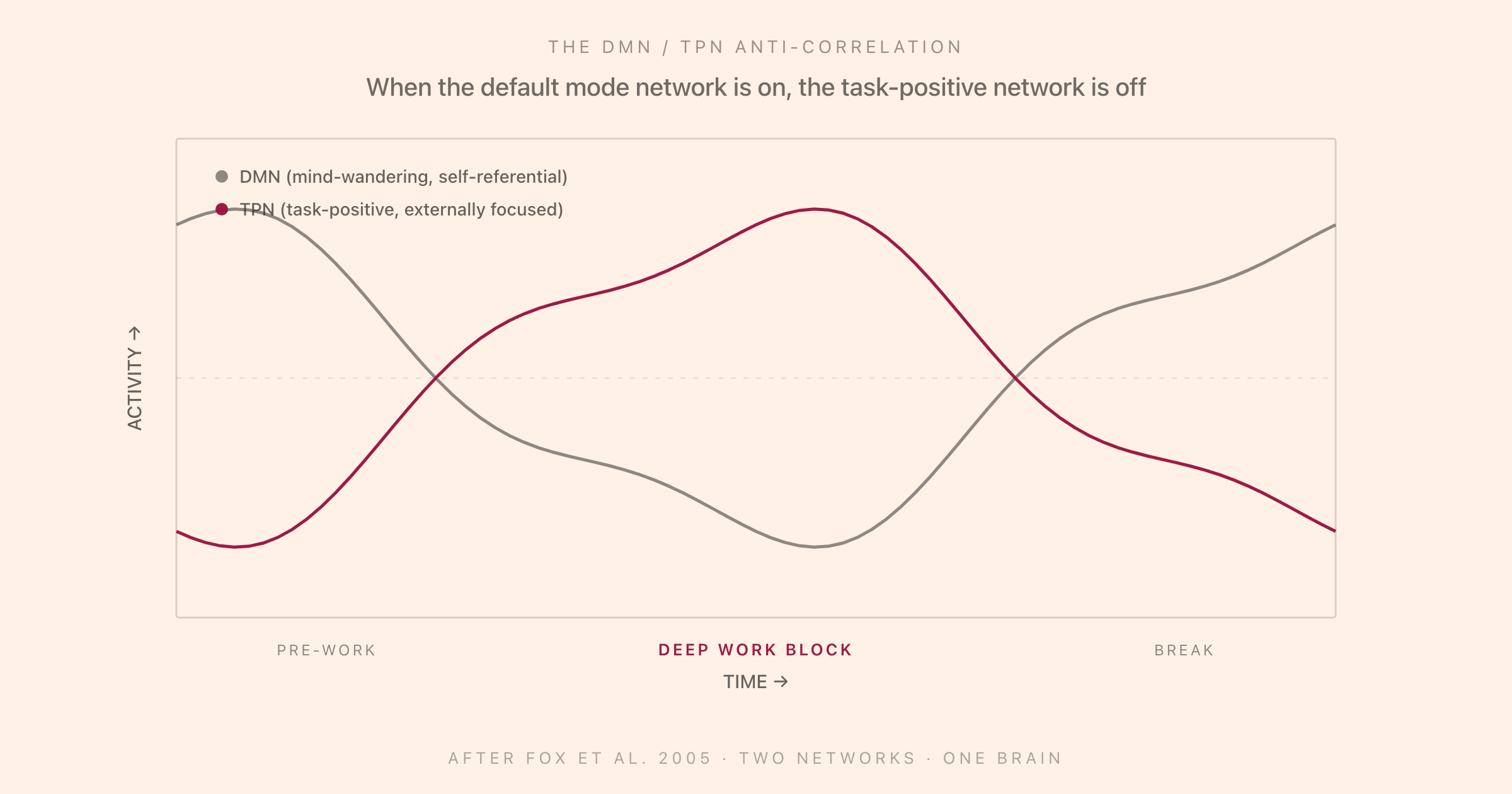
- It is anti-correlated with externally focused attention. When the task-positive network engages with a demanding external stimulus, the DMN deactivates. The two networks behave like a seesaw: one goes up, the other goes down. This anti-correlation is the central finding of Fox et al.'s 2005 PNAS paper, and it has been replicated dozens of times since.
- It is necessary, not pathological. Sustained DMN suppression is not the goal. The DMN handles autobiographical memory consolidation, theory-of-mind processing, creative incubation, and self-referential thought. People with damaged DMN regions show impairments in social cognition and personal narrative. The goal is correct switching, not permanent suppression.
The deep work problem is not that the DMN exists. It is that the DMN keeps re-engaging during work that should be DMN-quiet, because the work is too easy, too unstructured, too feedback-poor, or because something in the environment keeps re-triggering it. The shape of an effective focus protocol is whatever holds the DMN-to-TPN ratio low for long enough to finish the work.
The Brain Regions That Make Up the Default Mode Network
The DMN is not a single area. It is a distributed network of three or four major hubs that fire together. The hubs were identified in resting-state fMRI studies and confirmed across hundreds of subsequent papers.
Medial prefrontal cortex (mPFC). The hub at the front of the brain, sitting in the inner surface of the frontal lobes. The mPFC is associated with self-referential processing (thinking about oneself), social cognition (modelling other minds), and the integration of emotional information into ongoing thought. When you are running a "what does this mean for me" loop, the mPFC is most of what you are running.
Posterior cingulate cortex (PCC) and precuneus. The hub at the back, sitting on the inner surface of the parietal lobes. The PCC and precuneus together handle autobiographical memory retrieval, scene construction, and the felt sense of being a continuous self over time. Most of what we mean by "remembering my own life" is PCC activity.
Inferior parietal lobules / angular gyri. The lateral hubs, sitting on the outer surface of the parietal lobes on both sides. These regions integrate multimodal information (visual, auditory, semantic) into a unified scene, and they are heavily involved in mental simulation of past or future events.
Hippocampus and parahippocampal cortex. Strongly coupled to the DMN, particularly during autobiographical memory and future-event simulation. The hippocampus is not always grouped formally inside the DMN, but its activity tracks the network closely during inwardly directed cognition.
The first thing to notice is that none of these regions are particularly involved in immediate sensory processing or motor execution. The DMN is not the brain handling the present moment. It is the brain handling everything except the present moment. That is also why it deactivates when the present moment becomes demanding enough to require attention.
What the Default Mode Network Actually Does
DMN activity correlates with several specific cognitive operations, all of which share the property of being internally rather than externally directed.
Mind-wandering and spontaneous thought. When subjects in fMRI scanners report being off-task or thinking about something other than the current stimulus, DMN activity is elevated. The Killingsworth and Gilbert 2010 mobile-experience-sampling study estimated that the average person spends about 47% of their waking hours mind-wandering, and the activity correlate of that mind-wandering is largely DMN.
Autobiographical memory. Recalling personally experienced events activates the DMN, particularly the PCC and the hippocampus. The richer and more vivid the recalled memory, the stronger the activation.
Future-event simulation and prospective thinking. Imagining a future scenario activates very similar DMN regions to recalling a past one. This led Schacter and Addis to propose the constructive episodic simulation hypothesis: the brain uses the same machinery to remember the past and to simulate the future, because both are acts of internal scene construction.
Theory of mind and social cognition. Modelling what another person is thinking, feeling, or intending activates the DMN, particularly the mPFC and the temporoparietal junction. The DMN is, among other things, the network that runs simulations of other minds.
Self-referential processing. Judging whether a trait word ("ambitious", "shy", "kind") describes oneself activates the mPFC strongly. This is the network that runs the "is this me" loop.
Creative incubation. Some of the strongest DMN activity is observed during the incubation phase of creative problem-solving, where the conscious mind has stopped explicitly working on a problem but the answer is being assembled in the background. This is the "shower idea" effect made measurable.
The pattern across all six of these is the same: the DMN runs internal simulations. It is the brain's offline-processing system. And it is exactly the system that has to go quiet for externally focused work to happen.
The Task-Positive Network: The DMN's Antagonist
The DMN does not exist alone. It exists in dynamic opposition to a second network, often called the task-positive network (TPN), the central executive network, or the dorsal attention network depending on which research group is naming it. The TPN consists of:
- The dorsolateral prefrontal cortex (dlPFC), lateral parts of the frontal lobes that handle working memory, cognitive control, and goal maintenance.
- The posterior parietal cortex (PPC), particularly the intraparietal sulcus, which handles visuospatial attention and top-down control of where attention is directed.
- The frontal eye fields (FEF), which handle the executive control of where the eyes (and by extension, attention) are pointed.
- The anterior insula and dorsal anterior cingulate cortex (dACC), which together act as a salience network that arbitrates between DMN and TPN dominance.
When the TPN engages with an externally demanding task (a difficult equation, a hard sentence, a tight feedback loop), DMN activity drops. When the task ends or becomes too easy, the DMN climbs back. The handoff is fast (the salience network can flip the dominance in seconds) and it is the moment-to-moment basis of whether attention is focused or wandering.
The Fox et al. 2005 paper is the canonical reference for the anti-correlation. They showed that across resting-state fMRI scans, DMN regions and TPN regions exhibit negatively correlated time courses: when one fluctuates upward, the other fluctuates downward, in lockstep. This is not a side effect of task instruction. It is a baseline organisational principle of the brain.
The implication for focus: extending a deep work block is, at the brain level, extending TPN dominance. Anything that disrupts TPN dominance (an unexpected sound, a notification, a moment of internal narrative, the work becoming too easy or too hard) is an opportunity for the DMN to climb back. The protocol moves that work are the ones that hold TPN dominance steady.
Why External Audio Helps Suppress DMN Activity
External audio is one of the cheapest and best-evidenced interventions for keeping DMN activity low during work. Three mechanisms account for this.
Sensory anchoring. Continuous, predictable audio occupies a small slice of auditory attention, which is auditory cortex activity, which is part of the externally directed processing the TPN coordinates. The audio acts as a constant low-level engagement of the externally directed system, making it harder for the DMN to climb back into dominance during a quiet moment.
Reduction of unpredictable distractors. The single fastest way to flip from TPN to DMN is an unpredictable salient sound (a door slam, a notification, a voice in the next room). Continuous audio raises the auditory floor enough that those distractors stop being salient. The salience network does not switch dominance, the DMN stays quiet.
Frequency-following entrainment. This is the more speculative mechanism, with thinner evidence than the first two but real signal. Binaural beats, isochronic tones, and certain spectral profiles can entrain the brain's electrical activity toward a target frequency band (gamma for high-load focus, beta for sustained attention, alpha for relaxed receptive states). Cortical activity in those bands is associated with TPN-dominant states; audio that pushes the brain toward the right band makes TPN dominance easier to hold. The effect sizes in the literature are modest but consistent. See 40 Hz gamma waves and how alpha waves improve focus for the specific bands.
The combination of all three is why ambient audio reliably extends time-on-task in focus studies. It is not magic. It is sensory anchoring plus distractor floor plus modest frequency entrainment, all working in the direction of holding TPN dominance over DMN.
How to Suppress DMN Activity in Practice
Five specific protocol moves reduce DMN activity and extend deep work blocks. They are listed in order of effect size, biggest first.
1. Match the Challenge to the Skill
The single most reliable DMN suppressor is a task at the upper edge of the worker's current skill. Too easy and the DMN engages because the work does not absorb attention. Too hard and the DMN engages because the working memory load fails and the brain falls back to "what does this mean for me" rumination. The flow channel is, at the brain level, the regime in which TPN dominance is easy to maintain. See flow state for the full picture.
2. Reduce Unpredictable Distractors
Notifications, open Slack, an inbox in the corner of the screen, a phone face-up on the desk. Each of these is a salience-network trigger. The DMN climbs every time the salience network flips. Reducing the trigger floor (do-not-disturb, a blocked notification list, the phone in another room) is the single biggest environmental lever.
3. Add a Continuous Audio Floor
Ambient continuous audio (binaural beats, brown noise, instrumental music with low spectral surprise) raises the auditory floor enough that small environmental sounds stop being salient. Brown noise and binaural beats are the most-evidenced choices; see brown noise and binaural beats safety for the specifics. Tomatoes is built around this layer.
4. Pre-Load the Goal
Clear, immediate, unambiguous goals reduce the DMN re-entry rate. "Write the chapter" is too abstract. "Finish this paragraph cleanly" is concrete enough that the TPN has somewhere to go. Goals that decompose into steps that take 5 to 30 minutes each are the operating range that holds TPN dominance steady.
5. Run Deep Work in 90-Minute Blocks With Breaks
The brain runs in ultradian rhythms of about 90 minutes. Pushing past the natural cycle drops TPN engagement and raises DMN activity. Breaks restore the system. A 90-minute deep work block followed by a 15- to 20-minute genuine break is more productive than a 3-hour grind, because the DMN-to-TPN ratio degrades as the block extends past about 90 minutes.
What the Default Mode Network Tells Us About Modern Distraction
The shape of modern distraction is precisely a series of small DMN re-entries. A notification arrives. The salience network flips. The DMN climbs. The user opens the app, processes the message, switches contexts, and tries to return to the work. The cost is not the 30 seconds spent reading the notification. The cost is the 5 to 15 minutes it takes the TPN to fully reclaim dominance afterwards.
Sophie Leroy named this attention-residue: the lingering presence of the previous task in the brain's network state. The DMN does not switch back instantly. It takes time, and during that time, work is happening at a degraded performance level.
The implication is the same one Cal Newport reaches via a different route in Deep Work. The cost of distraction is not the moment of distraction itself. It is the subsequent recovery time, multiplied across the day, until the cumulative cost dominates everything else. At the brain level, this cost is DMN-to-TPN switching latency, which is a real and measurable quantity in the fMRI literature.
The Bottom Line
The default mode network is the brain's baseline. It runs whenever the task-positive network is not running something demanding enough to suppress it. Mind-wandering, autobiographical memory, future planning, social cognition, and self-referential thought are all DMN territory. Externally focused work, particularly demanding work, is TPN territory. The two networks anti-correlate, with the salience network arbitrating which one is dominant moment to moment.
Productive work is sustained TPN dominance for long enough to finish a unit of output. The protocol moves that hold that dominance, in order of effect size, are: match challenge to skill, reduce unpredictable distractors, add a continuous audio floor, pre-load concrete goals, and respect the 90-minute ultradian cycle.
Tomatoes is the audio floor. It is a generative, science-grounded ambient audio system designed specifically to act as a TPN-supportive sensory anchor, with binaural-beat layers tuned to the brain's focus-relevant frequency bands. It is a one-time $39 with no subscription. The science of why it works is the science of why your brain has two networks instead of one.
Knowing about the default mode network does not make it shut up. But it does turn distraction from a personal failing into a network-level dynamic with measurable causes and reproducible interventions. That is the difference between feeling scattered and engineering focus.