Hyperfocus is the state where four hours pass and a meal is missed and the dog is staring and the bladder is angry and somehow the only thing that has happened in your head is the one task in front of you. People with ADHD know it as the trait that lets them write a thirty-page essay in a single sitting, fix a bug nobody else can find, or memorise the entire FIFA squad list of every Premier League team for no reason. People without ADHD know it from the rare night they fell into a Wikipedia rabbit hole or a coding problem and lost an evening. Productivity culture has spent fifteen years selling hyperfocus as a superpower, and it has spent the same fifteen years confusing it with flow. The two are not the same. The neuroscience is different, the costs are different, and a focus protocol that treats them the same will keep producing the wrong outcome.
This article is the science version. What hyperfocus actually is in measurable terms. The dopamine and locus-coeruleus circuit that drives it. Why it locks the way it does and crashes the way it does. The clean distinction from Csikszentmihalyi's flow. And the audio and protocol moves that pull attention back into voluntary focus rather than involuntary lock. Tomatoes is built around the audio half of that pulling, and is a one-time $39 with no subscription. The rest of this piece is the science of what the audio is supporting.
What Hyperfocus Actually Is
Hyperfocus is the colloquial term for an intense, sustained, narrowed-attention state in which a person becomes absorbed in a single task or stimulus, often to the exclusion of basic physiological signals (hunger, thirst, fatigue, full bladder) and time perception. The term is used most often in clinical literature on attention deficit hyperactivity disorder (ADHD), where it appears in self-report studies as a paradoxical complement to the inattention that defines the diagnosis. The same person who cannot finish a 20-minute tax return can spend nine hours on a 3D-modelling project they have wanted to start since Tuesday.
The clinical definition is contested. The most-cited operational definition comes from Ozel-Kizil et al. (2013, 2016), who defined hyperfocus as "an attentional state characterised by intense concentration that disrupts time perception and task-switching ability, persisting beyond the point of useful engagement". Their Hyperfocus Questionnaire (HFQ) measures it across three dimensions: the depth of engagement, the difficulty of disengagement, and the perceived productivity of the state. A 2021 review by Hupfeld, Abagis, and Shah surveyed 25 hyperfocus studies and concluded that hyperfocus is observable in both ADHD and non-ADHD populations, that it is not unique to ADHD, but that ADHD individuals report longer episodes, more difficulty disengaging, and greater downstream cost.
Three observations consistently show up across the research, and they are what define hyperfocus as a state distinct from flow.
- The lock is involuntary. People in hyperfocus do not choose to stay; they cannot easily leave. Self-report consistently describes the state as "I look up and four hours have passed". The capacity to voluntarily disengage is impaired, not merely unused.
- The reward source is narrow and saliency-driven. Hyperfocus locks on stimuli that produce high subjective reward (intrinsic interest, novelty, immediate feedback, sensory salience, gamified loops). The trigger is not challenge-skill match; it is dopaminergic salience. This is why the same person who cannot focus on filing taxes can hyperfocus on Skyrim.
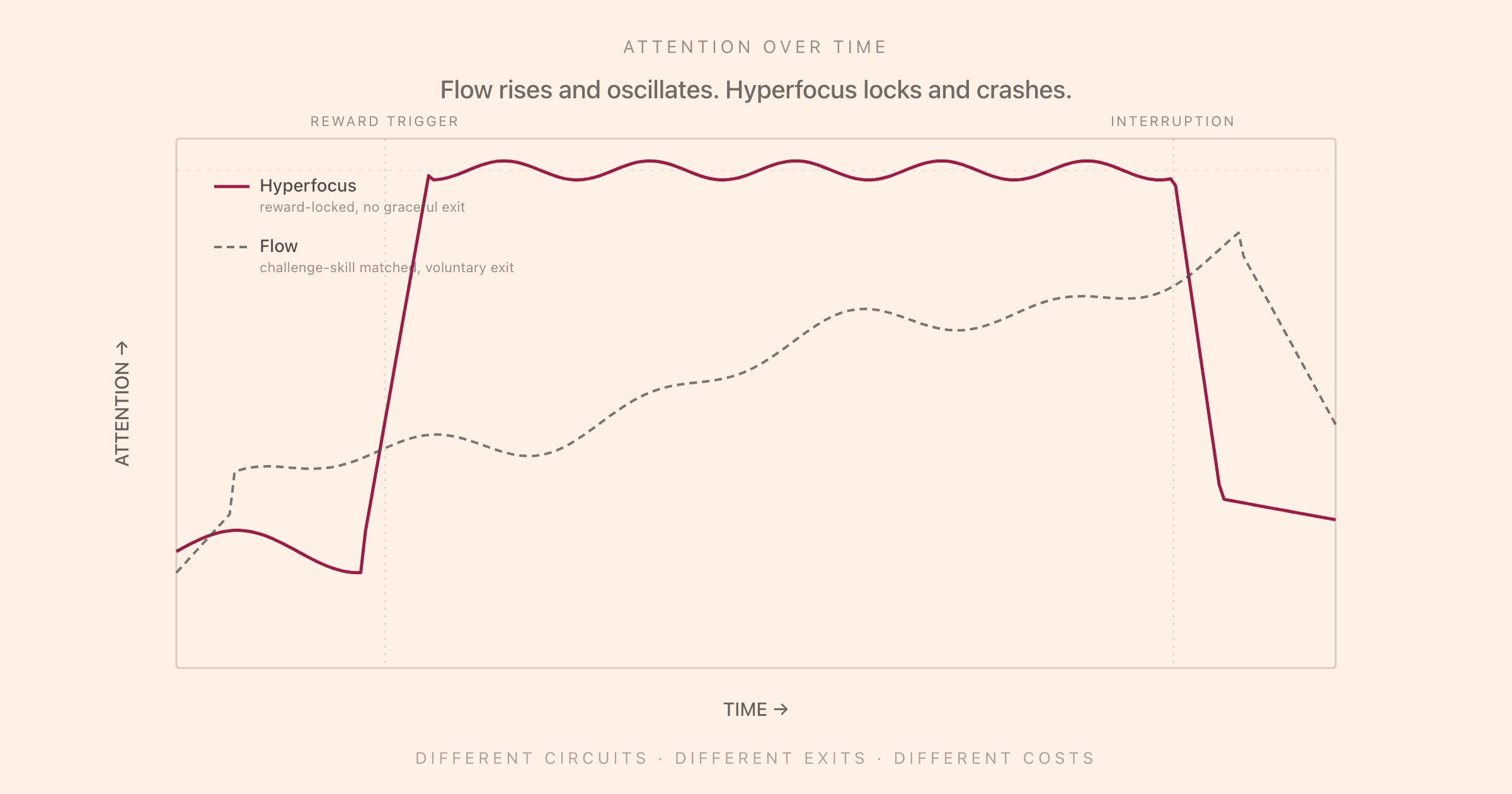
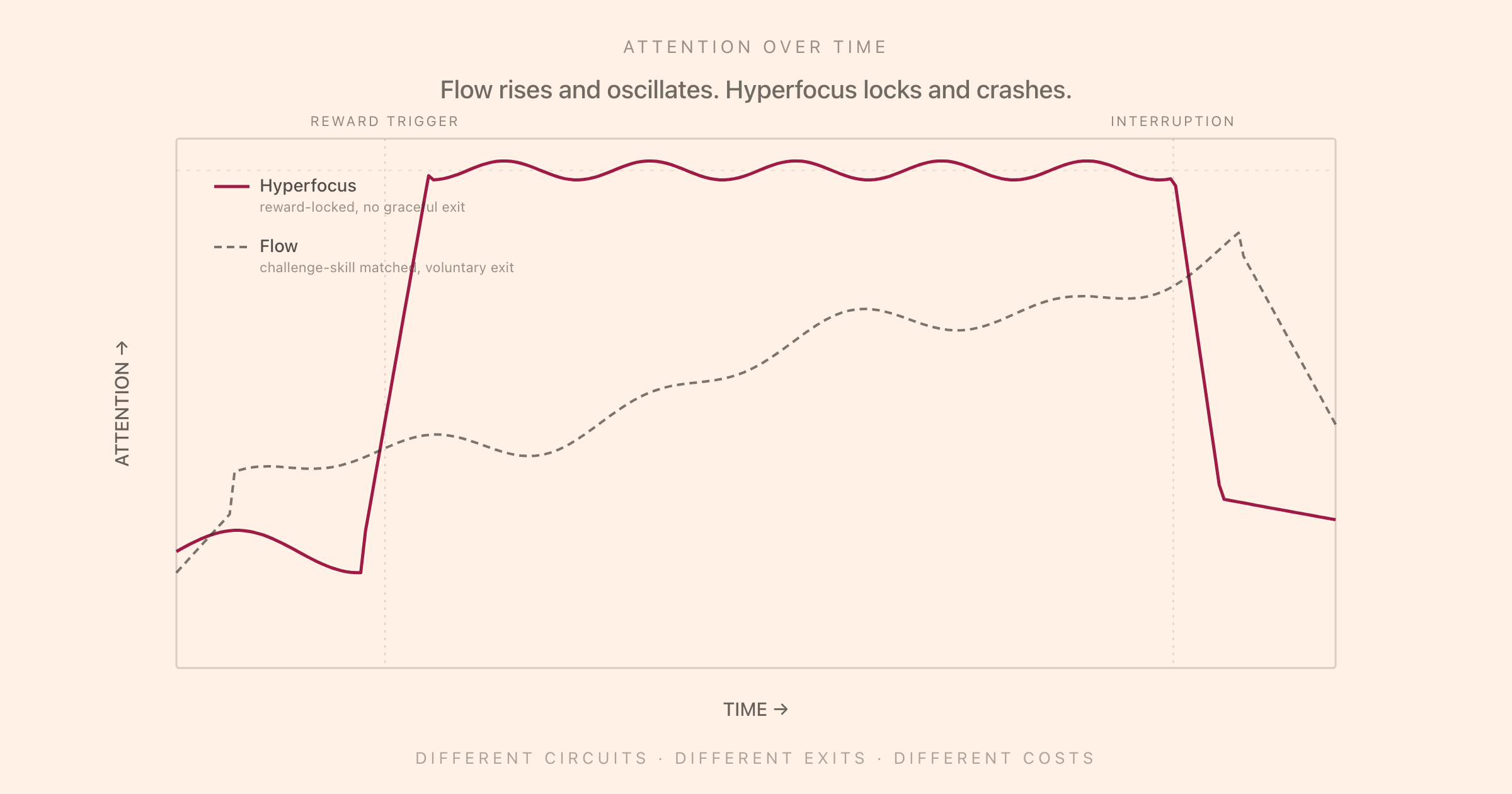
- The exit is sudden and costly. When hyperfocus ends, it usually ends because the reward source stops (the level finishes, the project ships, the battery dies) or because an external interruption forces it (someone calls, a meeting starts). The drop in attention is steep, often accompanied by physical exhaustion, mental fog, and a small grief at the loss of the absorbed state.
The third observation is the one that distinguishes hyperfocus from flow most clearly. Flow exits gracefully when the task ends or the person decides to stop. Hyperfocus crashes.
The Neuroscience: Why Hyperfocus Locks
The clearest mechanistic account of hyperfocus is the one that situates it inside the brain's reward and attention systems, not inside the executive-control systems that flow research has traditionally focused on. The two systems run on different neurotransmitters and produce different attentional dynamics.
The dopaminergic component. The reward system is heavily mediated by dopamine, with a key circuit running from the ventral tegmental area (VTA) to the nucleus accumbens to the prefrontal cortex. ADHD is characterised in part by atypical dopamine signalling: the basal level is often within range, but the response to anticipated and experienced reward is heightened on novel, intrinsically interesting stimuli and blunted on routine, low-saliency ones. This is the molecular shape of "I cannot start the boring thing but I cannot stop the interesting one". In hyperfocus, dopamine signalling pins to a high-reward stimulus, and the prefrontal cortex receives the signal that this is the most rewarding thing currently happening; switching becomes neurochemically expensive, because the reward gradient between staying and leaving is steep.
The locus coeruleus / norepinephrine component. The locus coeruleus is a small brainstem nucleus that is the brain's primary source of norepinephrine and the gain control on attention. It operates in two modes: a "phasic" mode that fires in response to task-relevant stimuli and supports focused attention, and a "tonic" mode of generalised arousal that supports exploratory attention. Aston-Jones and Cohen's (2005) adaptive-gain theory describes the trade-off: phasic firing locks attention onto a current task; tonic firing keeps attention available for new opportunities. In hyperfocus, the system appears to lock into phasic mode for unusually long periods, with reduced disengagement signals from the salience and frontoparietal networks. The lock is the locus coeruleus refusing to release the gain on the current input.
The default mode network does not engage. During hyperfocus, the default mode network (the brain's mind-wandering and self-referential network) is suppressed for far longer than during typical task engagement. Sustained DMN suppression is one of the markers of deep work, but extreme suppression also explains some of the costs of hyperfocus: the autobiographical and self-monitoring processes that the DMN handles include things like noticing time, hunger, and emotional state. With the DMN out of the way for hours, those signals are not noticed until they cross a threshold that forces them through. We have a longer piece on the default mode network if the brain-network half of this is the part you want to follow up on.
The prefrontal cortex contribution is heterogeneous. Different sub-regions of the prefrontal cortex contribute differently. The dorsolateral prefrontal cortex supports working memory and goal maintenance; the ventromedial prefrontal cortex weights reward; the anterior cingulate cortex monitors conflict and effort. In hyperfocus, the goal-maintenance circuitry holds the current task active, the reward-weighting circuitry assigns it disproportionately high value, and the conflict-monitoring circuitry under-flags the cost of staying. The result is a brain configured to keep doing what it is doing, even when staying is no longer adaptive.
The shorthand version: hyperfocus is what happens when the locus-coeruleus-and-dopamine system locks on a high-reward stimulus and the prefrontal-and-cingulate cost-evaluation system fails to flag the cost of staying. It looks like deep focus from the outside. It is closer to a behavioural-neuroscience analogue of compulsive engagement.
Hyperfocus vs Flow: The Distinction That Matters
Flow, as Csikszentmihalyi originally defined it, is a state of optimal engagement that arises when challenge and skill are both high and matched. Flow has been studied for fifty years and has a dense empirical literature. The features Csikszentmihalyi listed (clear goals, immediate feedback, action-awareness merging, time distortion, intrinsic reward, loss of self-consciousness) define what flow looks like phenomenologically. Hyperfocus shares some of these features superficially. The mechanism underneath is different.
Five distinctions sharpen the difference. We covered the broader flow state article separately; this is the focused comparison.
| Dimension | Flow | Hyperfocus |
|---|---|---|
| Trigger | Challenge matches rising skill | High-saliency reward stimulus |
| Voluntary entry | Yes, can be engineered | Largely involuntary; trigger-dependent |
| Voluntary exit | Yes, graceful | No, exit is forced or extracted |
| Productivity profile | Outputs scale with the task | Outputs unrelated to productive importance |
| Cost on exit | Low; energised | High; depleted, foggy, sometimes dysphoric |
The productivity profile distinction is the one that matters most for anyone trying to organise their working day. Flow produces outputs proportional to the importance of the task because the task selection is voluntary; the person chose to enter flow on this thing because this thing was worth doing at the right level of challenge. Hyperfocus produces outputs proportional to the saliency of the stimulus, which is a different variable entirely. A person can hyperfocus on cleaning their entire keyboard with a toothpick for three hours. The output is real, the absorption is real, the time loss is real, and the productive importance is approximately zero. The state feels the same as the four-hour deep work session that produced an actually-important deliverable. The brain is not the right judge of which it was.
This is where the productivity-culture confusion of hyperfocus and flow does the most damage. A person who treats every absorbed state as a win optimises for absorption, not for output. A person who treats every absorbed state as flow makes life decisions ("I am most productive when in flow") on a state that is sometimes flow and sometimes hyperfocus on the wrong thing. Building a focus practice on the wrong distinction means rewarding behaviours that cost more than they produce.
The Hyperfocus Trap: When the Lock Is the Problem
The clinical literature on hyperfocus tracks five common failure modes. Each is worth recognising on the day, in real time, while the lock is still happening. The single move that pulls a person out of hyperfocus before the crash is noticing that the lock is the wrong shape.
- Locking on the wrong task. The person sat down to write a quarterly report and is now seven hours into refactoring the colour palette of the dashboard nobody asked them to touch. The task is real, the work is real, the absorbed state is real. The strategic value is approximately zero. Hyperfocus selects on saliency, not on importance, and "the colour palette" is high-saliency because it is intrinsically interesting and provides immediate visual feedback.
- Missing physiological signals. The DMN suppression that supports hyperfocus also suppresses the routine self-monitoring that surfaces hunger, thirst, fatigue, full bladder, and emotional state. A typical hyperfocus episode of four to six hours will produce dehydration, low blood sugar, and physical stiffness that the person does not notice until the lock breaks. The cost is real and compounds.
- Missing social signals. Partners, children, colleagues, and friends are pinged and then unsurfaced. The hyperfocus state is intrinsically isolating, not because the person is choosing to ignore others but because the salience map has narrowed. The downstream relational cost is one of the most consistent findings in adult-ADHD self-report.
- The crash is steep. When hyperfocus ends, the system goes from near-maximum attention to near-zero quickly, often accompanied by mental fog, low mood, and a brief depressive dip that can last hours. This is the energetic shape of dopamine signalling that has been pinned at high level for hours and then drops; it is not the same as the rested-after-deep-work feeling that follows flow. The crash discourages future engagement and biases people away from the kind of sustained focus that, done properly, would feel different.
- The trigger does not generalise. Because hyperfocus locks on saliency rather than on a chosen task, it cannot be deployed on demand for the task that actually needs to be done. People who learn to "use their hyperfocus" are usually rationalising a state they cannot in fact summon. This is why ADHD coaching consistently emphasises voluntary-attention scaffolding (timers, externalised structure, body-doubling, environmental interventions) over hoping for a hyperfocus episode.
The single most useful intervention is the meta-noticing one: an alarm or external cue that breaks into the state every ninety minutes and asks "is this the task you sat down to do, and is the cost of staying still worth the value of the next hour". A hyperfocus episode that survives that question is closer to flow. One that does not has been usefully interrupted.
Audio and Voluntary Focus: How Tomatoes Fits
The reason an audio anchor matters in this picture is that the audio is one of the cheapest available interventions that bias attention towards voluntary focus rather than involuntary hyperfocus. The mechanism is not "audio causes flow"; the mechanism is that the audio makes voluntary entry into focus easier and provides a temporal scaffold that the brain can use as an anchor when the salience-driven hyperfocus circuitry is still warm.
Three pieces of the science explain why.
Auditory steady-state response (ASSR) at task-relevant bands biases attention. The 40 Hz gamma resonance and the 8-12 Hz alpha bands have measurable effects on attention through neural phase-locking. The 40 Hz gamma waves piece covers the ASSR mechanism in detail. The relevant point here is that a steady auditory rhythm in the right band can act as a soft attention anchor that supports voluntary task engagement without forcing the locus-coeruleus into the kind of high-tonic lock that produces hyperfocus.
Background noise narrows the window through which distractors can compete. Brown, pink, and green noise mask irregular environmental sound, lowering the threshold for voluntary attention to stay on task. The effect is well-described in the focus-music literature; we cover it in the white vs pink noise piece and in the brown noise piece. The relevant point here is that noise lowers the cost of voluntary engagement; it does not lock attention.
A timed protocol externalises the task-end signal. This is the single biggest difference between Tomatoes-style focus audio and the silent-room hyperfocus shape. A 25-minute pomodoro or a 50-90 minute ultradian block has a built-in end. The audio finishes; the brain receives an end signal that it would not otherwise receive in a hyperfocus state. The end signal is the graceful exit that hyperfocus does not have.
Tomatoes is built around these three pieces. It generates real-time focus music with brain-band-tuned binaural and isochronic components, a noise floor that masks intermittent distractors, and a session structure with explicit start, mid-cycle, and end markers. The result is not a tool for entering hyperfocus. It is a tool for entering and exiting voluntary focus on a schedule the user controls. For ADHD users specifically, the difference between a state that exits when you tell it to and a state that exits when the battery dies is the difference between a sustainable working day and a crash.
A Practical Test: Is This Flow or Hyperfocus
The simplest field test is the four-question check below. Run it the next time you surface from a deeply absorbed working session.
- Did you choose the task on the basis of importance, not saliency? If you sat down to do this specific thing because it was the right thing to do, points towards flow. If you slid into it because it was the most interesting available stimulus, points towards hyperfocus.
- Could you have stopped voluntarily at any point in the last hour? If yes, flow. If you noticed a pull but kept going, hyperfocus.
- Did you notice physiological signals (hunger, thirst, posture) and respond to them? If yes, flow. If you missed them entirely until you stopped, hyperfocus.
- What does the next thirty minutes feel like now? Energised and ready for an adjacent task points towards flow. Foggy, hungry, and mildly low points towards hyperfocus.
A four-out-of-four flow signature does not mean the session was useless if some of the answers point the other way. It means that the session that just happened is more likely to be repeatable and lower-cost. A four-out-of-four hyperfocus signature does not mean the session was bad. It means that the next move should be a deliberate recovery, and that the next session should be scaffolded more carefully so it produces flow next time.
The Bottom Line
Hyperfocus is not a productivity superpower. It is a reward-locked attention state with a real neural signature, real costs, and a poor exit profile. It is more common in ADHD but is not unique to it. It looks like flow from the outside. It is closer to a compulsive engagement state that the saliency system has pinned to a high-reward stimulus.
The right relationship to hyperfocus is to recognise it, to interrupt it before the crash, and to build a working day around voluntary focus instead. Voluntary focus has the same feeling of absorption when it is going well, exits gracefully, and produces output proportional to the importance of the work. The audio scaffold, the timed block structure, and the explicit end signal are the cheapest available interventions. Tomatoes is a one-time $39 app that does all three. The rest is your decision about which state you want your working day to be made of.