The Pomodoro Technique is a five-step focus protocol that runs work in twenty-five-minute timed intervals (called pomodoros) separated by short breaks, with a longer break after every four intervals. It is the productivity method with the highest brand recognition in the focus literature: it has a name, a story, a book, and a cult following that spans students, software engineers, ADHD coaches, and remote-work productivity-Twitter. It also has more empirical support than most of the methods it sits alongside, which is unusual for a technique whose origin is a single Italian student in 1987 holding up a kitchen timer shaped like a tomato.
This piece is the cognitive-science version of the Pomodoro Technique: the Francesco Cirillo origin story, the five-step protocol exactly as it was originally published, the four cognitive mechanisms that explain why a twenty-five-minute interval works better than a forty-five-minute interval or a continuous five-hour session, the variations (Flowmodoro, fifty-ten, the ninety-minute ultradian block), why the protocol works particularly well for ADHD, when it fails, and how a focus app like Tomatoes layers binaural-beats focus audio into the pomodoro interval to reduce the moment-to-moment attention drift that makes the timer ring before the work feels finished. Tomatoes is a one-time $39 with no subscription; the rest of this article is the science of the timer.
The Origin: Francesco Cirillo, Bologna, 1987
Francesco Cirillo was a university student at the Università LUISS Guido Carli in Rome (he later studied at IULM in Milan) in the late 1980s. By his own account, the protocol was born from a moment of frustration: he was unable to study for an exam and challenged himself to find ten minutes of uninterrupted concentration. He picked a kitchen tomato timer (pomodoro is the Italian word for tomato) off a shelf, set it to a short interval, and worked until it rang. The first iteration of the method was that single act repeated.
Over the next two years, Cirillo refined the protocol through trial and error: the interval lengthened, the break got formalised, the cycle-of-four-then-long-break structure was added, the logging discipline was introduced. By 1992 he was teaching it to colleagues, and in 1998 he began publishing the method commercially. The defining book, simply titled The Pomodoro Technique, has been continuously in print since 2006 with multiple editions through the 2020s.
The technique is now genericised. "Pomodoro" is used to describe any twenty-five-minute timed focus block. Cirillo holds the trademark on the term "The Pomodoro Technique" in some jurisdictions but the underlying interval-and-break structure is in the public domain and has spawned hundreds of timer apps, browser extensions, and physical kitchen timers shaped like tomatoes.
The Five-Step Protocol
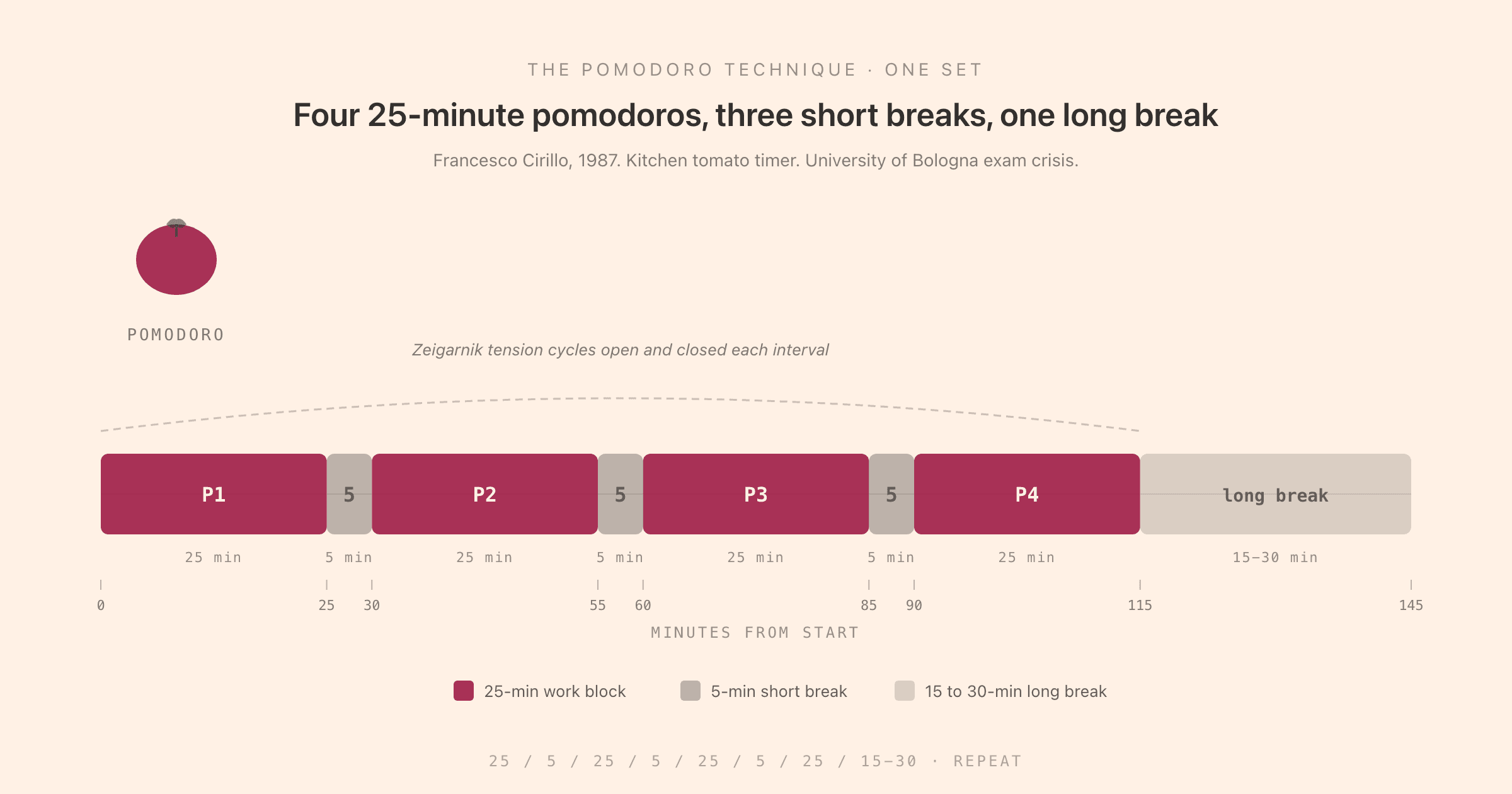
The original protocol, as published in Cirillo's book, is five steps. Most internet summaries collapse this to three or four; the original has more structure.
- Plan the session. Pick the task or tasks. Estimate them in pomodoros (one pomodoro = 25 minutes). This is the foundation; without an estimate, you cannot measure your accuracy over time, which the protocol uses as a self-calibration loop.
- Set the timer for 25 minutes and start. The interval is fixed. Work on the planned task with no context switches. If you finish before the timer rings, you spend the remaining time reviewing or polishing the work; you do not start the next task and you do not stop the timer early.
- Work until the timer rings. If a distraction appears, write it down on the planned-distractions list and return to the task. The Cirillo language for this is "inform, negotiate, schedule, call back": acknowledge the interruption, propose a later time, set it, return to the task.
- Take a five-minute break. A real break: stand up, get water, look out a window. Not email, not Slack, not the next thing. The point is to vacate working memory of the previous task.
- After four pomodoros, take a longer break of 15 to 30 minutes. This is the recovery block: enough time for the cognitive load to drop and the prefrontal cortex to come back to a near-baseline state.
A sixth step that the book treats as integral but most summaries omit: log every completed pomodoro on a sheet. The log is what makes the protocol a measurement system rather than just a timer. Across days, the log reveals how many pomodoros a category of task actually takes (almost always more than the initial estimate), which trains realistic planning over weeks.
Why It Works: Four Cognitive Mechanisms
The Pomodoro Technique is not magic and Cirillo never claimed it was; the book is the work of an engineer building a self-management system, not a neuroscientist. The reason the method has held up empirically is that the twenty-five-minute interval coincidentally lands on top of four converging cognitive mechanisms.
Zeigarnik Tension and the Open Loop
Bluma Zeigarnik's 1927 work, replicated in dozens of variations since, found that unfinished tasks create a measurable cognitive tension that makes them more accessible to recall than completed ones. The classic version is the waiter who can list every dish on an unpaid table but forgets them the moment the bill is settled. The Pomodoro Technique deliberately creates the open loop and then forces a hard stop on it: when the timer rings mid-paragraph, the brain holds the unfinished structure under tension during the break, which makes the return cheaper. Closing the loop after a 25-minute pomodoro and re-opening a fresh one each cycle keeps Zeigarnik tension productively cycled rather than letting it accumulate across an entire afternoon and become anxiety.
Attention Restoration Theory
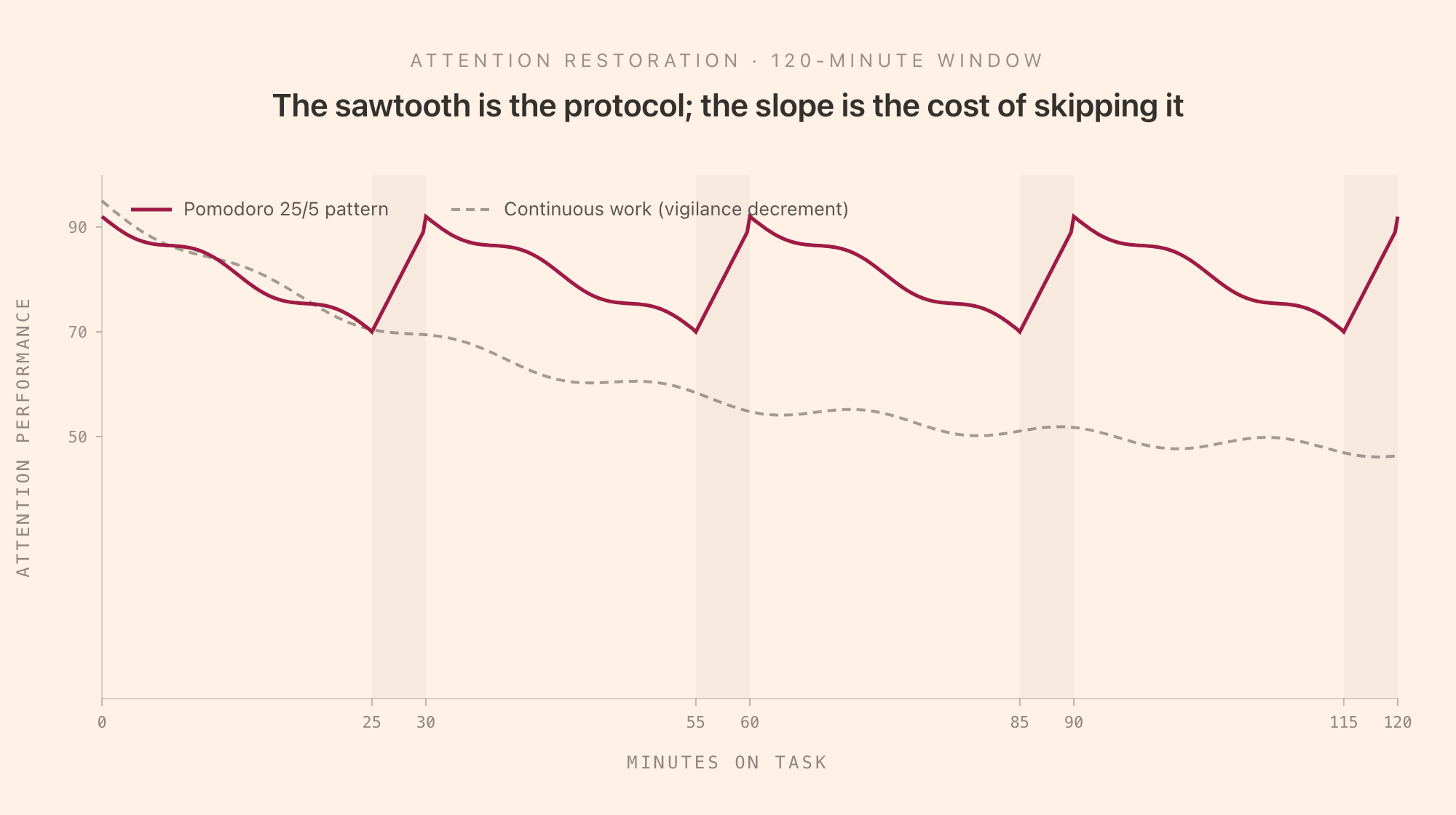
Rachel and Stephen Kaplan's Attention Restoration Theory (ART), published in 1989, distinguishes between directed attention (effortful, prefrontally driven, fatigues with use) and involuntary attention (effortless, captured by interest). ART argues that directed attention is a limited resource and that recovery requires switching modes, not just continuing to push. The five-minute pomodoro break is too short for deep restoration but long enough to release directed attention back to its baseline level, especially if the break content is genuinely involuntary (looking out a window, walking, anything not screen-shaped). Over four cycles plus a long break, the cumulative restoration is real and measurable.
Task-Switching and Context-Reload Cost
Sophie Leroy's 2009 work on "attention residue" found that when people switch from one task to another, mental traces of the previous task persist and degrade performance on the new one for several minutes. The implication for sustained focus is the opposite of what naïve productivity advice often says: more breaks can be worse if each break triggers a context switch with associated residue. The pomodoro protocol resolves this by making the break content deliberately empty (no Slack, no email) and by returning to the same task after the break. The result is a break that restores attention without paying the residue cost of a real task switch.
The Cortical Refractory Window
EEG research on sustained attention finds that vigilance performance degrades non-linearly over time on task, with a steep drop somewhere between twenty and forty-five minutes depending on task complexity and individual capacity. The twenty-five-minute pomodoro lands deliberately on the conservative side of that window: at 25 minutes most healthy adults are still inside their best-performance band on most cognitive tasks. The 5-minute break catches the curve before it bends. Pushing to 45 or 60 minutes shifts performance into the fatigued tail and starts cashing in errors and rework.
Variations: Flowmodoro, Fifty-Ten, and the Ultradian Block
The 25/5 ratio is not sacred. It is the ratio that worked for Cirillo as a student in 1987 and survived contact with his subsequent users. Several variations have empirical support.
- Flowmodoro: start the timer in counting-up mode, work until naturally interrupted by attention fatigue, then break for one-fifth of the elapsed work time. A 50-minute work block earns a 10-minute break. This variation respects flow states (see our separate piece on flow state) but requires self-honesty about when fatigue actually arrives.
- 50/10: double the pomodoro. Works for deeper analytical tasks where the 25-minute interval feels truncated. Loses some Zeigarnik benefit because the loop is open longer; gains some context-amortisation benefit.
- 90/20 ultradian: anchored to the basic rest-activity cycle of roughly 90 minutes that runs through the day. Aligns work blocks with the natural arousal peak of each ultradian cycle and breaks during the trough. The longest of the practical variants. Our ultradian rhythm article covers the underlying cycle.
- 52/17 (DeskTime): the productivity-software company DeskTime reported that their top 10% of users averaged a 52-minute work / 17-minute break ratio. Treat this as observational rather than experimental; it describes what high-output people do, not what causes high output.
Pomodoro Technique and ADHD
The Pomodoro Technique has unusually strong adoption in ADHD communities, and the reason is structural. ADHD presents reliably as a deficit in executive function: time perception (the time-blindness problem), task initiation, working memory, and self-monitoring. The pomodoro protocol externalises each of those functions.
- The timer is an external clock that solves time-blindness without requiring the brain to track elapsed time.
- The 25-minute commitment is short enough to defeat the activation-energy threshold that makes task initiation hard.
- The planning-and-logging discipline is an external working-memory aid; you do not need to hold the plan in your head because it is on paper or in an app.
- The break-and-return cycle gives the executive function repeated low-cost decisions ("start the next pomodoro") rather than one impossibly large one ("focus all afternoon").
Russell Barkley's reframe of ADHD as a working-memory and self-regulation disorder rather than an attention disorder predicts exactly this kind of externalised-protocol benefit. The 2017 review by Solanto on cognitive-behavioural therapy for adult ADHD describes interval-based time management as one of the most consistently helpful behavioural interventions. The pomodoro is the most accessible interval-based protocol on the market.
When the Pomodoro Technique Fails
The protocol does not work for every kind of work. The two reliable failure modes are deep creative flow and high-context analytical work.
In deep creative flow, the cost of being interrupted is not the loss of the next five minutes; it is the destruction of an internal scaffold that took thirty minutes to build. A timer ringing at the wrong moment in a writing or design session can cost an hour of rebuild. The protocol gives a clean answer to this: if you are inside true flow at 25 minutes, do not honour the timer. Cirillo's own guidance is that the protocol is a default to fall back to, not a default to override flow with.
In high-context analytical work (debugging a complex system, working a maths proof, reading a dense paper), the per-context-switch cost is high. The 5-minute break is enough time for the working-memory contents to decay and the cost of the rebuild can exceed the attention-restoration gain. The 50/10 or 90/20 variants are usually a better fit for this class of work.
The Pomodoro Technique is a default protocol for medium-context, finite, discrete-task work: writing emails, coding feature work, studying chapters, reviewing documents, processing a queue of similar items. For tasks of that shape, the 25/5 ratio is hard to beat.
How Tomatoes Implements the Pomodoro Technique
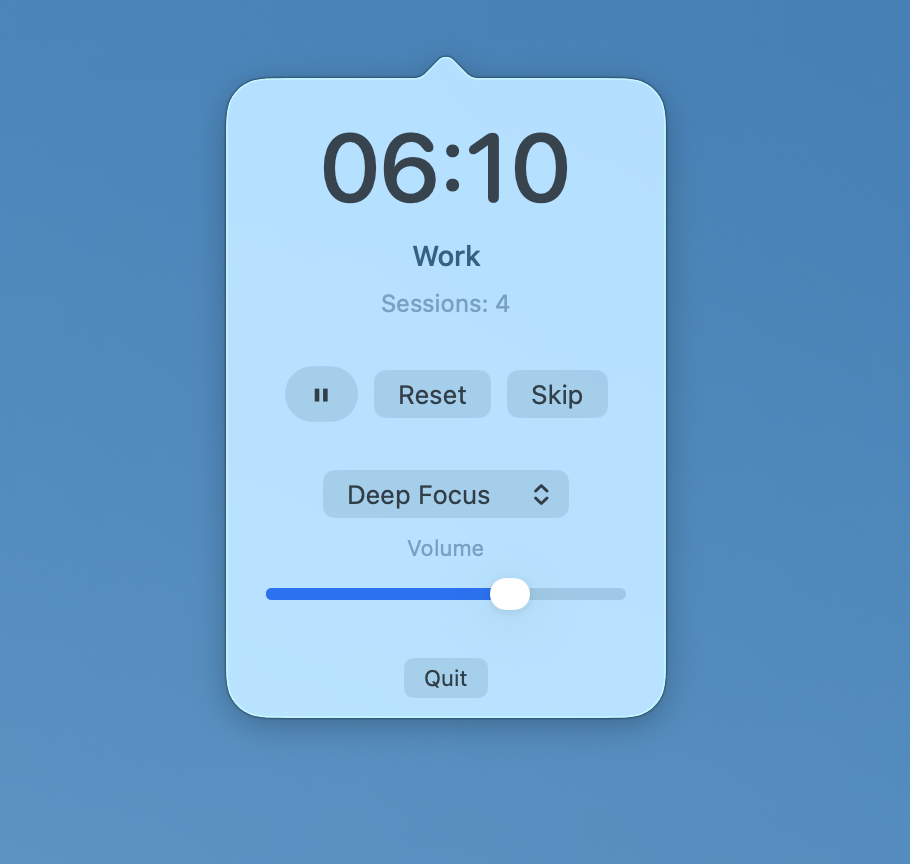
Most pomodoro timers are silent. They count down twenty-five minutes, they ring, you take a break, they count down five minutes, they ring again. The Tomatoes approach is to layer focus audio into the 25-minute interval itself: binaural-beats stimulation tuned to the attention-supporting alpha-and-low-beta frequency band, with a granular ambient bed and gentle envelope changes that signal the approach of the break. The audio reduces moment-to-moment attention drift inside the interval, which is the variable that determines whether a pomodoro ends with momentum or with the timer ringing on a half-finished sentence.
If you want the protocol with the audio built in, Tomatoes is a one-time $39 with no subscription. The native menu-bar app runs the timer, plays the audio through the 25-minute interval, ducks the audio during the break, and ramps it back when you start the next pomodoro. For more on the audio side of why this works, our focus music taxonomy article covers the five categories of focus audio and what each one is doing to working memory.
The Bottom Line
The Pomodoro Technique is a 1987 Italian protocol that has held up because it accidentally lands on top of four cognitive mechanisms that converge on the same answer: cycle directed attention in finite intervals, force breaks before the fatigue curve bends, externalise the executive function, and keep Zeigarnik tension productively open. Twenty-five minutes is not a magic number, but it is on the right side of the cortical refractory window for most healthy adults on most cognitive tasks, which makes it the conservative default that is hard to beat without per-person tuning.
The protocol works particularly well for medium-context work and for ADHD; it works less well for deep creative flow and very-high-context analytical work. The variations (Flowmodoro, 50/10, the 90/20 ultradian block) cover most of the cases the basic 25/5 cannot. The logging discipline, often the first thing dropped by people adopting the method, is the part that turns it from a timer into a measurement system.
You do not need an app to run a pomodoro. A kitchen tomato timer and a sheet of paper is the original protocol and it still works. What an app adds is the audio environment that reduces drift inside the interval, which is the variable that determines whether the protocol ends a session ahead of estimate or behind it.