Caffeine is the most widely used psychoactive drug on earth, taken every morning by most of the adult population without anyone thinking of it as a drug at all. It does something genuinely useful for focus, but it does not do what most people assume. Caffeine adds no energy to the system. It works by blocking a brake. Understanding which brake, and what happens when the brake comes back, explains nearly everything people find confusing about coffee: the crash, the tolerance, why the same cup that does nothing at 8am wrecks your sleep at 11pm, and why the people who feel they "need" coffee to function may simply be reversing their own withdrawal.
This is the neuroscience of caffeine: what the molecule actually is, the adenosine system it acts on, why blocking adenosine produces alertness, the five-hour half-life that governs how long it lasts, the real story behind the crash and tolerance and withdrawal, whether it improves focus or just restores it, and how to time it so it helps your work without stealing your sleep. Tomatoes is a focus tool built for sustained, deliberate work sessions, the kind caffeine can support but cannot manufacture. The app is free for 3 days, then $4.99/week, $29.99/year, or $39 lifetime.
What Caffeine Actually Is
Caffeine is a small molecule, 1,3,7-trimethylxanthine, a member of the methylxanthine family of purine alkaloids. Plants make it as a natural pesticide, which is why it turns up in coffee beans, tea leaves, cacao, kola nuts, guarana, and yerba mate, lineages of plant that evolved the same defensive chemistry independently. In humans, at the doses people actually consume, it is a mild central nervous system stimulant with a remarkably clean and specific mechanism.
The key fact about caffeine's shape is that it looks, to a receptor, a great deal like adenosine. Both are purines. Both fit the same molecular pocket. This structural mimicry is the entire basis of how caffeine works: it is close enough to adenosine to slot into adenosine's receptors, but different enough that it does not switch them on. To understand the drug, you have to understand the molecule it impersonates.
Adenosine: The Brake Caffeine Blocks
Adenosine is, among other things, the brain's running tally of how long you have been awake. Every cell uses adenosine triphosphate (ATP) as its energy currency, and as neurons burn through ATP across a day of activity, adenosine accumulates in the extracellular space as a metabolic byproduct. The longer and harder the brain works while awake, the more adenosine builds up. It is, quite literally, a chemical measure of accumulated metabolic cost.
That accumulating adenosine binds to a family of receptors, principally the A1 and A2A receptors, distributed widely across the brain. When adenosine activates A1 receptors, it inhibits neural firing, dampening the release of the brain's alerting neurotransmitters. As the day goes on and adenosine rises, this inhibition deepens, neural excitability falls, and the subjective result is the slow, heavy accumulation of sleepiness. The basal-forebrain work of Porkka-Heiskanen and colleagues in the late 1990s showed adenosine rising in wake-promoting brain regions during prolonged wakefulness and falling during sleep, which is exactly what a sleep-pressure signal should do.
This is the molecular substrate of what sleep scientists call Process S, the homeostatic sleep drive in Borbély's two-process model. Process S rises across waking and is discharged during sleep, working alongside the circadian Process C (the body clock) to time when you feel sleepy. Adenosine is the chemistry of Process S. It is cleared during sleep, especially during the deep slow-wave stages, which is part of why a night of real sleep resets your alertness and a night of poor sleep does not. (The sleep architecture that does the clearing is covered in the sleep stages guide, and the body-clock half of the model in the circadian rhythm guide.)
Why Caffeine Wakes You Up
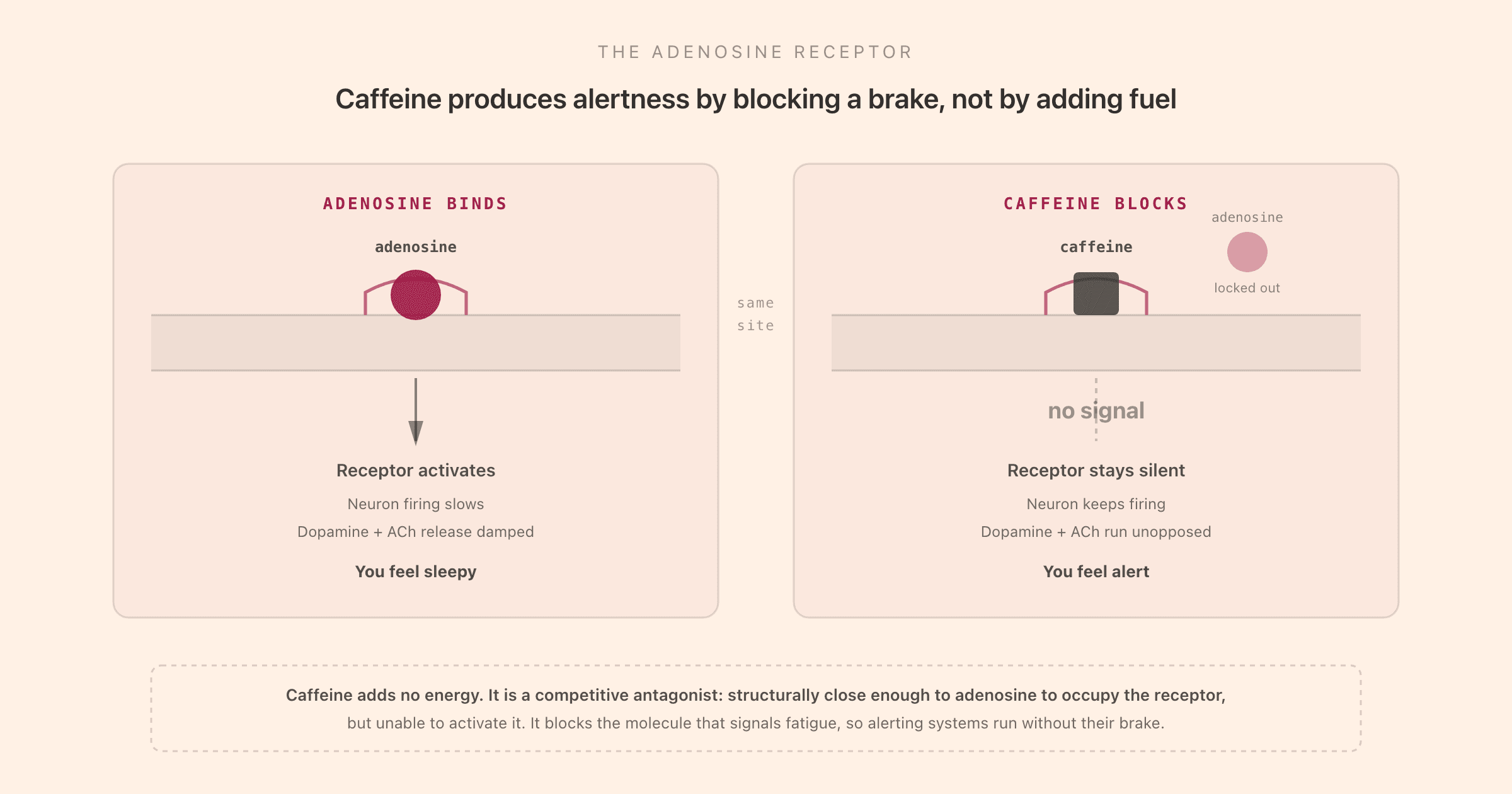
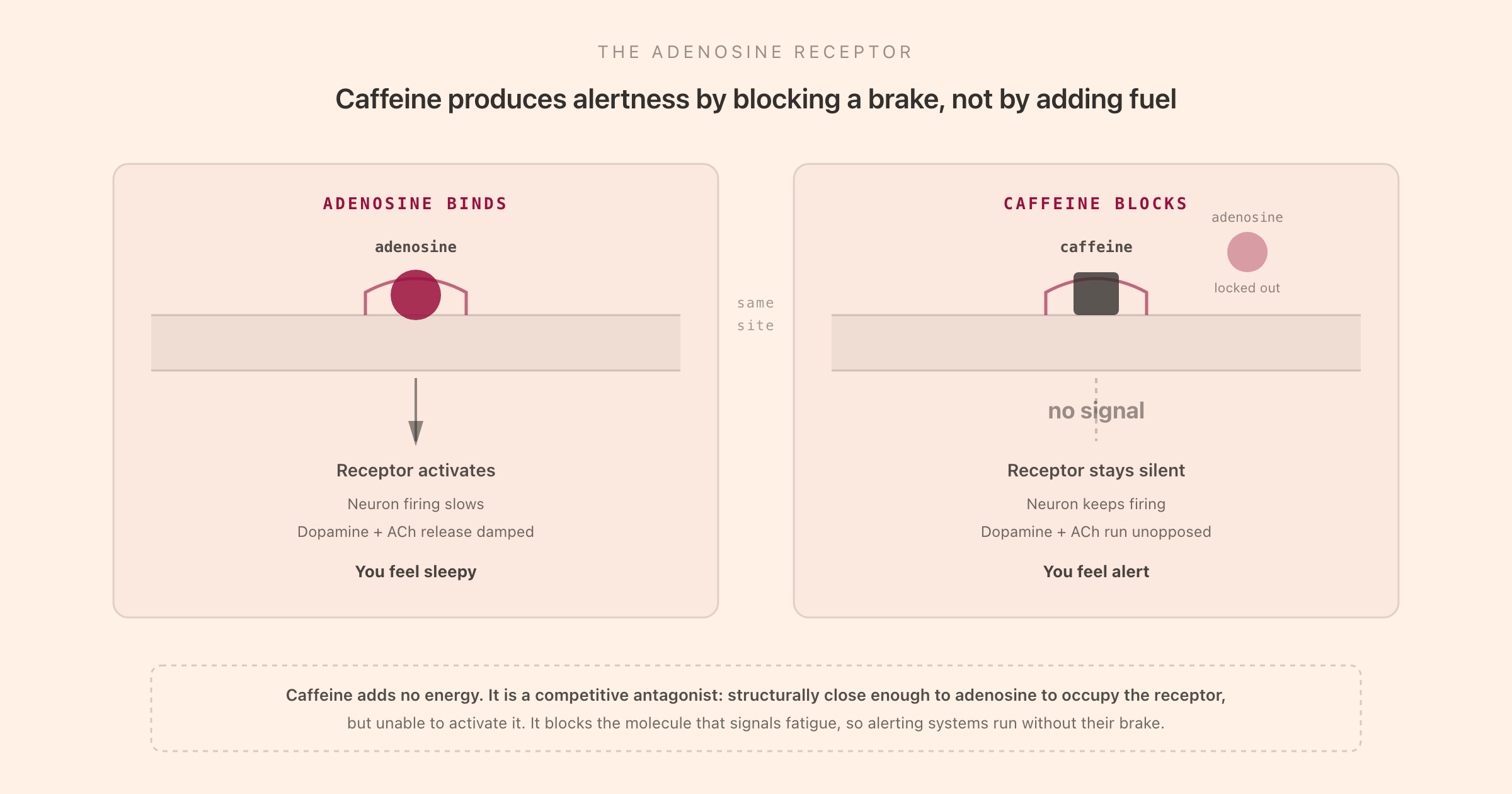
Caffeine is a competitive antagonist at the adenosine receptors. It diffuses into the brain, occupies the A1 and A2A receptors, and because it does not activate them, it simply prevents adenosine from binding. The adenosine is still there, still accumulating, but the brain can no longer read the signal. The brake is physically present but disconnected.
The downstream effect is disinhibition. Adenosine normally restrains the brain's alerting systems; remove that restraint and those systems run more freely. Blocking A2A receptors in the striatum is particularly consequential, because A2A receptors are physically coupled to dopamine D2 receptors there, and antagonising A2A enhances dopamine signalling, which is part of why caffeine is mildly rewarding and reinforcing. With the adenosine brake off, dopamine, acetylcholine, and norepinephrine systems all operate with less suppression, and the net result is increased arousal, faster reaction time, and the sense of being awake.
The crucial point, and the one the hero diagram makes, is that none of this is added energy. Caffeine supplies no fuel, no extra ATP, no genuine recovery. It masks the fatigue signal. The metabolic debt the adenosine was reporting goes right on accumulating behind the blocked receptors. This is why caffeine cannot replace sleep, and why the bill eventually arrives.
The Five-Hour Half-Life
Caffeine is absorbed quickly. Plasma levels peak roughly 30 to 60 minutes after you drink it, which is why the lift is fairly prompt. What surprises people is how slowly it leaves.
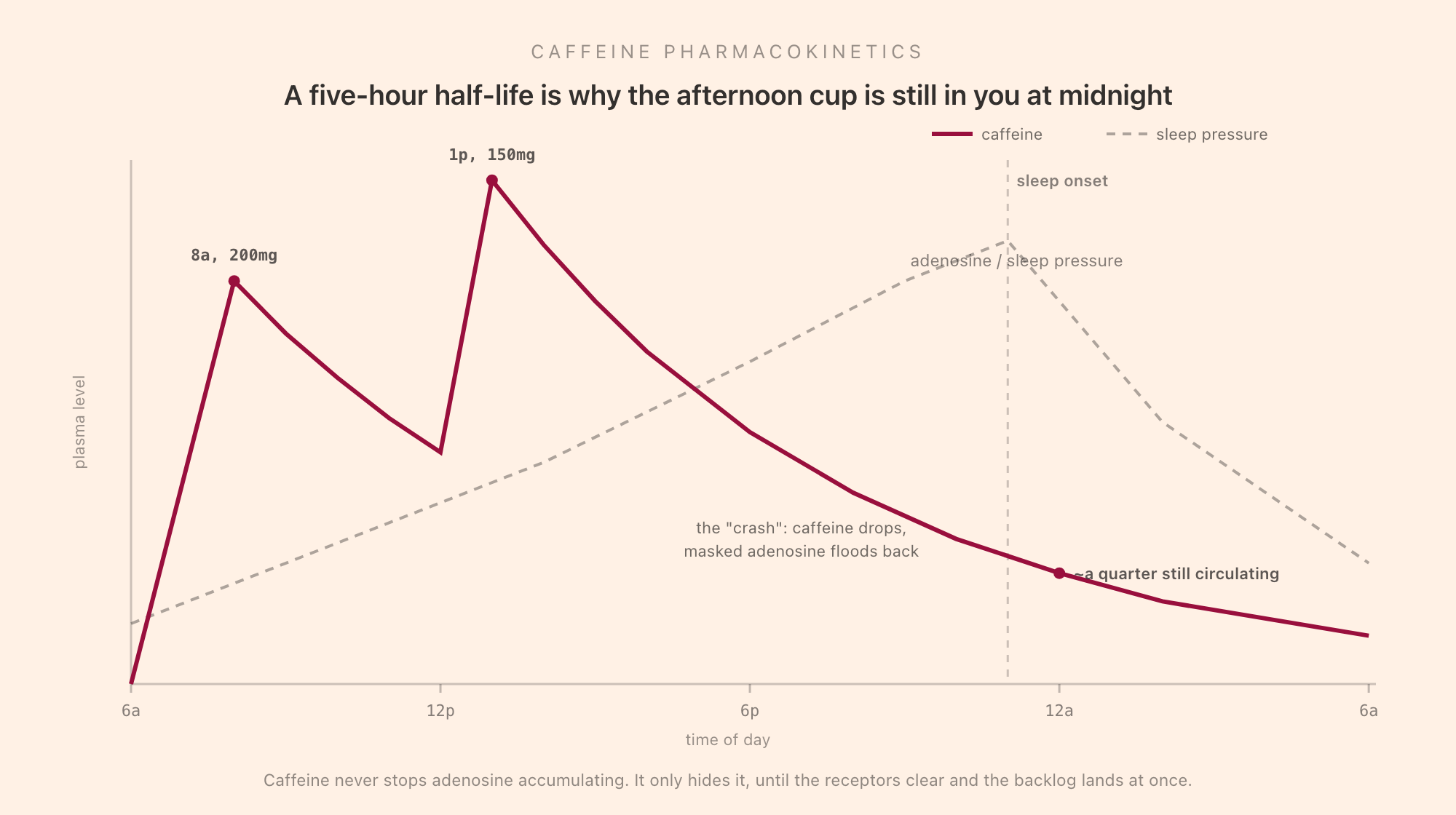
The half-life of caffeine, the time for your body to clear half of a given dose, averages around five hours in a healthy adult, with a normal range of about three to seven hours. It is metabolised in the liver by the enzyme CYP1A2, and the speed of that enzyme varies a lot between people and conditions. Smoking roughly doubles the clearance rate (smokers process caffeine fast); pregnancy and oral contraceptives slow it dramatically (half-life can stretch past ten hours); some people carry CYP1A2 gene variants that make them constitutionally slow metabolisers, the people for whom one afternoon espresso means a wired, sleepless night.
A five-hour half-life has a counterintuitive consequence, shown in the clearance curve below. If you drink a 150 mg coffee at 1pm, you still have roughly 75 mg at 6pm, around 38 mg at 11pm, and a meaningful residue well into the night. The afternoon cup is genuinely still circulating at bedtime.
The Crash, Explained
The "caffeine crash" is the slump of tiredness that follows the peak, and the adenosine model explains it precisely. While caffeine was blocking the receptors, adenosine kept accumulating, unread. The brain, sensing reduced adenosine signalling, may even have responded by making more receptors available. When caffeine concentrations fall and the receptors clear, all of that backed-up adenosine binds at once, often hitting a system that is now more sensitive than before. The fatigue signal does not return gently; it lands as a backlog.
Blood-sugar dynamics can add to it, especially if the caffeine arrived with sugar, and so can the body's circadian post-lunch dip if the timing coincides. But the core of the crash is the adenosine rebound: the inevitable consequence of having hidden a signal rather than resolved it. The harder and longer you masked the fatigue, the sharper the correction.
Does Caffeine Actually Improve Focus?
Mostly yes, with an important caveat. The most robust effects of caffeine are on alertness, vigilance, and reaction time, particularly sustained attention over long, monotonous tasks, and the benefits are largest when you are sleep-deprived, fatigued, or in caffeine withdrawal. Shift workers, soldiers, drivers, and students pulling long sessions reliably perform better on attention tasks with caffeine than without. For the focus-seeker, that is the real prize: caffeine helps you keep paying attention when you otherwise could not.
The caveat is the withdrawal-reversal debate. Because regular consumers develop tolerance and go into mild withdrawal overnight, much of the "boost" a habitual coffee drinker feels from their morning cup may be the reversal of that overnight withdrawal, returning them to a normal baseline rather than lifting them above it. Researchers such as Peter Rogers and Jack James have argued this accounts for a large share of caffeine's apparent benefits in habituated users. The effect on complex, higher-order cognition (reasoning, creative problem-solving, learning new material) is modest at best in well-rested people, and high doses can tip you past the peak of the arousal-performance curve into jittery, error-prone over-arousal. Caffeine is excellent at keeping a tired brain on task. It is not a nootropic that makes a rested brain smarter.
Tolerance and Withdrawal
Use caffeine regularly and the brain adapts. The most consistent finding is upregulation: with the adenosine receptors chronically blocked, the brain manufactures more of them, increasing receptor density over days to weeks. With more receptors to occupy, the same dose has a smaller net effect, which is tolerance. It is the same logic of receptor adaptation discussed in the dopamine piece: the system pushes back against persistent pharmacological pressure to defend its set point.
Tolerance is also why withdrawal is real and, in the classic study by Juliano and Griffiths, well characterised. When a habituated user stops, all those extra receptors are suddenly exposed to a full adenosine load with nothing blocking them, and the brain is now over-equipped to sense fatigue. The hallmark symptom is a headache, along with fatigue, low mood, irritability, and difficulty concentrating. Onset is typically 12 to 24 hours after the last dose, symptoms peak around one to two days in, and they resolve over roughly two to nine days as receptor numbers normalise. This is why a tapered reduction is far more comfortable than going cold turkey, and why a few days off can reset your sensitivity so that caffeine works better when you return to it.
The Coffee Nap
The mechanism makes one genuinely clever trick possible: the coffee nap (or caffeine nap). Caffeine takes about 20 minutes to cross into the brain and start acting. A short nap of around 20 minutes clears a chunk of accumulated adenosine from the receptors. So if you drink a coffee and immediately lie down for a 20-minute nap, two things converge as you wake: the nap has freed up the receptors, and the caffeine arrives to keep them blocked. Driving-simulator studies by Reyner and Horne found the coffee-plus-nap combination reduced sleepiness and improved performance more than either the nap or the caffeine alone. The keys are keeping the nap short enough to avoid sleep inertia from deep sleep, and drinking the caffeine immediately before lying down rather than after.
How to Time Caffeine for Focus
The practical implications follow directly from the half-life and the adenosine model.
Protect your sleep with the half-life math. Because caffeine lingers for many hours, set a daily cutoff. A common, defensible rule is to stop caffeine 8 to 10 hours before bed, so that for an 11pm bedtime the last cup is early-to-mid afternoon. Caffeine taken even six hours before bed has been shown to measurably reduce total sleep time, often without the drinker noticing, because it erodes deep sleep silently. Bad sleep then raises next-day adenosine, demanding more caffeine: the loop that turns a helpful drug into a dependence.
Be skeptical of the "wait 90 minutes after waking" rule. The popular advice to delay your first coffee until after the morning cortisol peak has settled is widely repeated but rests on thin evidence; there is no strong data that delaying caffeine relative to the cortisol-awakening response improves focus or reduces tolerance. Time your caffeine to your work, not to a folk theory.
Use it for the task it is good at. Caffeine shines on sustained attention and vigilance, so the highest-value use is to pair a moderate dose with a block of focused, monotony-prone work, then let it carry you through the stretch where attention would otherwise fade. That is exactly the shape of a structured focus session: a defined block of deliberate attention. Caffeine can hold the alertness; the structure has to come from you (or from a tool that enforces it).
The Bottom Line
Caffeine is a competitive antagonist at the adenosine receptors. It produces alertness not by adding energy but by blocking the brain's accumulating fatigue signal, which disinhibits the dopamine, acetylcholine, and norepinephrine systems and leaves you feeling awake while the metabolic debt quietly grows behind the blocked receptors. Its roughly five-hour half-life means an afternoon cup is still measurably present at midnight, which is why timing matters more than dose for protecting sleep. The crash is the adenosine backlog landing when the drug clears; tolerance is the brain growing more receptors to compensate; withdrawal is those extra receptors meeting a full adenosine load when you stop. Caffeine genuinely improves sustained attention and reaction time, especially when you are tired, but much of a habitual user's "boost" is reversing overnight withdrawal, and it does little for complex thinking in a rested brain. Drink it deliberately, cut it off in the early afternoon, take periodic breaks to reset your sensitivity, and use it to support real focused work rather than to substitute for sleep. When you want a structure to put that alertness to work, Tomatoes runs your focus sessions for you, free for 3 days, then $4.99/week, $29.99/year, or $39 lifetime.