Dopamine detox is the most successful productivity meme of the last five years and the one that most consistently misrepresents what it claims to fix. The pitch is familiar: spend 24 hours, or a weekend, or a week, away from phones, social media, video games, sugar, music, sometimes also from conversation and from food itself, and the brain's dopamine system will "reset," returning sensitivity to everyday rewards and breaking the compulsive pull of the high-stimulus stack. The pitch is so popular because the underlying frustration is real. The mechanism it proposes is not.
This piece is the neuroscience version of dopamine detox. The argument is that the meme borrows the right vocabulary (dopamine, reward, addiction, sensitivity, reset) from a body of research that does not endorse the conclusion, then prescribes a 24-hour intervention that operates on a timescale the dopamine system does not run on. There is a real problem underneath the meme: compulsive reward-seeking driven by variable-ratio reinforcement schedules baked into modern apps, food, and content. There are real interventions that reduce it. They are slower, less photogenic, and more boring than the meme suggests, and they are the actual subject of Anna Lembke's Dopamine Nation, which the meme misquotes as often as it cites. Tomatoes is a focus tool built around making working blocks structurally easier to enter and harder to interrupt, which is one of the five real interventions the literature supports. The app is a one-time $39 with no subscription.
What Dopamine Actually Does
To see why the detox framing is wrong, it helps to start from what the dopamine system is, and is not. Dopamine is a catecholamine neurotransmitter produced by neurons clustered mostly in two midbrain regions: the substantia nigra (which projects to the dorsal striatum and controls movement, the system that degenerates in Parkinson's disease) and the ventral tegmental area (which projects forward through two pathways and is the system the productivity meme is talking about).
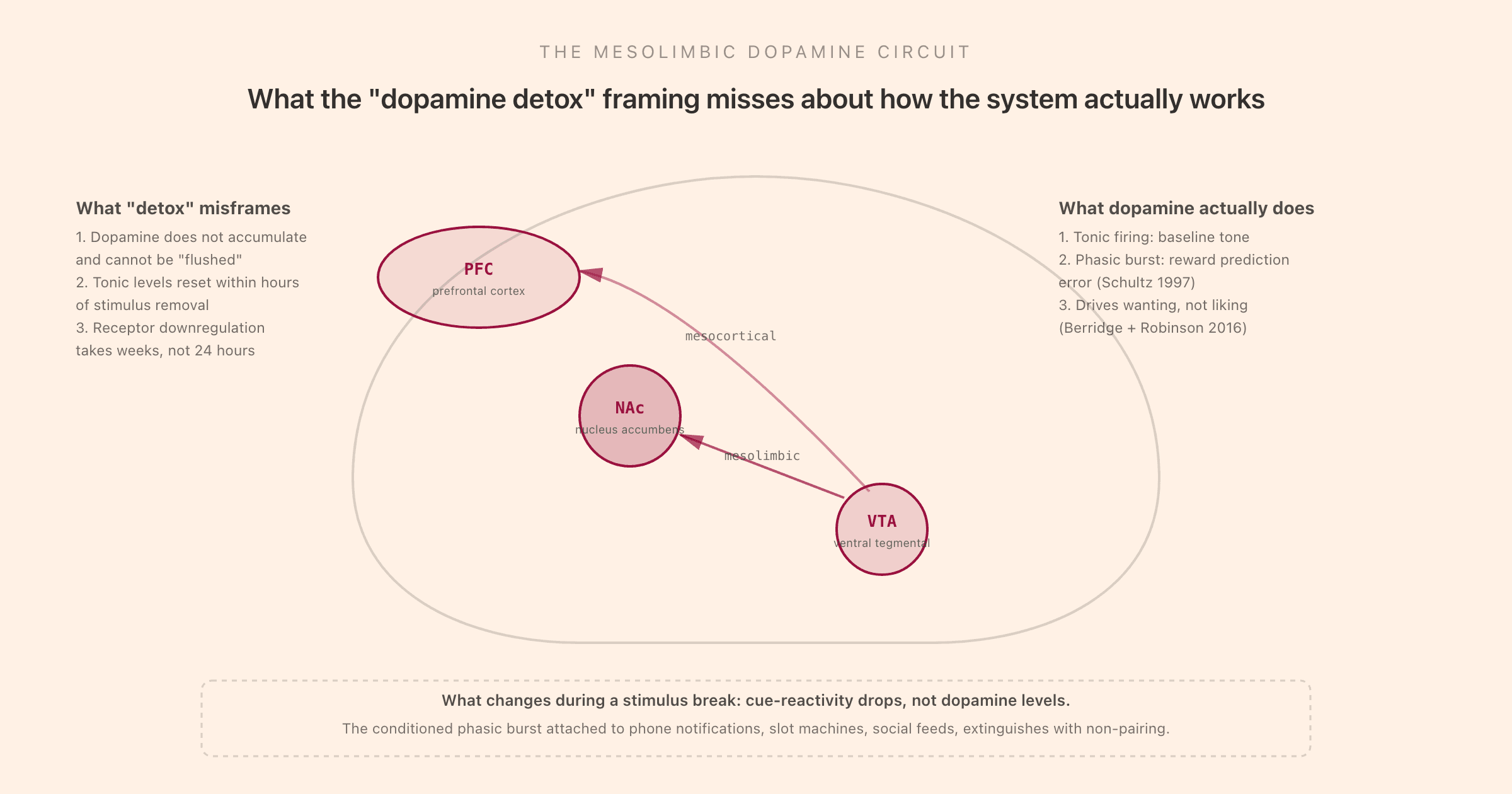
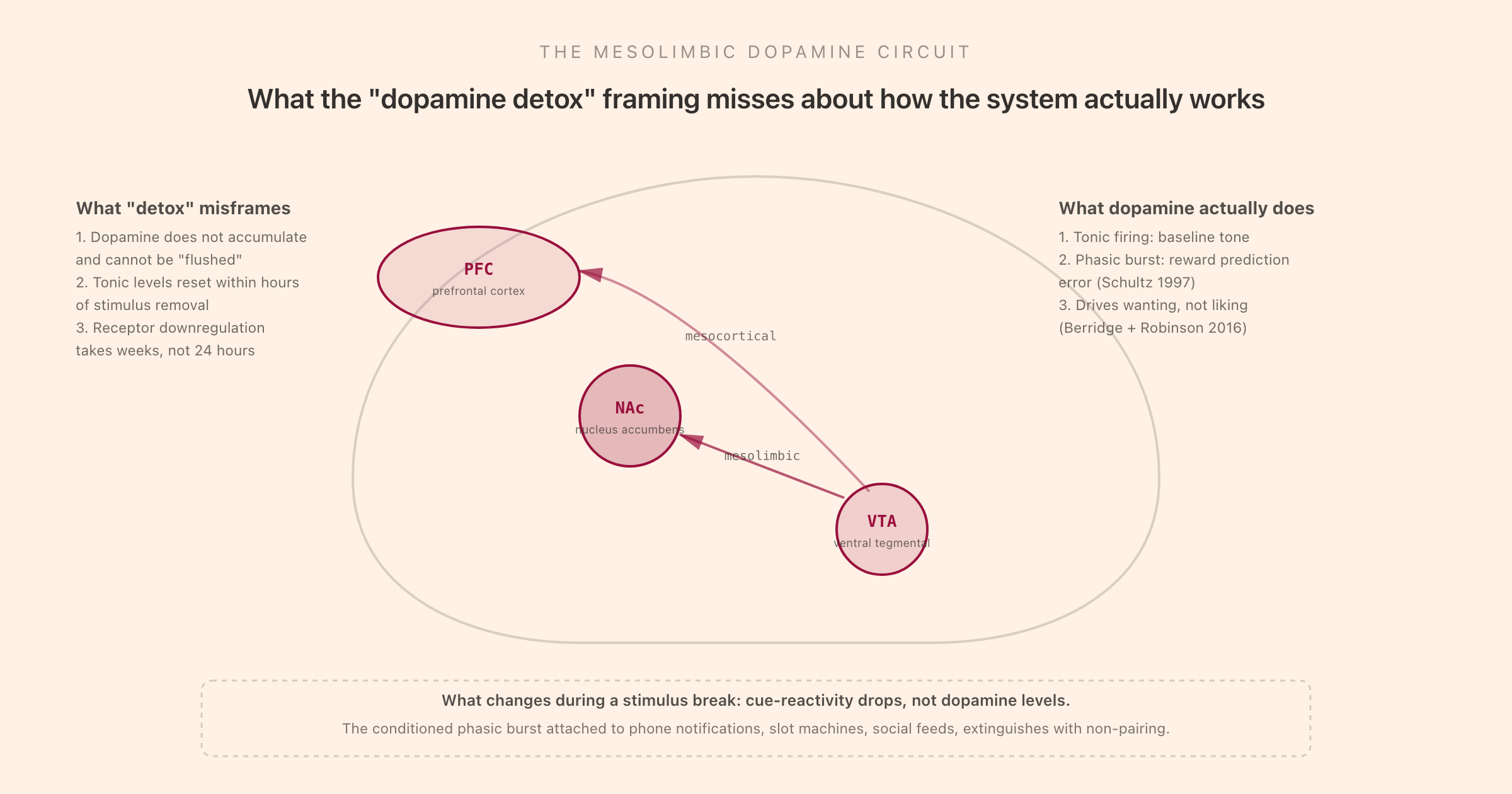
The mesolimbic pathway runs from the VTA to the nucleus accumbens in the ventral striatum. This is the so-called "reward circuit," though that name is a thirty-year oversimplification the field has been quietly revising. The mesocortical pathway runs from the VTA to the prefrontal cortex and is part of how cognitive control and motivation interact. The same neurons split projections across both, so the system does not run on independent reward and control channels.
VTA dopamine neurons fire in two modes, and this is the part the detox meme leaves out entirely.
Tonic firing is the slow baseline rate, roughly 1 to 5 Hz, that keeps a steady ambient level of dopamine in the synapse. Tonic dopamine sets motivational tone: how willing you are to expend effort for a reward, how strongly you pursue distant goals. Reduce tonic dopamine and people become apathetic and effort-averse, the symptom cluster seen in untreated Parkinson's and in some depressions.
Phasic firing is the burst mode: brief volleys of 15 to 30 Hz triggered by salient stimuli. Wolfram Schultz's famous 1997 monkey experiments established that these phasic bursts do not simply mark reward. They mark reward prediction error, the difference between predicted and actual reward. A surprise reward triggers a big burst. An expected reward triggers almost no burst. A predicted reward that fails to arrive triggers a dip below baseline. The phasic dopamine signal is, mathematically, exactly what a reinforcement-learning algorithm needs to update the value of actions. It is the brain's update rule, not the brain's pleasure.
Kent Berridge and Terry Robinson extended this with the wanting versus liking distinction. Their decades of microinjection work in rats showed that dopamine drives wanting (the motivation to pursue) but not liking (the hedonic experience itself). You can ablate the mesolimbic dopamine system and rats still display pleasure facial expressions for sweet tastes; they just stop working to obtain them. The opioid and endocannabinoid systems, not dopamine, generate the actual hedonic signal. This is one of the most important findings the productivity meme erases by saying "dopamine = pleasure."
Three implications of the actual biology that the detox meme ignores:
- Dopamine is the learning signal, not the reward itself. Phone notifications hijack the system because their variable, unpredictable delivery maximises prediction-error bursts. Removing the notifications for a day does not "reset" the system; it stops feeding the bursts.
- Tonic and phasic are separable. A baseline-level reduction (from prolonged stress, sleep deprivation, certain illnesses) produces different symptoms from a hijacked phasic system (compulsive checking). Conflating them, which the detox meme does, prescribes the wrong intervention for either problem.
- Reward prediction error is computed against a learned baseline. Repeated unpredictable rewards raise the baseline expectation, which is what reduces the phasic burst over time. The behavioural consequence is tolerance and the felt sense of "needing more." This is real. It just is not the dopamine system being "flooded."
Why a 24-Hour Detox Does Not Reset the System
The standard dopamine-detox protocol prescribes 24 hours (sometimes 48, occasionally a week) of abstinence from "high-dopamine" activities, claimed to reset the brain's sensitivity. The dosage is the giveaway. Twenty-four hours is not a timescale on which the dopamine system rebuilds anything.
Tonic dopamine returns to baseline within hours of stimulus removal. The dopamine in a synapse is cleared by the dopamine transporter (DAT) on the order of milliseconds; the firing rate of VTA neurons reflects current ambient conditions and current drive. A four-hour break from a phone produces a tonic dopamine state essentially indistinguishable from a 24-hour break. The detox framing borrows the language of "clearing" without specifying anything that could be cleared on the prescribed timescale.
Phasic responses are not stored. There is no reservoir to deplete. When a stimulus arrives, the VTA fires based on the prediction error against the current learned baseline. The phasic system is a real-time computation; the only way to change its output is to change the prediction model, which is a learning process and operates over many repeated experiences, not 24 hours.
Receptor downregulation is the part of the addiction literature the meme is reaching for. With chronic high-magnitude stimulus, D2 dopamine receptors in the striatum genuinely do downregulate, as shown in classic PET imaging studies by Nora Volkow at NIDA in cocaine and methamphetamine users. The effect is real, large (roughly 20 to 30% reductions in D2 binding potential have been reported), and clinically meaningful. It is also slow to develop and slow to reverse, on the order of weeks to months of abstinence. Cameron and colleagues (2017) showed partial recovery over six months in methamphetamine abstainers. A 24-hour fast affects this not at all.
Sensitisation and tolerance at the circuit level also operate over weeks. The cellular machinery (DeltaFosB accumulation, dendritic spine remodelling in the nucleus accumbens, conditioned cue learning in the amygdala and hippocampus) does not reverse meaningfully in a weekend. The Robinson and Berridge incentive-sensitisation model explicitly emphasises that the changes are durable.
The honest version is this: the dopamine system is not the thing the detox is acting on, because the dopamine system does not operate on a timescale where the detox could work. What is happening on a 24-hour timescale is different.
What Actually Happens During a "Detox"
What is real about the experience is not what the meme claims. People who do a 24-hour or weekend fast from high-stimulus inputs reliably report a noticeable shift, and the reports are not placebo. The shift is real, it has identifiable mechanisms, and none of them are "dopamine reset."
Cue-reactivity extinction starts immediately. The conditioned phasic bursts attached to specific cues (the lock-screen, the inbox notification chime, the slot-machine reel sound) are extinguished by non-pairing. Stop pairing the cue with reward and the burst weakens. This is classical Pavlovian extinction, mediated through the amygdala and the ventromedial PFC. A 24-hour absence does not extinguish a conditioned response that took years to establish, but it begins the process and produces the felt sense of "not reaching for my phone as often."
Habituation reverses. The thalamocortical attentional system habituates to constant stimulation, raising the threshold at which mundane stimuli register as salient. Removing the high-amplitude stimuli for a day lowers the salience threshold, so a walk outside, a book, a conversation, register as more interesting than they did the day before. The sensation of "the world looks brighter after a detox" is mostly this. It is a sensory-attention effect, not a dopamine effect.
Sleep usually improves. A 24-hour break from late-night screen exposure removes a circadian-disruption load (per the circadian rhythm piece, evening light suppresses melatonin onset). The cognitive lift the next day partly reflects better sleep, which directly improves working memory and executive function (covered in working memory and executive function) without any dopamine system involvement.
The default mode network engages more. Without continuous external stimulus, the DMN takes over for longer stretches, producing the rumination, mind-wandering, and creative-association experience people describe during a detox. Some of this is uncomfortable (boredom, anxiety, the urgent pull back to the phone), which is the actual reason most attempts fail at hour six.
Self-control reserves transiently rebuild. The dorsolateral PFC, which mediates effortful inhibition, operates with metabolic and possibly glycogen-dependent costs. A day of low cognitive-control demand (since you are not constantly resisting the phone) leaves more capacity for the next day's tasks. This is not the long-debated "ego depletion" claim (which has not survived replication); it is a more modest acute-fatigue effect.
None of these are bad outcomes. Several are genuinely useful. They are just not "dopamine reset."
What Anna Lembke Actually Argues
The dopamine-detox meme cites Anna Lembke's Dopamine Nation: Finding Balance in the Age of Indulgence (2021) as its scientific backing, often via a single talking point: "dopamine fasts work." This is not what the book argues, and the misquotation matters because Lembke's actual model is more useful than the meme version.
Lembke is a Stanford psychiatrist running an addiction clinic. The book's central concept is the pleasure-pain balance: the brain pairs pleasure and pain on the same neural seesaw, and after every hedonic peak the seesaw tilts the opposite way, producing a compensatory dip (this is the opponent-process model, originally formulated by Solomon and Corbit in 1974, which Lembke is updating with current circuit-level findings). With repeated stimulus, the dip deepens and lengthens, and tolerance develops. The withdrawal-mediated dip becomes the baseline state, which is why heavy users feel terrible when not using and only neutral when using.
Lembke's prescription has a specific structure she calls the DOPAMINE framework: Data (audit the use), Objectives (why are you using it), Problems (what is it costing), Abstinence (a 4-week minimum, not 24 hours), Mindfulness (sit with the discomfort), Insight (notice what the use was suppressing), Next steps (graded re-introduction or full abstinence), and Experiment (test the graded re-introduction).
The relevant numbers are 4 weeks, not 24 hours. The four-week period is chosen because the clinical literature on stimulus-control interventions consistently finds that meaningful cue-reactivity extinction, mood normalisation, and capacity to enjoy non-target rewards begin around 2 to 4 weeks of abstinence. The 24-hour version of the meme is genuinely not what Lembke prescribes, and she has said as much in subsequent interviews.
The book's other contribution is its framing of digital addiction as continuous with substance addiction, mediated by the same circuit, the same neurotransmitter system, and the same incentive-sensitisation process. The neuroscience supports this framing more strongly than the casual user might expect: phone-use disorder, problem gambling, and substance use disorder show overlapping neural signatures on fMRI and similar response to behavioural interventions. The shared underlying machinery is the mesolimbic system covered above.
The Five Levers That Actually Reduce Compulsive Reward-Seeking
The clinical and behavioural-neuroscience literature converges on a small number of interventions that genuinely reduce compulsive reward-seeking. They are slower and less photogenic than a weekend phone fast, and they work.
1. Stimulus control (multi-week, not 24-hour)
Remove the cue, not just the consumption. The strongest behavioural lever in any addiction treatment is environmental restructuring: get the stimulus out of physical reach, out of automatic-login state, off the home screen, behind friction. The reason is the cue-reactivity mechanism above: it is the cue, not the consumption, that triggers the conditioned phasic burst. Removing the cue allows extinction to proceed; reducing consumption while leaving cues in place does not.
The 24-hour version of this is the dopamine detox. The four-week version is the Lembke protocol. The lifetime version is the recovering-alcoholic rule of not keeping liquor in the house. The mechanism is the same at all three timescales; only the depth of the change differs.
2. Variable-ratio reinforcement removal
The single most exploitable feature of the dopamine system is variable-ratio reinforcement, the schedule on which slot machines, social-media feeds, dating apps, and inbox-pull operate. Reward arrives at unpredictable intervals, which maximises both phasic prediction-error bursts and behavioural persistence (variable ratio is the most extinction-resistant schedule in operant psychology, established by Ferster and Skinner in 1957). The intervention is not "use less"; it is switch to a fixed schedule. Email twice a day at scheduled times. Social-media at a fixed window. The same total exposure, on a fixed schedule, produces dramatically less compulsion because the schedule is the active ingredient.
3. Structured working blocks that crowd out cue-checking
This is where focus tools like the Pomodoro Technique earn their reputation. The mechanism is not that the technique is intrinsically motivating; it is that a 25-minute committed block with the phone in another room is a 25-minute window in which the cue is unavailable and the compulsive check cannot happen. Repeated daily, this directly extinguishes the conditioned cue-checking response. Tomatoes is built on this mechanism: steady audio masks variable sound, the timer externalises the commitment, the cycle removes the moment-by-moment "should I check" decision. None of this requires a detox; it requires structure that makes the checking inconvenient.
4. Hard physical exercise
Acute exercise transiently increases tonic dopamine and noradrenaline and, through repeated exercise, upregulates dopamine receptor density in animal models (Vučetić and colleagues 2008; less direct human evidence but reasonable inference). It does not "reset" the system, but it elevates baseline motivational tone, which makes everyday rewards more rewarding by contrast and reduces the relative pull of the high-stimulus stack. The intervention costs time and effort, which is precisely why it works and why no one is selling it as a viral meme.
5. Sleep, sunlight, and protein-adequate diet (the boring foundation)
The dopamine system is a downstream consequence of upstream brain health. Sleep debt, circadian misalignment, undernutrition (particularly low intake of tyrosine, the dopamine precursor), and chronic inflammation all reduce dopaminergic function in ways that look like loss of motivation. The interventions are boring, slow, and not market-ready: seven to nine hours of sleep on a regular schedule, morning sunlight for circadian anchoring, adequate protein and micronutrients, and reduction of chronic inflammatory load. They are the foundation on which any of the above can build. They do not photograph well.
What Tomatoes Actually Does, and Does Not, Do
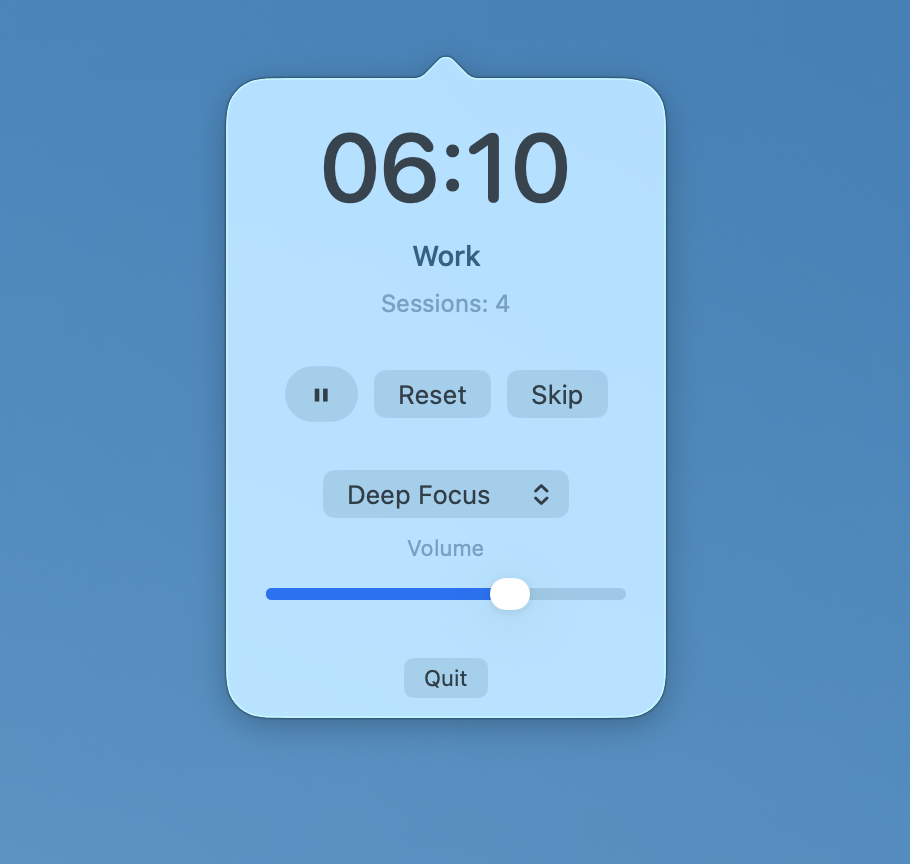
Tomatoes is a focus tool. It does not detox dopamine. What it does is make a working block structurally easier to enter and harder to interrupt, which is the third of the five levers above.
The audio engine generates steady, science-driven focus music (binaural beats, pink and brown noise, 40 Hz gamma stimulation) that masks variable environmental sound, removing the constant low-level prediction-error stream that makes background noise distracting. The timer externalises the commitment to a 25-minute working window so the user does not spend cognitive resources on moment-by-moment continuation decisions. The cycle structure (25 working, 5 short, longer break after four) follows the ultradian rhythm of natural attentional cycles. None of this changes the dopamine system. It changes the working environment so that the conditioned cue-check (the phone, the tab, the inbox) becomes unavailable for a structured window, allowing the extinction process to actually run.
Tomatoes is a one-time $39 desktop app with no subscription and no account. It runs locally, syncs with the system menu bar, and is built for working blocks of three to six hours per day.
Dopamine detox is the wrong name for a real problem. The real problem is compulsive reward-seeking driven by variable-ratio reinforcement schedules engineered into modern apps and content. The real fix is structural cue-removal applied consistently for weeks, paired with deliberate working blocks that crowd out the cue-checking habit. The weekend version makes a useful first signal that the problem exists. The four-week version starts to change the system. The lifetime version of building structured working blocks is what eventually works.