Executive function is the brain's top-down control system: the set of processes that hold a goal in mind, suppress the impulses that compete with it, and switch flexibly between the sub-tasks that get you there. It is the reason you can ignore a notification, stop yourself sending the angry email, hold a deadline against a more tempting present-moment option, and follow a multi-step plan without losing the thread. When people say they "can't focus," what has usually failed is not attention as a searchlight but executive function as a controller. Attention is what executive function points.
This piece is the cognitive-science version of executive function: what it is, the Miyake unity-and-diversity model that gives it three separable components, the prefrontal-cortex circuitry it runs on, the protracted development curve that does not finish until the mid-twenties, what executive dysfunction looks like and why ADHD is its canonical profile, how it is measured, and the contested question of whether it can be trained (the answer rhymes with the working-memory training answer: the trained task improves, the far transfer mostly does not). Tomatoes is a focus tool built around reducing the load on one specific executive component, the inhibitory-control cost of suppressing distractors, by masking them with a steady audio channel instead. The app is a one-time $39 with no subscription. The rest of this article is the science of the system the app is trying to support.
What Executive Function Actually Is
Executive function is an umbrella term for the cognitive control processes that regulate thought and action in the service of a goal. The word "executive" is the right metaphor: these are not the processes that do the work, they are the processes that decide which work gets done, in what order, and with what resources. A person can have an intact memory, intact perception, intact language, and intact motor control, and still be profoundly impaired if the executive layer that coordinates them is damaged. That dissociation, demonstrated repeatedly in patients with prefrontal damage, is the original evidence that executive function is a distinct system rather than a by-product of the abilities it governs.
Three properties define it and separate it from the cognitive abilities underneath:
It is top-down, not bottom-up. Bottom-up processing is stimulus-driven: a loud noise captures attention whether you want it to or not. Executive function is the top-down counterforce, the goal-driven signal that says "ignore that, the goal is here." Most focus failures are a contest between a strong bottom-up pull and a weak top-down hold.
It is effortful and capacity-limited. Executive function feels like work because it is work. It cannot run many processes at once, it is sensitive to fatigue, sleep loss, stress, and time of day, and it competes with itself: suppressing one distractor uses resources that are then unavailable for holding the goal. This is why a cluttered environment is expensive even when you are "successfully" ignoring the clutter.
It is goal-oriented and future-directed. Executive function is the machinery of doing something now because of an outcome later. It holds the future-relevant goal in active contact with the present moment so that present behaviour can be organised around it. When that contact weakens, behaviour defaults to whatever the most salient present stimulus is, which is the mechanism behind both ordinary procrastination and the more severe time-blindness of ADHD.
The Miyake Model: Unity and Diversity
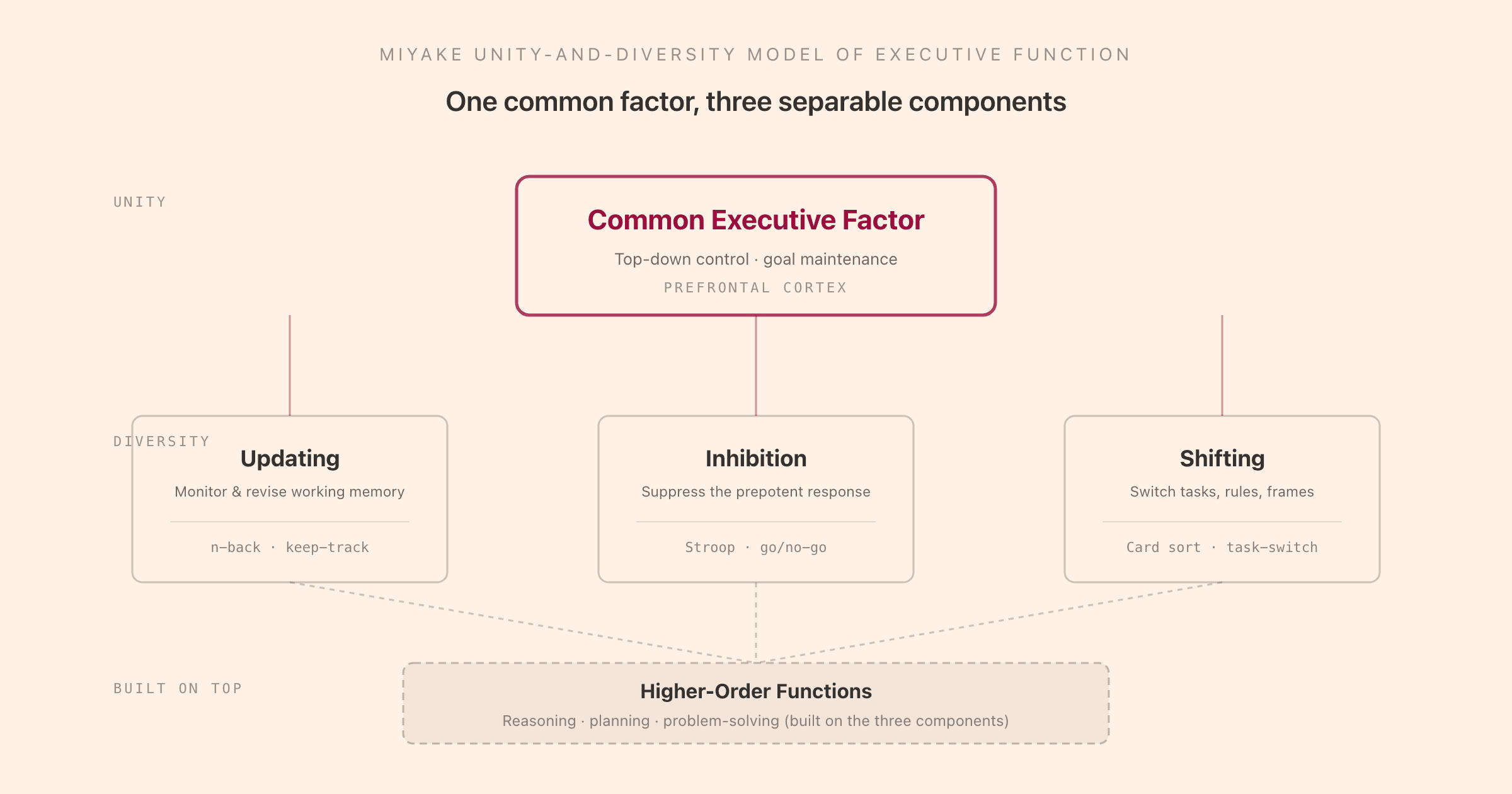
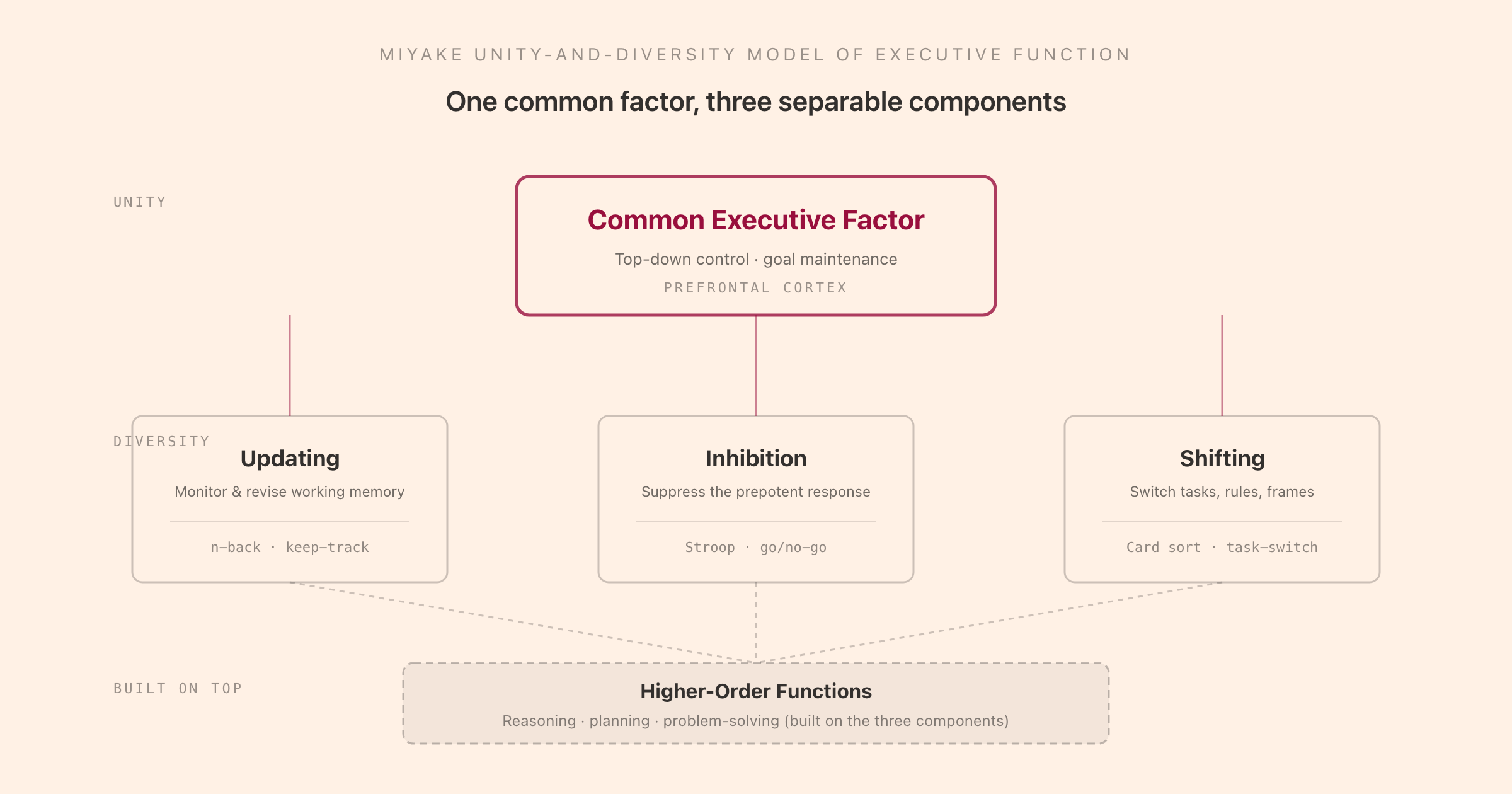
The most influential framework for executive function comes from Akira Miyake and colleagues (2000). They administered a battery of executive tasks to participants and ran a confirmatory factor analysis to ask a structural question: is executive function one thing or many? The answer was "both," which is why the model is called unity and diversity. The tasks loaded onto three separable factors, but the three factors were correlated, implying a shared common executive component underneath. Three components, one family.
Updating. The monitoring and rapid revision of the contents of working memory: keeping the workspace current, swapping out information that is no longer relevant for information that just became relevant. Updating is the executive component that overlaps most directly with working memory; Baddeley's "central executive," the attentional controller in his working-memory model, is essentially the updating function described from the memory side. Measured by tasks such as the n-back and keep-track tasks.
Inhibition. The deliberate suppression of a prepotent or automatic response when that response conflicts with the goal. Inhibitory control is what stops you reading the word in a Stroop task so you can name the ink colour, what stops you checking the phone, what stops the first draft of a sentence from being the one you say out loud. It is also the component most obviously taxed by a distracting environment.
Shifting. Cognitive flexibility: moving between tasks, rule sets, or mental frames. Shifting is what lets you switch from the spreadsheet to the email and back, but it is not free. Every shift carries a switch cost, a measurable slowdown as the executive system reconfigures, and incomplete prior tasks leave attention residue that the system keeps paying for. Shifting is the component that multitasking abuses.
Robert Diamond's widely cited 2013 review frames the same territory slightly differently: three core executive functions (inhibitory control, working memory, cognitive flexibility) from which the higher-order functions (reasoning, planning, problem-solving) are constructed. The terminology differs, the structure is the same. Updating, inhibition, shifting at the base; reasoning, planning, problem-solving built on top.
Where Executive Function Lives
The neural seat of executive function is the prefrontal cortex, the region behind the forehead, with the dorsolateral prefrontal cortex doing the heaviest lifting for the "cold" abstract-logical executive work and the ventromedial and orbitofrontal prefrontal cortex handling the "hot" affective-motivational executive work (decisions with emotional or reward stakes). The prefrontal cortex does not act alone: the anterior cingulate cortex monitors for conflict and signals when more control is needed, and parietal regions support the working-memory side. But the prefrontal cortex is the hub, and prefrontal damage is the classic cause of dysexecutive syndrome.
The historical anchor is Phineas Gage, the railway foreman whose prefrontal cortex was destroyed by an iron rod in 1848 and whose memory, language, and motor control survived intact while his capacity to plan, regulate, and organise behaviour did not. The modern framework is Norman and Shallice's supervisory attentional system: routine behaviour can run on automatic schemas, but when a situation is novel, dangerous, or requires overriding a habit, a supervisory system has to step in. That supervisory system is executive function, and it is what the prefrontal cortex provides.
The Development Curve: Slow to Arrive, First to Leave
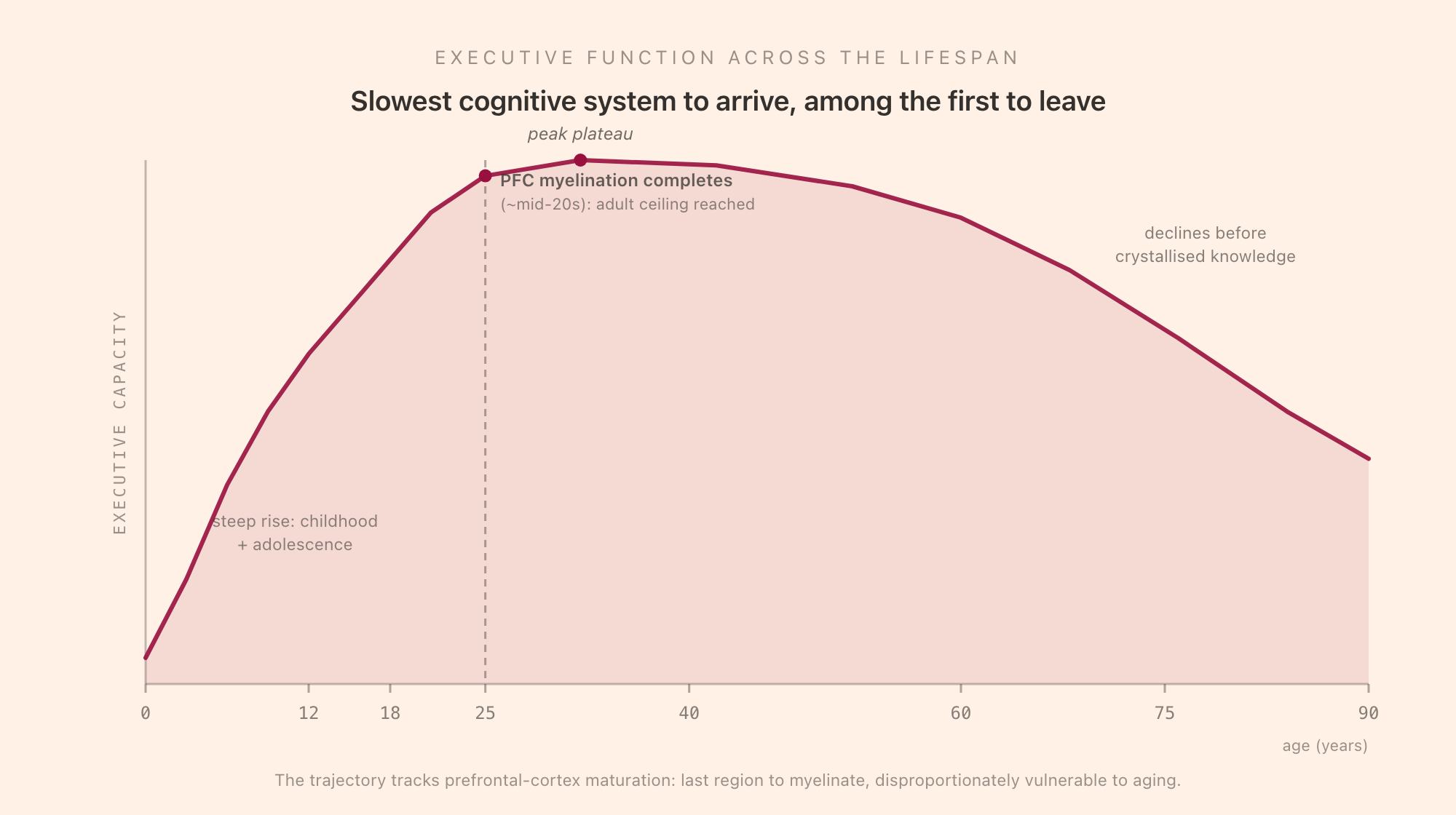
Executive function has the most protracted developmental timeline of any cognitive system, and the reason is structural: the prefrontal cortex is the last brain region to fully mature. Synaptic pruning and, critically, myelination of prefrontal circuits continue into the mid-twenties. This is why executive function rises steeply through early and middle childhood, keeps climbing through adolescence, and does not reach its adult ceiling until roughly age twenty-five. The adolescent who is intellectually capable but impulsive, poor at planning, and bad at resisting immediate rewards is not failing; their prefrontal hardware is still being built.
At the other end of the lifespan, executive function is among the first cognitive domains to decline in normal aging, again because the prefrontal cortex is disproportionately vulnerable to age-related change. Processing speed and executive control fall before crystallised knowledge does, which is why an older adult can retain a vast vocabulary and deep expertise while finding task-switching and inhibition measurably harder.
The practical reading of the curve: executive function is not a fixed trait you either have or lack. It is a capacity with a developmental arc, and within any given day it also fluctuates with sleep, stress, and time on task. Designing your environment around that fluctuation is more productive than treating your executive function as a constant.
Executive Dysfunction and the ADHD Link
Executive dysfunction is not a standalone diagnosis. It is a transdiagnostic feature, a pattern of impaired cognitive control that shows up across many conditions: traumatic brain injury, depression, schizophrenia, the normal aging process, and most prominently attention-deficit/hyperactivity disorder.
ADHD is the canonical executive-dysfunction profile, and Russell Barkley's model makes the strong version of the claim: ADHD is fundamentally a disorder of executive function, with inhibitory control and working memory as the central impairments, and the attention deficit is largely downstream of those. The logic is the same one that runs through the working-memory piece. If the executive system that holds a future-relevant goal against present distractors is weak, future goals fade faster, and behaviour defaults to the most salient present stimulus. That is the phenomenology of ADHD: not an inability to attend, but an inability to direct and sustain attention against competition. Time-blindness, the difficulty holding a deadline in working contact with the present, falls out of the same weak executive hold.
The practical implication does not depend on winning the definitional argument about whether ADHD is "really" an attention disorder or "really" an executive disorder. Either way, executive load makes the symptoms worse and external scaffolding makes them better. Lists, timers, calendar reminders, and a visible deadline are all ways of moving part of the executive job out of the prefrontal cortex and into the environment, where it does not have to be actively held. The procrastination piece covers the motivational side of the same failure, and the hyperfocus piece covers the opposite failure mode, where the shifting component locks up and the executive system cannot disengage from a single salient task.
How Executive Function Is Measured
Each component of the Miyake model has a workhorse measure.
Inhibition: the Stroop task. Colour words printed in conflicting ink ("RED" printed in blue). Naming the ink colour requires suppressing the prepotent response of reading the word. The slowdown on incongruent trials is the inhibition cost.
Updating: backward digit span and the n-back. Holding and manipulating the contents of working memory. Backward digit span (repeat a list in reverse) and the n-back (flag the stimulus n positions back) both load the updating component.
Shifting: the Wisconsin Card Sorting Test and task-switching paradigms. The Wisconsin Card Sorting Test asks the participant to sort cards by a rule that changes without warning, measuring how flexibly they can abandon an old rule for a new one. Task-switching paradigms measure the switch cost directly.
Higher-order function: the Tower of London and Trail Making Test B. The Tower of London measures planning by requiring a sequence of moves worked out in advance. Trail Making Test B (alternating between numbers and letters) loads shifting plus speed and is a common clinical screen.
No single test captures "executive function" as a whole, because the model says there is no single thing to capture. A proper assessment samples all three components, because a person can be strong on inhibition and weak on shifting, or the reverse.
Can Executive Function Be Trained?
This is the contested question, and the honest answer is closely parallel to the working-memory training answer. Computerised training on a specific executive task reliably improves performance on that task and on tasks that closely resemble it (near transfer), but the evidence for far transfer, generalised improvement in untrained executive abilities or in real-world outcomes, is weak and inconsistent. The brain-training industry has consistently over-promised here, and the large meta-analyses have consistently under-delivered on the industry's behalf.
The more useful finding comes from Diamond and Ling's reviews of what does move executive function. The activities with the best evidence are not isolated computer drills but activities that continually and progressively challenge executive function while engaging the whole person: aerobic exercise, certain mindfulness practices, and structured school curricula (such as Tools of the Mind) that build executive demands into the activity itself. The common thread is that executive function improves most when it is stretched in a varied, motivating, real context rather than in a narrow trained task, and when the supporting conditions (sleep, stress, physical health) are addressed rather than ignored.
The realistic takeaway: do not buy an app expecting it to enlarge your executive capacity in general. Do treat executive function as a resource to be protected and supported. Protect it with sleep and exercise, support it with environmental scaffolding that offloads part of the job, and stop spending it on multitasking, which is the single most expensive thing you can do to the shifting component.
What This Means for Focus Work
Three implications follow directly from the model.
Externalise the executive job wherever you can. Every list, timer, and calendar reminder is a piece of the executive load moved out of the prefrontal cortex and into the environment. The goal is not to have a stronger executive system, it is to give the one you have less to hold.
Single-task, because shifting is the expensive component. Multitasking is not doing two things at once, it is rapid switching, and every switch pays a reconfiguration cost plus the attention residue left by the unfinished task. The most direct way to spend less executive function is to switch less.
Reduce the inhibitory-control bill by removing distractors instead of resisting them. Inhibition is effortful and capacity-limited. Every distractor you successfully ignore still cost you something to ignore. Removing the distractor is cheaper than suppressing it, and where it cannot be removed, masking it is the next best thing. A steady, low-information audio channel covers variable environmental sound so the executive system does not have to keep flagging and suppressing each new noise. That is the specific job a focus-music channel does: it lowers the inhibition load so more of the executive budget is available for the updating and the goal-holding.
The default mode network piece covers the circuit that competes with executive control for the brain, and the working-memory piece covers the updating component in depth.
The Bottom Line
Executive function is the prefrontal control system that holds a goal, suppresses what competes with it, and switches flexibly between sub-tasks. The Miyake model gives it structure: updating, inhibition, and shifting, three separable components with a shared core, supporting the higher-order functions of reasoning and planning. It runs on the prefrontal cortex, it takes twenty-five years to fully build and is among the first systems to decline with age, and it is the system whose weakness defines executive dysfunction and, on Barkley's account, ADHD. It cannot be expanded by drilling a narrow task, but it can be protected, supported, and offloaded.
The pomodoro pattern is, read through this model, an executive-function protocol. The fixed twenty-five-minute block removes the shifting decision (no switching is allowed inside the block, so the shifting component is not spent). The timer externalises the goal-holding (the executive system does not have to track time, the timer does). The break lets a depletable resource recover before the next block. And the audio inside the block lowers the inhibition cost of the environment. Tomatoes is built around that pattern and is a one-time $39 with no subscription. The executive system does the focusing; the tool's job is to give it less to fight.