
The prefrontal cortex is the part of your brain that decides whether you focus. Sitting just behind your forehead, at the very front of the frontal lobe, it is the control center for everything we mean by self-direction: holding a goal in mind, resisting the urge to check your phone, planning the next step, and choosing what to pay attention to out of the flood of things competing for it. Every other system in the brain can be working perfectly, but if the prefrontal cortex is depleted, you will not be able to stay on task. This is the focus-science guide to the prefrontal cortex: what it is, what its subregions actually do, why it matures last and collapses first under stress and fatigue, and what you can do to protect the one region your attention most depends on.
Understanding it changes how you think about focus. Concentration is not a personality trait or a matter of willpower in the moralistic sense; it is a physical process run by a specific, energy-hungry, and surprisingly fragile piece of cortex. Tomatoes is a focus tool built around protected, low-distraction work blocks that work with this system instead of against it. The app is free for 3 days, then $4.99/week, $29.99/year, or $39 lifetime.
What Is the Prefrontal Cortex?
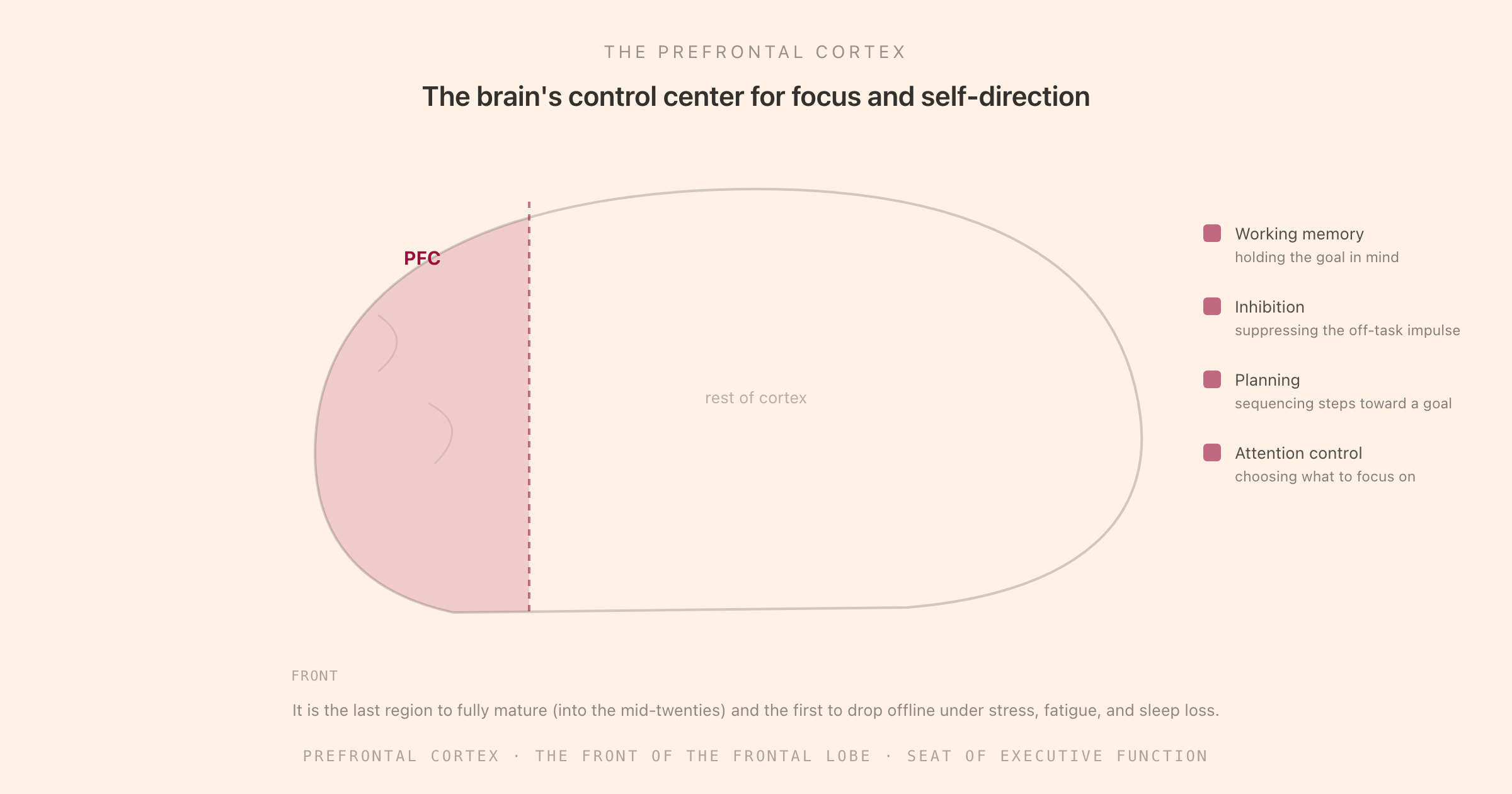
The prefrontal cortex, often shortened to PFC, is the front-most part of the frontal lobe, the large region of cortex directly behind your forehead. It makes up a strikingly large share of the human brain (proportionally far more than in other animals) and it is the part most associated with what we think of as higher cognition: reasoning, judgment, personality, and the deliberate control of behavior. If the back of the brain is largely about perceiving the world and the deeper structures are about drives and emotions, the prefrontal cortex is about deciding what to do with all of it.
It is best understood not as a thing that "does" tasks itself but as a conductor. It does not store your memories or move your muscles directly; it coordinates the rest of the brain in the service of a goal. When you hold an intention in mind and steer your behavior toward it despite distractions, that top-down control is the prefrontal cortex at work. This is why it is described as the seat of executive function, the brain's management system, and why damage to it can leave perception, memory, and movement intact while devastating a person's ability to plan, regulate impulses, and stay on track.
What the Prefrontal Cortex Does for Focus
Four of the prefrontal cortex's jobs map directly onto the experience of concentrating:
- Working memory. The PFC holds the current goal and the relevant information "online" so you can act on it. When you keep the point of a paragraph in mind while reading the next one, that is prefrontal working memory at work. Lose it, and you read the same line three times.
- Inhibition. Focus is as much about what you suppress as what you attend to. The PFC inhibits the prepotent, easier response: the impulse to open a new tab, check a notification, or chase a more interesting thought. Every act of "not right now" is an act of prefrontal inhibition.
- Planning. The PFC sequences behavior toward a goal, breaking a large intention into ordered steps and keeping the plan coherent over time.
- Attention control. Out of everything your senses and thoughts offer, the PFC helps select what gets the spotlight and keeps it there, biasing the rest of the brain toward the task-relevant signal and away from noise.
These are not four separate skills so much as four faces of one capacity: the ability to keep behavior aligned with an internal goal rather than letting it be captured by whatever is most immediately salient. That capacity is, essentially, focus.
Inside the Prefrontal Cortex: The Subregions
The prefrontal cortex is not uniform. It has functionally distinct subregions, and a few of them matter especially for attention.
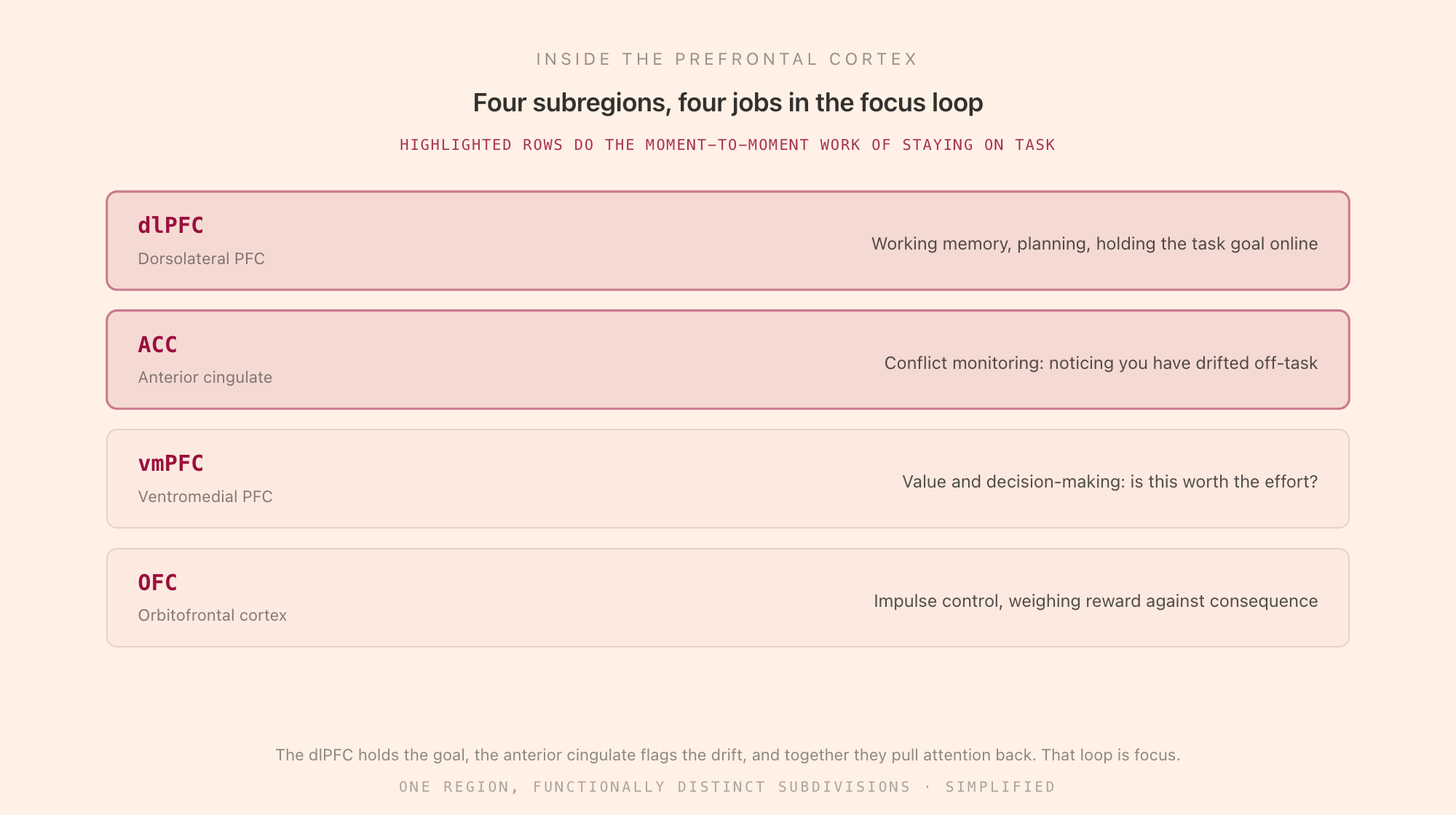
- The dorsolateral prefrontal cortex (dlPFC) is the workhorse of focus. It is the primary site of working memory and planning, the region that holds the task goal online and keeps your behavior pointed at it.
- The anterior cingulate cortex (ACC), sitting alongside the prefrontal regions, does conflict monitoring: it detects when there is a mismatch between what you intended and what you are actually doing, in other words, it notices when you have drifted off-task. It is the alarm that says "you meant to be writing, and you are reading about something else."
- The ventromedial prefrontal cortex (vmPFC) is central to value and decision-making, weighing whether something is worth the effort, which is part of why a task that feels pointless is so hard to start.
- The orbitofrontal cortex (OFC) handles impulse control and the weighing of reward against consequence.
The focus loop falls out of this naturally: the dlPFC holds the goal, the ACC flags the drift, and together they pull attention back to the task. That cycle, repeated thousands of times a day, is what concentration actually is at the level of brain regions.
The Prefrontal Cortex and Dopamine
The prefrontal cortex does not run on willpower; it runs on neurochemistry, and dopamine is central. The mesocortical pathway carries dopamine from the midbrain directly to the prefrontal cortex, and the level of that dopamine tone sets how well the PFC can do its job. The relationship follows an inverted-U: too little dopamine and the PFC is underpowered, leaving you unfocused and unmotivated; too much and it becomes scattered and impulsive; somewhere in the middle is the sweet spot where working memory and attention control work best.
This is why the dopamine system and the prefrontal cortex have to be understood together. Conditions like ADHD involve prefrontal dopamine signaling, which is part of why stimulant medications that raise dopamine and norepinephrine availability can improve prefrontal function and focus. It is also why the PFC is so sensitive to your state: anything that pushes dopamine and the related neuromodulators out of that optimal middle band degrades prefrontal performance.
Why the Prefrontal Cortex Goes Offline First
Here is the most practically important fact about the prefrontal cortex: it is the most fragile part of your higher brain. It is metabolically expensive, it depends on a delicate neurochemical balance, and as a result it is the first system to drop offline when conditions are bad.
Stress is the clearest example. Under acute stress, a surge of cortisol and norepinephrine effectively takes the prefrontal cortex offline and shifts control to faster, more reflexive brain regions. This made evolutionary sense (in a genuine emergency you want fast habitual responses, not careful deliberation) but it is precisely why you cannot think clearly, plan, or resist distraction when you are stressed, anxious, or overwhelmed. The control center has been demoted on purpose.
Sleep deprivation does something similar. The prefrontal cortex is disproportionately impaired by lack of sleep, which is why a tired brain shows poor judgment, weak impulse control, and scattered attention even when simpler functions seem fine. Mental fatigue across a long day of demanding work also degrades prefrontal performance, which is why focus reliably gets harder in the afternoon.
The lesson is humbling and useful: a great deal of what feels like a personal failure of willpower is actually a prefrontal cortex that has been pushed offline by stress, fatigue, or sleep debt. You cannot out-discipline a depleted PFC. You can only protect it.
The Prefrontal Cortex Develops Last
The prefrontal cortex is also the last region of the brain to fully mature. Its development, including the myelination that speeds its connections, continues into the mid-twenties. This is the neuroscience behind a familiar observation: teenagers and young adults often have fully capable reasoning but weaker impulse control and long-term planning, because the prefrontal systems that govern those are still coming online. It is not a character flaw; it is a construction timeline. The same fact is a quiet encouragement for adults, because the prefrontal cortex remains plastic, and the control functions it supports can be strengthened with the right practice.
How to Protect and Strengthen Your Prefrontal Cortex
Because the PFC is fragile and state-dependent, the most effective thing you can do is protect the conditions it needs, then practice using it well.
- Protect sleep. Nothing restores prefrontal function like sleep, and nothing degrades it faster than the lack of it. This is the single highest-leverage move.
- Manage stress. Since cortisol takes the PFC offline, anything that lowers your stress load (slow breathing, exercise, not stacking every hard task into a frazzled afternoon) directly buys back prefrontal capacity.
- Work in protected blocks. The PFC's inhibition system is a limited resource, and every distraction it has to suppress spends some of it. Removing distractions in advance, rather than relying on in-the-moment willpower, means the prefrontal cortex spends its energy on the task instead of on resisting temptation. This is the core logic of single-tasking in a quiet, protected window.
- Respect the daily curve. Prefrontal capacity is highest when you are rested and depletes across the day. Schedule your most demanding, focus-heavy work for when the PFC is fresh, and save low-control tasks for when it is tired.
- Train it deliberately. The executive functions the PFC supports can be exercised. Sustained, effortful focus practice, the repeated act of noticing a drift and returning to task, is itself a workout for the dlPFC-ACC loop.
Working With Your Control Center
The prefrontal cortex is the brain region your focus runs on, and understanding it reframes concentration entirely. It is not a matter of wanting it badly enough; it is a matter of whether a specific, energy-hungry, sleep-and-stress-sensitive piece of cortex has the resources to do its job. Protect it with sleep and lower stress, stop forcing focus from a depleted state, and design your environment so the prefrontal cortex spends its limited inhibition on the work rather than on fighting distraction. The rest of your attention chemistry supplies the drive and alertness; the prefrontal cortex is what turns that into directed, sustained focus.
That is the principle Tomatoes is built on. A focus block is not about white-knuckling your way to concentration; it is about removing the distractions in advance so your prefrontal cortex does not have to spend itself suppressing them, and working in protected windows while it is fresh. If you want a focus tool designed around that, Tomatoes is free for 3 days, then $4.99/week, $29.99/year, or $39 lifetime.