Dopamine is the neurotransmitter your motivation runs on. It is the most talked-about and most misunderstood chemical in the brain, blamed for addiction and praised as the "pleasure molecule," sold as something to be detoxed from and hacked back up. Almost all of that is wrong, or at least badly oversimplified. Dopamine is not the chemical of pleasure. It is a teaching and motivation signal: it tells the brain that something turned out better than expected, it stamps in the behaviours that led there, and it generates the wanting that gets you to pursue a goal in the first place. For focus, that makes it foundational. Dopamine is what makes a task feel worth starting and worth continuing, and when its tone is low, the first thing to go is not your happiness but your drive to begin.
This is the focus-science version of dopamine: what it actually is, the small midbrain nuclei that supply it, the four pathways it travels, the prediction-error theory that explains what it really does, what low dopamine looks like, and what genuinely supports it. Tomatoes is a focus tool built around protected, low-distraction work blocks that work with this system instead of against it. The app is free for 3 days, then $4.99/week, $29.99/year, or $39 lifetime.
What Dopamine Actually Is
Dopamine is a monoamine neurotransmitter, built from the amino acid tyrosine through a short synthetic chain: tyrosine becomes L-DOPA, and L-DOPA becomes dopamine. It belongs to the same catecholamine family as norepinephrine and adrenaline, and in fact dopamine is the direct precursor the body uses to make norepinephrine. It acts across the brain on five receptor subtypes, grouped into two families: the D1-like family (D1 and D5), which tends to be excitatory, and the D2-like family (D2, D3, D4), which tends to be inhibitory. The balance between these receptor types in a given region is part of why dopamine can sharpen focus at the right level and scatter it at the wrong one.
Like the other neuromodulators, dopamine is not a fast point-to-point messenger carrying specific content. It is a slower, broadcast-style signal that sets a tone and biases how circuits behave. A relatively small number of dopamine-producing neurons, by changing their firing, shift motivation, learning, and movement across large territories of the brain at once. That is the design principle worth holding onto: dopamine is a system-level dial, not a single lever.
Where Dopamine Comes From: The Midbrain Sources
Almost all of the brain's dopamine is produced by two small clusters of neurons in the midbrain: the ventral tegmental area (VTA) and the substantia nigra. These are tiny structures, but their projections reach widely into the forebrain, and which target a projection reaches determines what the dopamine does there. This is the single most important fact for cutting through dopamine confusion: dopamine does not do one thing. It does different things in different places, and the "roads" it travels are distinct enough to have their own names.
The Four Pathways
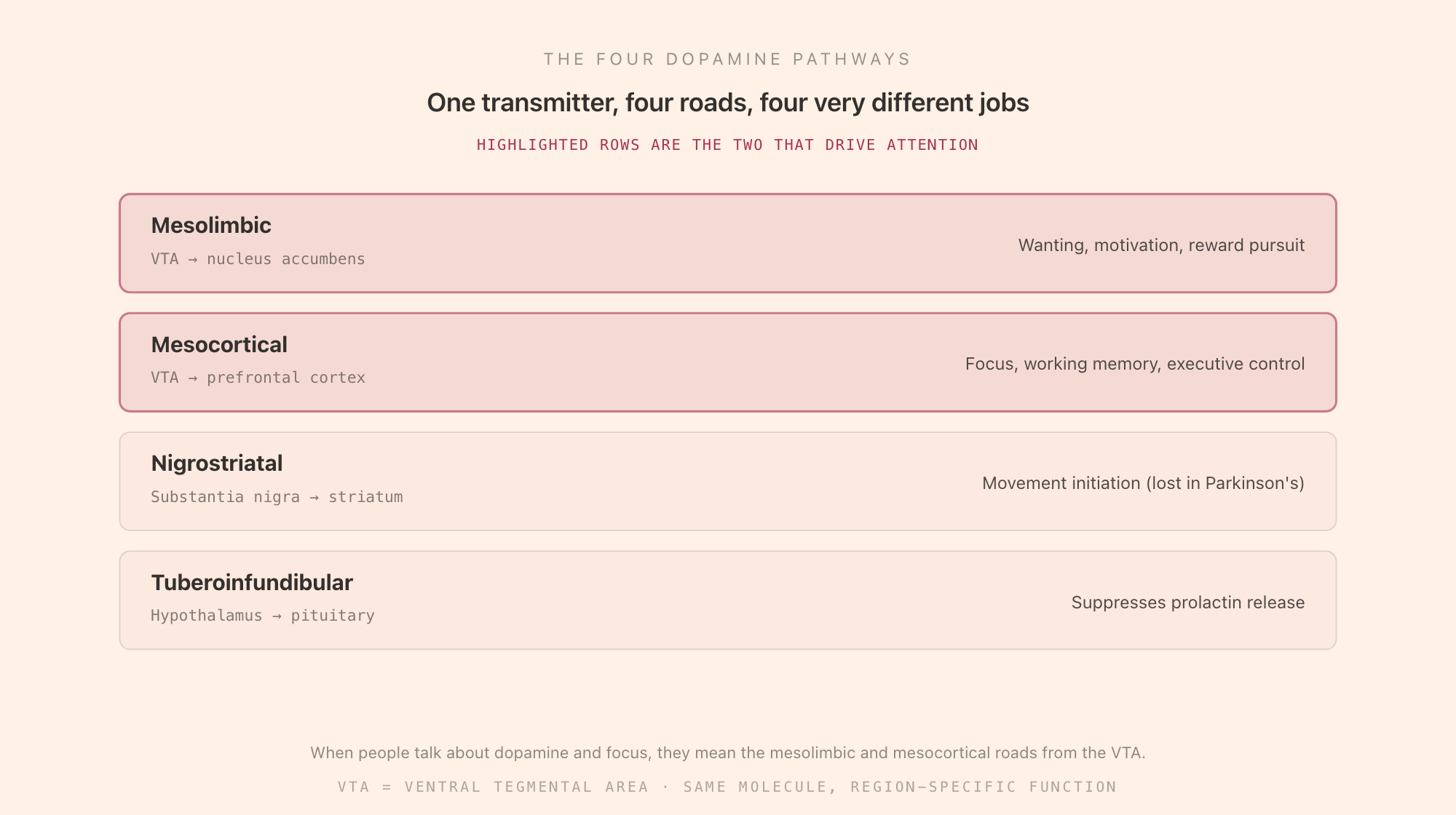
The mesolimbic pathway runs from the VTA to the nucleus accumbens. This is the motivation and reward-pursuit circuit, the one people mean when they talk about dopamine "hits." It generates wanting and the drive to act.
The mesocortical pathway runs from the VTA to the prefrontal cortex. This is the one that matters most for cognition: it supports working memory, attention, and executive control. Dopamine tone in the prefrontal cortex follows an inverted-U, where too little leaves you unfocused and unmotivated and too much makes you scattered and impulsive.
The nigrostriatal pathway runs from the substantia nigra to the striatum and governs the initiation of movement. It is the pathway that degenerates in Parkinson's disease, which is why the symptoms are about starting and controlling movement.
The tuberoinfundibular pathway runs from the hypothalamus to the pituitary and mostly does endocrine work, chiefly suppressing the release of prolactin.
When this article talks about dopamine and focus, it means the first two: the mesolimbic drive to pursue and the mesocortical machinery of attention.
What Does Dopamine Do? The Prediction-Error Insight
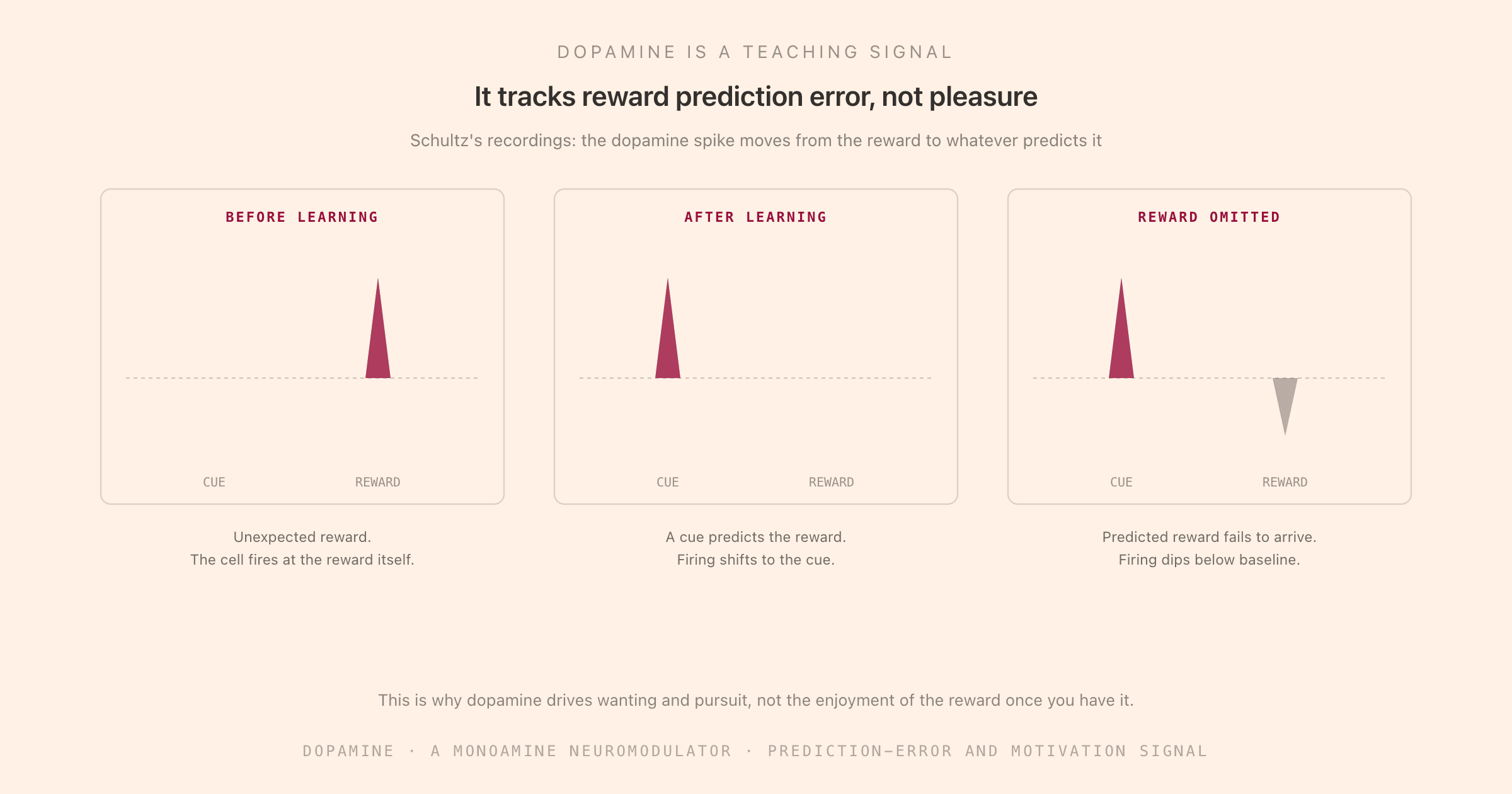
The popular story is that dopamine is released when you experience something pleasurable, so more dopamine means more pleasure. The actual science, built largely on Wolfram Schultz's recordings of dopamine neurons, tells a more precise and more useful story. Dopamine neurons fire in response to reward prediction error: the gap between what you expected and what you got.
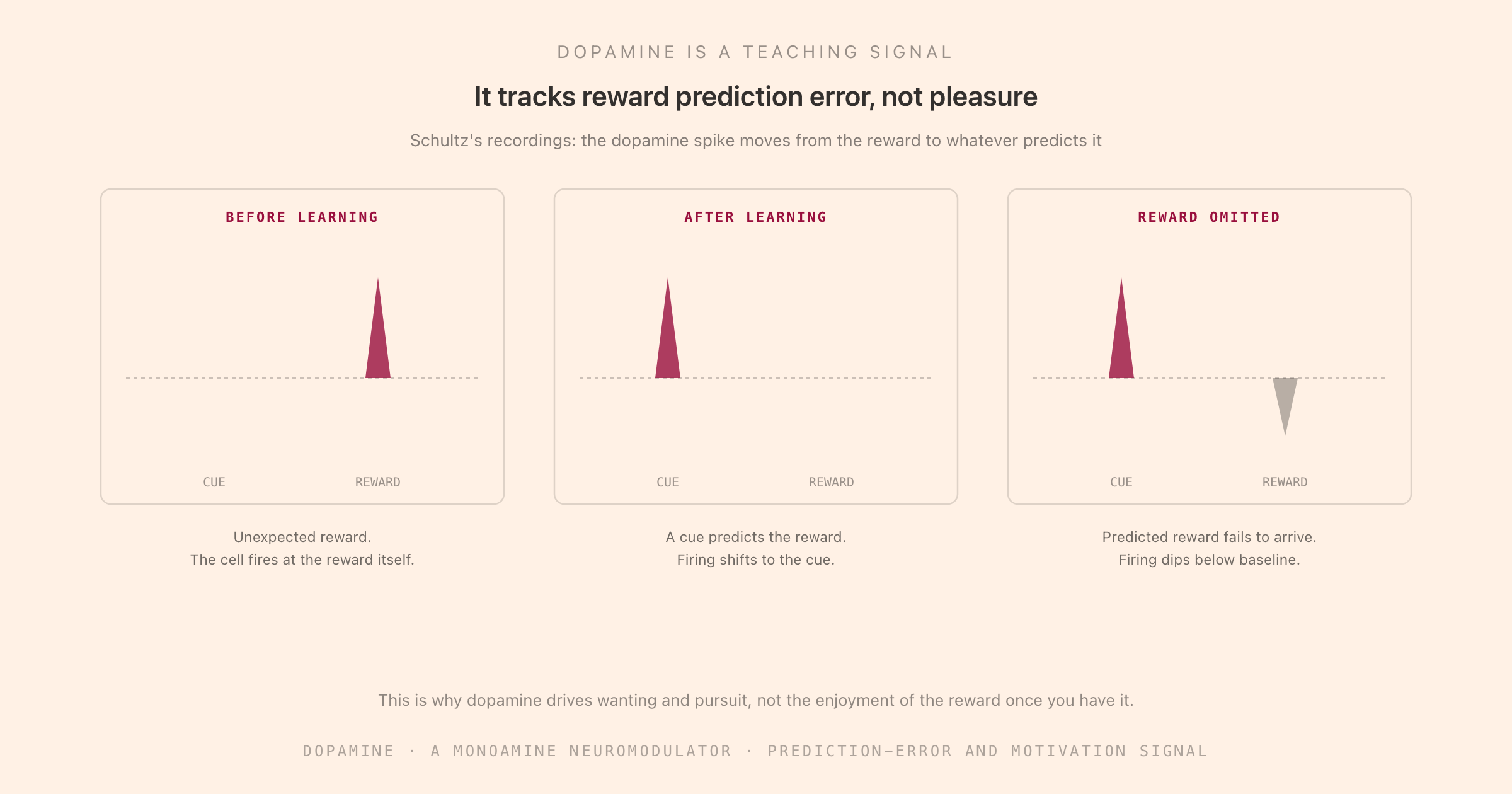
The classic experiment makes it vivid. When an animal receives an unexpected reward, its dopamine neurons fire at the moment of the reward. But once a cue (a tone, a light) reliably predicts that reward, the firing shifts to the cue and no longer fires at the reward itself, because the reward is now fully expected and there is no error to signal. And if the predicted reward then fails to arrive, the neurons dip below baseline at exactly the moment it was due. The dopamine signal is not tracking pleasure. It is tracking surprise, in the direction of "better than expected" or "worse than expected."
This is why the right way to think about dopamine is as a teaching signal. A positive prediction error says "whatever you just did worked out better than you thought, do more of that," and the brain strengthens the relevant connections. The system that generates this signal is the same one that drives wanting: the anticipation, the pull toward a goal, the willingness to put in effort. The pioneering work of researchers like Kent Berridge separated wanting (the motivational pull, which is dopamine-dependent) from liking (the actual hedonic pleasure of consuming a reward, which depends more on opioid systems). You can want something intensely without enjoying it much when you get it. Addiction is in many ways a story of runaway wanting with diminishing liking, which only makes sense once you stop treating dopamine as the pleasure chemical.
Dopamine and Focus
The link to focus runs through both of the attention-relevant pathways. The mesolimbic system supplies the motivation to engage with a task at all, the sense that it is worth starting and worth sustaining effort on. The mesocortical system supplies the prefrontal machinery to hold the task in working memory, resist distraction, and keep behaviour aligned with the goal.
A task that offers a steady trickle of small, slightly-better-than-expected outcomes, clear progress, a problem yielding, a section finishing, generates a healthy stream of prediction-error signals that make the work feel rewarding and keep you in it. A task with no perceptible progress generates none, which is part of why work that feels like a flat, featureless slog is so hard to stay with. It is also why the brain reaches for the phone: social media, feeds, and games are engineered to deliver dense, unpredictable, frequent reward prediction errors, exactly the kind of signal that captures the mesolimbic system far more efficiently than slow, real work does. The competition for your attention is, at a neural level, a competition for prediction-error signals.
What Low Dopamine Looks Like
People imagine "low dopamine" as feeling sad. More often, the signature of low dopamine tone is a collapse of drive rather than mood. The hallmark is anhedonia and amotivation: tasks feel pointless and effortful, getting started is disproportionately hard, and rewards that should feel worth pursuing simply do not generate the usual pull. Difficulty concentrating, mental fatigue, and a flat, "why bother" quality to effortful work are characteristic.
Clinically, the clearest demonstration of dopamine's role is Parkinson's disease, where the death of nigrostriatal dopamine neurons causes the movement symptoms, and where many patients also experience apathy and loss of motivation from the broader dopamine decline. Dopamine signalling is also central to ADHD, which is part of why stimulant medications that increase dopamine and norepinephrine availability can improve focus. None of this means you can diagnose yourself from a list of symptoms, and "dopamine deficiency" as a casual self-diagnosis is not a real clinical category. But the pattern is a useful lens: when motivation and the ability to start collapse together, the dopamine system is usually involved.
How to Increase Dopamine, Honestly
Search results for "how to increase dopamine" are full of supplement promises and quick hacks. The honest, evidence-aware version is less exciting and more durable, and it is mostly about protecting the system's normal function rather than spiking it.
- Exercise. Regular aerobic exercise is one of the most reliable ways to support healthy dopamine function and receptor sensitivity over time, alongside its effects on the other neuromodulators.
- Sleep. Sleep deprivation downregulates dopamine receptors and blunts the system. Protecting sleep protects your drive. The relationship runs through the circadian and sleep architecture that all of your neurochemistry depends on.
- Pursue real goals with visible progress. Because dopamine is a prediction-error signal, structuring work so that it produces frequent, genuine small wins keeps the motivational system engaged. Breaking a large task into achievable steps is not just a productivity trick; it is a way of generating the prediction errors that make effort feel worthwhile.
- Protect the contrast. The concern behind the "dopamine detox" idea has a real kernel: a constant diet of dense, easy, supernormal rewards (endless feeds, short-form video) can make slow real-world rewards feel flat by comparison. You cannot literally deplete and refill a dopamine tank by abstaining for a day, but reducing the constant stream of cheap, high-frequency rewards genuinely makes ordinary tasks feel more rewarding again.
- Diet and supplements: be skeptical. Dopamine is built from tyrosine, and severe deficiency of its precursors would impair production, but in well-nourished people, megadosing tyrosine or "dopamine-boosting" supplements has weak and inconsistent evidence for healthy focus. The basics, food, movement, sleep, do more than any pill on the shelf.
Working With Your Motivation Chemistry
Dopamine is the part of your neurochemistry that decides whether a task feels worth doing. It is not a pleasure dial to crank up but a teaching and wanting signal that responds to progress, surprise, and effort that pays off. You cannot will it higher, and you cannot hack it with a one-day cleanse, but you can work with it: pursue goals that yield visible progress, protect your sleep, move your body, and stop drowning the system in cheap, supernormal rewards that make real work feel dull by comparison. The rest of your attention chemistry, from norepinephrine's alertness to acetylcholine's spotlight, builds on the drive that dopamine provides.
That is the principle Tomatoes is built on. A focus block is not about forcing motivation out of nothing; it is about removing the competing, supernormal rewards so that the genuine, slower satisfaction of real work can register, and structuring time so that progress is visible enough to keep the motivation system engaged. If you want a focus tool designed around protected, low-distraction work blocks, Tomatoes is free for 3 days, then $4.99/week, $29.99/year, or $39 lifetime.