Serotonin is the neurotransmitter that sets the patience your attention runs on. It is best known as the brain's mood chemical, the thing antidepressants act on, but that reputation hides the part that matters most for focus: serotonin is a restraint and impulse-control signal. It raises the threshold at which you act on an urge, it keeps you willing to wait for a delayed reward, and it stabilises the emotional baseline so a small frustration does not derail a whole work block. When serotonin tone is healthy, you can stay on one task while the world offers you a hundred more interesting ones. When it is low, the first thing to break is not your happiness; it is your ability to not chase the next shiny thing.
This is the focus-science version of serotonin: what it is, the tiny brainstem nuclei that broadcast it across the whole brain, the opponent balance it strikes with dopamine, what low serotonin actually looks like, and what genuinely raises it. Tomatoes is a focus tool built around protected, low-distraction work blocks, the kind of practice that works with this system instead of against it. The app is free for 3 days, then $4.99/week, $29.99/year, or $39 lifetime.
What Serotonin Actually Is
Serotonin, chemically 5-hydroxytryptamine or 5-HT, is a monoamine neurotransmitter built from the amino acid tryptophan. The body makes it in two largely separate pools. The vast majority, around 90 to 95 percent, lives in the gut, where it regulates intestinal motility and has nothing directly to do with mood or attention because it cannot cross the blood-brain barrier. The small remaining fraction is made inside the brain itself, and that is the pool this article is about. Gut serotonin and brain serotonin are produced from the same precursor but operate as two different systems, which is why "serotonin" headlines about the gut rarely mean what people assume.
Inside the brain, serotonin is synthesised in a short chain: tryptophan is converted to 5-HTP by the rate-limiting enzyme tryptophan hydroxylase, and 5-HTP is then converted to serotonin. That rate-limiting step is the reason supplements and diet can nudge the system, and the reason the conversion is sensitive to how much tryptophan reaches the brain in the first place. Serotonin then acts on a famously large family of receptors, at least fourteen subtypes, which is why a single transmitter can be involved in mood, sleep, appetite, nausea, and cognition all at once.
The Raphe Nuclei: A Tiny Source for a Brain-Wide Signal
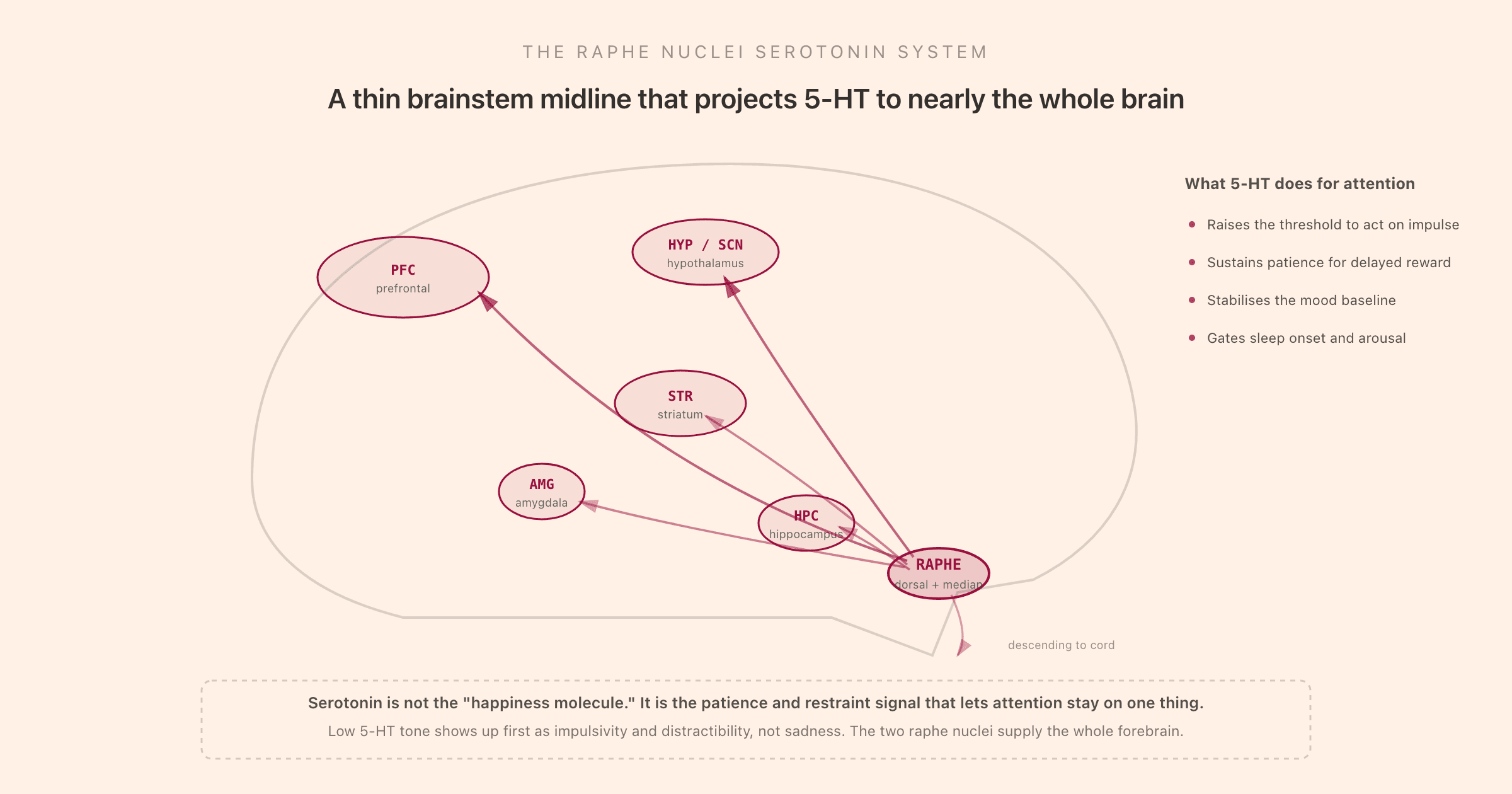
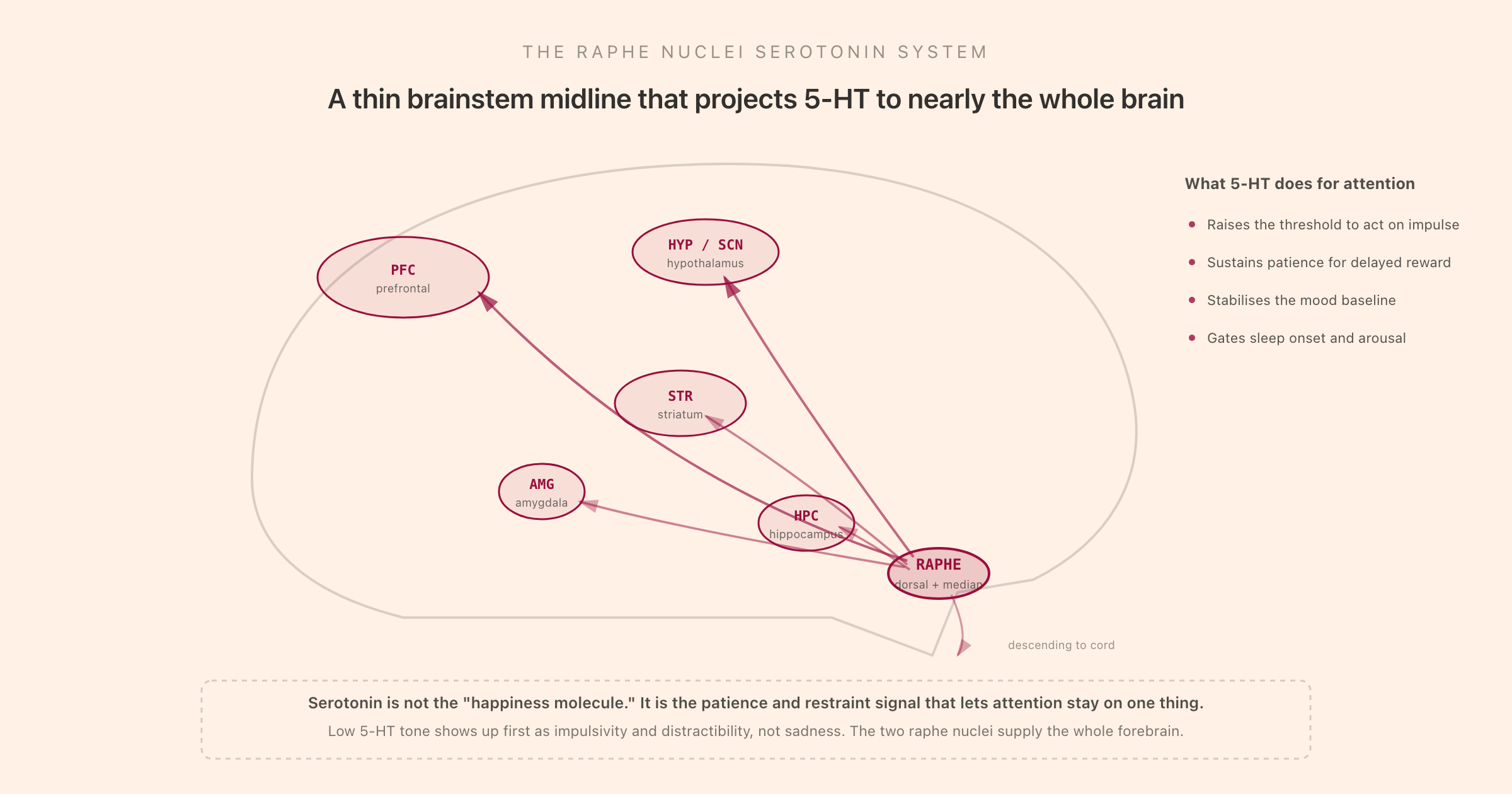
Almost all of the brain's serotonin comes from a thin line of cells along the midline of the brainstem called the raphe nuclei. The two that matter most for the forebrain are the dorsal raphe and the median raphe. These are small structures, but their reach is enormous: their axons ascend and fan out to nearly the entire forebrain, including the prefrontal cortex, the striatum, the amygdala, the hippocampus, and the hypothalamus. A separate set of projections descends to the spinal cord.
This architecture is the key to understanding serotonin's job. A handful of neurons in the brainstem, by raising or lowering their tonic firing rate, set a slow, brain-wide background level of a neuromodulator. Serotonin is not a fast, point-to-point signal carrying specific information the way glutamate is. It is a global tone, a setting, that biases how the rest of the brain behaves. That is the same design principle behind the locus coeruleus and norepinephrine: a tiny nucleus tuning the gain of the whole system. Serotonin and norepinephrine are two of the brain's master dials, and the raphe is where the serotonin dial lives.
Not the Happiness Molecule: Patience and Impulse Control
The popular picture of serotonin as a happiness molecule is misleading. Mood is involved, but the more precise and more useful description, supported by both animal and human work, is that serotonin governs behavioural inhibition and patience. It is the signal that lets you hold back.
In experiments where serotonin function is reduced, animals and people become more impulsive: they discount future rewards more steeply, choosing a smaller reward now over a larger one later, and they are quicker to abandon a course of action. Raising serotonin function does the opposite, increasing willingness to wait. Some researchers describe the dorsal raphe as encoding the value of patience, with serotonin neurons firing while an animal waits for a delayed reward and that firing sustaining the wait. In humans, low serotonin is repeatedly linked to impulsive aggression and poor inhibitory control, not simply to sadness.
For focus this reframing is everything. Sustained attention is, mechanically, a patience problem. To stay on a single task you have to repeatedly decline more immediately rewarding alternatives: the notification, the new idea, the urge to check something. That declining is inhibition, and inhibition is exactly what serotonin underwrites. A stable focus session is a long act of restraint, and serotonin is the chemistry of restraint.
Serotonin and Dopamine: The Opponent Balance
Serotonin makes the most sense when set against dopamine, because the two work as a balanced pair. Dopamine drives pursuit: it is the wanting signal, the push toward a goal, the chemistry of "go and get it." Serotonin supplies the counterweight: restraint, satiety, the sense of "this is enough" and "stay where you are." Neither is good or bad; focus needs both.
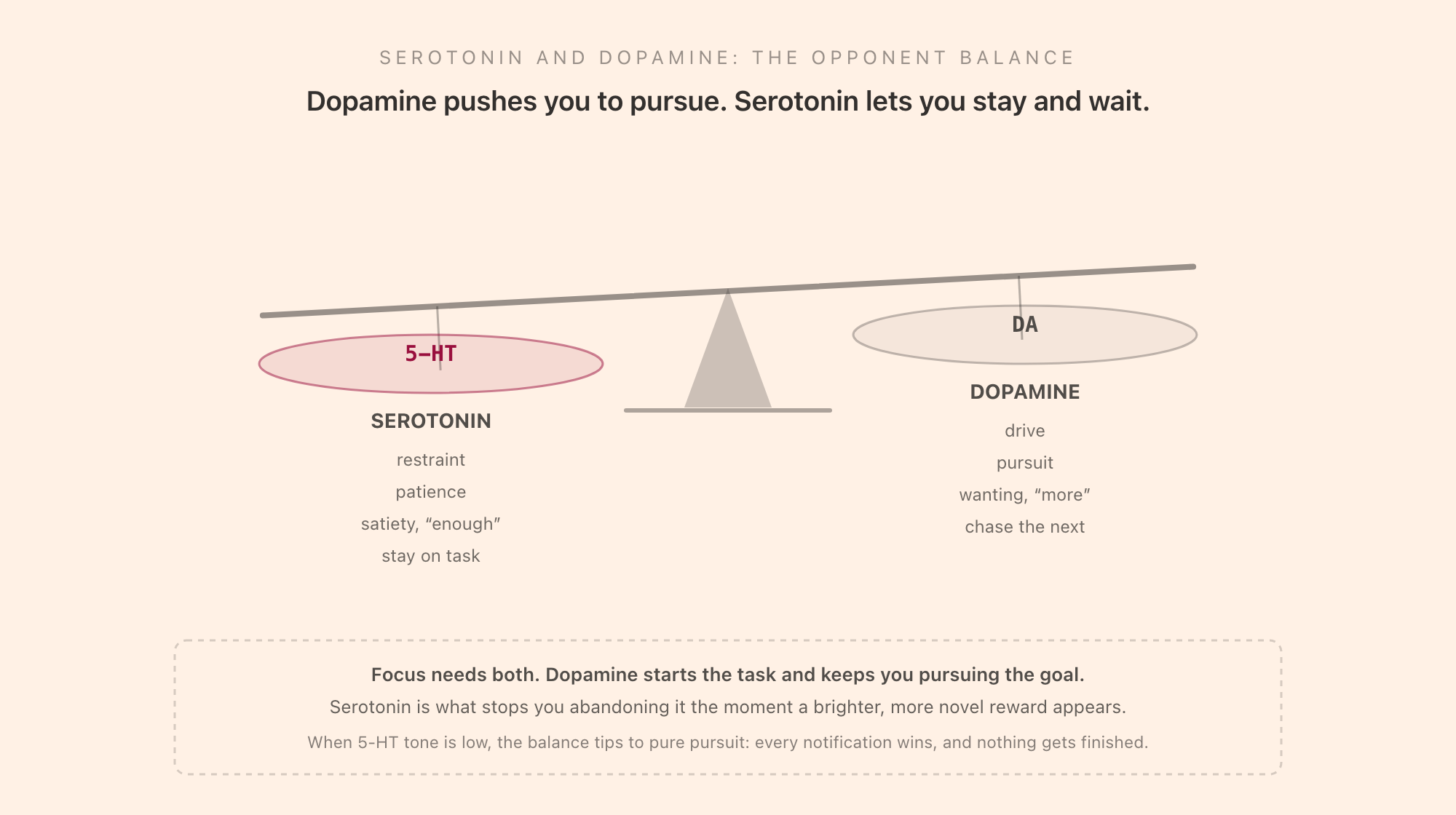
Think of a work session as a negotiation between these two systems. Dopamine starts the task and keeps you pursuing the goal; without it you would never begin, which is the failure mode covered in our piece on dopamine and the modern overstimulated reward system. Serotonin is what stops you abandoning that task the instant a brighter, more novel reward appears. When the two are balanced, you pursue a goal and also stick with it. When serotonin tone falls and dopamine-driven pursuit runs unopposed, the balance tips to pure chasing: every notification wins, every new idea pulls you off course, and nothing gets finished. That state feels like restlessness and distractibility, and it is one of the cleanest behavioural readouts of low serotonin function.
What Low Serotonin Actually Looks Like
Because of the happiness-molecule myth, people expect serotonin deficiency to look like depression and nothing else. In practice the focus-relevant signs show up earlier and look different:
- Impulsivity and a short fuse. Acting on urges before thinking, snapping at small frustrations, struggling to delay gratification.
- Distractibility. Difficulty staying with one task when a more novel option is available, which overlaps heavily with the everyday experience of poor focus.
- Rumination and a low, irritable baseline. Not always sadness, often more like a flat, edgy mood that makes sustained work feel harder.
- Disrupted sleep and appetite. Because serotonin feeds into both, low tone often shows up as trouble winding down at night or as carbohydrate craving (carbohydrates transiently raise tryptophan uptake into the brain).
None of this is a substitute for medical assessment, and clinical low mood is its own serious matter. The point for focus is narrower: a lot of what people call "I just can't concentrate lately" is, at the level of chemistry, reduced behavioural inhibition, and serotonin tone is one of the levers underneath it.
What Genuinely Raises Serotonin
The honest answer is that most of the reliable, non-drug levers are the same boring fundamentals that move every other part of this system, and they work because they act on the rate-limiting steps of serotonin synthesis and release. Simon Young's much-cited review on raising brain serotonin without drugs lists several with real evidence:
- Bright light. Light exposure increases serotonin activity, which is part of why morning daylight is such a high-leverage habit and why bright-light therapy helps seasonal low mood. This ties serotonin directly into the circadian system: the same morning light that anchors your body clock also supports serotonin tone.
- Aerobic exercise. Regular aerobic activity raises serotonin function, partly by increasing both the firing of serotonin neurons and the availability of tryptophan in the brain. It is one of the most dependable interventions there is.
- Tryptophan availability. Serotonin is built from tryptophan, and brain tryptophan depends not just on intake but on competition with other amino acids for transport across the blood-brain barrier. This is the mechanism behind the old observation that carbohydrate-rich meals can transiently raise serotonin, by shifting that amino-acid competition.
- 5-HTP supplementation. Because 5-HTP sits one step past the rate-limiting enzyme, it can raise serotonin synthesis. It is sold as a supplement, but it interacts with serotonergic medication and is not something to stack casually.
A word on the pharmacological lever: SSRIs (selective serotonin reuptake inhibitors) raise serotonin signalling by blocking its reuptake from the synapse, leaving more in place to act on receptors. They are genuinely effective medicines for the conditions they treat, but they are not a focus hack, they take weeks to act because the real change is downstream receptor adaptation rather than the immediate reuptake block, and combining serotonergic drugs and supplements risks serotonin syndrome, a dangerous excess state. Chemistry that powerful belongs with a clinician, not a productivity routine.
Serotonin, Sleep, and the Focus Baseline
There is one more reason serotonin matters for focus, and it runs through the night. Serotonin is the direct precursor to melatonin: in the pineal gland, serotonin is converted to melatonin as darkness falls. A serotonin system that is well supported during the day, by light and movement, feeds the melatonin signal that governs sleep onset, and good sleep is the single largest input to next-day attention. The links run in a loop. Daytime light raises serotonin; serotonin supports mood and patience through the day and becomes melatonin at night; melatonin supports the sleep that restores the sleep-dependent systems attention depends on. Serotonin is not a standalone dial you turn for focus. It is one node in a daily cycle, and the way you raise it is the same way you protect your clock and your sleep.
That is the practical takeaway. You do not chase serotonin directly. You get morning light, you move, you sleep, you protect your attention from the constant pull of novelty, and the serotonin system that underwrites patience takes care of itself. Tomatoes is built for that last part: protected, single-task work blocks that train the restraint serotonin makes possible, instead of feeding the distractibility that low tone produces. The app is free for 3 days, then $4.99/week, $29.99/year, or $39 lifetime. Build the sessions, and let the chemistry follow.