Boredom is the state of wanting to be engaged and finding nothing that satisfies. That definition is more precise than it sounds, and it explains why boredom is so much more unpleasant than simply having nothing to do. Rest is fine. Doing nothing on purpose is fine. Boredom is the specific frustration of an engine running with nothing to grip, and it is aversive enough that people will choose genuinely unpleasant alternatives to escape it. It is also, awkwardly for a productivity site, something you probably need more of rather than less, because the mental state boredom pushes you into is the one that does a surprising amount of useful work.
This article covers what boredom actually is, the research on how far people will go to avoid it, why it happens (including the counterintuitive fact that a task can be too hard as well as too easy), why phones have made it so much harder to tolerate, what chronic boredom is associated with, and what you lose by eliminating it entirely.
What Boredom Actually Is
Researchers generally define boredom as an aversive state involving both an unfulfilled desire for satisfying activity and difficulty sustaining attention. Both halves are necessary. If you did not want engagement, you would simply be relaxed. If you could focus on what is in front of you, you would not be bored by it.
That framing makes boredom an attention problem rather than a scheduling one, which is why it can strike in a room full of options and why "find something to do" is such useless advice. The person who is bored is not short of activities, they are unable to engage with the ones available.
It is worth separating boredom from things it resembles. Apathy is not wanting to engage at all, which is a different and more concerning state. Relaxation is contentment with low stimulation. Mental fatigue is depletion after effort, which can look like boredom but eases with rest, whereas boredom does not. And boredom is emphatically not laziness: it is an uncomfortable state of arousal with nowhere to go, which is closer to restlessness than to sloth.
People Will Do Almost Anything to Avoid It
The most striking demonstration comes from a set of studies by Timothy Wilson and colleagues, published in Science in 2014. Participants were left alone in a bare room for six to fifteen minutes with nothing to do but think. Many found it genuinely difficult and unpleasant.
In the version everyone remembers, participants were given the option of administering themselves a mild electric shock, one they had previously sampled and said they would pay money to avoid, if they wanted something to break up the time. Two thirds of the men and a quarter of the women shocked themselves at least once during the short period alone. One outlier aside, the numbers are not enormous, but the direction is unambiguous: a substantial share of people preferred a known unpleasant stimulus to being alone with their thoughts.
The finding is often over-dramatised, so it is worth being precise about what it shows. It does not show that people hate thinking. It shows that unstructured, undirected mental time is harder than most of us expect, and that the pull towards any stimulation at all is strong. Anyone who has reached for their phone in a lift already knows this experimentally.
Why You Get Bored
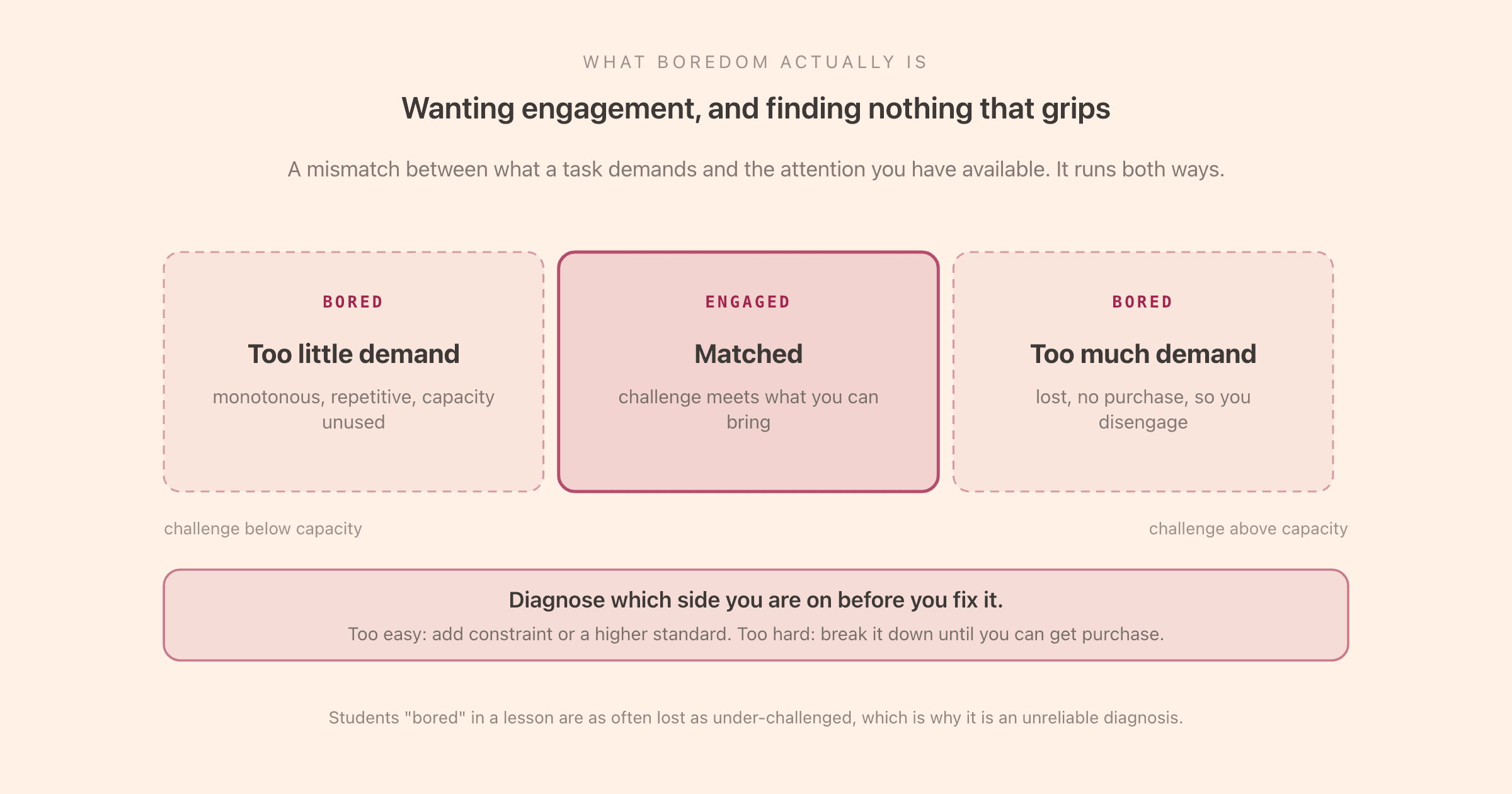
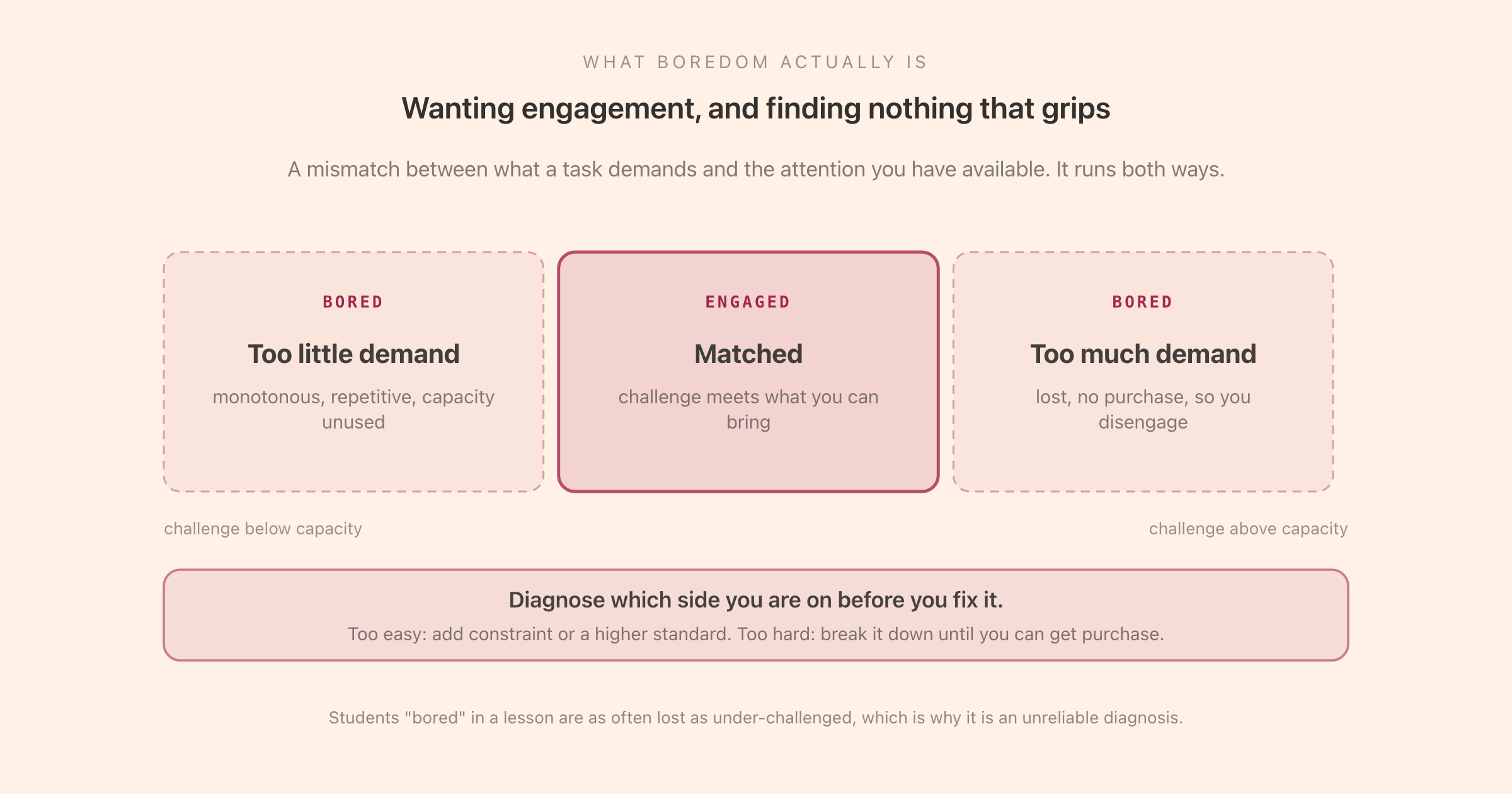
Boredom arises from a mismatch between the attention a situation demands and the attention you have available, and the mismatch runs in both directions.
Too little demand. The obvious case: a monotonous, repetitive, or under-stimulating task leaves capacity unused, and the mind wanders towards anything more interesting.
Too much demand. The case people miss. A task that is too difficult, or explained badly, also produces boredom, because you cannot get purchase on it and so disengage. Students bored in a lesson are as often lost as under-challenged, which is why "they're bored" is an unreliable diagnosis.
No sense of meaning. Work you cannot connect to any purpose is hard to stay engaged with regardless of its difficulty.
No control. Constraint is a powerful driver. The same activity is far more boring when you cannot leave, which is why waiting rooms are worse than waiting.
Being interrupted, repeatedly. Fragmented attention makes it hard to get into anything deeply enough to find it interesting, and shallow engagement is boring almost by definition.
The relationship to flow is exact and instructive: flow occurs when challenge and skill are matched at a high level, and boredom is one of the states on the other side of that balance. Adjust the difficulty and you can often move yourself out of boredom without changing the task at all.
Phones Made It Worse
Boredom has not become more common because life got duller. It has become harder to tolerate, which is a different problem.
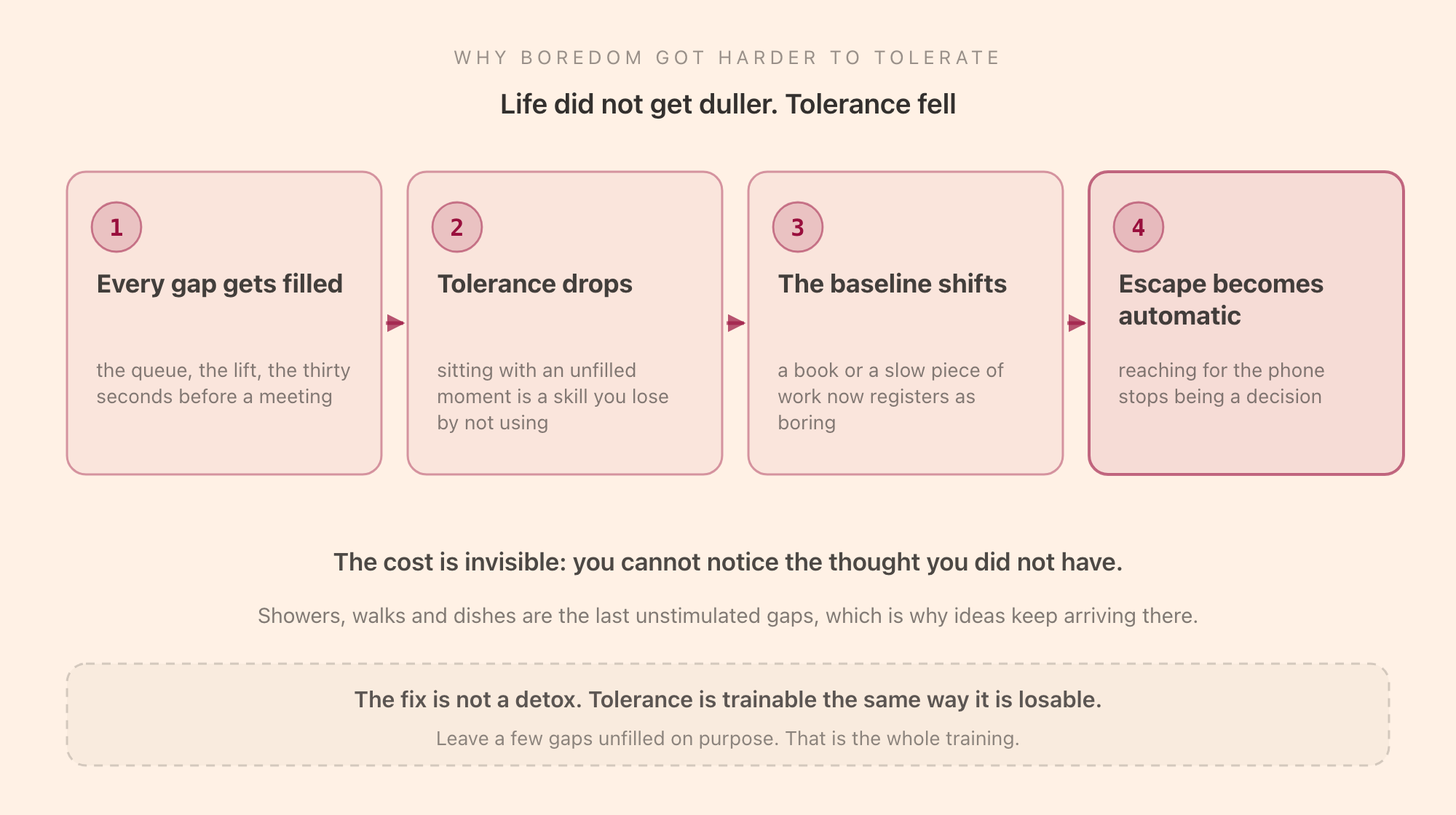
Every gap in the day, the queue, the lift, the advert break, the thirty seconds before a meeting starts, can now be filled instantly with something engineered to be more engaging than the gap. Three things follow.
Tolerance drops. Any capacity behaves like a skill. Sitting with an unfilled moment is something you get worse at when you never do it, and the discomfort threshold falls until even brief unstimulated time feels unbearable.
The baseline shifts. Compared with an endlessly novel feed, ordinary activities, a book, a walk, a conversation, a slow piece of work, start to register as boring when they are simply normally paced.
Escape becomes automatic. Reaching for the phone stops being a decision. This matters for focus specifically, because the moment of mild boredom mid-task is exactly the moment where deep work is either entered or abandoned, and if that moment is reflexively filled, you never get past the shallow part of anything.
The practical implication is not a digital detox. It is that tolerance for boredom is trainable in the same way it is losable, and the training is simply leaving some gaps unfilled.
Chronic Boredom Is a Different Thing
Everyday boredom is unpleasant and harmless. A persistent tendency towards it, which researchers measure as "boredom proneness", is associated with a considerably less cheerful set of outcomes.
People high in boredom proneness show higher rates of depression and anxiety, greater impulsivity, more risk-taking, and stronger associations with problematic substance use and gambling. Boredom in this sense functions as a push towards stimulation of whatever kind is available, and where the available options are harmful, that is where the push lands.
The direction of causation is genuinely unclear and probably runs both ways: low mood makes it harder to find anything engaging, and a persistent inability to engage lowers mood. Either way, chronic boredom is worth treating as a signal rather than a personality quirk. Persistent inability to engage with anything at all, especially alongside low mood, is worth talking to a doctor about rather than trying to solve with a better to-do list.
What Boredom Is For
Here is the part that makes boredom worth defending. It appears to be functional.
Boredom is a signal that your current activity is not worth your attention, and a prompt to change something. Without it, there is nothing pushing you off unproductive tasks and towards better ones. A creature that could tolerate anything indefinitely would have no mechanism for seeking out novelty, learning, or improvement. Boredom is uncomfortable for the same reason hunger is uncomfortable: it is supposed to make you act.
There is also the well-known link to creativity. When you are unstimulated, attention turns inward and the default mode network becomes more active, which is the state associated with mind-wandering, autobiographical thinking, and making connections between ideas that are not obviously related. Studies on this have found that performing a boring task before a creative one can improve idea generation, though the effect is modest and the research is not unanimous, so the honest version is "there is something here" rather than "boredom makes you creative".
What is less disputable is the everyday experience: good ideas arrive in the shower, on walks, and while doing dishes, and they arrive there because those are the last remaining moments where the mind is unstimulated enough to wander. Filling every one of those gaps with a screen removes the conditions under which that happens, and the loss is invisible, because you cannot notice the thought you did not have.
What to Actually Do About It
Diagnose the mismatch first. If a task bores you because it is too easy, add constraint, speed, or a higher standard. If it bores you because you are lost, the fix is the opposite: break it down until you can get purchase on it. Treating the second case as the first is why people give up on hard things believing they were uninterested.
Connect it to something. Tasks with a visible purpose are markedly easier to stay with.
Take real breaks, not stimulating ones. A break spent scrolling refills attention with more input rather than letting it recover, which is why you can finish a fifteen-minute break feeling less ready to work than when you started.
Leave some gaps unfilled deliberately. The queue, the walk, the commute. This is tolerance training, and it is also where the mind-wandering happens.
Do not confuse it with fatigue. If rest fixes it, it was tiredness. If rest does not, changing the challenge level will do more than resting harder.
Where Focus Music Fits
There is a specific moment this all comes down to. Twenty minutes into a piece of difficult work, a task usually becomes briefly boring, before it becomes interesting again on the other side. What you do at that moment decides whether the session becomes deep work or becomes twenty minutes followed by a phone. If the environment makes escape frictionless, escape wins nearly every time.
Tomatoes is built for that moment: focus music that gives you a steady, unchanging sound environment, enough to make a working session feel continuous without offering anything novel to be pulled towards. It is free to try for 3 days, then from $4.99 a week, $29.99 a year, or $39 for lifetime access. If you want to get past the boring middle of hard tasks more often, try Tomatoes free for 3 days.
Boredom has a bad reputation it only partly deserves. It is genuinely unpleasant, it is a real driver of impulsive behaviour, and in its chronic form it is worth taking seriously. But it is also a functioning signal doing a useful job, and the mental state it forces you into, unstimulated, inward-turned, wandering, is where a decent share of thinking actually happens. The goal is not to be bored more. It is to stop treating every unfilled moment as an emergency, and to notice that the discomfort is information: something about the challenge in front of you is wrong, and the fix is usually to change it rather than to escape it.