Burnout is not just being tired, and treating it as though a good weekend will fix it is exactly why so many people stay stuck in it. Real burnout is a state of chronic exhaustion, cynicism, and reduced effectiveness that builds up over months of unrelenting stress without adequate recovery, and it does not lift after a lie-in or a holiday. It is the point where the tank is not just low but structurally empty, where work that once felt meaningful now feels pointless, and where pushing harder, the instinctive response, makes everything worse. Understanding what burnout actually is, and what it is not, is the first step to recovering from it or avoiding it altogether.
This article explains what burnout really is, how it differs from ordinary stress, the warning signs to watch for, what causes it, and, most importantly, how to genuinely recover, which is slower and less glamorous than the internet often suggests. If you are running on empty and a rest never seems to refill you, this is for you.
What Is Burnout?
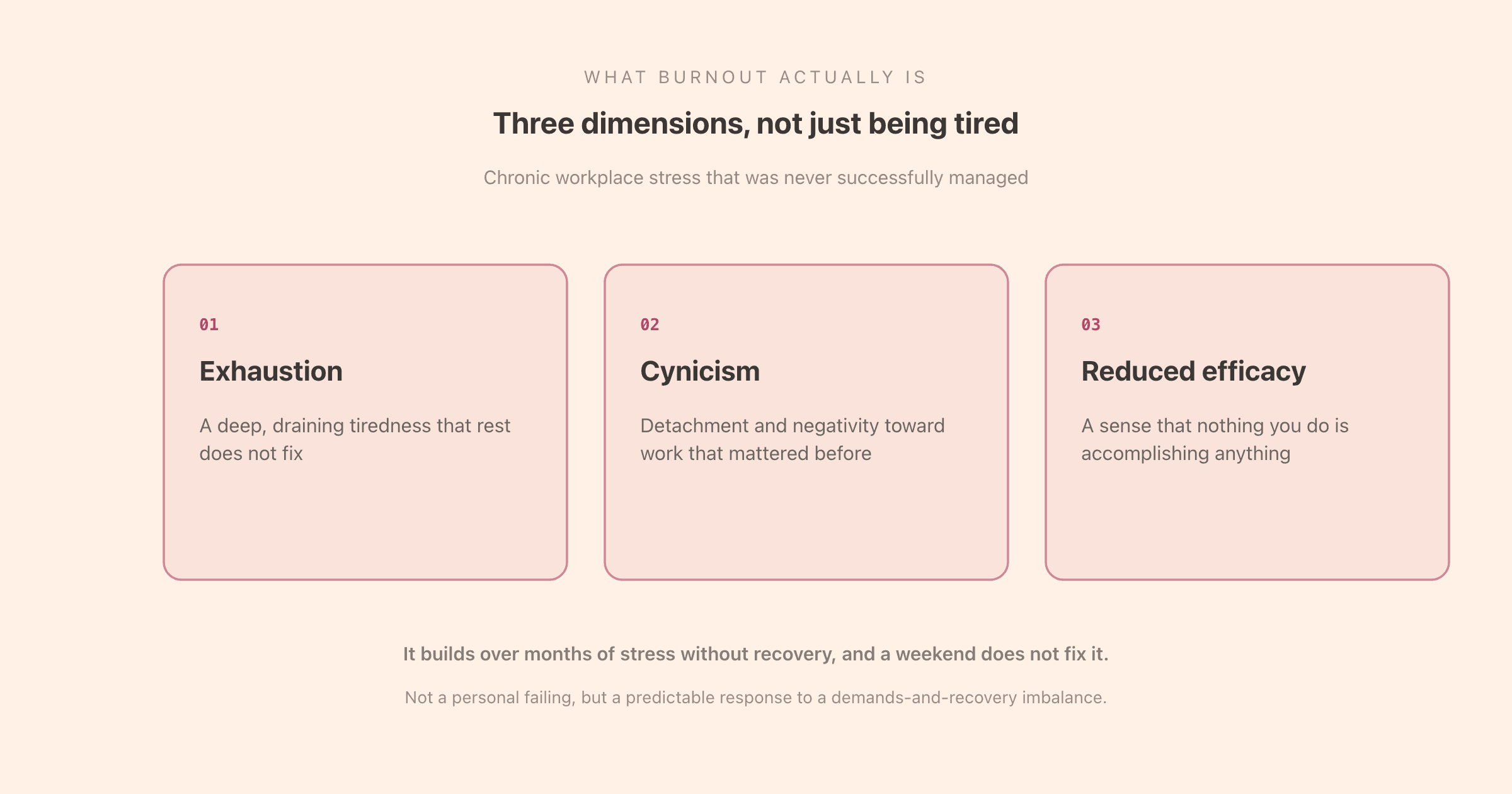
Burnout is a state of physical and emotional exhaustion caused by prolonged, unmanaged stress, most often from work. The World Health Organization recognises it specifically as an occupational phenomenon, the result of chronic workplace stress that has not been successfully managed, and defines it by three distinct dimensions, drawn from decades of research by the psychologist Christina Maslach.
The first is exhaustion: a deep, draining tiredness that rest does not seem to fix, both physical and emotional. The second is cynicism, sometimes called depersonalisation: a growing mental distance from your work, a detachment or negativity toward the job and the people in it that was not there before. The third is reduced efficacy: a sense that you are no longer accomplishing anything, that your work does not matter or that you are no longer good at it. Burnout is the combination of all three, and that combination is what distinguishes it from simply being overworked for a week.
It is worth being precise about what burnout is not. It is not a medical diagnosis in itself, and it is not the same as depression, though the two can overlap and burnout can lead to it. And crucially, it is not a personal failing or a lack of resilience. Burnout is a predictable response to a chronic imbalance between demands and recovery, which means it is a situation to be changed, not a character flaw to be ashamed of.
Burnout Is Not the Same as Stress
The most useful distinction to grasp is between stress and burnout, because they feel different and need different responses, and confusing them keeps people stuck.
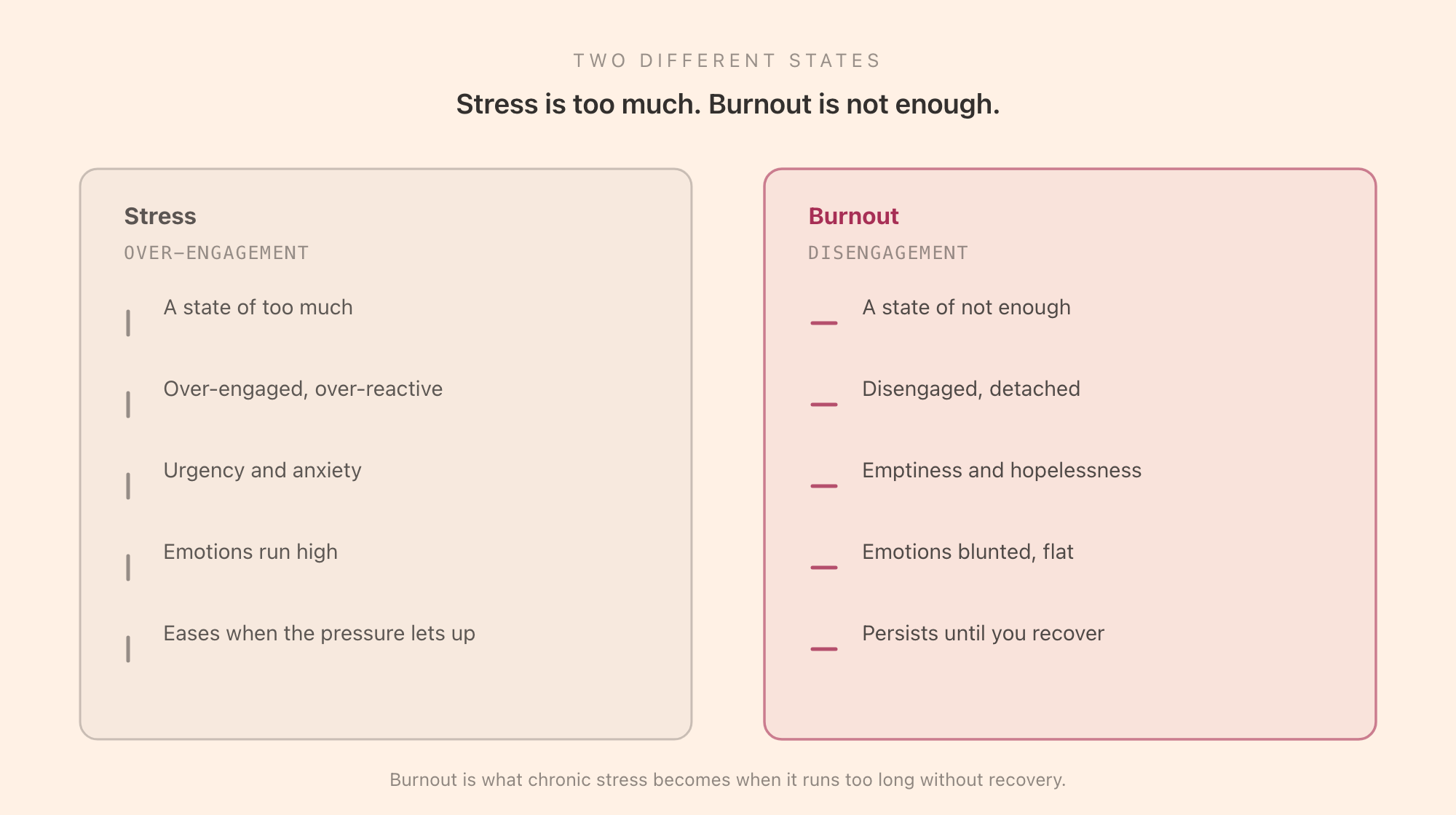
Stress is a state of too much. Under stress you are over-engaged, your emotions are overreactive, and you feel a sense of urgency and anxiety. It is exhausting, but there is still energy in the system, often too much of it. Stress, in the short term, can even be productive, and it typically eases when the pressure lets up.
Burnout is a state of not enough. Where stress is over-engagement, burnout is disengagement. The emotions are not overreactive but blunted; the feeling is not anxiety but emptiness and hopelessness; the sense is not urgency but a kind of giving up. Burnout is what chronic stress becomes when it goes on too long without recovery, the system finally running dry.
This is why the usual advice for stress can fail for burnout. Someone burnt out does not need to be told to push through or manage their time better; they need to refill a reserve that has been depleted for months. Recognising which state you are in tells you whether you need to manage the pressure or to genuinely recover.
The Warning Signs
Burnout builds gradually, which is what makes it so easy to miss until it is severe. The signs cluster in three areas.
Physical: persistent tiredness that sleep does not resolve, frequent headaches or muscle tension, changes in sleep and appetite, and getting sick more often as chronic stress wears down the body.
Emotional: a sense of dread about work, irritability and a shorter fuse, loss of motivation, cynicism, detachment, and a creeping feeling of hopelessness or that nothing you do matters.
Behavioural: withdrawing from responsibilities and people, declining performance and concentration, procrastinating on things that used to be easy, and sometimes using food, alcohol, or other escapes to cope. If several of these have been building for weeks or months, it is worth taking seriously rather than pushing through.
What Causes Burnout
Burnout is fundamentally about a sustained imbalance between what is demanded of you and the resources and recovery you have to meet it. The research points to several recurring drivers: an unmanageable workload, a lack of control over your work, insufficient reward or recognition for the effort, a sense of unfairness, the breakdown of community and support, and a mismatch between the job and your values.
Underneath all of them sits one physiological thread: chronic stress without recovery. When stress is constant, the body's stress response never fully switches off, and sustained high cortisol takes a measurable toll on the brain and body over time. The stress response evolved to be acute, to spike and then subside. Burnout is what happens when it never gets to subside, when the sleep debt accumulates and the recovery that should reset the system never comes. This is why burnout is not solved by working through it: the problem is precisely the absence of recovery, and more work is the opposite of the cure.
How to Recover From Burnout
Recovering from burnout is slower than anyone wants it to be, and the first and hardest step is accepting that. There is no weekend fix for months of depletion. But recovery is genuinely possible, and it follows a recognisable path.
Reduce the load, for real. You cannot recover while the thing causing the burnout continues unchanged. This is the non-negotiable part: something in the demand side has to give, whether that is time off, delegating, renegotiating your workload, or setting boundaries you have not been setting. Recovery without reducing the input is just a pause before the next crash.
Prioritise deep rest and sleep. The depleted reserve refills through genuine recovery, and sleep is its foundation. Protecting sleep, and real downtime that is not just collapsing in front of a screen, is where the actual refilling happens.
Reconnect with meaning and control. Because burnout involves cynicism and a lost sense of efficacy, part of recovery is rebuilding connection to why the work matters and regaining some control over how you do it. Small wins and small autonomies help restore the efficacy that burnout strips away.
Rebuild support and seek help. Isolation deepens burnout. Reconnecting with people, and, when it is serious, seeking professional support, is not weakness but a core part of recovery. Burnout that has tipped into depression especially needs proper help.
Build recovery back into normal life. The long-term fix is not a single big rest but a sustainable rhythm where recovery is a permanent feature, not an emergency measure. Regular breaks, protected downtime, and a workload that leaves room to recharge are what stop burnout from simply returning.
Where Focus Music Fits
Burnout is, at its core, a failure of the balance between effort and recovery, and while no app fixes that balance for you, the way you work day to day either protects it or erodes it. Frantic, scattered, always-on work that never lets your mind settle burns energy faster and recovers it slower. Calmer, more focused work, done in sustainable bouts with real breaks between them, is gentler on the system that burnout depletes.
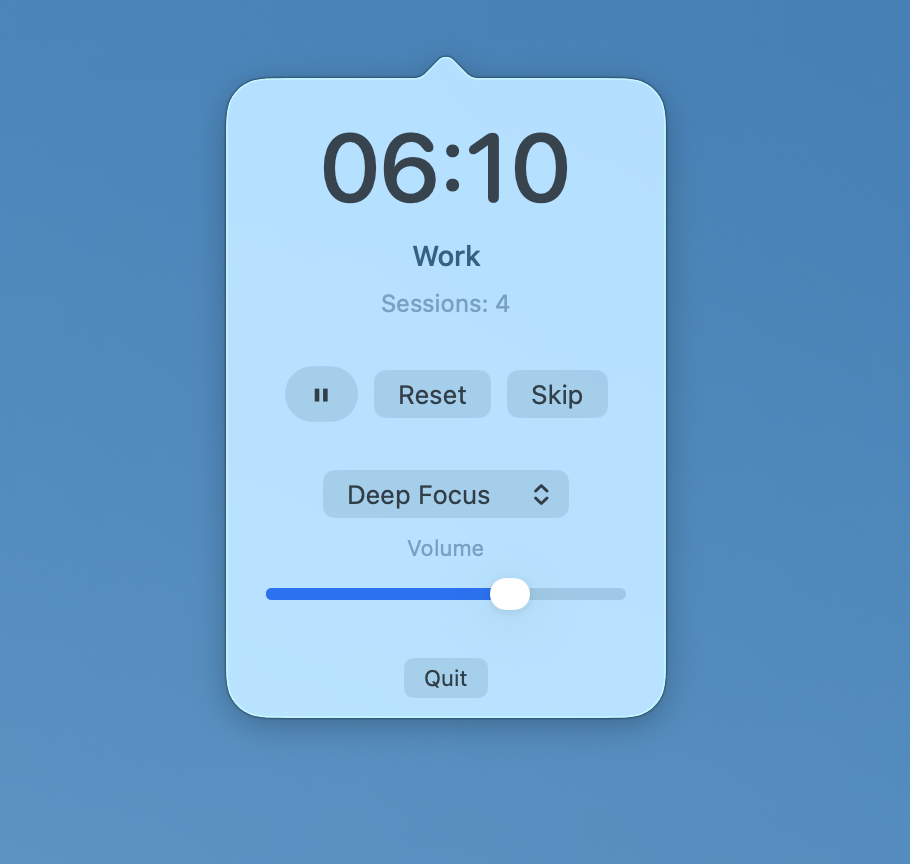
Tomatoes is built around that sustainable rhythm: focus music to help you work in calm, contained sessions rather than a state of constant frazzle, making it easier to do deep work and then genuinely stop, which is exactly the effort-and-recovery balance that protects against burnout. It is free to try for 3 days, then from $4.99 a week, $29.99 a year, or $39 for lifetime access. If you are trying to work in a way that does not run you into the ground, a calmer focus rhythm is a good place to start: try Tomatoes free for 3 days.
Burnout is the body and mind enforcing a truth we tend to ignore: that effort without recovery is not sustainable, and that pushing harder past a certain point does not produce more, it produces collapse. The way out is not more willpower but the thing burnout has been missing all along, real, protected recovery. Take that seriously, reduce the load that caused it, and rebuild a rhythm where rest is not an afterthought, and the reserve that feels permanently empty can, slowly, fill back up.