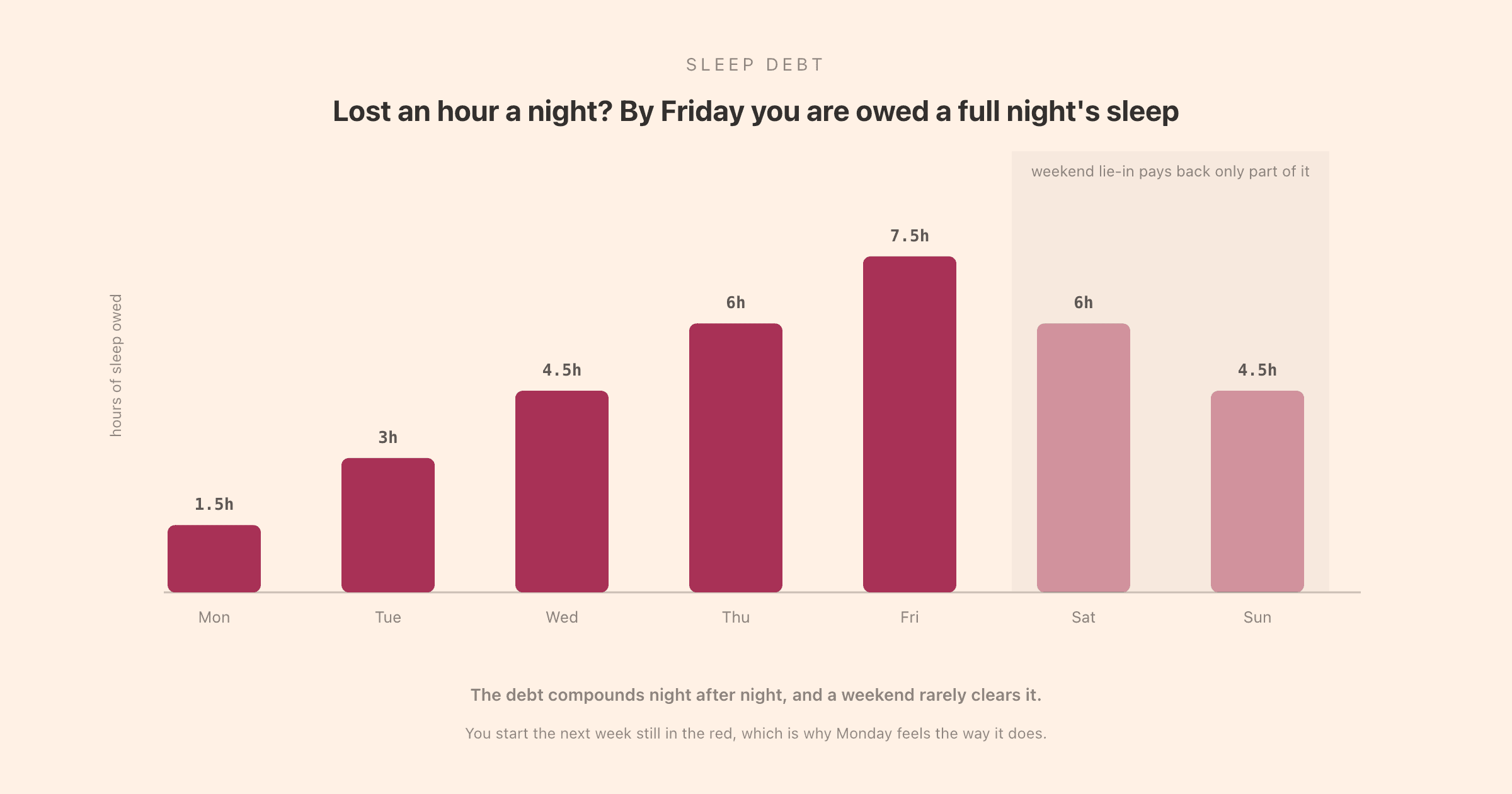
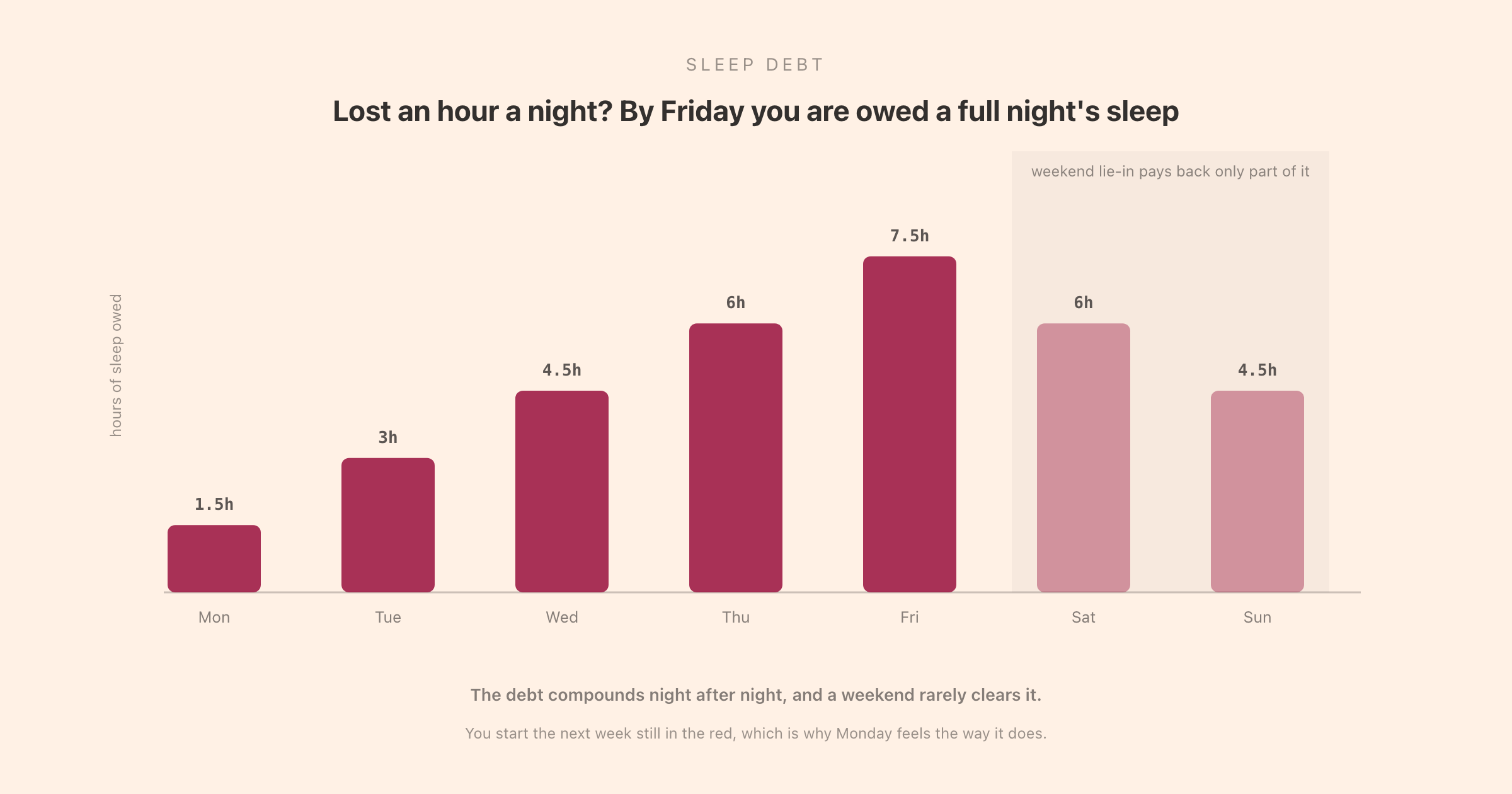
Sleep debt is the reason you can do everything else right, eat well, exercise, plan your day, and still find that your focus has quietly collapsed by Wednesday afternoon. It is the running total of the sleep you needed but did not get, and it accumulates with a ruthless simplicity: lose an hour a night, and by the end of the working week you are carrying a deficit the size of a whole night's sleep. Worse, the impairment it causes is largely invisible from the inside. You do not feel five times worse after five bad nights; you feel roughly the same tired you felt after one, while your actual performance keeps sliding. For anyone who cares about focus, sleep debt is the single most under-rated variable, because it degrades concentration silently and no amount of technique can out-run it.
This article explains what sleep debt is, how it accumulates, why the impairment it causes is so easy to miss, why you cannot fully repay it with a weekend lie-in, and what actually reduces it. The good news is that sleep debt is one of the most fixable causes of poor focus. The catch is that the fix is the one thing a busy person is most tempted to skip.
What Is Sleep Debt?
Sleep debt, sometimes called sleep deficit, is the cumulative difference between the sleep your body needs and the sleep it actually gets. If you need eight hours and sleep six and a half, you have taken on an hour and a half of debt that night. The concept matters because the deficit does not reset each morning. It carries forward and compounds. Two hours short across five nights is not five separate minor inconveniences; it is a ten-hour deficit sitting on your nervous system by Friday, more than a full night's worth of missing sleep.
The reason this compounding matters is that sleep is not a luxury the brain can simply skip. It is when the brain runs essential maintenance: consolidating memories, clearing metabolic waste, and, as covered in the article on adenosine, lowering the sleep-pressure signal that builds across every waking hour. When you cut sleep short, you leave that maintenance half-finished, and the unfinished work stacks up night after night. Sleep debt is the ledger of that unfinished maintenance.
It is worth being clear about how much sleep most people actually need. For the large majority of adults, that is seven to nine hours, and the proportion of people who genuinely thrive on significantly less is vanishingly small, far smaller than the proportion who believe they belong to it. Most people who feel fine on six hours are not resistant to sleep debt; they have simply forgotten what being fully rested feels like.
Why Sleep Debt Destroys Focus
The cognitive cost of sleep debt lands hardest on exactly the functions that focused work depends on: sustained attention, working memory, and the ability to resist distraction. Sleep-deprivation research consistently shows that even modest, chronic short-sleeping, the two-hours-short-every-night pattern that millions of people live in, produces measurable declines in attention and reaction time that accumulate day by day.
The mechanism is not mysterious. Attention is metabolically expensive and depends on prefrontal circuits that are especially vulnerable to insufficient sleep. When sleep debt builds, these circuits become less able to hold a goal in mind and suppress distractions, which is felt as a wandering mind, re-reading the same paragraph, and reaching for your phone without deciding to. Sleep debt also disrupts the circadian rhythm and shortchanges the specific sleep stages, particularly deep slow-wave sleep and REM, that do the heavy lifting for memory and restoration. You lose not just quantity but the most valuable parts of the night.
There is also a mood and motivation cost. Sleep debt raises stress reactivity and lowers the threshold at which frustration and impulsivity take over, which means that on a large sleep deficit you are not only less able to focus, you are also less able to make yourself sit down and try.
The Dangerous Part: You Stop Noticing
Here is the most insidious feature of sleep debt, and the reason it is so easy to live in for years. As the deficit grows, your subjective sense of how tired you are does not keep pace with your actual impairment. In controlled sleep-restriction studies, people's objective performance on attention tasks keeps declining day after day, while their own ratings of how sleepy or impaired they feel level off after the first few days. They adapt to the feeling of being tired, and mistake that adaptation for being fine.
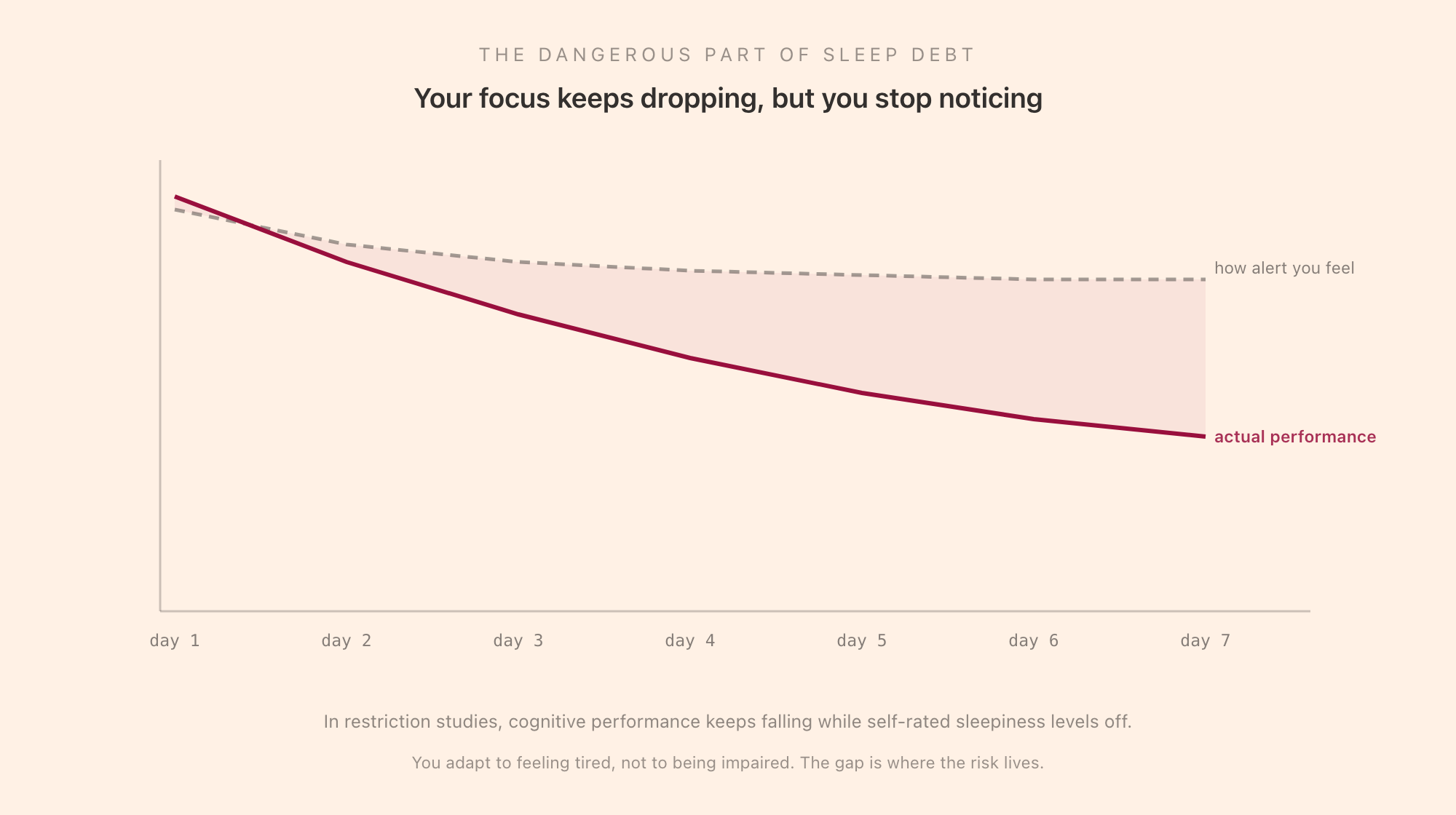
This gap between felt tiredness and actual impairment is where the real danger lives. You believe you have adjusted to running on six hours because you no longer feel dramatically worse each day, but the objective decline is still happening underneath. It is the reason chronically sleep-deprived people so confidently insist they function fine on little sleep: they genuinely feel that way, because the internal gauge stopped tracking the damage. The only reliable way to know your true baseline is to actually pay the debt down and notice how different fully-rested feels.
Why You Can't Fully Catch Up on the Weekend
The universal strategy for sleep debt is the weekend lie-in, and it is better than nothing, but it does not do what people hope. Research on recovery sleep shows that a weekend of extra sleep can repay part of a week's deficit and restore some measures of performance, but it does not fully reverse the damage from chronic restriction, and some functions, particularly sustained attention, recover incompletely.
There are two reasons. First, the debt is often simply too large: you cannot bank ten hours of missing sleep into two long mornings, because there is a ceiling on how much extra sleep the body will take in a single stretch. Second, the weekend catch-up itself disrupts your circadian rhythm. Sleeping until noon on Saturday and Sunday shifts your body clock later, so that Sunday night you struggle to fall asleep at a reasonable hour, and Monday morning you wake unrested into a new week, a pattern sometimes called social jetlag. You start the next week already back in the red. The lie-in pays down part of the balance while quietly setting up the next deficit.
The uncomfortable conclusion is that sleep debt cannot be crammed away the way a deadline can. It is paid down gradually, by consistently getting enough, not heroically, by occasionally getting a lot.
How to Actually Reduce Sleep Debt
The real fix for sleep debt is unglamorous but reliable: shift from occasional catch-up to consistent sufficiency. A few principles follow from the biology.
Add sleep gradually and consistently, not in one heroic weekend. Because the body will only bank so much extra sleep at once, the effective way to pay down a large debt is to add sleep steadily, going to bed 30 to 60 minutes earlier every night for a couple of weeks, rather than trying to clear it in one blowout. Consistency also stabilises the circadian rhythm that weekend catch-ups disrupt.
Protect a consistent sleep and wake time, including weekends. The single highest-leverage habit for both sleep debt and circadian health is a regular schedule. Keeping your wake time roughly constant, even at weekends, prevents the social-jetlag whipsaw and lets sleep pressure and the body clock stay aligned.
Use short naps to blunt the deficit, carefully. A short daytime nap, ideally 20 minutes or so and not too late in the day, genuinely reduces sleep pressure and can sharpen a debt-laden afternoon. The caution is the same as always: naps that are long or late can steal from that night's sleep and restart the cycle.
Stop treating sleep as the flexible variable. The deepest fix is a mindset one. Sleep is not the thing to cut when you are busy; it is the thing that determines whether the hours you are awake are any good. An hour of focused work on a rested brain beats two hours of distracted work on a sleep-deprived one, which means protecting sleep is not in tension with productivity, it is the foundation of it.
Where Focus Music Fits
Sleep debt sets a hard ceiling on how well you can concentrate, and nothing you do while awake can lift that ceiling if the debt is large. The honest first move for anyone struggling to focus is to check whether they are simply under-slept, because no tool substitutes for the sleep the brain actually needs. What a focus environment can do is help you make the most of the capacity you do have: when you are reasonably rested, the difference between a productive hour and a leaked one is often whether you can drop into the work and stay there.
That is what Tomatoes is built for. It generates focus music designed to hold your attention steady through a work block, so that on the days you are rested, you actually convert that capacity into finished work instead of losing it to distraction. It is a one-time $39 app, no subscriptions and no account. Pay down your sleep debt first, then, when your focus is worth something, get Tomatoes here to protect it.
Sleep debt is the quietest thief of focus there is, because it takes your concentration a little at a time and switches off the alarm that would tell you. You cannot out-discipline it, out-caffeinate it, or fully repay it on a Sunday. But you can pay it down, steadily, by giving your brain the sleep it has been quietly keeping score of, and when you do, you will discover that the focus you thought you had lost was only ever being held as collateral.