Adenosine is the single molecule that most quietly governs whether you can concentrate right now. It is not a stimulant, not a stress hormone, and not something you can supplement your way out of. It is a metabolic byproduct that accumulates in your brain for every hour you are awake, and the more of it that builds up, the harder sustained attention becomes. If you have ever wondered why the same task feels effortless at 9am and impossible at 3pm despite no change in motivation, the answer is largely a question of how much adenosine has piled up against your receptors since you woke.
This article is a deep dive into what adenosine actually is, how it creates what sleep scientists call sleep pressure, why caffeine works by blocking it rather than by adding energy, and, most usefully, how to schedule demanding focus around the rhythm adenosine imposes on your day. Understanding this one molecule changes how you read your own energy, because it reframes the afternoon slump from a personal failing into a predictable piece of neurochemistry.
What Adenosine Actually Is
Adenosine is a nucleoside: a molecule built from the base adenine attached to a ribose sugar. You already know it in another form. It sits at the core of ATP (adenosine triphosphate), the universal energy currency your cells spend to do work. Every time a neuron fires, every time a sodium pump resets a membrane, every time anything in your brain consumes energy, ATP is broken down, losing phosphate groups to become ADP, then AMP, and ultimately free adenosine.
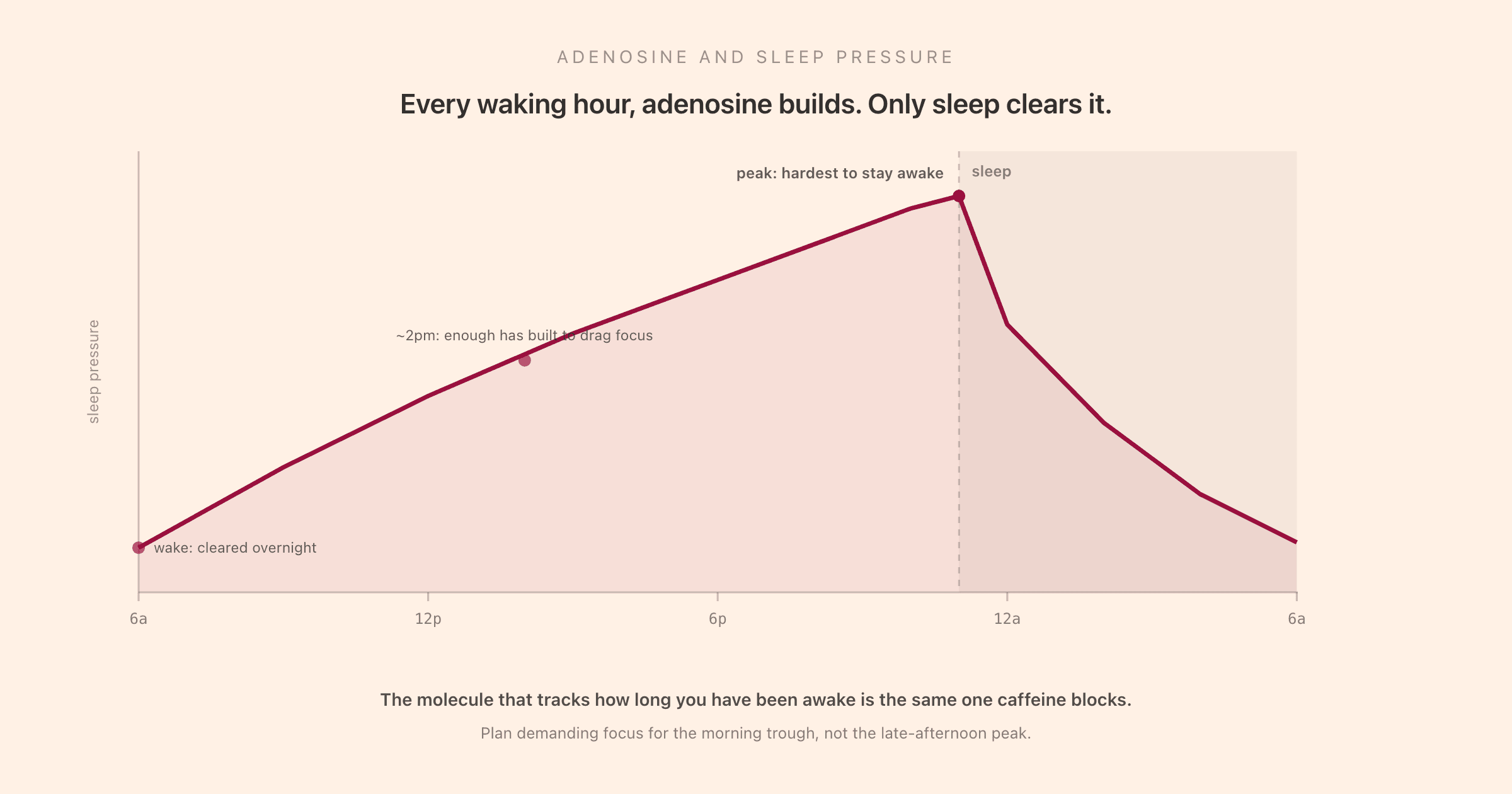
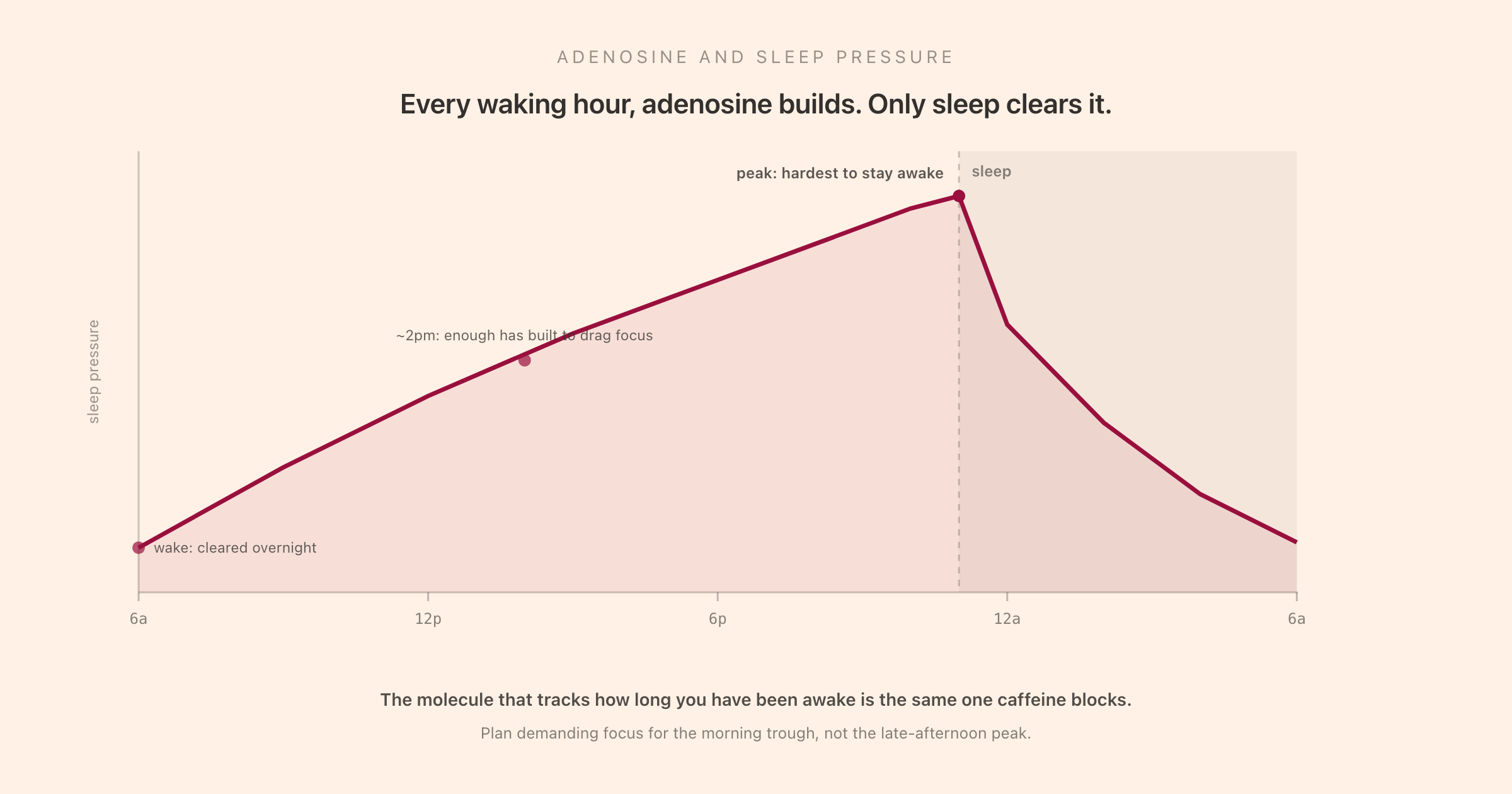
That is the elegant part of the mechanism. Adenosine is the literal residue of having spent energy. The more neural work your brain has done since you last slept, the more adenosine has been liberated into the extracellular space. It is not a clock counting hours directly; it is a tally of cumulative metabolic activity, which over a normal day amounts to roughly the same thing. The molecule that signals "you have been running for a while" is the ash left behind by the fire of your own cognition.
Free adenosine then drifts to specific receptors on the surface of neurons, and that is where its effect on your attention begins.
How Adenosine Creates Sleep Pressure
Adenosine acts on four receptor subtypes, but two matter for wakefulness: the A1 and A2A receptors. These are inhibitory in their net effect on arousal. When adenosine binds A1 receptors on wakefulness-promoting neurons, it quiets them. When it binds A2A receptors, it indirectly promotes the activity of sleep-generating regions like the ventrolateral preoptic nucleus. The combined result is straightforward: rising adenosine progressively dampens the brain's arousal systems and tilts the whole network toward sleep.
Sleep scientists call this accumulated drive sleep pressure, or Process S in the classic two-process model of sleep regulation. It is one of two forces that decide how alert you feel. Process S is the homeostatic pressure that builds with time awake. The other, Process C, is the circadian signal, an internal wave of alerting that your circadian rhythm broadcasts on a roughly 24-hour cycle regardless of how long you have been awake. How alert you feel at any given moment is essentially the gap between these two curves.
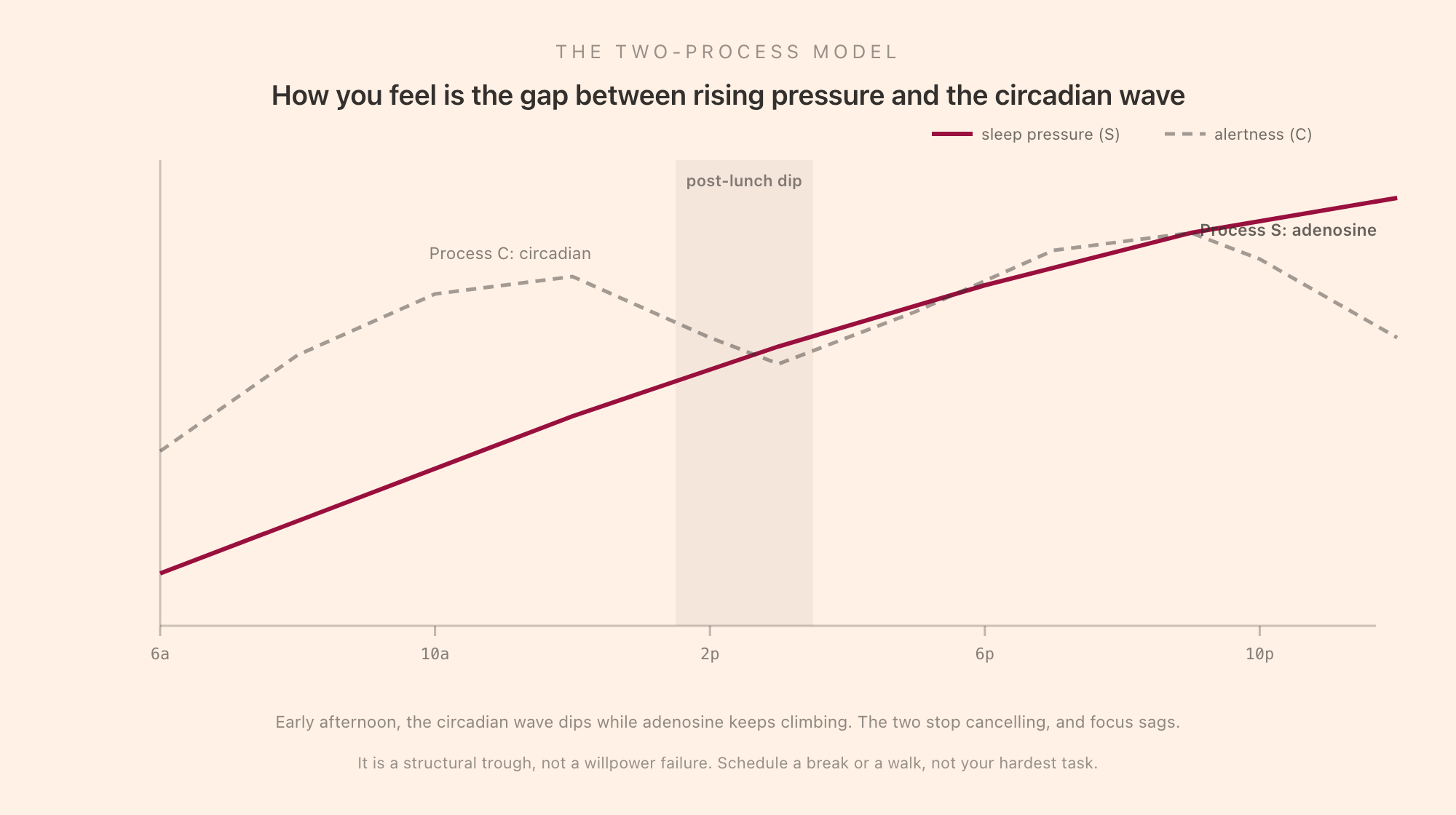
This is why the afternoon dip is real and predictable. In the early afternoon the circadian alerting signal naturally troughs while adenosine has been climbing steadily since morning. For a few hours the two stop cancelling each other out, and the accumulated sleep pressure shows through. It is not the sandwich, and it is not a lack of discipline. It is a structural low point in the daily curve, and you can plan around it instead of fighting it.
During sleep, and especially during deep slow-wave sleep, the brain clears adenosine. Receptors reset, extracellular concentrations fall, and Process S returns to its baseline. This is the core reason a night of proper sleep restores your capacity to concentrate: you have physically lowered the molecule that was suppressing your arousal systems. Cut the night short and you begin the next day with a residual adenosine load, which is the neurochemical signature of feeling foggy before you have done anything.
Adenosine and Caffeine: Blocking the Brake
Here is the part almost everyone gets backwards. Caffeine does not give you energy. Caffeine is an adenosine receptor antagonist: its molecular structure is similar enough to adenosine that it fits into the same A1 and A2A receptor pockets, but it does not activate them. It sits in the parking space so adenosine cannot.
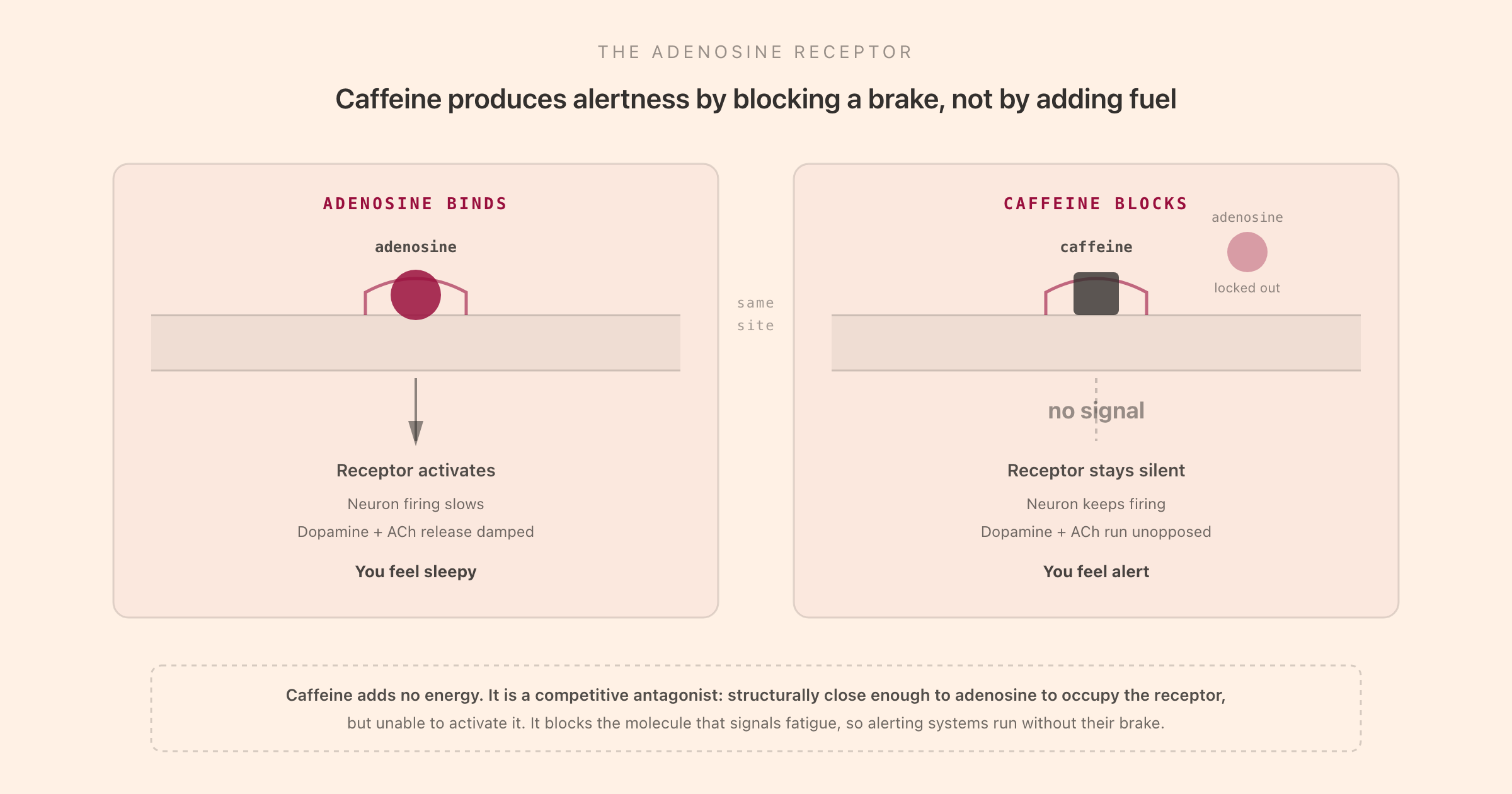
The consequence is that caffeine removes a brake rather than pressing an accelerator. With adenosine locked out, the wakefulness-promoting neurons it would normally quiet keep firing, and downstream systems run without their usual damping. You feel alert, but no energy has been added to the system. That distinction matters for two practical reasons.
First, the adenosine never stopped accumulating. While caffeine occupies the receptors, free adenosine keeps building in the background. When the caffeine clears, all of that backlog lands at once, which is the neurochemistry of the caffeine crash. You can read the full pharmacokinetics of that in the deep dive on caffeine, but the short version is that a five-hour half-life means an afternoon coffee is masking, not resolving, a debt that is still growing.
Second, this is why caffeine timing matters more than caffeine quantity. A cup taken at the bottom of the afternoon dip, when adenosine has built but the circadian signal is low, can be genuinely useful. A cup taken late enough that a meaningful fraction is still circulating at bedtime quietly degrades the deep sleep that would have cleared your adenosine, so you wake with a higher baseline and reach for more caffeine the next day. The loop is self-reinforcing, and it is built entirely on this one receptor interaction.
Why You Cannot Supplement Your Way Around It
Because adenosine sounds like a discrete chemical, a reasonable instinct is to ask whether you can take something to lower it. You cannot, in any practical sense, and the reason is instructive. Adenosine is not a deficiency state you are topping up or draining. It is a continuously generated readout of cumulative brain metabolism, regenerated every second your neurons do work. There is no pill that meaningfully accelerates its clearance during wakefulness; the one process that reliably clears it is sleep itself.
This is the same reason the various "natural energy" claims tend to disappoint. Anything that makes you feel more alert without addressing accumulated adenosine is, like caffeine, masking the signal rather than resolving it. The only true reset is the one your brain already runs every night. The actionable conclusion is not a supplement; it is to stop treating sleep as the variable you cut when you are busy, because it is the single lever that controls your adenosine baseline for the entire following day.
Working With Adenosine Instead of Against It
Once you accept that adenosine rises monotonically across the day, a few scheduling principles follow directly from the biology.
Front-load your hardest cognitive work. Adenosine is at its lowest in the first few hours after waking, once sleep inertia has worn off. This is your widest gap between low sleep pressure and a rising circadian signal, which is to say your best window for the work that demands the most sustained attention. If you spend that window on email and meetings and save the deep work for the afternoon, you are doing your most demanding thinking against your highest adenosine load. The structured deep-work blocks in the Pomodoro technique are most valuable when you point them at the morning trough rather than the afternoon peak.
Treat the early-afternoon dip as a scheduled trough, not a flaw. Because it is the predictable convergence of rising adenosine and a dipping circadian signal, the early afternoon is the worst time to schedule work that needs peak concentration and a reasonable time for tasks that tolerate lower arousal: admin, routine execution, a walk, or a genuine break. Caffeine can bridge it; so can twenty minutes of daylight and movement, which transiently lifts arousal without adding to your evening caffeine load.
Protect the sleep that clears it. Every hour of deep sleep you lose is adenosine you carry into the next day. Late caffeine, late screens, and short nights all compress the slow-wave sleep that does the clearing. The single highest-leverage move for tomorrow's focus is not tomorrow's coffee; it is tonight's sleep.
Use the afternoon nap deliberately, if you nap. A short nap genuinely lowers adenosine, which is why even twenty minutes can sharpen the late afternoon. But the same clearing means a long or late nap can blunt your sleep pressure enough to delay sleep onset that night, restarting the cycle. The tool works precisely because it taps the same mechanism, so it has to be used with the mechanism in mind.
Where Focus Music Fits
None of this requires a product, but it does point to where an external cue helps. Adenosine sets the ceiling on how alert you can be; it does not, by itself, decide whether you actually drop into focused work within that ceiling. That gap, between having the capacity to concentrate and reliably engaging it, is where a consistent auditory environment earns its place. A stable, non-distracting soundscape during your morning low-adenosine window helps you spend that scarce, high-quality attention on the work rather than on the dozen small frictions that pull you out of it.
That is the entire design idea behind Tomatoes. It generates focus music meant to hold attention steady through a work block, so that when your adenosine load is low and your circadian signal is climbing, you actually use the window instead of leaking it to context-switching. It is a one-time $39 app, no subscriptions and no account, built to make the good hours count. If you want to put your best, lowest-adenosine hours to work, get Tomatoes here.
Adenosine is not something to defeat. It is the honest accounting of how much your brain has spent since it last rested. Read it correctly and it stops being a mysterious afternoon enemy and becomes a schedule: do the hard thinking early, respect the dip, and guard the sleep that wipes the slate clean.