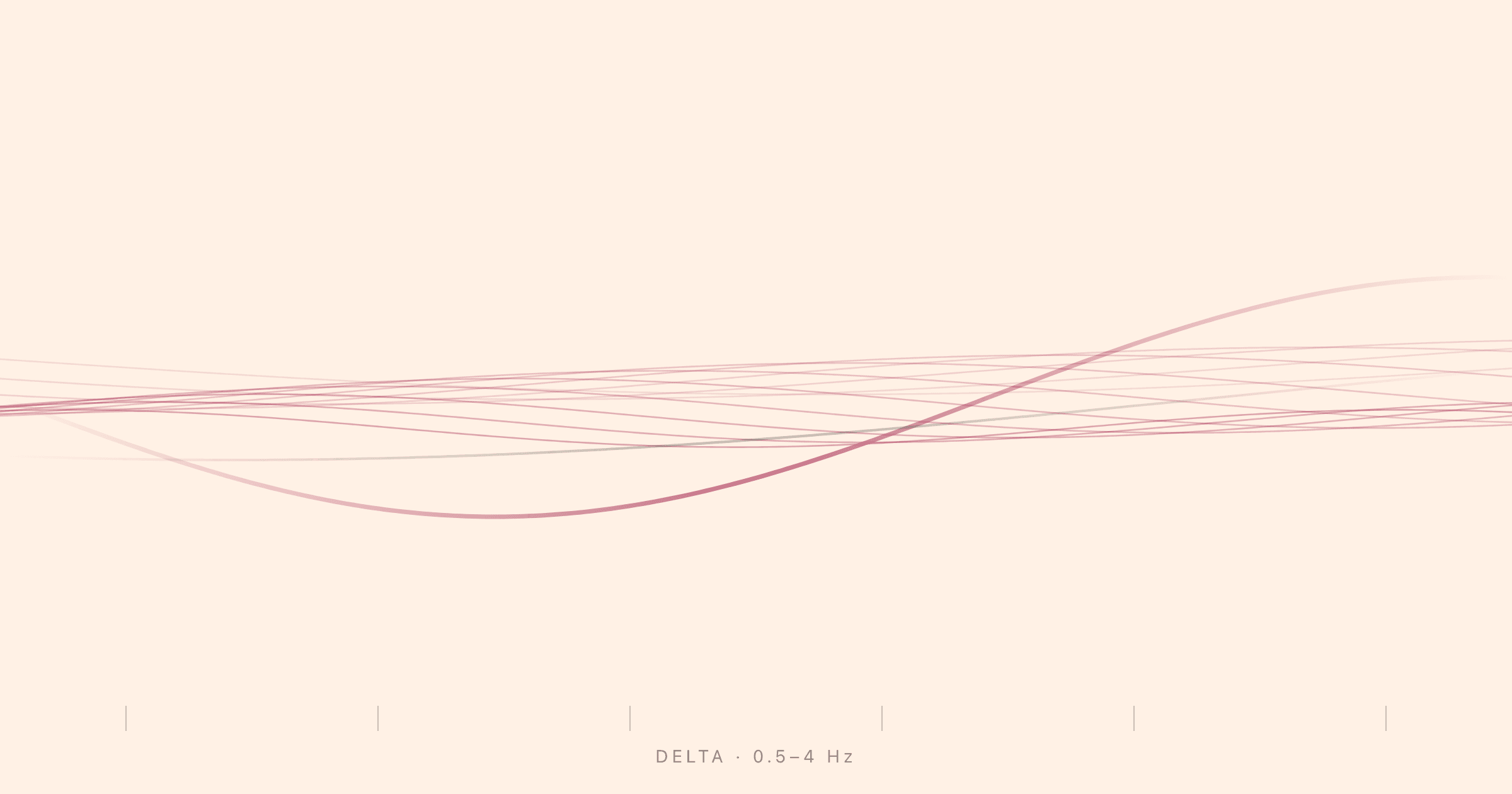
Delta waves are the slowest of the five canonical brainwave bands, sitting at 0.5 to 4 Hz, and they are the dominant signal during the deepest stages of non-REM sleep. They are what the EEG technician sees when a sleep study marks "stage N3" or "slow-wave sleep". They are also where most of the night's restorative work happens: memory consolidation, glymphatic clearance, growth-hormone secretion, and the systems-level housekeeping a brain does when its conscious operator has stepped offline. None of which makes them a focus signal. Of all the brainwave bands marketed in entrainment apps, delta is the one whose function is the least ambiguous and the least useful to anyone trying to concentrate.
This article is the deeper dive on delta waves: what defines them in the EEG, what they actually do during sleep, why the focus-music industry sometimes mis-sells them, and where they sit in the broader brainwave landscape. If you are looking for entrainment that supports cognition rather than sleep, the alpha, beta, and gamma bands are where the evidence lives. Tomatoes uses real DSP to generate those bands as part of a focus toolkit, and it is a one-time $39 with no subscription. The rest of this piece is the science of why delta belongs in your bedroom, not your study.
What Delta Waves Actually Are
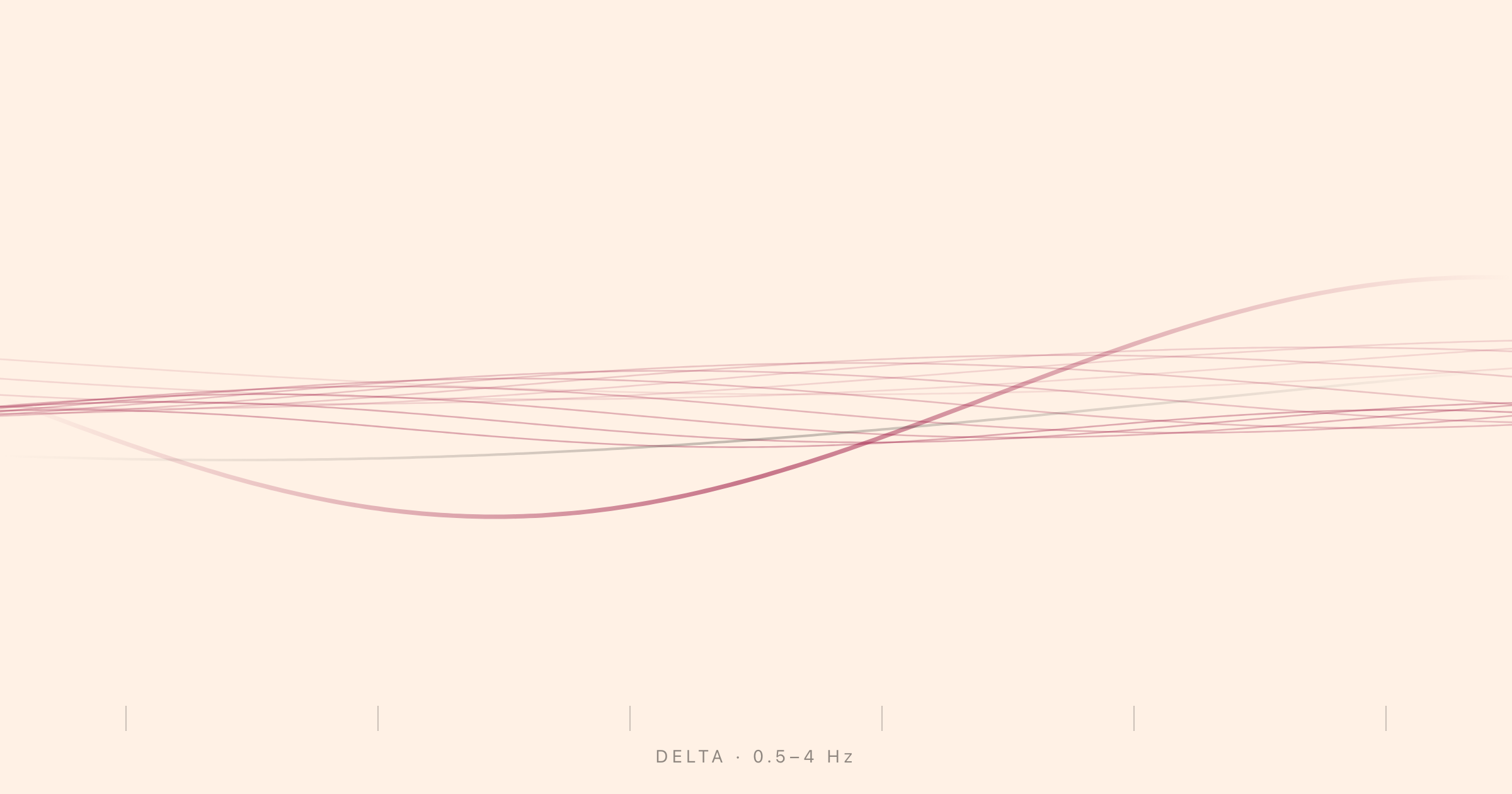
Delta waves are large-amplitude, low-frequency oscillations measured in the EEG, typically 0.5 to 4 Hz with peak-to-peak amplitudes between 75 and 200 microvolts. They are the slowest of the five EEG bands (delta, theta, alpha, beta, gamma) and also the largest in amplitude. Three properties define them consistently across the sleep-medicine and clinical-neurophysiology literature.
- Frequency. 0.5 to 4 Hz. Some references push the upper bound to 3.5 Hz, others to 4 Hz. The American Academy of Sleep Medicine scoring rules use 0.5 to 2 Hz as the strict criterion for "slow-wave activity" during N3 staging.
- Amplitude. At least 75 microvolts peak-to-peak in the AASM criterion. This is large by EEG standards. Delta waves are visible to the naked eye on a paper trace, where alpha and beta require careful reading.
- Cortical synchrony. Delta waves represent the synchronous, slow oscillation of cortical neurons between hyperpolarised "down states" and depolarised "up states". This bistable cycling is the cellular basis of why N3 sleep looks the way it does in EEG and why it is so functionally specialised.
Where alpha and beta arise from networks of cortical neurons firing in distributed patterns of moderate synchrony, delta waves arise from massive, near-simultaneous synchronisation across large cortical territories. That synchronisation is what produces the slow, high-amplitude waveform, and it is also what makes delta sleep functionally different from the other stages.
The Cellular Mechanism in One Paragraph
Each delta-wave cycle reflects roughly a half-second hyperpolarisation followed by a half-second depolarisation across a large cortical population. During the hyperpolarised "down state", the involved neurons are silent. During the depolarised "up state", they fire briefly. This bistability is driven by thalamocortical loops modulated by neuromodulators that drop during sleep (acetylcholine, noradrenaline, serotonin) and by intrinsic conductances that switch the cortex into the slow-oscillation regime. The mechanism is well-characterised. It is why delta waves are sleep-specific outside of pathology: the cortex cannot enter that bistable regime while ascending arousal systems are firing.
Where Delta Waves Sit Among the Five Brainwave Bands
The five EEG bands map roughly onto a continuum from deep sleep to peak cognitive engagement. Delta sits at the deep-sleep end. Each band is characterised by a frequency range, a typical state, and a dominant cognitive correlate.
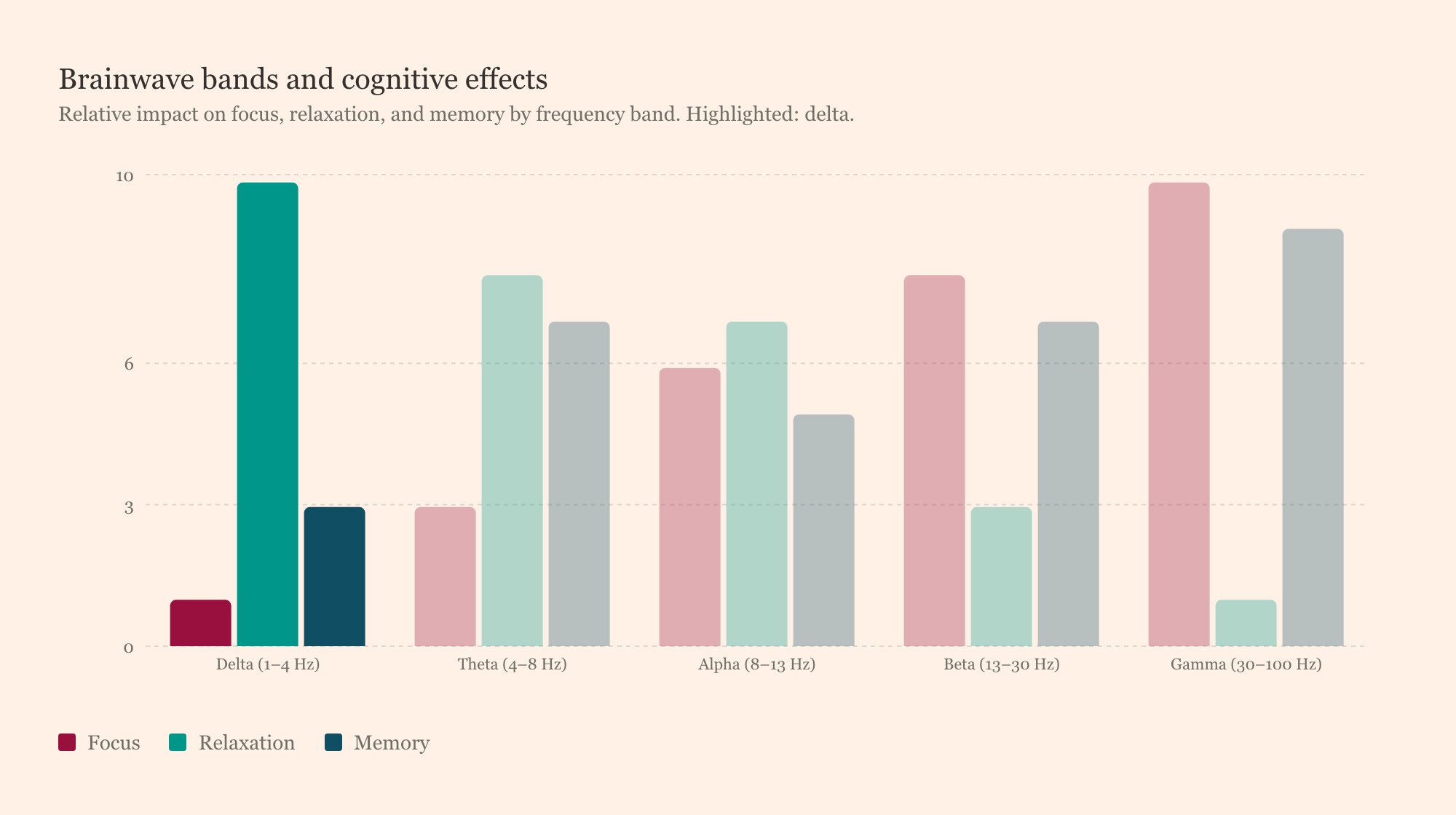
The cluster of articles on the other bands gives the longer treatment of each:
- Theta waves (4–8 Hz) are the band of drowsy transition, deep meditation, REM sleep, and certain creative states.
- Alpha waves (8–13 Hz) dominate the relaxed-but-awake state, particularly with eyes closed, and modulate sensory gating.
- Beta waves (13–30 Hz) are the engaged-cognition band: active thinking, problem-solving, motor control.
- Gamma waves (30+ Hz) are the binding and high-level integration band, with the 40 Hz peak carrying particular significance for auditory steady-state responses.
Delta is the outlier. The other four bands all increase in dominance as the brain moves from rest toward engagement. Delta does the opposite: it dominates only when consciousness is largely offline. That is the central fact about the band, and it is the fact most "delta waves for focus" content elides.
What Delta Waves Do During Sleep
Slow-wave sleep, the stage where delta dominates, is the most functionally specialised of the four NREM/REM stages. Three processes converge on delta sleep, and each is part of why losing it has the consequences it does.
Memory Consolidation: The Hippocampus-to-Cortex Handover
The two-stage model of memory consolidation, introduced by Buzsáki and elaborated by sleep researchers since the late 1990s, holds that recent memories are initially encoded in the hippocampus and gradually transferred to neocortical storage during slow-wave sleep. The mechanism involves a coordinated interplay between three sleep oscillations:
- Slow oscillations (the delta-band component itself): orchestrate when other oscillations occur.
- Sleep spindles (12 to 16 Hz, occurring during N2 and the up states of N3): carry the hippocampal memory trace.
- Sharp-wave ripples (high-frequency hippocampal events): mark the moment a memory trace is replayed.
The slow oscillation acts as the conductor. Spindles and ripples are nested into the up state of each delta cycle, and the temporal alignment of these three rhythms is what allows memory traces to be consolidated into long-term cortical networks. This is why the most reliable predictor of next-day memory performance after learning is the amount and quality of slow-wave sleep, not total sleep duration.
When slow-wave sleep is selectively suppressed (with acoustic disruption that disrupts delta oscillations without waking the participant), declarative memory consolidation suffers. Total sleep time can be unchanged. The delta-band activity is the active ingredient.
Glymphatic Clearance: The Brain's Waste Removal
The glymphatic system, characterised in the early 2010s in mouse studies and increasingly in humans, is a network of perivascular channels through which cerebrospinal fluid washes through the brain parenchyma and clears metabolic waste, including amyloid-beta. The system is roughly ten times more active during sleep than during waking, and the activity is concentrated in slow-wave sleep specifically.
The proposed mechanism: during slow-wave sleep, the interstitial space between neurons expands by approximately 60 percent. CSF inflow accelerates. Metabolic byproducts that have accumulated during the day are flushed. The slow oscillation appears to be coupled to this clearance, with each delta cycle pumping fluid through the perivascular channels.
This is one reason chronic sleep deprivation is associated with cognitive decline and is suspected as a risk factor for neurodegenerative disease. The system that removes amyloid-beta runs primarily during the brain state where delta waves dominate.
Growth Hormone, Immune Function, and Tissue Repair
The largest pulse of growth-hormone secretion in a 24-hour cycle occurs during the first slow-wave sleep episode of the night, typically within the first 90 minutes of falling asleep. Growth hormone is involved in tissue repair, muscle synthesis, and immune-system maintenance. The pulse is tightly coupled to delta-wave activity. Disrupted slow-wave sleep blunts the pulse. This is the mechanism behind the long-observed link between sleep quality and physical recovery in athletes, and it is why fragmented sleep is associated with impaired immune function in the next-day window.
When Delta Waves Cluster: The Architecture of a Night
Slow-wave sleep does not distribute evenly across the night. It clusters heavily in the first half. A typical 8-hour night looks like this:
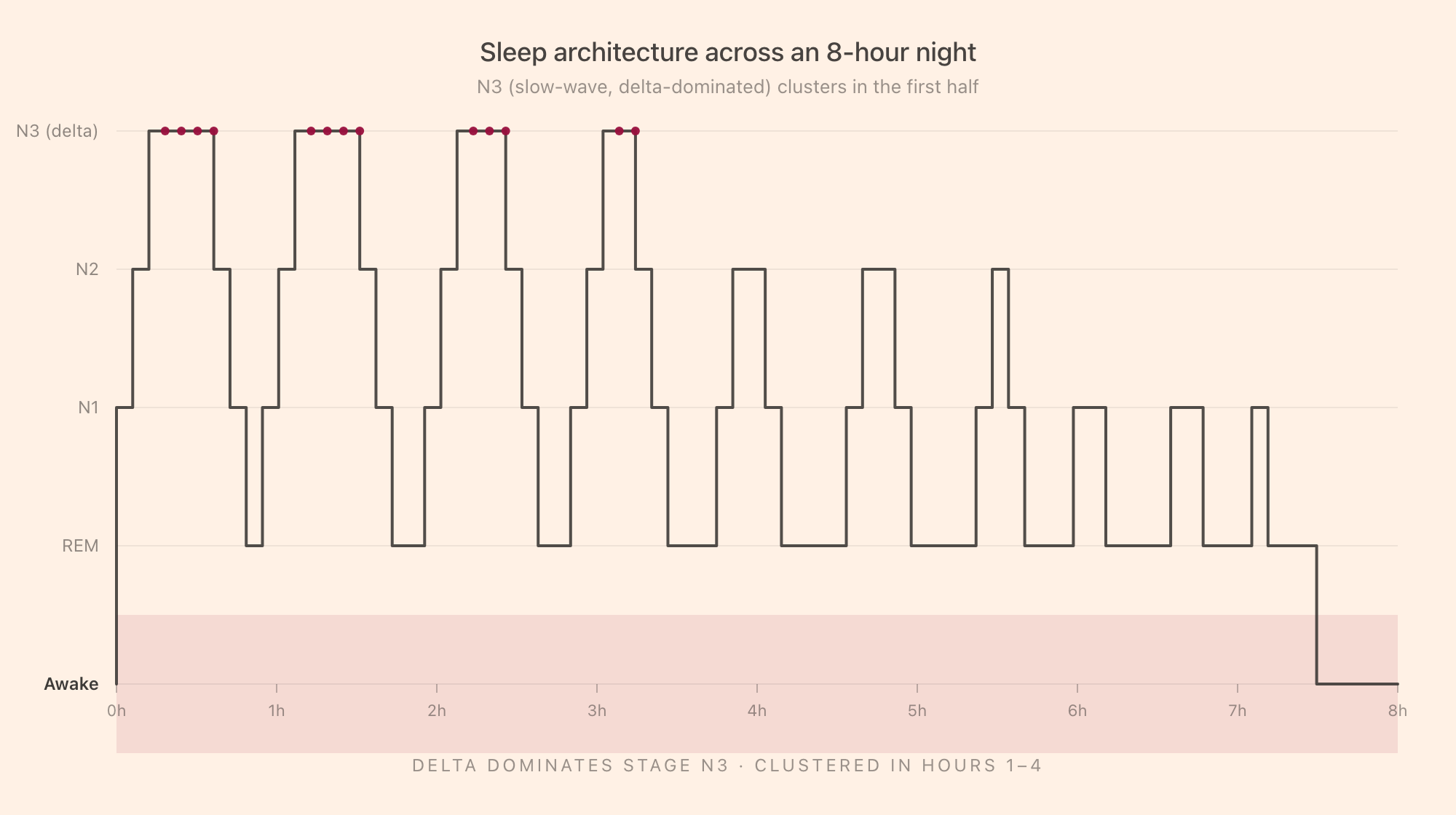
Three patterns matter. First, the first slow-wave episode begins roughly 30 to 45 minutes after sleep onset and is the longest single N3 episode of the night. Second, slow-wave sleep gradually shortens in each successive cycle, with the third or fourth cycle often containing little or no N3 at all. Third, the first half of the night is delta-dominated; the second half is REM-dominated.
This architecture has practical consequences:
- Cutting sleep short cuts REM, not delta. A 4-hour sleeper gets most of their slow-wave sleep, very little REM, and wakes up cognitively depleted in a different way to a 6-hour sleeper. The 4-hour version is selectively REM-deprived, not delta-deprived.
- Naps under 30 minutes typically miss N3 entirely and avoid the post-nap grogginess that comes from being woken out of slow-wave sleep. Naps over 90 minutes complete a full cycle and exit through REM, which is why they feel restorative.
- Sleep fragmentation in the first half of the night (a child waking, a noisy environment, an early-evening drink wearing off) selectively disrupts delta-rich sleep and produces the worst next-day deficit even if total sleep time is preserved.
Can You Use Delta Waves For Focus? The Honest Answer
A meaningful subset of the binaural-beats and brainwave-entrainment market sells delta-band content as a relaxation and focus tool. The framing is misleading. Three things are worth separating.
Cannot use delta entrainment to enter a focused state. The delta band is associated with a state of cortical bistability that is incompatible with sustained attention. A delta-band binaural beat at 2 Hz, if it has any genuine entrainment effect at all (the evidence for which is heavily contested at this band), would shift the listener toward sleepiness, not focus. The framing "delta waves for deep focus" is selling the opposite of what the band does.
Can use delta-band content as sleep music or relaxation aid. This is the legitimate use case. A binaural beat or low-frequency drone tuned in the 1 to 4 Hz range is consistent with the slowing of cortical activity that precedes sleep onset. Whether the beat itself produces meaningful entrainment is a separate question (the evidence is mixed at best for the delta band), but the genre as background sleep audio is an entirely reasonable use, like rain sounds or pink noise for sleep.
Cannot equate delta waves with relaxation in general. The body has multiple physiological correlates of relaxation. EEG alpha is the relaxed-but-awake correlate. Reduced sympathetic tone, slower breathing, lower heart rate variability shifts, all of those are independent. Delta waves are specifically the deep-sleep correlate. Conflating them with general relaxation is a category error common in the wellness space.
The general principle: the band you want to entrain is the band corresponding to the state you want to be in. For focus, that means alpha, beta, or gamma depending on the type of focus. For sleep, it means delta. For meditation, it means alpha or theta. The binaural beats safety guide covers the broader question of whether brainwave entrainment works at all and at what magnitudes; the short answer is that the entrainment effect is real but small, and the band-state correspondence still matters.
Disorders of Delta Sleep
Delta-wave activity is one of the most clinically informative measurements in sleep medicine. Several disorders manifest as either too much, too little, or anomalously distributed slow-wave activity.
- Idiopathic insomnia and adult-onset insomnia typically present with reduced N3 and an increased N1/N2 fraction. Restoring slow-wave sleep is one of the goals of treatment.
- Sleep apnoea fragments slow-wave sleep through repeated micro-arousals. The total sleep time can look adequate while N3 is heavily disrupted.
- Major depression is associated with reduced slow-wave activity in the first sleep cycle and a shortened REM latency. The reduction in early-night delta is one of the more replicable polysomnographic findings in the depression literature.
- Narcolepsy is associated with intrusion of REM features into wakefulness, but slow-wave sleep architecture is also disrupted.
- Slow-wave-sleep parasomnias (sleepwalking, night terrors, confusional arousals) are abrupt partial arousals out of N3 sleep. They occur most often in the first third of the night, when delta dominance is highest.
The clinical picture is one reason "improving slow-wave sleep" is a meaningful target in sleep-medicine interventions, from CPAP for sleep apnoea to acoustic stimulation studies that play tones synchronised to the up state of detected slow waves to enhance their amplitude. The early evidence for that latter approach (closed-loop acoustic stimulation) suggests modest improvements in next-day declarative memory in some populations, although the field is still small.
How Delta Differs From the Bands It Is Often Confused With
Two confusions show up regularly in the focus-music space.
Delta versus theta. Theta sits at 4 to 8 Hz, immediately above delta. Theta is the band of drowsy transitional states, deep meditation, and REM sleep. The two are easy to confuse because both can appear in sleep and both are on the slower end of the EEG spectrum. The distinction matters: theta is associated with creativity, meditative states, and REM dreaming; delta is associated with deep restorative sleep with little dreaming. Marketing that promises "deep meditation with delta waves" is more likely describing theta-band activity.
Delta versus the slow component of normal awake EEG. Even during the day, an EEG trace contains a low level of delta-band activity. Pathological delta in the awake state (focal or generalised slowing) is a sign of cortical dysfunction. The delta band in the wake state is therefore not a cognitive resource to be enhanced; in clinical contexts it is generally a finding to be investigated.
The takeaway is that "boost your delta waves" is not a coherent goal outside of the sleep window. The right framing is whether your slow-wave sleep is sufficient and high-quality, which is governed by sleep duration, sleep timing, and the absence of disruption.
What Helps Slow-Wave Sleep (and Therefore Delta)
The interventions with the strongest evidence for improving slow-wave sleep are not entrainment products. They are the basics of sleep hygiene plus a few specific levers. In rough order of effect size:
- Adequate sleep duration. N3 fraction depends on sleep pressure (the time-since-last-sleep accumulation of homeostatic drive). Cut sleep short and the next night's N3 rebounds. Chronically restrict and the rebound becomes incomplete.
- Consistent timing. Slow-wave sleep is anchored to the early portion of the sleep period. Going to bed at the same time every night helps the architecture stabilise.
- Cool ambient temperature. Core body temperature drops during slow-wave sleep. A cooler bedroom (16 to 18°C / 60 to 65°F) supports the drop. Hot environments fragment N3 specifically.
- Alcohol avoidance late in the day. A drink within four hours of bedtime suppresses slow-wave sleep in the first half of the night and produces a REM rebound in the second half. The fragmenting effect on N3 is robust.
- Exercise. Regular aerobic exercise increases the proportion of slow-wave sleep, with effects observed across populations from healthy adults to chronic-insomnia patients.
- Avoiding sleep-disrupting medications. Many common medications (some antidepressants, some sleep aids paradoxically) reduce slow-wave sleep. Worth checking with a prescriber if sleep quality has changed.
A separate category, with smaller and more contested evidence, includes interventions that specifically target slow-wave activity: acoustic stimulation phase-locked to delta, transcranial slow oscillation stimulation, and certain pharmacological agents that enhance slow-wave activity. None of these are mainstream consumer products at this time, and their effects are modest where they are positive at all.
The Bottom Line on Delta Waves
Delta waves are the EEG signature of slow-wave sleep, the deepest and most functionally specialised stage of human sleep. They drive memory consolidation, glymphatic clearance, growth-hormone secretion, and the systems-level restoration that sleep exists to perform. They are not a focus signal. The framing "delta waves for productivity" inverts what the band actually does. The framing "support your slow-wave sleep so tomorrow's focus is intact" is the one consistent with the science.
If your interest is genuine cognitive performance, the brainwave band you want to think about is the one corresponding to the cognitive state you want to be in: alpha for relaxed attention, beta for active engagement, gamma for high-level integration. Tomatoes uses DSP to generate music that has been measured against those bands, not delta. It is a one-time $39 with no subscription and the engineering is in the audio, not the marketing.
If your interest is sleep, the answer is simpler still: sleep more, sleep cooler, sleep on a consistent schedule, and your delta waves will take care of themselves. That is what the band is for.