Endorphins are the closest thing your body has to a built-in supply of morphine. When you push through a hard workout, laugh until it hurts, or feel a warm glow of connection with other people, endorphins are part of what you are feeling: the body's own chemicals for dulling pain and lifting mood. Their very name gives the game away, "endorphin" is a contraction of "endogenous morphine," meaning morphine produced from within. They are one of the reasons exercise feels good, stress can be endured, and certain simple pleasures are so reliably mood-boosting. And because mood, stress, and energy all feed directly into your ability to focus and do good work, endorphins are worth understanding for more than just the runner's high.
This article explains what endorphins are, what they actually do, the surprising truth about the famous "runner's high," and the natural, evidence-supported ways to get more of them. None of it requires anything exotic; the levers are mostly things you already have access to and probably do not use enough.
What Are Endorphins?
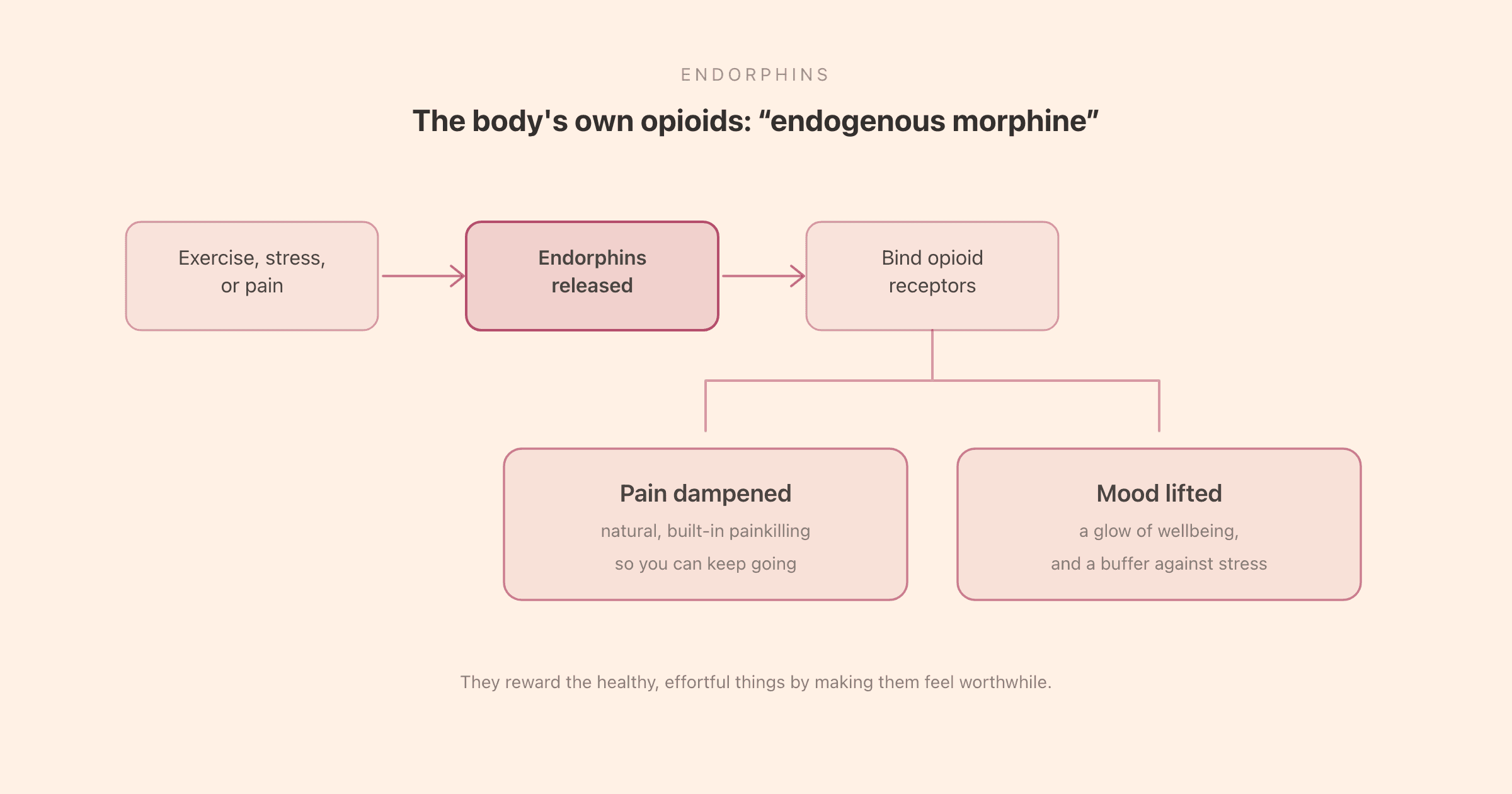
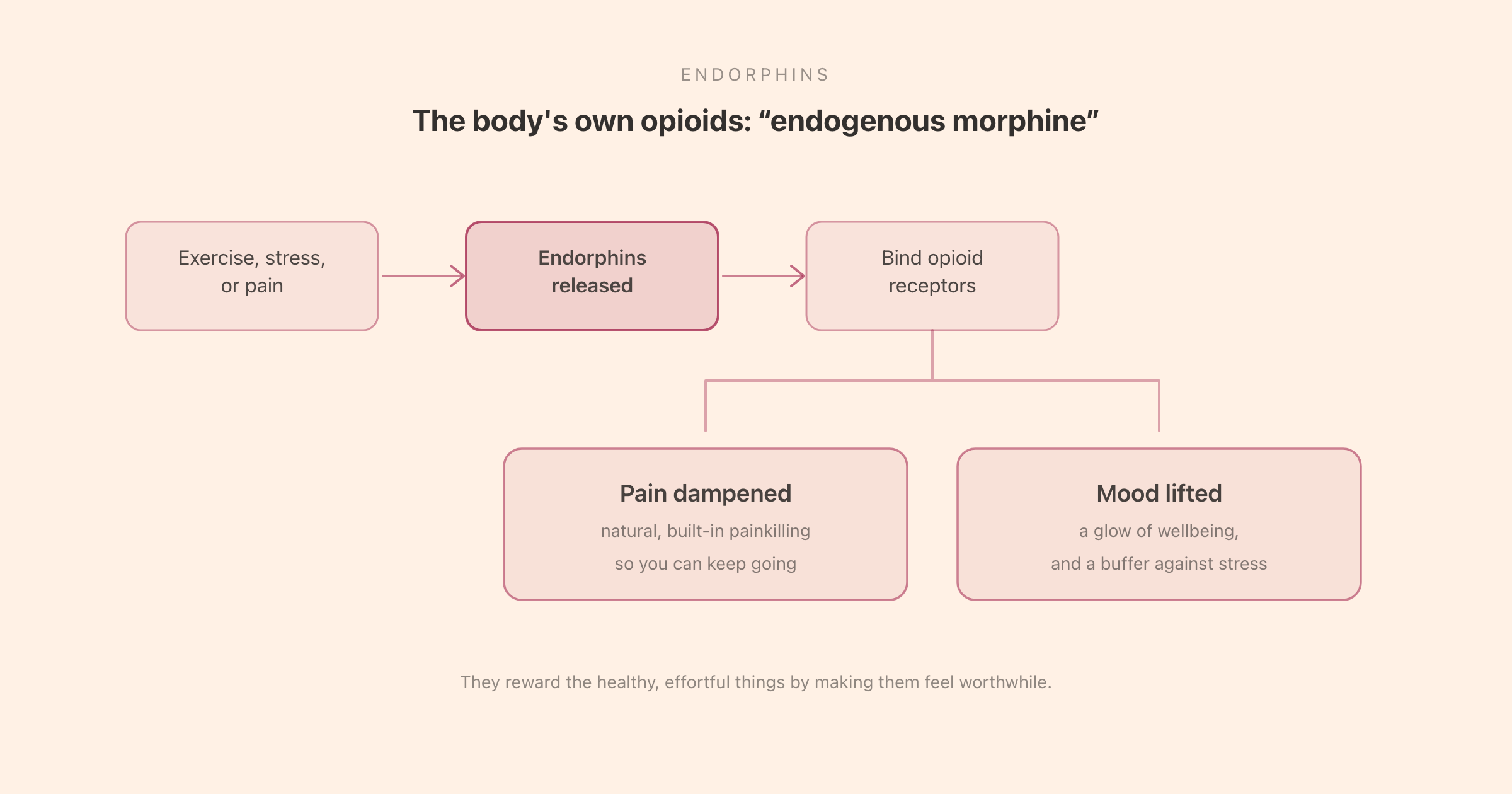
Endorphins are a group of chemicals produced by your nervous system to cope with pain and stress. They are neuropeptides, released chiefly by the brain and pituitary gland, and they work by binding to the same receptors, the opioid receptors, that painkilling drugs like morphine target. This is why they are described as the body's natural opioids: they act on the very same system, just produced internally and in a gentler, self-regulating way.
Their primary evolutionary job is pain management. When the body is under physical stress or injury, endorphins are released to dampen the pain signals, allowing you to keep going through a hard effort or a difficult moment. A runner finishing a race, a person coping with an injury, someone pushing through exhaustion, all are being helped, in part, by endorphins blunting the discomfort. Alongside that pain relief comes a second effect that we notice more: a lift in mood, a sense of wellbeing or even mild euphoria.
It is worth distinguishing endorphins from the other "feel-good" chemicals they get lumped in with. Dopamine drives motivation and reward-seeking, serotonin supports stable mood, and endorphins specifically handle pain and the pleasure of relief. They overlap and interact, but endorphins are the body's painkiller-and-glow system in particular.
What Endorphins Do
Endorphins have a handful of well-established effects, all flowing from their action on the opioid system.
They relieve pain. This is their core function: reducing the perception of pain, which is what lets you push through physical discomfort. It is a natural, built-in analgesia.
They lift mood and reduce stress. The release of endorphins produces feelings of wellbeing and can create a mild euphoria, while also helping to buffer the effects of stress. This is why activities that release them feel good and leave you calmer.
They contribute to the pleasure of certain activities. Much of the enjoyment of exercise, laughter, music, and social connection is bound up with endorphin release, which is part of why these activities are so reliably restorative.
The overall picture is of a system designed to help you endure and recover: to blunt pain when you need to keep going, and to reward the effort with a mood lift afterward. It is the body's way of making hard, healthy things feel worthwhile.
The Truth About the Runner's High
The "runner's high," that euphoric, floaty feeling some people get during or after sustained exercise, is the most famous example of endorphins at work, and for decades it was attributed to them entirely. The story was simple and satisfying: run far enough, flood your brain with endorphins, feel the high.
The truth turns out to be more interesting. More recent research has cast doubt on endorphins being the whole story, and possibly even the main one. Endorphins are relatively large molecules, and there is real question about how easily they cross the blood-brain barrier to produce the mental effects of the high. Attention has turned to another system: endocannabinoids, the body's own cannabis-like molecules, which are also released by exercise, do readily reach the brain, and produce exactly the kind of calm euphoria the runner's high describes. The current view is that the runner's high is probably a blend, with endocannabinoids playing a larger role than the endorphin-only story suggested.
This does not diminish endorphins; they are still genuinely released by exercise and still contribute to feeling good and coping with the effort. It is just a good reminder that the brain's chemistry is usually a collaboration, not a single-chemical story, and that the tidy explanations we inherit are sometimes only part of the picture.
How to Boost Endorphins Naturally
The genuinely useful news is that endorphin release responds to ordinary activities, and you can prompt it deliberately. None of these are exotic.
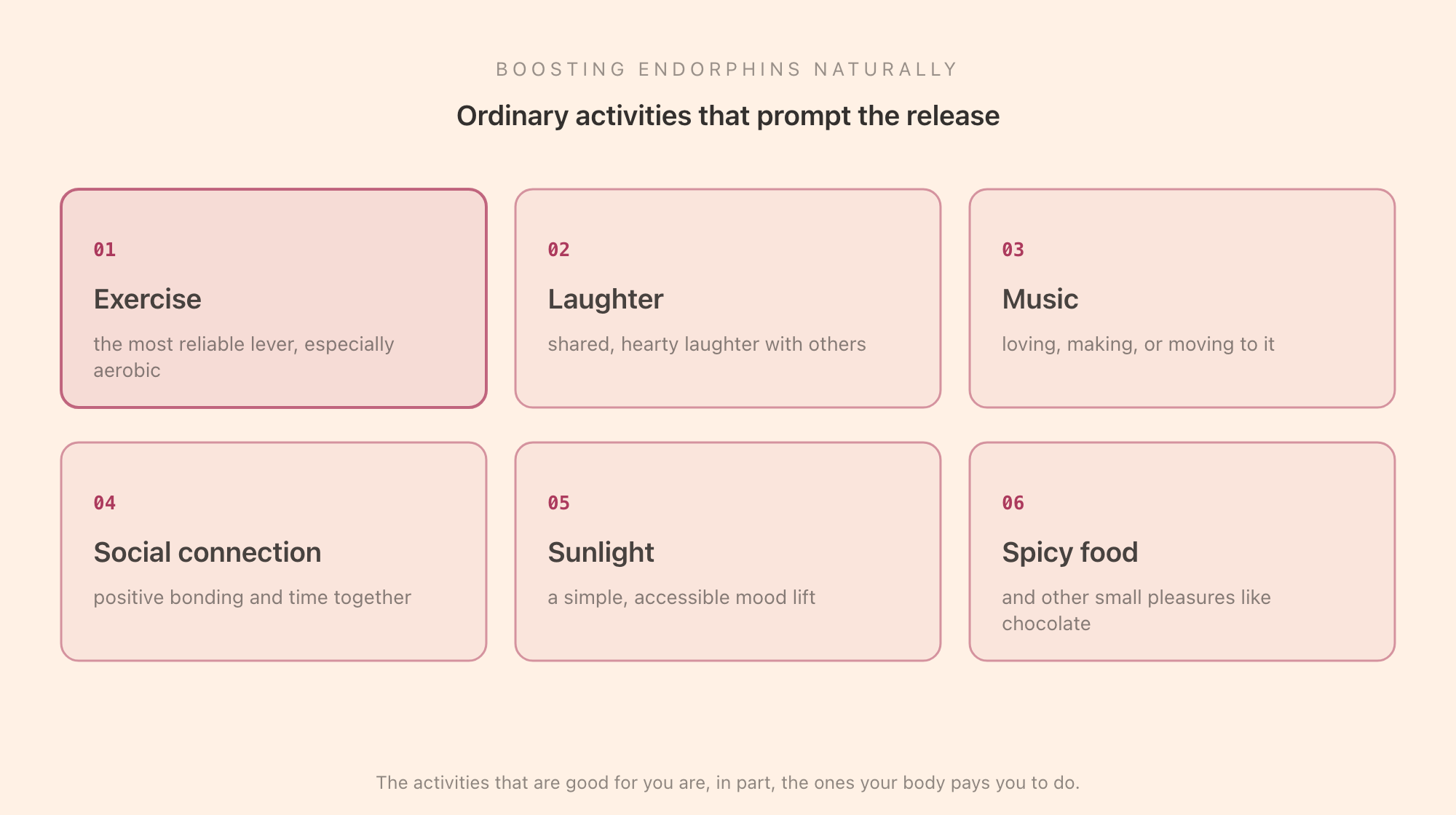
Exercise. The most reliable lever, especially sustained aerobic exercise. It is the classic endorphin trigger, and one of the best-evidenced natural mood boosters there is.
Laughter. Genuine, hearty laughter, the kind you share with others, prompts endorphin release, which is part of why laughing feels so good and so connecting.
Music. Listening to music you love, and especially making or moving to it, is associated with endorphin release and the pleasure and chills that come with it.
Social connection. Positive social interaction and bonding release endorphins, part of the neurochemistry of why being with people we like feels good and eases stress.
Sunlight and other pleasures. Sunlight, along with simple pleasures like eating dark chocolate or spicy food, can also prompt release, small, accessible mood lifts.
The theme is that endorphins reward the healthy, connecting, pleasurable things, which is a rather elegant piece of design: the activities that are good for you are, in part, the ones your body pays you to do.
Can You Have Too Many, or Too Few?
Because endorphins feel good, it is natural to wonder whether you can overdo them or run short. For the everyday, naturally-released kind, the answer is reassuringly simple: this is a self-regulating system, and the endorphins prompted by exercise, laughter, or music are not something you can meaningfully overdose on. The activities that release them have natural limits, and the system is built to reward healthy behaviour, not to be exploited.
Where it gets more complicated is at the extremes. The reason opioid drugs are so addictive is precisely that they flood the same receptors far more powerfully than the body ever does naturally, which is a world away from the gentle lift of a good run. And chronically low mood, or conditions involving pain and stress, can involve a dysregulated endorphin system, though that is a clinical matter rather than something to self-diagnose. For most people, the practical takeaway is the encouraging one: you do not need to worry about balance or dosage. You just need to give your body regular access to the ordinary activities, movement, connection, laughter, music, that let this quiet, healthy system do its job.
Endorphins, Mood, and Focus
The connection to focus is real, if indirect. Concentration is heavily dependent on mood and stress: it is very hard to focus when you feel low, anxious, or overwhelmed, and much easier when your mood is stable and your stress is manageable. Endorphins feed directly into that, they lift mood and buffer stress, which clears the emotional static that makes focus difficult. This is a big part of why exercise is so consistently linked to better cognitive performance: the endorphin-supported mood lift and stress relief create the calm, positive baseline that focus is built on.
So while endorphins are not a "focus chemical" in the way that alertness-related systems are, they support the conditions that make focus possible. Looking after the things that release them, moving your body, connecting with people, making room for laughter and music, is looking after the mood and stress foundations that concentration quietly depends on.
Where Focus Music Fits
There is a neat connection here, because music is itself one of the activities associated with endorphin release and the pleasure that comes with it. The right music does two things at once for a working session: it can prompt the small mood lift that makes focus easier, and it provides the steady, non-distracting sound environment that helps you settle into concentration in the first place.
Tomatoes is built around that second job, focus music designed to create a calm, consistent environment for deep work, while carrying the everyday mood-and-pleasure benefit that music brings. It is free to try for 3 days, then from $4.99 a week, $29.99 a year, or $39 for lifetime access. If you want a working environment that supports both your mood and your focus, a good sound environment is a simple place to start: try Tomatoes free for 3 days.
Endorphins are one of the body's quiet kindnesses: a built-in system that dulls pain, lifts mood, and rewards the effort of the things that are good for us. They are not a magic focus switch, and the runner's high turns out to be a more crowded story than the endorphin-only version we all learned. But the underlying truth is simple and encouraging: move your body, connect with people, make room for laughter and music, and your own chemistry pays you back with a mood lift and a buffer against stress, which is exactly the ground that good focus, and a good life, are built on.