Expertise is one of the few things almost everyone wants and almost nobody analyses. The popular account is that it takes 10,000 hours, which is memorable, widely repeated, and wrong in most of the ways that matter. Time is a poor predictor of skill: there are people who have driven for forty years and are mediocre drivers, and people who have been playing an instrument for four years and are genuinely good. What separates them is not hours logged but what happened inside those hours, and that turns out to be describable, teachable, and considerably more demanding than most practice.
This article covers what deliberate practice actually requires, where the 10,000 hour figure came from and what it originally said, why some fields reliably produce expertise and others do not, how expert perception differs, and what all of this means if you are trying to get good at something.
What the 10,000 Hour Rule Actually Said
The figure comes from a 1993 paper by Anders Ericsson, Ralf Krampe, and Clemens Tesch-Römer, studying violinists at a Berlin music academy. The best students had accumulated roughly 10,000 hours of solitary practice by age twenty; less accomplished students had accumulated less. The finding was real, and the paper's argument was that the quality and quantity of a specific kind of practice, not innate talent, explained most of the difference.
Malcolm Gladwell popularised it in Outliers in 2008, and in the retelling it became a rule: put in 10,000 hours and you will master anything. Ericsson spent much of the rest of his career objecting to that version, and his objections are worth knowing.
It was an average, not a threshold. Individual violinists varied enormously around it. Nothing happens at hour 10,000.
It was hours of deliberate practice, not hours of doing the activity. That distinction is the entire content of the research, and it is the part the popular version dropped.
It described one domain. Violin at an elite academy is not a general model for all skills, and the number differs wildly by field.
It did not claim anyone can master anything. Ericsson argued that practice mattered far more than commonly assumed, which is a different and more defensible claim.
There is also a genuine scientific dispute here that it would be dishonest to skip. A 2014 meta-analysis by Brooke Macnamara and colleagues found that deliberate practice explained a substantial share of performance variance in some domains, notably games and music, but much less in others such as education and professions. Practice is clearly the biggest lever you personally control. It is not the only thing that varies between people.
What Deliberate Practice Requires
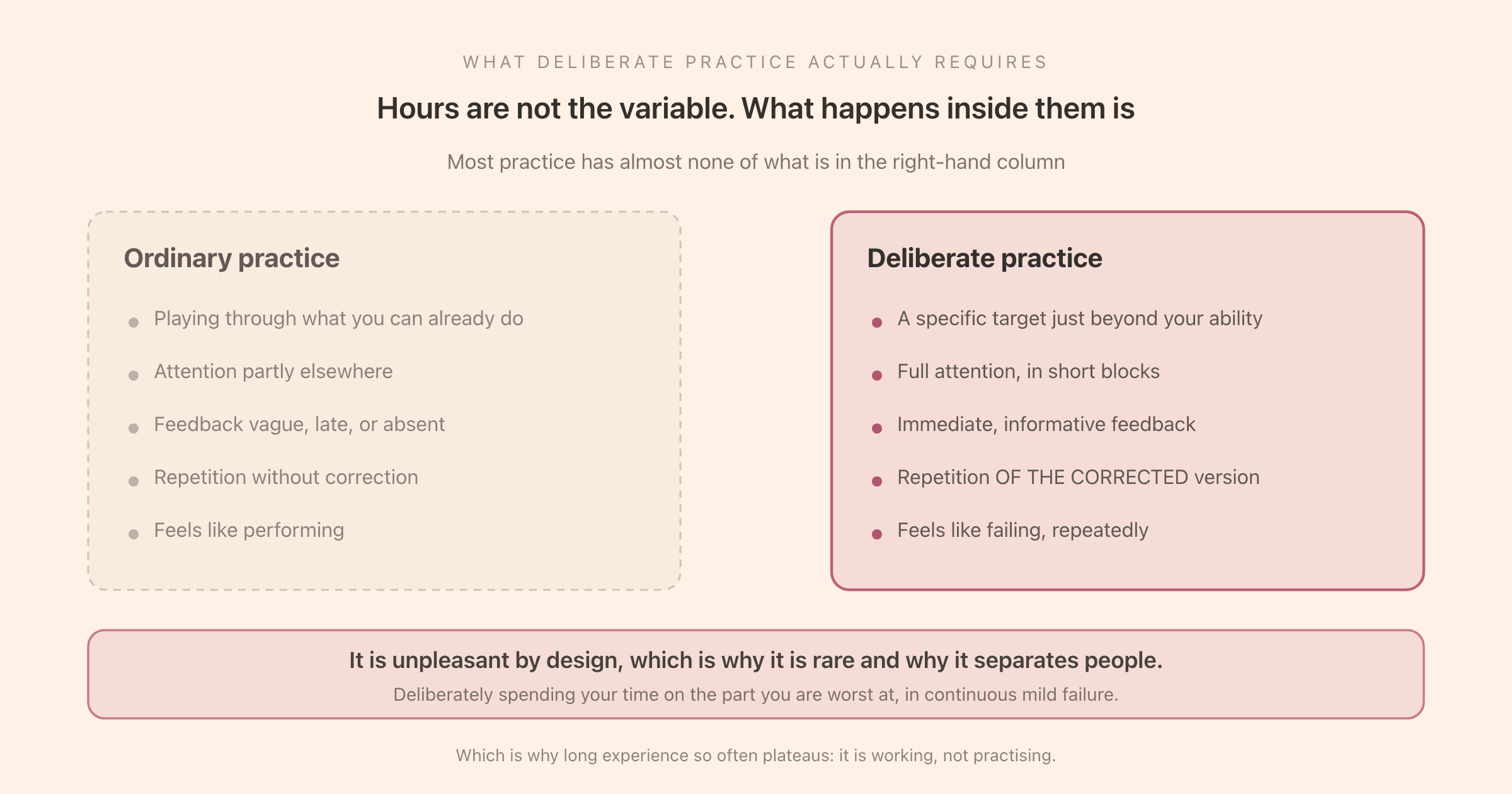
The useful part of Ericsson's work is the specification of what practice has to look like to develop skill. It has four elements, and most practice has none of them.
A specific target just beyond current ability. Not "practise the piece" but "get bars 40 to 48 clean at tempo". The target must be something you cannot currently do reliably, which means practice should feel like failing repeatedly, not like performing.
Full attention. Deliberate practice cannot be done absent-mindedly, which is why it is exhausting and why studies of elite performers find them practising in relatively short focused blocks rather than all day.
Immediate, informative feedback. You need to know, quickly, whether the attempt was right, and ideally why it was wrong. Without feedback, repetition just entrenches whatever you are already doing.
Repetition with correction. Not repeating the thing, but repeating the corrected version until it becomes reliable, then moving the target.
Almost everything people call practice fails on at least two of these. Playing through pieces you can already play is performing. Re-reading notes is reviewing. Doing your job competently is working. All are useful; none of them reliably build skill, which is why long experience so often plateaus.
The uncomfortable implication is that deliberate practice is unpleasant by design. It involves deliberately spending your time on the part you are worst at, in a state of continuous mild failure, with someone or something telling you what you got wrong. That is why it is rare, and it is a large part of why the people who do it pull away.
Why Some Fields Build Expertise and Others Do Not
This is the most useful and least known part of the research, and it comes from work by Daniel Kahneman and Gary Klein, who set out to reconcile their opposing views on expert intuition and ended up agreeing on the conditions.
Genuine expertise develops when two things are true.
The environment is regular enough to contain learnable patterns. Chess positions, musical structure, and the progression of a familiar illness all have real regularities. The long-term movement of individual stock prices largely does not.
Feedback is prompt and unambiguous. You find out whether you were right, quickly, and it is clear that it was your judgement that was right or wrong.
Where both hold, people who practise develop real, fast, accurate intuition: chess masters, anaesthetists, firefighters reading a building. Where either fails, people accumulate experience and confidence without accuracy, which is a genuinely dangerous combination, because the confidence grows regardless. This is why long-run political forecasters, clinical psychologists predicting individual outcomes, and stock pickers have such a poor record relative to how certain they sound.
The practical test is simple: ask what your feedback loop looks like. If you cannot say how and when you find out you were wrong, you are unlikely to be building expertise, no matter how many years you accumulate.
Experts See Differently
One of the most robust findings in the field is that expertise changes perception rather than merely speeding up reasoning.
The classic demonstration is from chess. Show a chess master a position from a real game for a few seconds and they can reconstruct it almost perfectly, far outperforming novices. Show them a board with pieces placed at random and their advantage largely disappears. The master is not remembering twenty pieces; they are recognising four or five familiar configurations. The technical term is chunking, and it means their memory is doing work that the novice must do with conscious reasoning.
The same shows up everywhere it has been looked for: radiologists spotting an abnormality in a fraction of a second, experienced nurses noticing a patient is deteriorating before the numbers say so, a mechanic hearing which part is failing. What looks like intuition is pattern recognition built out of a very large number of previous cases, which is exactly what the perception research predicts, since what you perceive is heavily shaped by the model you bring to it.
This has a practical consequence for learners. Expertise is built from exposure to many varied real cases, not from memorising rules about them, which is why case-based and problem-based learning outperforms rule memorisation in complex fields.
What This Means in Practice
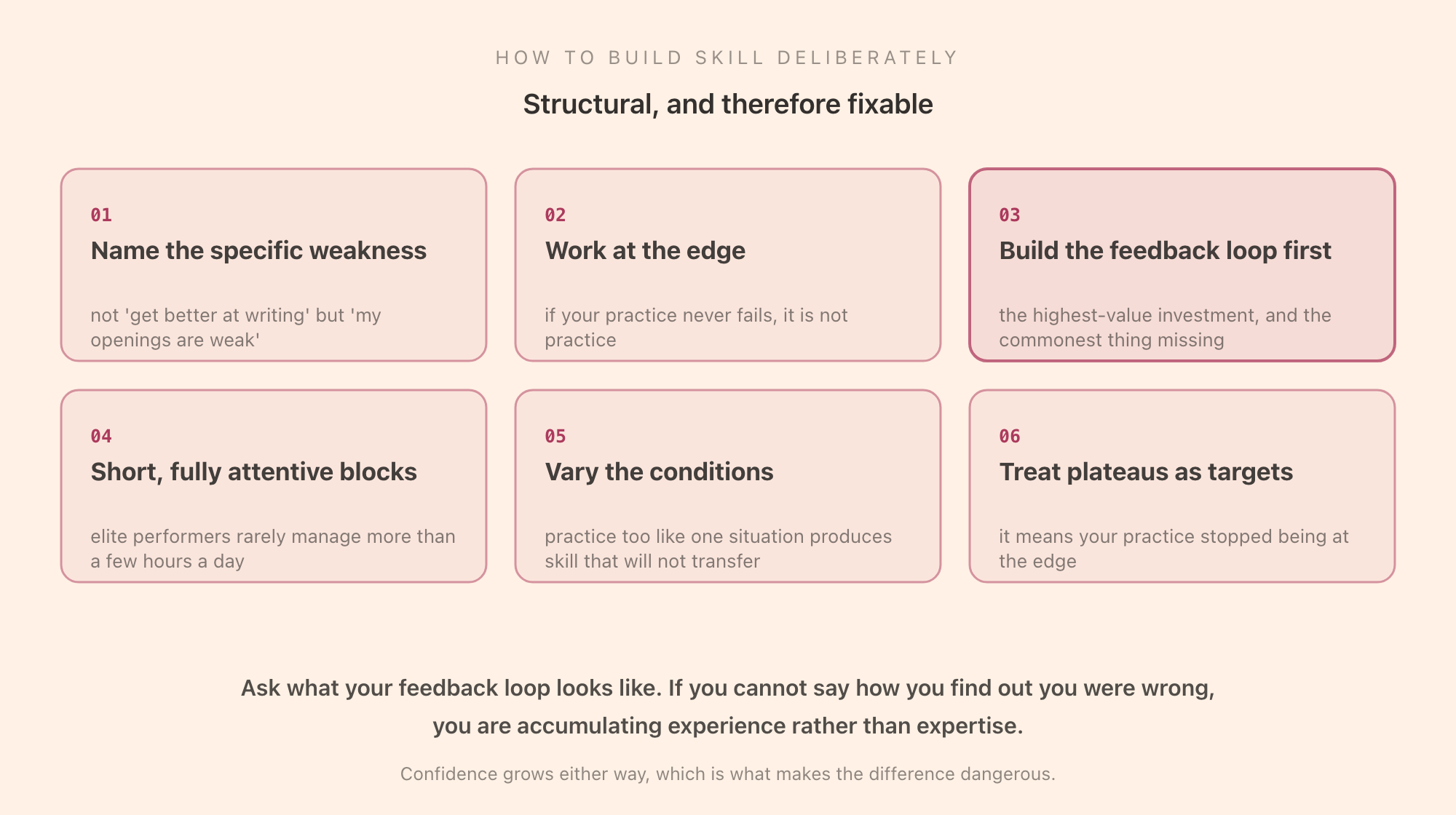
Identify the specific weakness. Not "get better at writing" but "my openings are weak". Vague goals produce vague practice.
Work at the edge, not in the comfortable middle. If your practice never fails, it is not practice.
Build a feedback loop before anything else. A coach, a test, a recording, a metric, a knowledgeable friend. This is the single highest-value investment, and its absence is the commonest reason experience does not become skill.
Practise in short, fully attentive blocks. Elite performers generally practise in bouts of an hour or so, with real rest, and rarely more than a few hours a day in total. Quantity beyond your capacity for attention is not deliberate practice, it is time.
Vary the conditions. Practice that too closely resembles one narrow situation produces skill that does not transfer.
Expect plateaus and treat them as targets. A plateau means your current practice has stopped being at the edge. Change the target, not the effort.
Get a lot of real cases. Especially in complex, judgement-heavy fields, where pattern recognition is doing most of the work.
Where Focus Music Fits
The requirement that quietly limits everything above is full attention. Deliberate practice is defined by it: the whole mechanism depends on noticing precisely what went wrong and correcting it, and that noticing is exactly what disappears when attention is divided. An hour of distracted practice is not a slightly worse hour of practice, it is repetition without correction, which entrenches your current habits rather than improving them.
That is the case for protecting practice time properly. Tomatoes provides focus music designed to give you a steady, non-distracting sound environment, so a practice or study block stays attentive for its full length. It is free to try for 3 days, then from $4.99 a week, $29.99 a year, or $39 for lifetime access. If you want your practice hours to actually count, try Tomatoes free for 3 days.
The genuinely encouraging thing about the expertise research is not the 10,000 hour version, which sets an intimidating and arbitrary bar. It is the finding that what separates people is largely structural and therefore fixable: a specific target at the edge of your ability, full attention, fast feedback, and correction rather than repetition. Most people never practise that way in their whole lives, which means the bar for pulling ahead in almost any field is lower than it looks, and the first step is not more hours. It is building the feedback loop that tells you what you are getting wrong.