Perception feels like a window. You open your eyes and the world is simply there, in colour, already sorted into objects, with no sense of effort or interpretation. That feeling is the most convincing illusion your brain produces. What is actually reaching you is a stream of ambiguous, incomplete, upside-down signals, and the rich, stable, obvious world you experience is something your brain constructs from them, largely by guessing. Understanding this is worth the effort for its own sake, and it has one immediately practical consequence: because perception is constructed, what you notice depends enormously on what you were attending to, and people routinely fail to see things that are directly in front of them.
This article covers how perception actually works, the prediction model that has largely replaced the old bottom-up account, the two famous experiments that show attention deciding what reaches consciousness, why illusions are informative rather than embarrassing, and what all of this means for anyone trying to work carefully.
The Problem Your Brain Is Solving
Start with how bad the raw input is. The image on your retina is two-dimensional, upside down, and has a hole in it where the optic nerve leaves, which you never notice. Your eyes move in rapid jumps several times a second, and vision is largely suppressed during each jump, yet the world does not appear to lurch. Only a tiny central region of your visual field has high resolution; peripheral vision is blurry and nearly colourless, despite the fact that your experience is of a wide, detailed, fully coloured scene.
The same problem appears everywhere in perception. Any pattern of light on the retina could have been produced by an infinite number of possible scenes: a large object far away or a small one nearby, a white surface in shadow or a grey surface in light. The signal genuinely does not determine the answer. This is called the inverse problem, and it means perception cannot work by simply reading off what is there, because what is there is underdetermined by the data.
What your brain does instead is use everything it knows, about lighting, physics, typical objects, and the immediate context, to arrive at the most probable interpretation. Perception is inference, and the feeling of directness is part of the output rather than evidence about the process.
Perception as Prediction
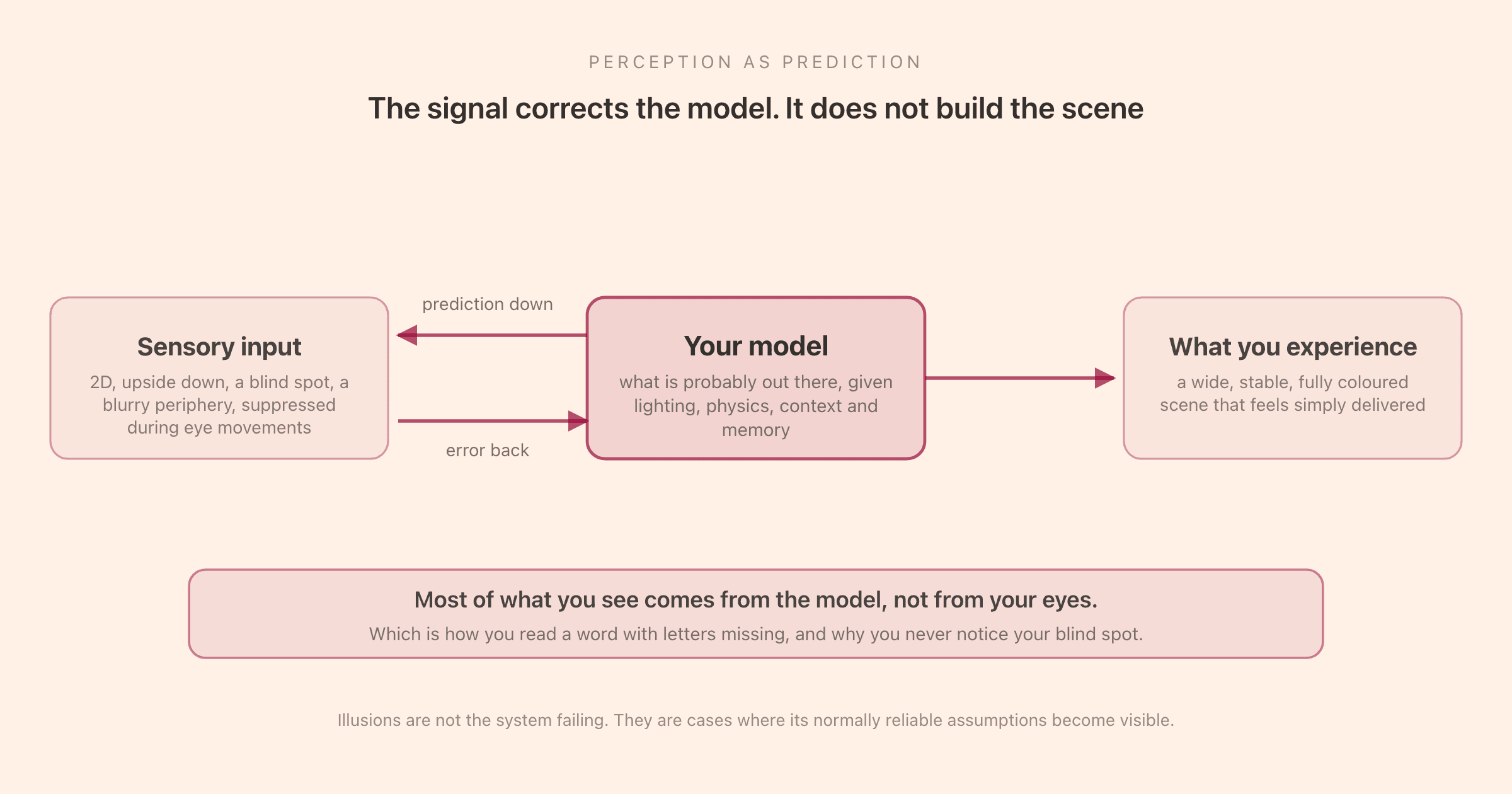
The account that has come to dominate in recent decades reverses the intuitive picture. Rather than building experience upwards from raw sensation, the brain runs a continuous model of what is probably out there and sends predictions down through the sensory hierarchy. Incoming signals are used mainly to check those predictions, and what travels back up is largely the prediction error: the part the model got wrong.
Two implications follow, and both are strange.
Most of what you see comes from the model, not the eyes. Sensory input is doing correction work, not construction work. This is why you can read a word with letters missing, understand speech in a noisy room, and see a complete scene despite a blind spot and a blurry periphery.
Expectation genuinely changes experience. Knowing what a degraded recording says makes you hear it clearly ever afterwards, and you cannot go back. Once the model has been updated, the perception changes with it, which is not a failure of attention but the system working as designed.
This is also why illusions matter. They are not tricks exposing a badly built system; they are cases where the brain's normally reliable assumptions are deliberately violated, so the assumptions become visible. An illusion is the machinery showing its working.
The Senses Are Not Separate Channels
Two further facts make the constructed nature of perception hard to dismiss.
Colour is not a property of objects. Surfaces reflect different wavelengths, but the experience of colour is manufactured, and the proof is that your brain corrects for illumination. A white shirt looks white in warm evening light and in blue midday light, even though the wavelengths reaching your eye are completely different. This is colour constancy, and it works so well that it is invisible until an image defeats it, which is exactly what happened with the dress photograph that split the internet in 2015: the lighting in the picture was genuinely ambiguous, so different brains made different assumptions about it and produced different colours, all of them sincerely seen.
Vision changes what you hear. In the McGurk effect, first reported in 1976, a video of a mouth forming one syllable is dubbed with the sound of a different one, and most people hear a third syllable that was never spoken. The striking part is that knowing about it does not help: close your eyes and you hear the real sound, open them and the illusion returns immediately. Perception is not a set of separate channels feeding a central observer; the senses are combined before you get to experience anything, and the combination is not under your control.
Together these make the point that perception is a construction rather than a delivery. What you experience is the brain's best current answer, assembled from several sources at once, and offered up as though it were simply the world.
Attention Decides What You See
Here is where perception stops being a curiosity and starts mattering for how you work.
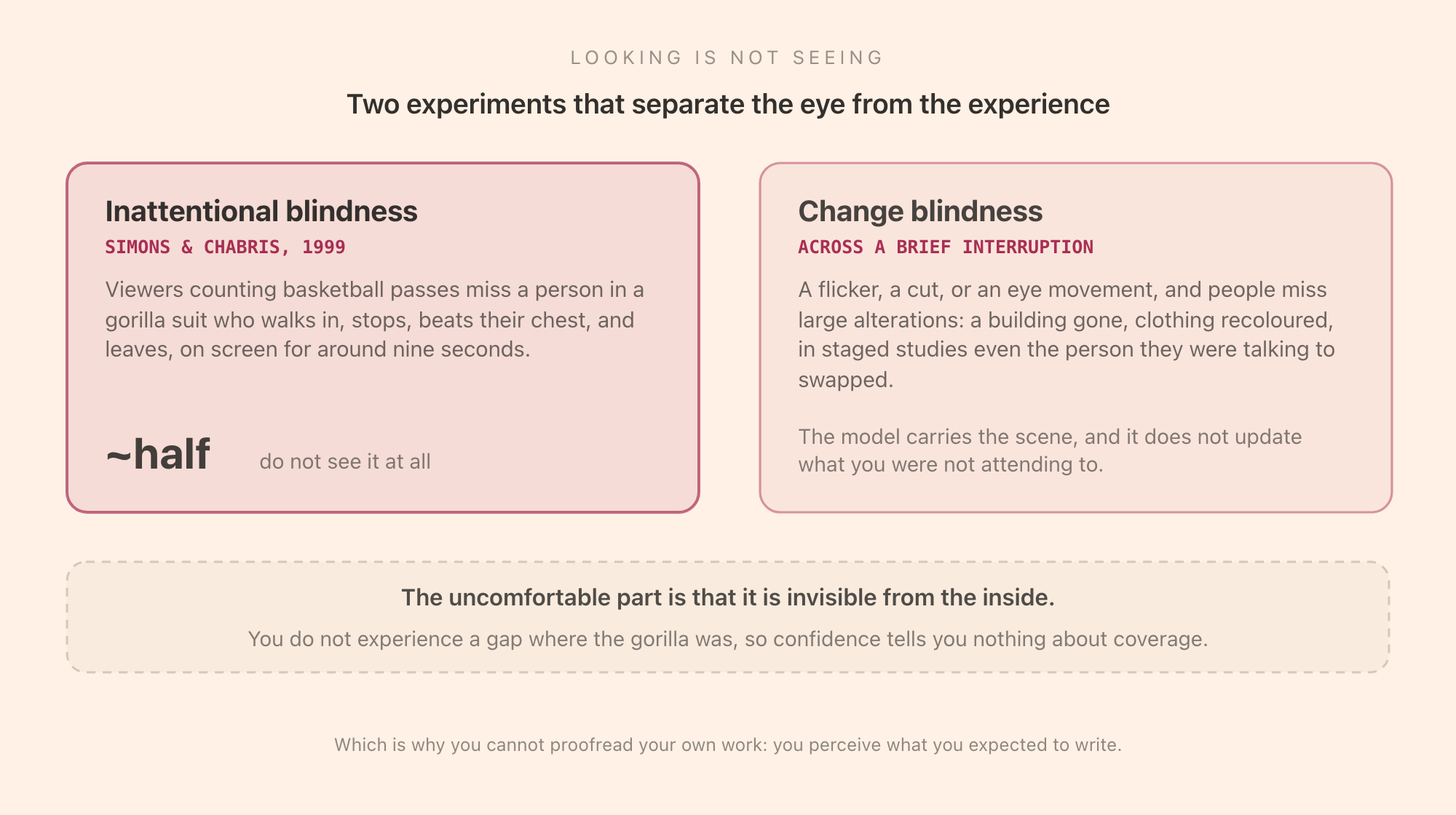
The best-known demonstration is the invisible gorilla study by Daniel Simons and Christopher Chabris, published in 1999. Viewers watched a short video of people passing basketballs and were asked to count the passes made by one team. Midway through, a person in a gorilla suit walks into the middle of the scene, stops, beats their chest, and walks off, on screen for around nine seconds. Roughly half of viewers, occupied with counting, do not see it at all. Told afterwards, many refuse to believe they were shown the same video.
This is inattentional blindness: not a failure of the eyes, which registered the gorilla perfectly well, but a failure of the gorilla to reach consciousness while attention was committed elsewhere. Looking and seeing are separable, and the gap between them is larger than anyone expects.
Change blindness makes the same point differently. When a scene is briefly interrupted, by a flicker, a cut, or an eye movement, people fail to notice remarkably large alterations: a building disappearing, a person's clothing changing colour, in some studies even the person they are talking to being swapped for someone else during a staged interruption. Because your model of the scene carries most of the load, and the model does not update what it was not attending to, the change simply does not register.
The uncomfortable part is not that this happens but that it is invisible from the inside. You do not experience a gap where the gorilla was. Your sense of having seen the whole scene is unaffected, which means you cannot use your own confidence as evidence that you did not miss something.
Why This Matters for Working
Several practical consequences follow directly.
Divided attention makes you miss things you are looking at. This is the strongest argument against doing careful work while monitoring something else. It is not that you work more slowly, it is that things in plain sight do not register at all, and you will not know which ones.
Checking your own work does not work well. You perceive what you expect, and you wrote what you expected, so your model supplies the correct version over the top of the error. This is why typos survive five readings and why proofreading is genuinely easier for someone else, or for you after enough delay that the model has faded.
Confidence is not coverage. Feeling that you have looked at everything is produced by the same machinery whether or not you have, which is precisely why a structured checklist beats a general look around in any setting where missing something is expensive.
Expertise changes perception itself. With practice, people genuinely see different things in the same scene: a radiologist sees an abnormality where a novice sees texture, a chess player sees a position where a beginner sees pieces. This is one of the concrete ways memory supports attention, because the model doing the predicting is built out of what you already know.
What Helps
Do one thing at a time when noticing matters. Multitasking does not merely slow careful work, it makes it unreliable in a way you cannot detect from the inside.
Use external structure rather than your own vigilance. A checklist works because it does not depend on you noticing that you should look.
Change the input. Read it aloud, change the font, print it, or come back tomorrow. Anything that stops your model supplying the expected version helps you see the actual one.
Get a second pair of eyes. Someone else's model is built from different expectations, which is why they find your errors immediately.
Expect the gaps. The single most useful takeaway from the gorilla study is not that people miss things, it is that they are certain they did not.
Where Focus Music Fits
The through-line here is that attention is not a spotlight illuminating an already-visible scene. It largely determines what the scene consists of. When attention is fragmented, you are not experiencing a slightly degraded version of the same work, you are experiencing a different and thinner one, with holes you cannot see.
That is the case for protecting a working session properly. Tomatoes provides focus music designed to give you a steady, non-distracting sound environment, so attention stays on the thing you are actually trying to notice rather than being repeatedly claimed by something else. It is free to try for 3 days, then from $4.99 a week, $29.99 a year, or $39 for lifetime access. If you want to work in a way that catches what matters, try Tomatoes free for 3 days.
Perception is one of those subjects that is quietly humbling. The world looks like it is simply being delivered to you, and instead it is being constructed, continuously and mostly from your own model, using sensory data as a corrective rather than a source. That system is extraordinarily good, which is why it is invisible. But it comes with a specific and consistent failure: what you were not attending to does not arrive, and nothing in your experience marks its absence. Working carefully means building that fact into how you work, rather than trusting the feeling of having looked.