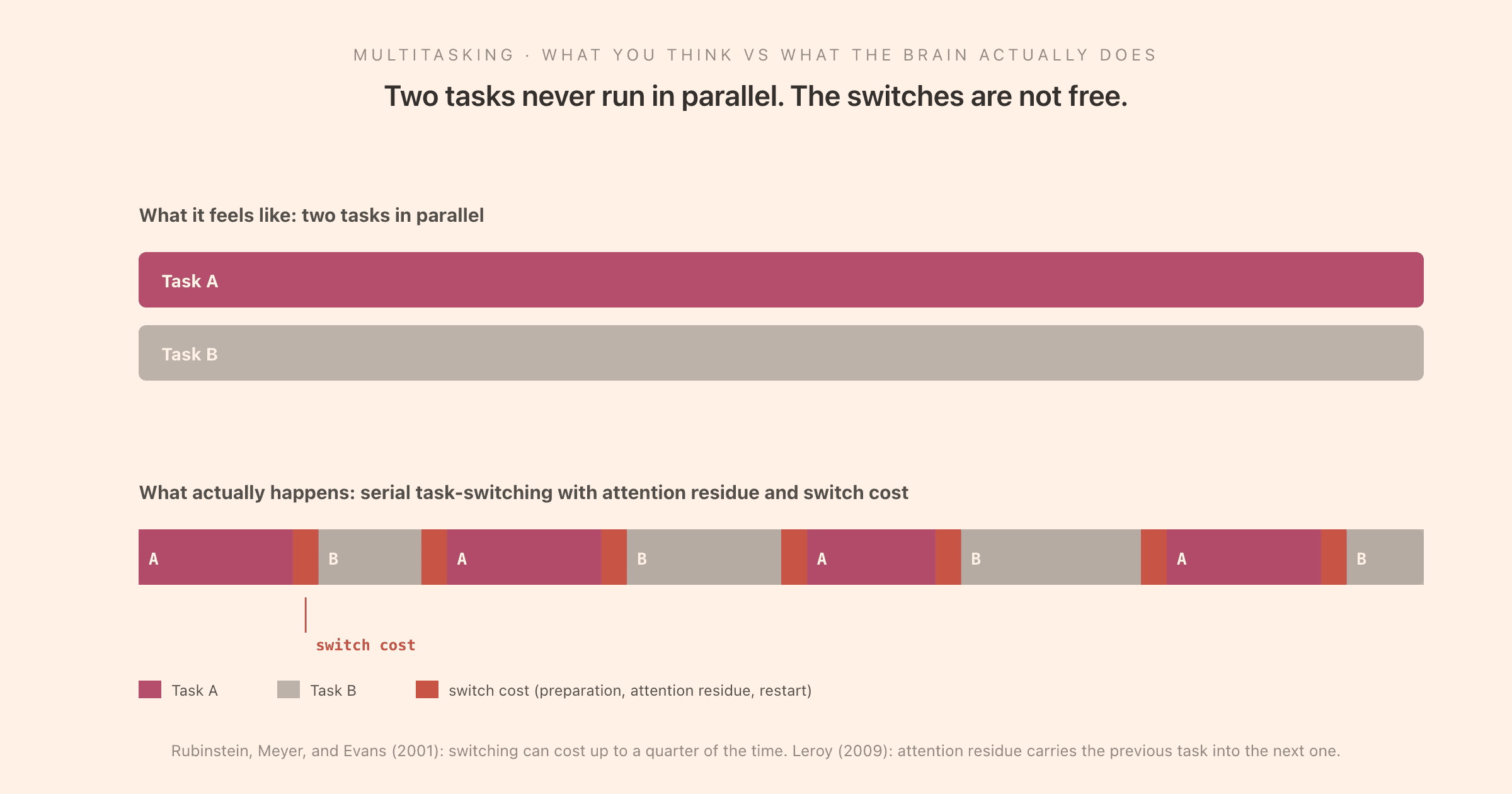
Multitasking, as most people use the word, does not exist. The brain cannot consume two attention-demanding inputs at the same instant; it can only task-switch, moving back and forth so quickly that the alternation feels like simultaneity. Each switch costs time, and each switch leaves a residue of the task you just left bleeding into the task you just picked up. The result, demonstrated repeatedly across the cognitive-psychology literature, is that "doing both at once" is slower and more error-prone than doing them in sequence, and the people who multitask most heavily are not better at it than everyone else. They are, on average, measurably worse at the underlying cognitive skills the alternation requires.
This piece is the cognitive-neuroscience version of multitasking: a precise account of what the brain can and cannot run in parallel, the central-bottleneck and switch-cost evidence, Sophie Leroy's attention-residue work, the Ophir, Nass and Wagner result that heavy media multitaskers score worse on every cognitive control measure tested, the phone-and-driving studies, and the narrow exceptions where automated tasks really do run alongside an attended one. Tomatoes is a focus tool built for the opposite of multitasking: single-task working blocks that protect the system from the switch costs this article describes. The app is free for 3 days, then $4.99/week, $29.99/year, or $39 lifetime.
What Multitasking Actually Is (and Is Not)
In everyday usage, "multitasking" means doing two or more things at once. In cognitive psychology, the word covers a few quite different phenomena and the difference between them is the whole story.
The first kind is true parallel processing: two cognitive operations running at the same time on the same brain. For attention-demanding tasks (anything that asks for working memory, controlled response selection, or cognitive control) this is essentially impossible. The brain has a bottleneck at the level of response selection that lets only one such operation proceed at any moment. This is the central-bottleneck theory developed by Harold Pashler and others, and it is supported by the psychological refractory period (PRP): present a second task close to the first and the second response is delayed in proportion to how close the two arrived, because the second has to wait for the first to clear the bottleneck.
The second is concurrent automatic processing: a well-practised task that no longer requires conscious attention can run alongside an attended one. Walking and talking is the classic example; experienced typing while listening to music is another. The trick is that the "second" task is not actually being attended to: it is being executed by overlearned motor and perceptual routines. The exception is real, and it bounds how much you should worry about multitasking: tasks that are genuinely automatic do not compete for the bottleneck.
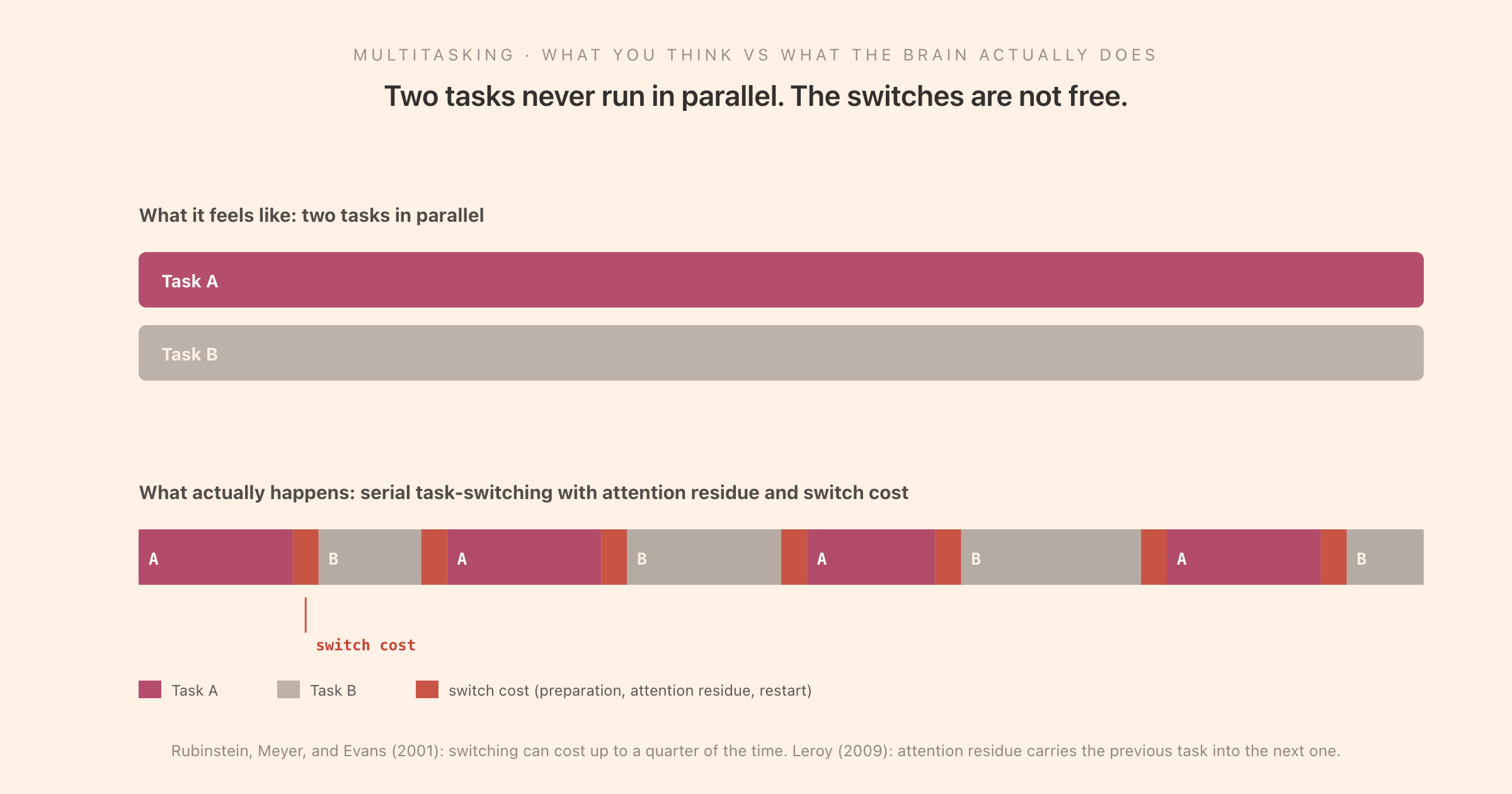
The third is what people usually mean: fast task-switching. You feel like you are doing two things at once because you are alternating between them on a sub-second timescale. The bottleneck is still serial; only one task is being attended to at any moment. What the brain is actually doing is buying the appearance of parallelism by paying in switches, and the switches are not free.
To answer the common question directly, is multitasking bad: for cognitively demanding work, yes. It is not a moral failing; it is a structural one. The brain is built to do this one thing at a time, and treating it otherwise has a measurable cost.
The Switch Cost
The decisive experimental finding is the switch cost: doing two tasks in alternation takes longer (and produces more errors) than doing the same total amount of each task in two consecutive blocks. Joshua Rubinstein, David Meyer, and Jeffrey Evans demonstrated this systematically in a 2001 series of experiments published in the Journal of Experimental Psychology. Across tasks of varying complexity and familiarity, alternating between them imposed time costs that could reach roughly a quarter of the total time when the tasks were unfamiliar or complex.
The cost has several components. There is a preparation cost: the brain needs to load the rules for the new task ("if X then press left" gives way to "if X then press right") before it can execute. There is a set-shifting cost: the active mental set governing how stimuli are processed has to be reconfigured. And there is an interference cost: the previous task's representation is still partially active and competes with the new one. None of these is conscious; all of them are paid every time you switch.
For knowledge work the upshot is unambiguous. Two attention-demanding tasks done in two protected blocks finish faster and with fewer errors than the same two tasks done by alternating between them. The intuition that you are gaining something by interleaving is the intuition the data does not support.
Attention Residue
Sophie Leroy's 2009 paper, "Why is it so hard to do my work?", added a second, subtler cost on top of the switch cost. When you leave one task without fully completing it and turn to another, the first task does not vacate cleanly: parts of your attention remain attached to it for a while, an effect Leroy named attention residue. The residue degrades performance on the new task, and it is heavier when the prior task was left in an unfinished state with looming deadlines.
The practical signature is one most knowledge workers will recognise. You move from a hard email to a coding task, and the email keeps intruding on your thinking for the first several minutes of the code, even though you are not consciously thinking about it. Performance on the code is measurably worse during that residue window than it would be if the email had been finished, or never started, before you opened the editor. The fix Leroy's data supports is straightforward: small structural rituals that finish or properly close the prior task before starting the next one ("ready-to-resume" plans, brief closure summaries) reduce the residue and restore performance on the new task.
Switch cost and attention residue are different effects but they ride together. Both are the price of crossing a task boundary, and the more often you cross, the more often you pay.
The Heavy-Media-Multitasker Paradox
The cleanest blow to the multitasking-as-skill story came from a Stanford study by Eyal Ophir, Clifford Nass, and Anthony Wagner, published in PNAS in 2009. Their question was whether people who routinely consume multiple streams of media at once (call them heavy media multitaskers, or HMMs) have trained up better cognitive control as a result. The expected answer, given that the brain is plastic and practice usually pays, was "yes, at least somewhat."
The result was the opposite. Compared to light media multitaskers (LMMs), heavy media multitaskers scored worse on every measure of cognitive control the study tested: worse at filtering irrelevant information from working memory, worse at filtering irrelevant stimuli from perception, and slower at switching between tasks. They were not better at the very skill set you would expect their lifestyle to train.
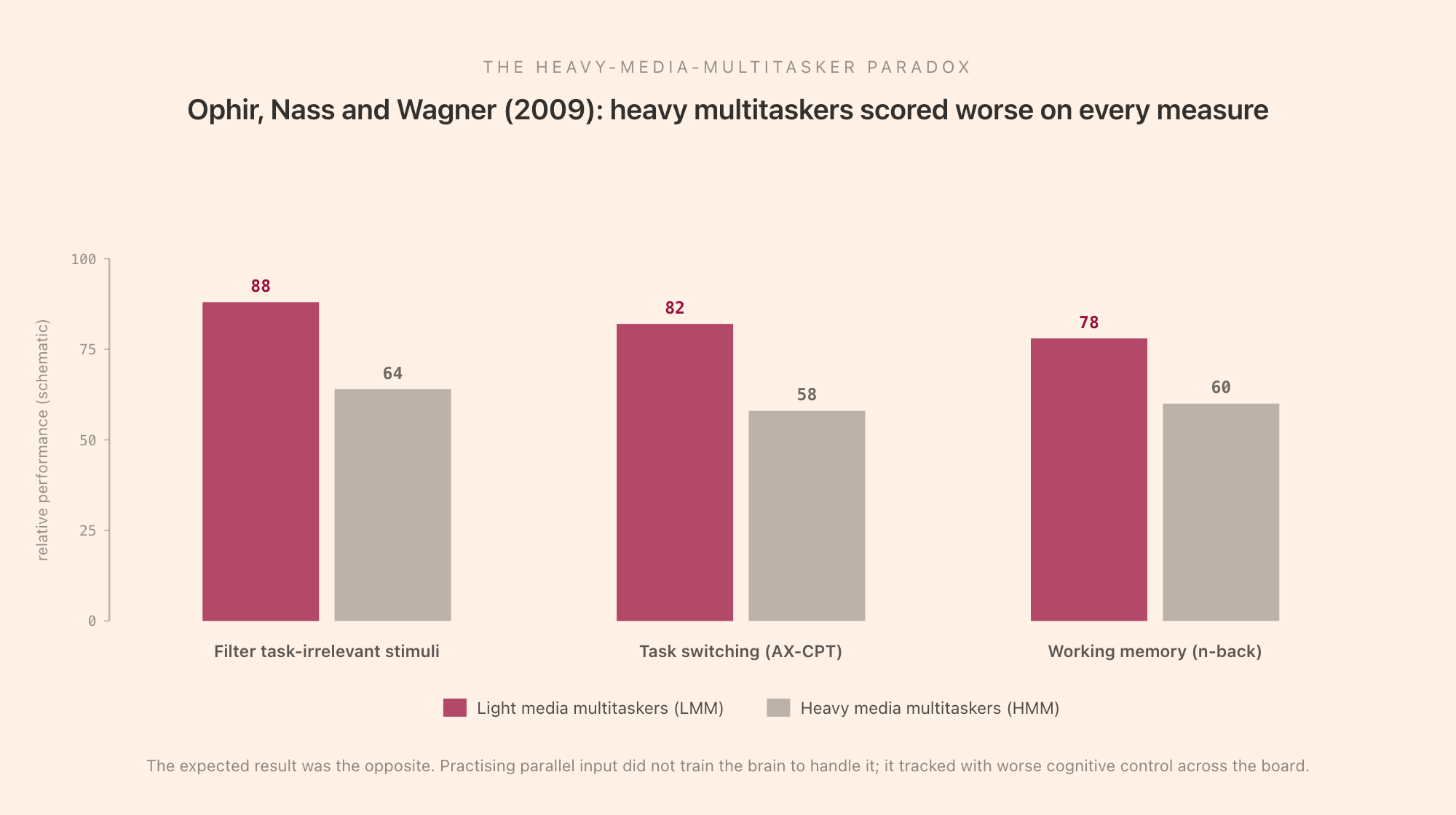
The result reverberated, and like any single finding it has been argued about, with later replications producing a mixed picture: the broad pattern that HMMs do not outperform LMMs on cognitive-control tasks has held up well; the specific claim that they are reliably worse is more variable. Either way, the headline is clear enough. Routine media-multitasking does not earn you a measurably better attention system, and there is good evidence it is associated with a worse one. The neuroplasticity rule that "you wire what you practise" is consistent with this: what HMMs practise is dividing attention between irrelevant streams, and that is not the same thing as concentrated cognitive control.
Phones and Driving: When the Cost Becomes a Casualty
For applied stakes, the most consequential multitasking research is the work by David Strayer and colleagues on phone use while driving. Across a long series of simulator and on-road studies, using a phone (handheld or hands-free) while driving produces impairments in attention, hazard detection, and reaction time on a scale that is comparable, on several measures, to driving while legally drunk. Hands-free does not solve it; the cost is not in the hands, it is in the divided attention.
What makes this research important is that driving feels automatic, the conversation feels automatic, and the conjunction of the two feels like a routine pairing in which nothing is happening cognitively. The data say otherwise. Both tasks are drawing on the central attentional bottleneck, and the bottleneck cannot serve both. The illusion of safe parallel driving-plus-conversation is exactly the illusion of safe parallel emailing-plus-coding, scaled to a context where the failure mode is a crash.
The Exceptions: Automaticity and Threaded Cognition
There are real exceptions, and naming them honestly matters because it stops the broad rule from sounding like a moral panic about doing two things at once.
The first exception is automaticity. A skill practised to the point where it no longer requires controlled attention can run alongside an attended task without interference. Walking while talking, breathing while reading, typing well-learned text while listening, all genuinely combine without competing for the bottleneck because one of the two is being executed by overlearned routines, not by attention. The cost only appears when both tasks need controlled processing.
The second exception is the model offered by Dario Salvucci and Niels Taatgen's threaded cognition work. Their account is that the brain manages multiple goals through a serialised but very fast scheduler, and that some combinations of tasks can interleave with minimal cost when they draw on different resources (visual perception vs auditory perception, vocal output vs manual output) and when one of them has long stretches where it does not need the bottleneck. Their model predicts and explains why some combinations work better than others without abandoning the central-bottleneck framework.
The takeaway from both exceptions is the same. The brain is not magic: it cannot run two attention-demanding operations in parallel. It can interleave them with cost, and it can pair an attended task with an automated one cheaply. Anything beyond that is task-switching.
How a Focus Block Defeats Multitasking
The lesson that follows from all of this is structural rather than motivational. You do not solve a switch-cost problem by trying harder to multitask; you solve it by reducing the number of switches. A focus block is a tool for exactly that: a protected window in which one task gets the attentional bottleneck without competition.
The cognitive systems Tomatoes is built around all live on this side of the line. The executive function machinery, particularly its shifting component, is the part of the brain that pays the switch costs; protecting it from unnecessary switches is the highest-leverage thing you can do for sustained work. Working memory is the small workspace task-switching evicts and reloads on every switch; fewer switches means less eviction. The neuroplasticity specificity principle says you wire what you practise; if you practise focused single-task blocks, you wire the circuits that support them, and Ophir's heavy-multitaskers are the cautionary version of the same rule. And the pomodoro technique is the simplest scheduling tool for keeping the block intact: time-limited, distraction-suppressed, and explicitly mono-task by design.
How Tomatoes Fits
Tomatoes does not stop you from switching tasks; only you can decide to stop. What a focus tool can do is protect the conditions in which not-switching is the easier choice. A stable acoustic environment (focus music, brown noise, or binaural beats) reduces the perceptual distractors that pull at attention; a timer sets a defined working window so the cost of breaking it is visible; and a minimal, distraction-free surface makes the next switch a deliberate decision rather than a habit. The block is what produces the conditions under which the bottleneck can do one thing well.
The fit is honest and narrow. The discipline to leave the inbox closed, to silence the phone, and to finish the task in front of you before opening the next one is yours. The app holds the boundary in which it can happen. Tomatoes is free for 3 days, then $4.99/week, $29.99/year, or $39 lifetime. It runs locally as a desktop app with a system menu-bar companion, generates its audio in real time, and is built for working blocks of a few hours a day.
The Short Version
Multitasking, in the strong sense of running two attention-demanding tasks in parallel, is impossible. The brain has a central bottleneck at response selection that processes one such task at a time, with the psychological refractory period as the experimental signature. What feels like multitasking is fast task-switching, which carries a measurable cost: Rubinstein, Meyer, and Evans (2001) put switching costs as high as roughly a quarter of the time on unfamiliar or complex tasks, and Leroy (2009) added the attention residue that carries the previous task into the next one. The popular assumption that heavy media multitaskers have trained themselves up was tested directly by Ophir, Nass, and Wagner (2009) and the result was the opposite of expected: heavy multitaskers performed worse on the cognitive-control tasks the study used, with later replications producing a mixed but never flattering picture. Phone-while-driving research extends the principle into a high-stakes setting where the bottleneck does not care about hands-free. There are genuine exceptions, automated tasks pairing freely with an attended one, and the threaded-cognition model captures the structure of interleaving honestly, but neither exception licences the everyday multitasker's faith. The practical fix is structural: build single-task blocks, finish tasks before crossing boundaries, and treat every reduction in switches as a direct reduction in cost.