Neuroplasticity is the brain's capacity to change its own structure and function in response to experience. It is not a metaphor and not a wellness slogan: it is a set of physical processes by which synapses strengthen and weaken, connections form and prune, and maps of the cortex redraw themselves around what an organism actually does. Every skill you have ever acquired, every memory you hold, and every habit you have built or broken is neuroplasticity having happened. The reason it matters for anyone who cares about focus and learning is simple: the changes that make you better at something are physical changes in tissue, and they only occur under specific conditions. Understanding those conditions is the difference between practice that rewires you and practice that does nothing.
This piece is the cognitive-neuroscience version of neuroplasticity: a precise definition, the cellular machinery (Hebbian plasticity and long-term potentiation), the structural side (synapse formation and pruning, cortical remapping), the timing (critical periods versus the more constrained plasticity of the adult brain), the genuine scientific debate over adult neurogenesis, the principles that govern when rewiring actually happens, and the myths worth discarding. Tomatoes is a focus tool built for the kind of sustained, attentive practice that drives real plastic change. The app is free for 3 days, then $4.99/week, $29.99/year, or $39 lifetime.
What Neuroplasticity Actually Is
The neuroplasticity definition that holds up is the broad one: any lasting change in the nervous system's structure or function that results from experience. The word covers a wide range of phenomena that operate at different scales. At the smallest scale it means a single synapse becoming more or less effective. At a larger scale it means whole populations of neurons reorganising which part of the body or which task they respond to. All of it is the same underlying idea, that the brain is not fixed hardware running fixed software but a self-modifying system whose wiring is shaped continuously by use.
It is worth retiring the old framing it replaced. For most of the twentieth century the mature brain was assumed to be essentially static, its circuits laid down in development and fixed thereafter. That view is gone. The adult brain changes throughout life, and the question is no longer whether it rewires but under what conditions, how much, and how fast. The honest answer is that plasticity is real and lifelong but also constrained: it is easier in childhood than adulthood, easier for some systems than others, and it does not happen automatically just because you showed up.
To answer the common question directly, can the brain rewire itself: yes, demonstrably, but rewiring is earned. It requires the right kind of experience, repeated enough, with enough attention and intensity, for the relevant circuit. The rest of this article is about what those qualifiers mean.
The Cellular Engine: Hebbian Plasticity and LTP
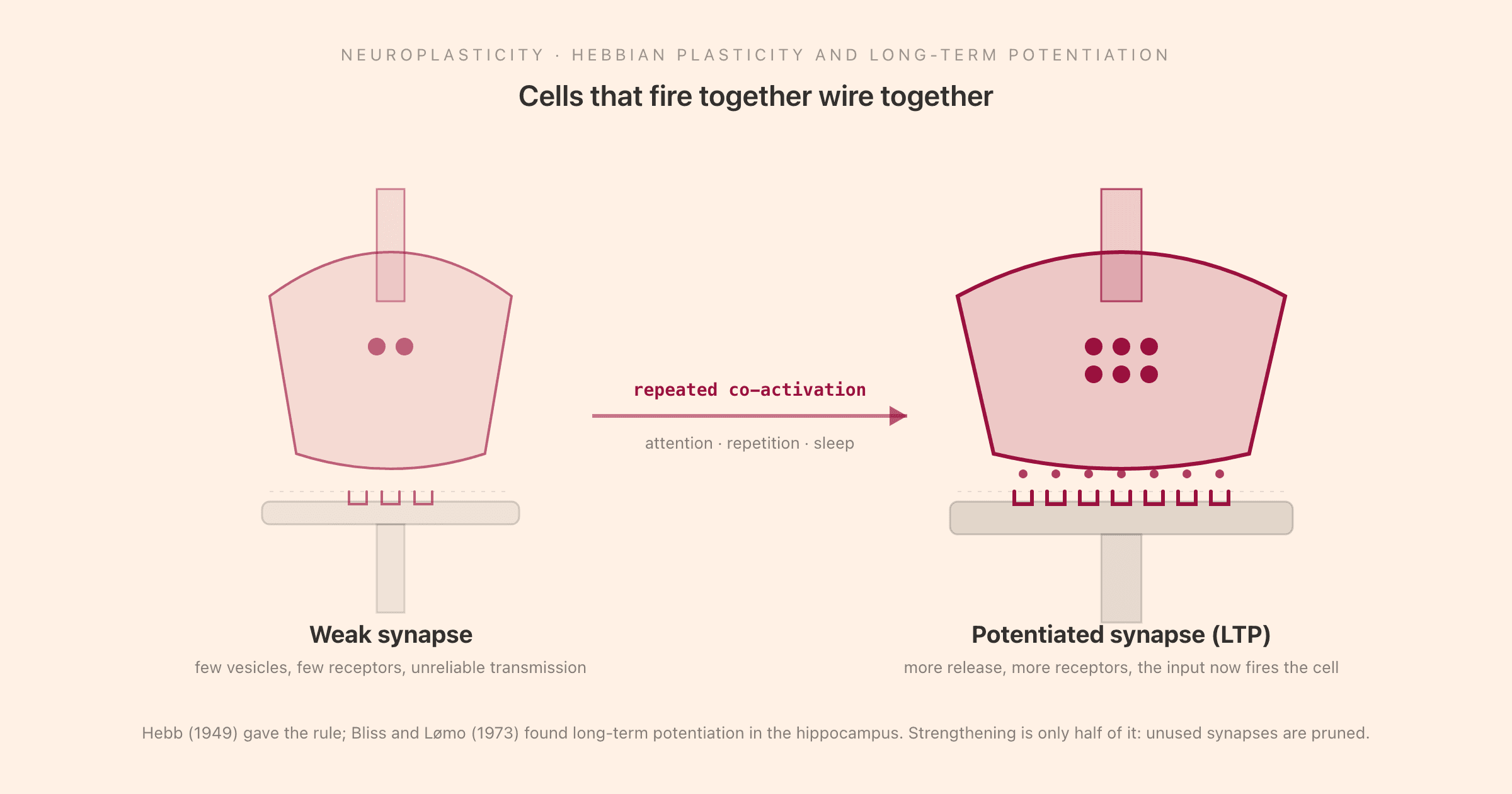
The mechanism at the heart of learning is synaptic plasticity, the strengthening and weakening of the connections between neurons. The governing idea was stated by the psychologist Donald Hebb in 1949: when one neuron repeatedly takes part in firing another, the connection between them strengthens. The shorthand that Carla Shatz later coined captures it perfectly: cells that fire together wire together.
Hebb proposed the rule; physiology later found the mechanism. In 1973 Timothy Bliss and Terje Lømo, recording in the rabbit hippocampus, showed that a brief burst of high-frequency stimulation to an input pathway produced a long-lasting increase in the strength of that synapse. They had found long-term potentiation, or LTP, the most studied cellular model of learning and memory. Its mirror image, long-term depression (LTD), weakens synapses that are not usefully co-active. Together they let the brain tune connection strengths up and down.
The molecular detail is elegant and worth knowing because it explains why attention matters. A central player in LTP is the NMDA receptor, which acts as a coincidence detector: it only opens fully when the presynaptic cell is releasing neurotransmitter and the postsynaptic cell is already depolarised at the same time. When both conditions are met, calcium flows into the postsynaptic neuron and triggers a cascade that inserts more AMPA receptors into the membrane, making the synapse more responsive to the same input. Fire the pathway together, strongly and repeatedly, and the synapse potentiates. This is the physical event under the phrase fire together, wire together, and it is why half-hearted, distracted repetition does so little: the coincidence has to be strong enough to be detected.
This synaptic tuning is the substrate for the cognitive systems built on top of it. It is what lets working memory traces consolidate into durable knowledge, and it is the cellular reason that active recall and spaced repetition work: retrieval and well-timed review are ways of driving exactly the kind of strong, repeated co-activation that potentiates the right synapses.
The Structural Side: Growth, Pruning, and Remapping
Synaptic strength is the fast layer of plasticity. Underneath it the brain also makes slower, structural changes: it grows new synapses and dendritic spines, and it eliminates ones it does not use. This is where the fire-together-wire-together story gains its essential second half, because the brain is at least as much a pruning machine as a building one.
Synaptic density in the human cortex follows a striking arc. It rises rapidly after birth to a peak in early childhood, at which point a young child has far more synapses than an adult, and then it is pruned back substantially through childhood and adolescence. The principle governing the pruning is use: connections that are active and useful are retained and strengthened, while those that are rarely active are eliminated. This is why "use it or lose it" is literally true at the level of tissue. The developing brain overproduces connections and then lets experience carve away the ones it does not need, a process the neuroscientists William Greenough and colleagues called experience-expectant plasticity (the brain expects certain inputs, like patterned vision, and wires itself around them) as distinct from experience-dependent plasticity (the lifelong, individual rewiring driven by your particular experiences).
At a larger scale, the cortex remaps. Michael Merzenich's experiments showed that the somatosensory map of a monkey's hand reorganises with use: train a digit heavily and its cortical territory expands; lose a digit and neighbouring areas invade its former territory. Crucially, Merzenich also showed that the remapping depends on attention. Passive stimulation produced little change; the same stimulation, when the animal had to attend to it, drove substantial reorganisation. The human counterpart is everywhere in the literature, from the enlarged posterior hippocampi of London taxi drivers who have internalised the city's street map to the cortical changes that follow intensive practice of a motor skill. Maps are not fixed; they are negotiated, continuously, by what you do and what you attend to.
Critical Periods and the Adult Brain
Plasticity is not uniform across the lifespan. Early in development there are critical periods (sometimes called sensitive periods), windows during which particular circuits are exceptionally malleable and require specific input to wire up correctly. The classic demonstration is David Hubel and Torsten Wiesel's Nobel-winning work on the visual cortex: depriving one eye of input during a narrow early window permanently reshapes ocular dominance in a way the same deprivation in adulthood does not. Language has a sensitive period too, which is why early childhood is the easiest time to acquire native-like phonology.
The mature brain is more constrained, but the once-common belief that adult plasticity is negligible is wrong. Adults learn new languages, recover function after strokes, and acquire complex motor skills, all of which require real rewiring. What changes with age is the ease and the speed, not the existence, of plasticity. Several brakes come online after the critical periods (the maturation of inhibitory circuits and the formation of structures called perineuronal nets that stabilise connections), which is part of why change is harder later. The practical reading is balanced: childhood is privileged for some forms of learning, but the adult brain remains genuinely plastic, and the conditions that drive adult rewiring are exactly the ones described in the next section.
What Actually Drives Rewiring
The most useful framework for anyone trying to change their own brain is the set of principles articulated by Jeffrey Kleim and Theresa Jones in 2008, drawn from the rehabilitation literature on experience-dependent plasticity. They are the conditions under which the brain actually rewires, and they are bracing because they rule out a lot of what passes for self-improvement.
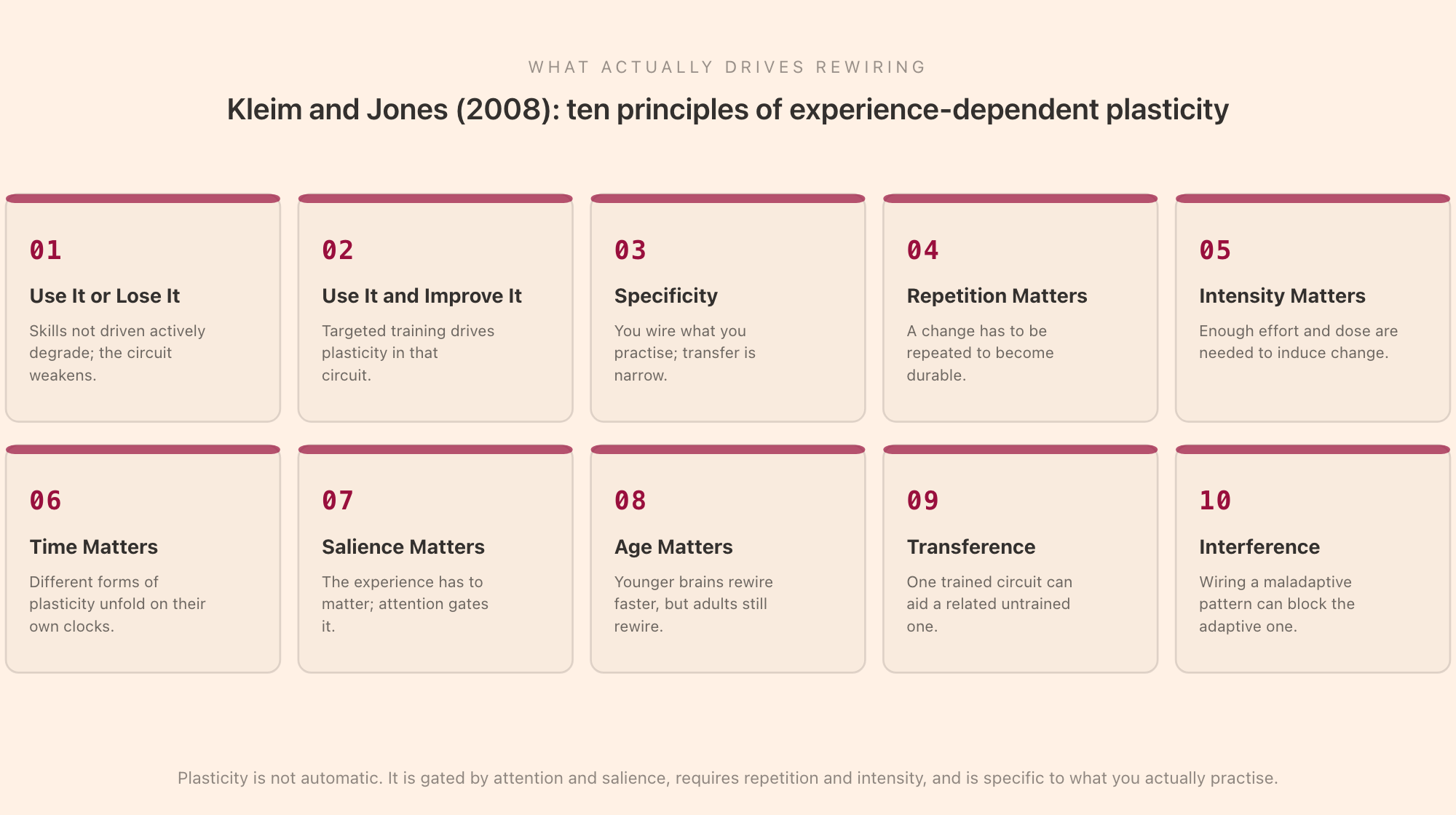
Several of the ten deserve emphasis because they are the ones most often ignored. Specificity says you wire what you practise, and only that; transfer to other tasks is narrow, which is the same lesson the working memory training literature teaches (brain-training games make you better at the games and rarely at anything else). Repetition and intensity say a change must be repeated, with sufficient effort and dose, to consolidate; a single exposure or a low-effort run does little. Salience says the experience has to matter, because attention gates plasticity at the cellular level, exactly as Merzenich's attended-versus-passive stimulation showed. And interference is the dark side: practising a maladaptive pattern wires it in and can block the adaptive one, which is why sloppy repetition is worse than none.
Two physiological multipliers sit alongside these principles. The first is aerobic exercise, which raises levels of brain-derived neurotrophic factor (BDNF), a protein that supports the growth and survival of neurons and the strengthening of synapses; the work of researchers including Henriette van Praag and Kirk Erickson links aerobic fitness to hippocampal plasticity and even hippocampal volume. The second is sleep, during which the day's plastic changes are consolidated and the synaptic landscape is rebalanced. The sleep stages, particularly slow-wave sleep, are when much of the consolidation happens, which is why learning without sleep is learning written in disappearing ink.
The Neurogenesis Question
A persistent question is whether the adult human brain grows entirely new neurons, a process called neurogenesis, as opposed to merely rewiring existing ones. The honest answer is that this is one of the live debates in the field, and it is worth representing accurately rather than overselling.
In rodents, adult neurogenesis in the hippocampus is well established. In humans the picture is genuinely contested. A landmark 1998 study by Peter Eriksson and colleagues found evidence of new neurons in the adult human hippocampus, and a striking 2013 study by Kirsty Spalding's group, using carbon-14 from Cold War nuclear testing to date cells, estimated that adult humans add on the order of hundreds of new hippocampal neurons per day. But in 2018 a high-profile paper by Shawn Sorrells and colleagues reported finding essentially no new neurons in the adult human hippocampus, while a second 2018 paper by Maura Boldrini's group reported the opposite. The discrepancy turns partly on tissue-preservation methods and markers, and the question is not fully settled.
The responsible takeaway is this: the brain's lifelong plasticity does not depend on settling the neurogenesis debate. The strengthening, weakening, growth, and pruning of synapses among existing neurons is more than enough to account for learning and rewiring across the lifespan. Adult neurogenesis, if and where it occurs, is an addition to that picture, not the foundation of it. Be skeptical of any product or program that hangs its claims on "growing new brain cells."
The Myths Worth Discarding
Neuroplasticity is real, which is exactly why it gets co-opted to sell things that are not. A few corrections.
The brain does not use only 10 percent of its capacity; that figure is a complete fabrication with no basis in physiology, and "unlock the other 90 percent" is a marketing line, not a neuroscience finding. Learning styles, the idea that matching instruction to a person's "visual" or "auditory" type improves learning, has been tested repeatedly and the evidence does not support it. The popular promise to "rewire your brain in X days" misrepresents the timescale: meaningful structural plasticity is the product of repetition over weeks and months, not a weekend. And no supplement has been shown to meaningfully accelerate human neuroplasticity; the levers with actual evidence are unglamorous and free or nearly so, namely attentive practice, repetition, aerobic exercise, and sleep.
The thread running through every myth is the same: they promise plasticity without the conditions plasticity requires. The real thing is more demanding and more encouraging at once. You can change, substantially, but only by doing the specific thing, repeatedly, with attention, and then sleeping on it.
How a Focus Block Drives Plastic Change
Put the science together and a clear picture emerges of what good practice looks like, and it maps almost exactly onto a structured focus block. Plasticity needs attention (salience gates it), repetition and intensity (the change must be driven hard and often), specificity (practise the actual target), and consolidation (sleep locks it in). A protected, single-task work block engineered to hold attention on one thing is, in effect, a plasticity-optimised container.
This is why the cognitive systems Tomatoes is built around all connect here. The executive function machinery that sustains attention is what supplies the salience that gates plasticity. Active recall and spaced repetition are scheduling strategies for driving strong, well-timed synaptic co-activation. And protecting the sleep stages afterward is what consolidates the day's changes. The block is where the firing-together happens; the night is where the wiring-together is made permanent.
How Tomatoes Fits
Tomatoes does not rewire your brain. No app can; plasticity is something only your own attentive, repeated practice produces. What a focus tool can do is protect the conditions plasticity depends on. A stable acoustic environment (focus music, brown noise, or binaural beats) reduces the extraneous load that competes for attention, so more of it lands on the thing you are trying to wire in. A timer imposes the repetition and the protected, intense practice window the Kleim and Jones principles call for. And a deliberately distraction-free surface makes it easier to keep attention on a single target, which is the salience that gates the whole process.
The fit is honest and narrow. The specificity, the repetition, the effort, and the sleep are yours. The app holds the block in which the attentive practice can happen without the environment fighting you. Tomatoes is free for 3 days, then $4.99/week, $29.99/year, or $39 lifetime. It runs locally as a desktop app with a system menu-bar companion, generates its audio in real time, and is built for working blocks of a few hours a day.
The Short Version
Neuroplasticity is the brain's lifelong capacity to change its structure and function with experience. At the cellular level it runs on synaptic plasticity: Hebb's fire-together-wire-together rule, realised physically as long-term potentiation, in which strong, repeated, attended co-activation drives more receptors into a synapse and makes it more effective, with long-term depression and synaptic pruning trimming what is not used. Structurally the brain grows and eliminates connections and remaps its cortex around use, with attention gating the change. Plasticity is greatest in early critical periods but remains real throughout adult life, just slower and more constrained. The conditions that actually drive rewiring are captured by the Kleim and Jones principles: specificity, repetition, intensity, and salience, multiplied by aerobic exercise and consolidated by sleep. Adult neurogenesis is a genuine and unsettled scientific debate, but lifelong plasticity does not depend on it, and the 10-percent-brain, learning-styles, rewire-in-a-weekend, and supplement claims should all be discarded. The practical core is unglamorous and powerful: practise the specific thing, repeatedly, with full attention, and sleep on it. Fire together, wire together, and protect the block where the firing happens.