Active recall is the study method of deliberately retrieving information from memory, rather than passively reviewing it, and it is the single most evidence-backed learning technique in cognitive psychology. The act of pulling a fact out of your own head, with the book closed, does more to cement that fact than rereading it ten times. This is not a productivity-blogger claim; it is the testing effect (also called the retrieval-practice effect), one of the most robust and replicated findings in the science of memory. When you test yourself, you are not measuring learning. You are causing it.
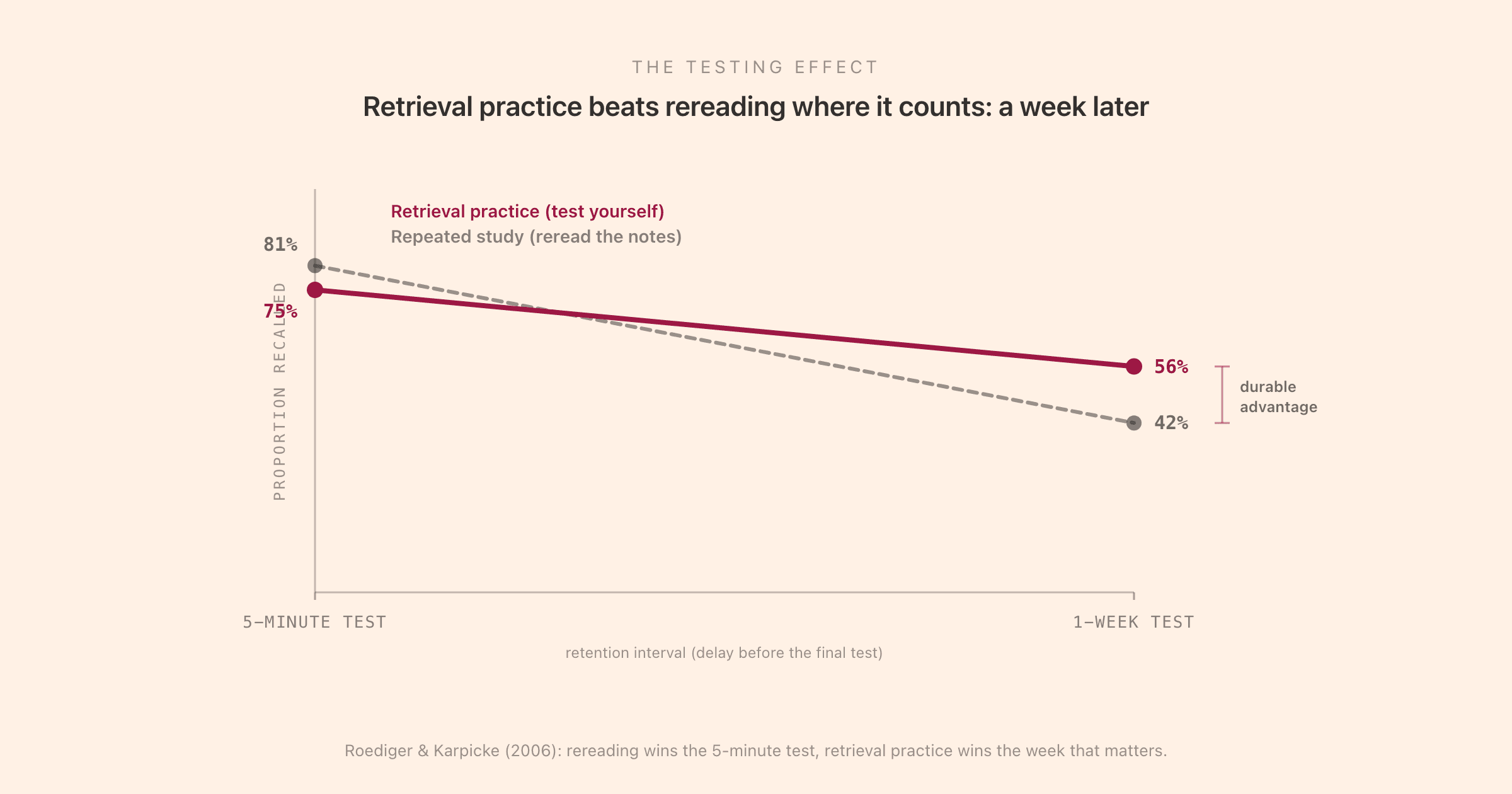
This piece is the cognitive-science version of active recall: what retrieval practice actually is, the testing-effect experiments that establish it (including the Roediger and Karpicke 2006 study whose crossover curve is the image at the top of this article), the desirable-difficulty mechanism that explains why effortful recall works, how active recall pairs with spaced repetition and with the overnight memory consolidation your brain does anyway, the practical methods that count as real retrieval practice, and the fluency illusion that makes rereading and highlighting feel productive while doing almost nothing. Tomatoes is a focus tool built for the working block where this kind of effortful study happens. The app is free for 3 days, then $4.99/week, $29.99/year, or $39 lifetime.
What Active Recall Actually Is
Active recall is any study activity in which you attempt to retrieve target information from memory without looking at the source. Closing the textbook and writing down everything you remember about a chapter is active recall. Answering a flashcard before flipping it is active recall. Doing a past exam paper from memory is active recall. Explaining a concept out loud to an empty room, then checking what you missed, is active recall.
The contrast is with passive review: rereading notes, re-highlighting a textbook, watching a lecture again, copying out definitions. In passive review, the information flows from the page into your eyes; your memory is never asked to produce anything. In active recall, your memory is forced to do the work of reconstruction, and that work is exactly what strengthens the memory.
The distinction matters because the two feel completely different in the moment, and the feeling is misleading. Rereading is fluent, smooth, and pleasant; the material looks familiar, so you feel like you know it. Retrieval is effortful, slow, and frequently uncomfortable; you stare at a blank page and struggle. The discomfort is the point. The struggle is the learning happening.
The Testing Effect
The defining experiment is Roediger and Karpicke's 2006 study (published in Psychological Science as part of their "test-enhanced learning" work). Students read prose passages, then either restudied the passage repeatedly or were tested on it (asked to recall as much as they could). Both groups were then given a final test at one of several delays.
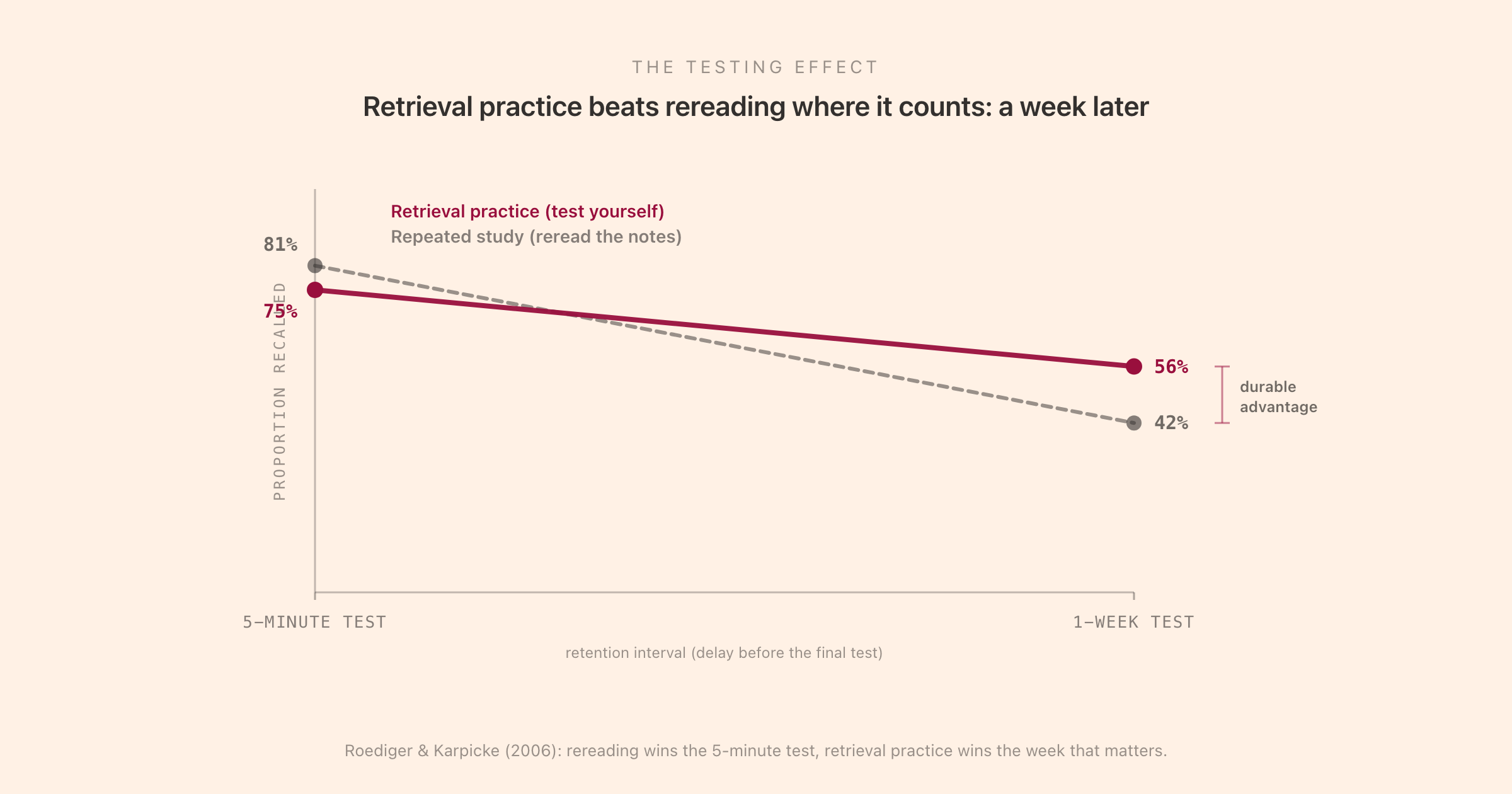
The result is the curve at the top of this article, and it is the whole argument in one image. On a final test taken five minutes later, the repeated-study group did slightly better (around 81 percent recalled versus around 75 percent for the tested group). Rereading wins in the very short term. But on a final test taken one week later, the picture inverts completely: the tested group retained around 56 percent, while the repeated-study group had collapsed to around 42 percent. The group that spent its time testing itself, despite performing worse on the immediate check, retained far more of the material across the week that actually matters.
This crossover is the most important thing to understand about studying. The technique that feels best and performs best immediately (rereading) is the worse technique for durable learning. The technique that feels worse and performs slightly worse immediately (retrieval practice) is dramatically better a week later. Almost every student optimises for the immediate feeling, which is exactly backwards.
The effect generalises far beyond prose passages. It has been demonstrated with vocabulary, medical-school content, statistics, motor skills, and classroom learning at every level. Karpicke and Blunt showed in 2011 (in Science) that retrieval practice even beat elaborative concept-mapping, a much more effortful-looking technique, on delayed tests. And in the same study, students predicted the opposite ranking, a point we return to below.
Why Retrieval Works: the Desirable-Difficulty Mechanism
The leading explanation comes from Robert and Elizabeth Bjork's framework of desirable difficulties and their "new theory of disuse." The theory distinguishes two properties of any memory: its storage strength (how well-learned it is) and its retrieval strength (how accessible it is right now).
Rereading mostly raises retrieval strength temporarily. The material is fresh and accessible, which is why the immediate test goes well, but storage strength barely moves, so the accessibility fades fast. Retrieval practice does the opposite. Every time you successfully pull a memory out of storage, the act of retrieval increases its storage strength, and counterintuitively, the harder the retrieval was (the closer to the edge of forgetting), the larger the gain. Retrieval is a "memory modifier," not a neutral readout. You change the memory by using it.
This is why difficulty is desirable. A retrieval that is too easy (testing yourself immediately after reading) produces a small storage gain. A retrieval that is effortful but still successful (testing yourself after a delay, when you almost forgot) produces a large one. The struggle to reconstruct is the mechanism, not a side effect. It is also why recognition (picking the right answer from a multiple-choice list) is weaker than free recall (producing the answer from nothing): recognition is a lower-effort retrieval, so it strengthens the memory less.
There is a working-memory angle here too. Retrieval forces the target information through the same limited-capacity workspace that all effortful cognition runs through, which is part of why it is tiring and part of why it works: the information is being actively manipulated, not just re-perceived.
Active Recall and Spaced Repetition Are a Pair
Active recall answers the question "what should studying consist of?" The answer is retrieval. Spaced repetition answers a different question: "when should the retrievals happen?" The answer is at expanding intervals.
The spacing effect is nearly as old and as robust as the testing effect. Hermann Ebbinghaus documented the forgetting curve in 1885 and noticed that distributing study over time produced far better retention than massing it together. A century of replication (summarised in Cepeda and colleagues' 2006 meta-analysis) confirms that spaced practice beats massed practice (cramming) for durable learning, and that the optimal gap between sessions scales with how long you need to remember the material.
The two combine into spaced retrieval practice: test yourself, then test yourself again after a gap, then again after a longer gap. Each retrieval, timed to land just as the memory starts to fade, is a maximally desirable difficulty. This is precisely what spaced-repetition software automates. The Leitner box system (physical flashcards moved between boxes by how well you know them) is the analog version; SuperMemo's SM-2 algorithm and the Anki app are the digital descendants. They schedule each card's next review for the moment retrieval will be effortful but still possible, which is the sweet spot the Bjork framework predicts.
The practical upshot: cramming the night before is the worst of both worlds. It is massed (no spacing) and usually passive (rereading). Spaced retrieval practice, a little every day with the material tested rather than reread, is the best of both, and it is less total work because you stop reviewing things you have actually learned.
Where Active Recall Meets Memory Consolidation
Retrieval practice does not finish when you close the flashcard app. Memory consolidation, the process by which a freshly-encoded memory is stabilised and integrated into long-term storage, continues for hours and days afterward, and a large part of it happens during sleep.
There are two layers. Synaptic consolidation stabilises a memory at the cellular level over the first hours after encoding. Systems consolidation is the slower transfer of a memory from hippocampal dependence to distributed neocortical storage, and it unfolds over days to weeks, heavily during the slow-wave and REM stages of sleep. The thalamocortical slow oscillations of deep sleep are thought to coordinate the hippocampal replay that moves the day's learning into permanent cortical representations.
Retrieval practice appears to feed this pipeline. A memory that has been actively retrieved is more strongly encoded going into the night, and there is evidence that retrieval also enhances later consolidation. There is also reconsolidation: retrieving a memory briefly returns it to a labile state in which it is updated and re-stored, another route by which the act of recall modifies, rather than merely reads, the trace. The practical implication is to study with retrieval during the day and protect the sleep that consolidates it overnight, rather than trading sleep for more cramming, which sacrifices the consolidation machinery to add low-value passive review.
How to Actually Do Active Recall
Retrieval practice is simple to describe and easy to skip, because the passive alternatives feel so much more comfortable. The methods that count:
- Closed-book brain dumps. After reading a section, close everything and write down everything you can remember on a blank page. Then open the source and fill the gaps in a different colour. The gaps are your actual learning targets.
- Flashcards, used properly. A flashcard is active recall only if you genuinely attempt the answer before flipping. Front: a question. Back: the answer. Spaced-repetition apps (Anki and similar) schedule the reviews for you.
- Practice testing and past papers. Doing questions from memory, under something like exam conditions, is retrieval practice plus a rehearsal of the retrieval context. Practice testing was rated one of only two "high utility" techniques in Dunlosky and colleagues' 2013 review of learning strategies.
- The Feynman technique. Explain the concept, out loud or in writing, as if to someone who does not know it, without looking at notes. The points where you stall or hand-wave are the points you do not actually understand.
- Question-generation. Turn your notes into questions as you take them, then answer the questions later from memory rather than rereading the notes.
The common structure is: produce first, check second. Anything where you check first and produce never is passive review wearing the costume of studying.
The Mistakes That Look Like Studying But Are Not
The reason active recall is undervalued is a metacognitive failure called the fluency illusion (or illusion of competence). When you reread or highlight, the material becomes perceptually fluent: it is easy to process, and your brain misreads that ease as a signal that you know it. You feel competent. You are feeling familiarity, which is not the same as the ability to retrieve.
This is why Karpicke and Blunt's 2011 subjects predicted that concept-mapping would beat retrieval practice, when the opposite was true: the more fluent, lower-effort technique felt more effective. Students consistently rank rereading and highlighting as their top strategies, and Dunlosky's 2013 review rated both as low utility. The techniques that feel productive are largely the ones that are not.
The specific traps:
- Rereading raises retrieval strength briefly and storage strength barely. It feels like the core of studying and is close to the weakest thing you can do.
- Highlighting and underlining are close to inert. They create the fluency illusion strongly while adding almost no storage strength, and they can even hurt by drawing attention to isolated phrases.
- Recognition masquerading as recall. Looking at the flashcard answer and thinking "yes, I knew that" is recognition, not recall. If you did not produce it cold, it did not count.
- Copying notes out neatly. Transcription feels diligent and is almost entirely passive.
The honest test of any study session is whether your memory had to produce something it could have got wrong. If there was no risk of being wrong, there was probably no learning.
How Active Recall Fits a Focus Block
Retrieval practice is cognitively demanding in a specific way: it is effortful, it draws hard on working memory and executive function, and it is uncomfortable enough that the mind looks for an excuse to switch back to the soothing passivity of rereading. That makes it exactly the kind of work that benefits from a structured, protected focus block.
A pomodoro-style session is a good container for it: a defined block in which the only permitted activity is closed-book retrieval, followed by a short break, repeated. The constraint of the block fights the pull toward passive review, because there is a clear rule (produce, do not reread) and a clear boundary. Spacing then sits on top: a block of retrieval today, another tomorrow, another in three days, rather than one long massed session.
The audio side is the part Tomatoes handles. Effortful retrieval needs sustained attention, and a stable acoustic environment (focus music, brown noise, or binaural beats, depending on what works for you) reduces the extraneous load that pulls attention off the blank page. It does not make the retrieval less effortful (nothing should; the effort is the mechanism), but it protects the conditions under which you can keep producing instead of drifting.
How Tomatoes Fits
Tomatoes does not teach, and it does not replace a flashcard system or a textbook. What it does is hold the working block in which active recall happens: real-time-generated focus audio (binaural beats, brown noise, granular textures, 40 Hz gamma and theta-band options), a timer for the block-and-break cadence, and a deliberately distraction-free surface. The technique is yours; the protected attention is what the app provides.
The fit is honest and narrow. No audio improves memory directly, and no app can make retrieval less effortful without making it less effective. What a focus tool can do is make it more likely that you spend the block actually testing yourself, in a stable environment, instead of sliding into the comfortable fluency of rereading. Tomatoes is free for 3 days, then $4.99/week, $29.99/year, or $39 lifetime. It runs locally as a desktop app with a system menu-bar companion, generates the audio in real time, and is built for working blocks of a few hours a day.
The Short Version
Active recall is the practice of retrieving information from memory rather than reviewing it, and it is the best-supported study technique in cognitive psychology. The testing effect (Roediger and Karpicke 2006) shows that self-testing, despite feeling worse and scoring slightly lower on an immediate test, retains far more a week later. The mechanism is desirable difficulty: effortful retrieval increases the storage strength of a memory in a way that passive rereading does not, and harder successful retrievals help more. Active recall pairs with spaced repetition (when to retrieve) and with overnight memory consolidation (which stabilises what you retrieved), so spaced retrieval practice plus protected sleep beats massed cramming on every axis. The methods that count are closed-book brain dumps, properly-used flashcards, practice testing, and the Feynman technique; the traps are rereading, highlighting, and recognition mistaken for recall, all of which trigger the fluency illusion that makes ineffective study feel productive. Test yourself, space it out, sleep on it. The discomfort of the blank page is the learning.