Spaced repetition is the practice of reviewing information at increasing intervals over time, timed so that each review lands just as the memory is starting to fade. It is the most efficient way known to move information into durable long-term memory, and it is the reason a few minutes of flashcards a day will out-remember an all-night cram by an enormous margin. The technique is not a study hack invented by an app; it is the direct application of the spacing effect, one of the oldest and most replicated findings in the science of memory, first documented by Hermann Ebbinghaus in 1885 and confirmed by more than a century of experiments since.
This piece is the cognitive-science version of spaced repetition: the Ebbinghaus forgetting curve and what it actually shows, the spacing effect and the meta-analytic evidence behind it, the question of optimal intervals, the lineage from the Leitner box to the SM-2 algorithm that powers Anki and SuperMemo, why it pairs inseparably with active recall, and the practical way to run it without turning your study life into an algorithm. Tomatoes is a focus tool built for the working block where this kind of deliberate review happens. The app is free for 3 days, then $4.99/week, $29.99/year, or $39 lifetime.
The Forgetting Curve
In 1885 Hermann Ebbinghaus published Über das Gedächtnis (Memory: A Contribution to Experimental Psychology), the first experimental study of human memory. His method was brutally simple and famously self-inflicted: he memorised long lists of nonsense syllables (consonant-vowel-consonant strings with no meaning, chosen precisely so that prior knowledge could not help) and then measured how much he could relearn after various delays, using the time saved on relearning as his measure of retention (the "savings method").
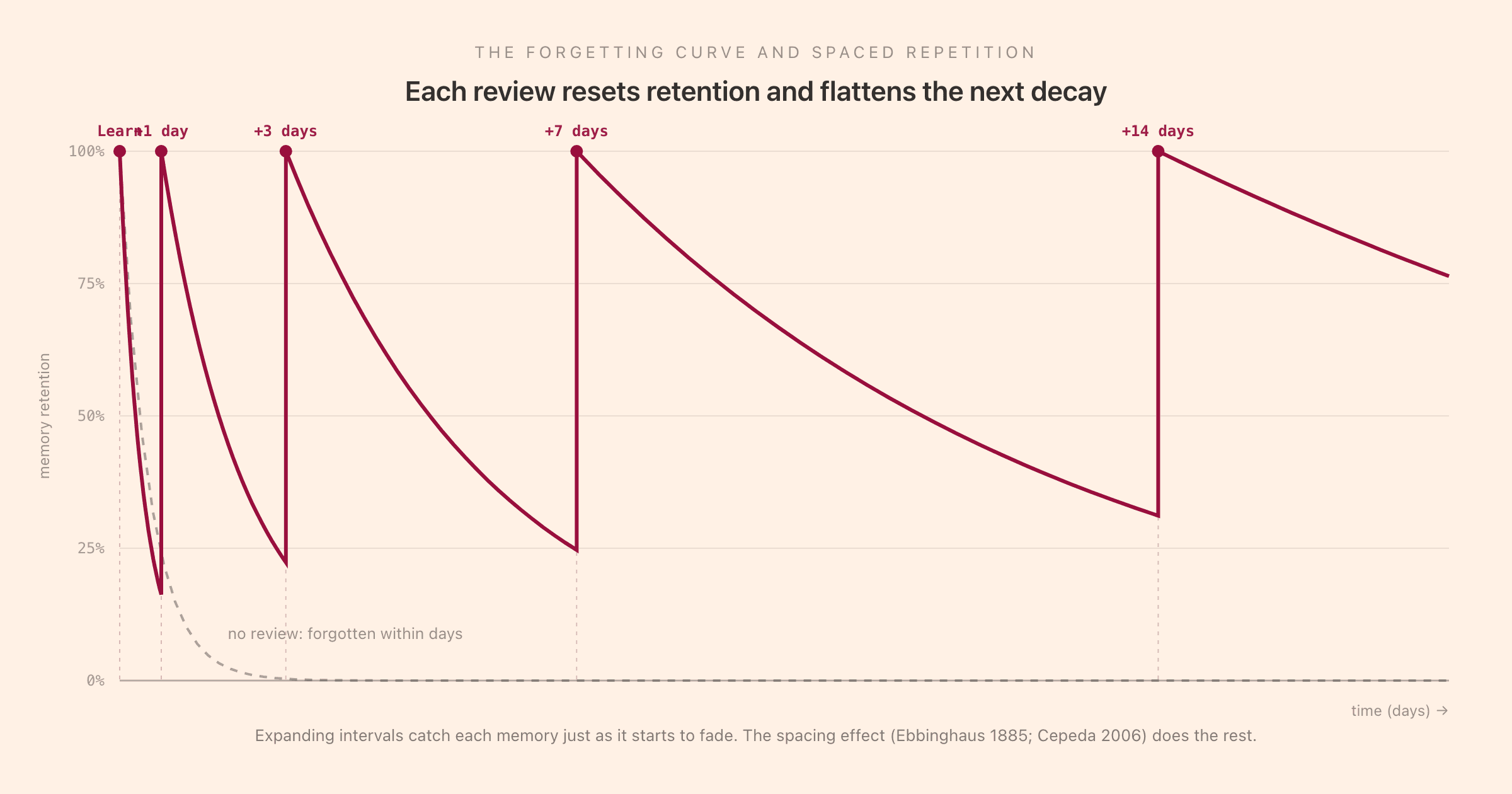
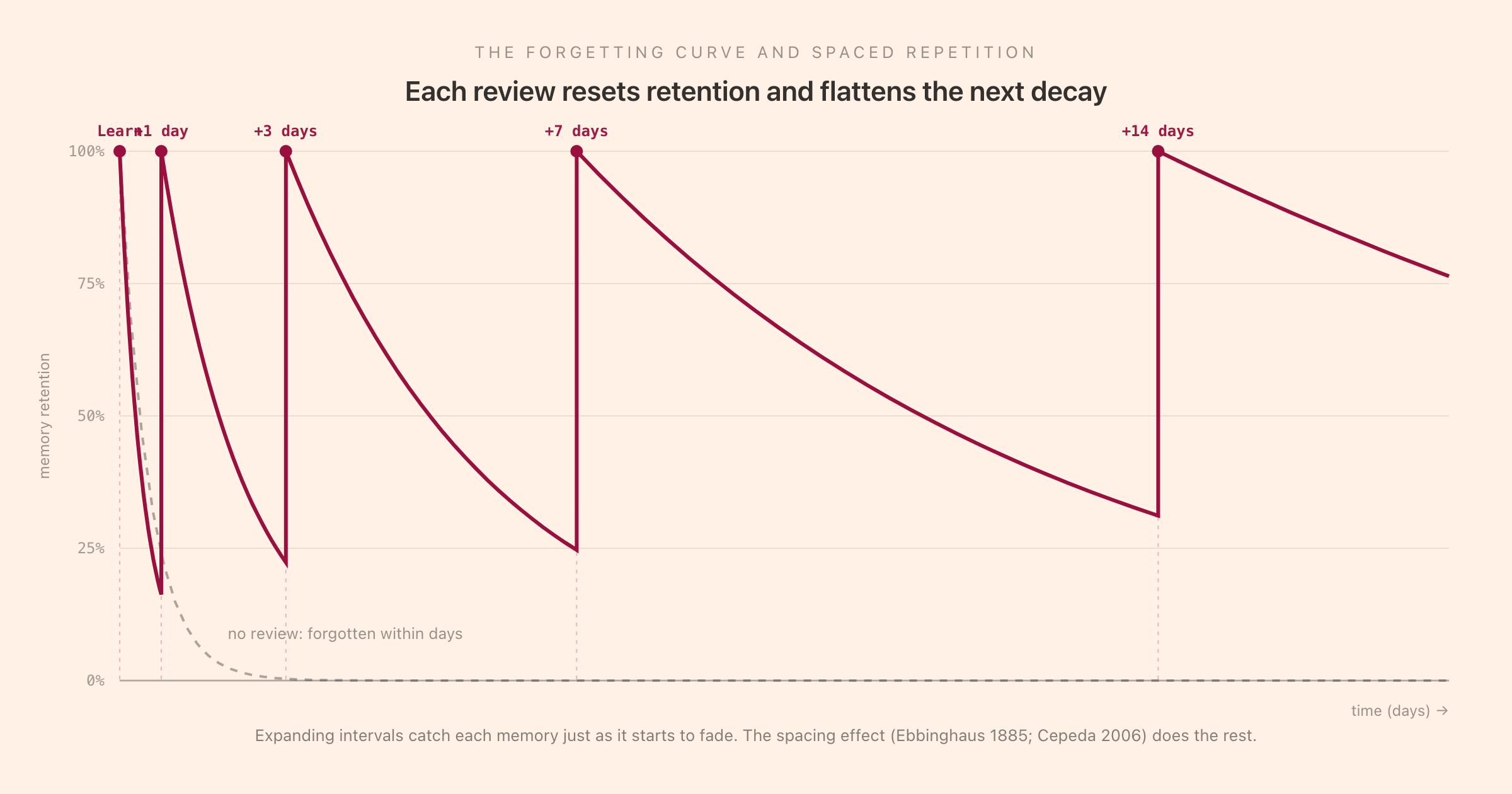
The result is the forgetting curve. Retention drops steeply in the first hours and days after learning, then levels off: you lose a large fraction of new material almost immediately, and the rate of loss slows for whatever survives. The exact shape Ebbinghaus fitted was close to logarithmic, and modern work often models the early decay as roughly exponential, but the qualitative shape is the durable finding. Left alone, a freshly-encoded memory decays toward nothing, and it does most of its decaying fast. The dashed curve in the image above is the no-review case: gone within days.
The forgetting curve is the problem statement. Everything spaced repetition does is a response to it. You cannot stop forgetting, but you can interrupt it at the right moments, and each interruption changes the curve.
The Spacing Effect
Ebbinghaus noticed the solution in the same work: spreading study sessions out over time produced far better retention than packing the same number of repetitions into one session. This is the spacing effect (also called distributed practice, in contrast to massed practice or cramming), and it is one of the most robust results in all of psychology.
The modern evidence is overwhelming. Cepeda, Pashler, Vul, Wixted, and Rohrer's 2006 meta-analysis in Psychological Bulletin pooled 254 studies covering more than 300 experiments and found that distributed practice reliably beats massed practice, with the spaced groups recalling substantially more on delayed tests. The effect holds across ages, materials, and tasks. It is not subtle, it is not fragile, and it is not in dispute.
What makes the spacing effect counterintuitive is that massed practice feels better while you do it. Reviewing the same fact five times in a row builds a strong, fluent, immediate sense of knowing it, and that fluency is exactly what fools people into cramming. The spaced schedule feels worse: by the time you come back to a card after a few days, you have partly forgotten it, the retrieval is effortful, and you feel like you are failing. That feeling is the spacing effect working. The partial forgetting is what makes the next retrieval valuable.
Why Spacing Works
The mechanism connects directly to the active-recall story, through Robert and Elizabeth Bjork's framework of storage strength versus retrieval strength. Storage strength is how deeply a memory is learned; retrieval strength is how accessible it is right now. The two come apart, and that gap is the whole game.
Cramming pushes retrieval strength up fast (the material is fresh and accessible) but does little for storage strength, so the accessibility drains away just as quickly. Spacing does the opposite. When you let time pass, retrieval strength falls, and the act of successfully pulling the memory back from a low-accessibility state produces a large gain in storage strength. The harder the (successful) retrieval, the bigger the gain. This is the desirable-difficulty principle: a review that is effortful but not impossible is the one that strengthens the memory most, and a review that is too easy barely moves the needle.
There is a working-memory cost to this that is worth naming, because it explains why spaced review feels tiring. Effortful retrieval runs the target information back through the same limited-capacity workspace that all demanding cognition uses; the strain is the manipulation that modifies the memory trace. And much of the consolidation that locks in a reviewed memory happens later, during sleep, when hippocampal replay transfers the day's strengthened traces into durable cortical storage. Space your reviews, retrieve effortfully, and sleep on it: each piece feeds the next.
The Optimal-Interval Question
If spacing helps, how far apart should the reviews be? This is where spaced repetition gets genuinely interesting, and where the simple "review at expanding intervals" advice meets some nuance.
The headline finding comes from Cepeda and colleagues' 2008 study in Psychological Science, which directly manipulated the gap between two study sessions and the delay until the final test. The result: the optimal gap scales with how long you need to remember the material, and it is roughly 10 to 20 percent of the retention interval. To remember something for a week, space the reviews about a day apart. To remember it for a year, space them weeks apart. There is no single magic number; the right interval depends on your deadline.
The second nuance is the expanding-versus-equal debate. The intuitive version of spaced repetition uses expanding intervals (1 day, then 3, then 7, then 16), and early work by Landauer and Bjork (1978) supported this. But Karpicke and Roediger (2007) found that equal-interval spacing can match or beat expanding intervals in some conditions, because expanding schedules front-load the easy retrievals. The reconciliation most researchers accept: what matters most is that each retrieval is successful but effortful. Expanding intervals are a good default because a freshly-learned item needs an early review before it decays past recovery, but the schedule is a means to the end of hard-but-possible retrieval, not a sacred sequence. Good spaced-repetition software effectively tunes the intervals per item to keep retrievals in that sweet spot, which is more precise than any fixed ladder.
From the Leitner Box to SM-2
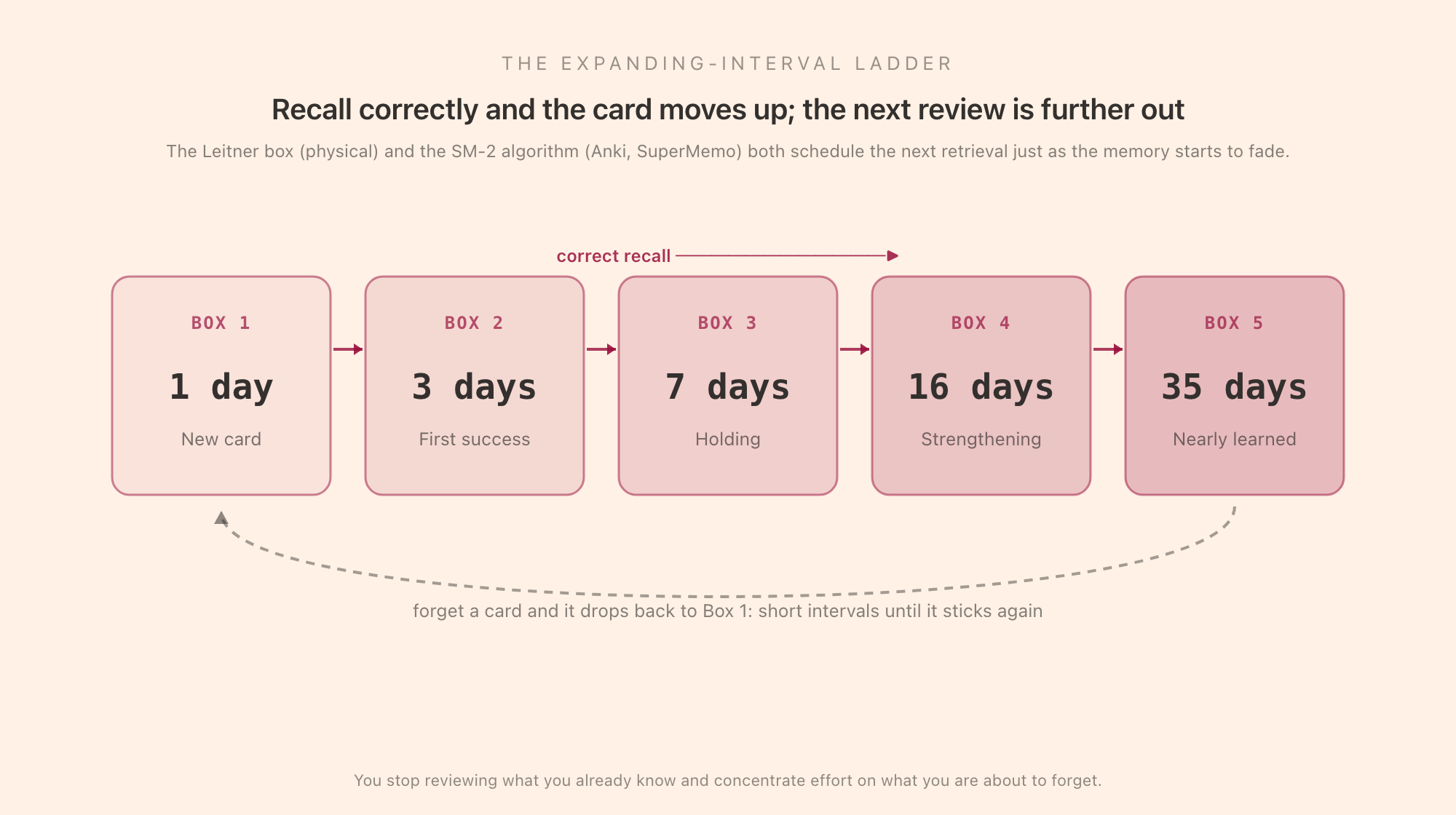
Spaced repetition existed as a manual technique long before software. The classic analog version is the Leitner system, devised by the German science journalist Sebastian Leitner in his 1972 book So lernt man lernen. You keep flashcards in a series of boxes. A new card starts in Box 1, reviewed often. Get a card right, and it moves up to the next box, which is reviewed less frequently. Get it wrong, and it drops back to Box 1, where the short intervals start again. The boxes are nothing more than a physical scheduler that gives well-known cards long intervals and shaky cards short ones.
The digital descendant is the SM-2 algorithm, designed by Piotr Woźniak for SuperMemo in the late 1980s and still the basis of the default scheduler in Anki, the most widely used spaced-repetition app. SM-2 keeps, for each card, an "ease factor" (a number starting around 2.5 that represents how easy the card is for you) and an interval. After each review you grade your recall on a quality scale. A good recall multiplies the interval by the ease factor, so intervals grow geometrically: roughly 1 day, then 6 days, then 6 times the ease factor, and so on. A poor recall resets the interval to the start and nudges the ease factor down, so genuinely hard cards come back sooner and more often. The ease factor has a floor (1.3) so that even the most stubborn card cannot be scheduled into oblivion.
The point of both systems is the same, and it is the thing that makes spaced repetition so efficient: you stop spending time on what you already know and concentrate it on what you are about to forget. A fact you have nailed migrates to a months-long interval and barely costs you anything; a fact you keep missing stays in heavy rotation. Newer schedulers like Anki's FSRS (Free Spaced Repetition Scheduler) replace SM-2's hand-tuned heuristics with a model fitted to your own review history, predicting the moment your recall probability drops to a target threshold and scheduling the review there. The principle is unchanged; only the precision of the interval has improved.
Spaced Repetition and Active Recall Are One Technique
It is worth being explicit that spaced repetition is not a complete study method on its own. It answers the question of when to review. It says nothing about what the review should consist of, and that is where active recall comes in: the review has to be retrieval, not rereading.
A spaced schedule of passive reviews (rereading the same notes at expanding intervals) captures only part of the benefit, because passive review barely builds storage strength even when it is spaced. The full technique is spaced retrieval practice: test yourself (active recall), space the tests at increasing intervals (spaced repetition), and each retrieval lands as a maximally desirable difficulty. The flashcard apps people associate with "spaced repetition" are really spaced-retrieval-practice machines: the card forces a retrieval, and the algorithm schedules it. Strip out either half and you lose most of the effect. Together they are, by a wide margin, the most efficient way to learn durably.
How to Actually Run It
The practical version does not require any particular app, only the two principles applied honestly.
- Make real cards, then actually retrieve. A flashcard works only if you produce the answer before flipping. Front: a question. Back: the answer. If you peek, it is rereading wearing a costume.
- Let an app handle the schedule. Anki, SuperMemo, or any spaced-repetition system removes the bookkeeping. You grade each card; it picks the next interval. The Leitner box does the same with physical cards if you prefer paper.
- Do a little every day. Spaced repetition is daily by nature: a short session clears the cards due today, including the ones from weeks ago that are resurfacing at long intervals. Skipping days lets a backlog build and pushes cards past the point of effortful-but-possible recall.
- Match the interval to the deadline. If the exam is in a week, the gaps should be a day or so. If you want to keep the material for years, let the intervals stretch to weeks and months. The 10-to-20-percent rule of thumb is a reasonable target.
- Trust the long intervals. The hardest psychological part is letting a well-known card go to a six-week interval and not reviewing it in between. The forgetting is doing useful work; reviewing too early wastes the desirable difficulty.
The thing spaced repetition fixes is the single worst study habit, which is cramming: massed (no spacing) and usually passive (rereading), the exact opposite of what the evidence supports on both axes. A small, daily, spaced, retrieval-based habit beats it on retention and, because you drop what you already know, on total time spent.
How Spaced Repetition Fits a Focus Block
A spaced-repetition session is short but cognitively sharp. It is effortful retrieval, repeated, with the constant small discomfort of half-forgotten cards, and that makes it exactly the kind of work the mind tries to escape into something easier. It benefits from a contained, protected block: a pomodoro-style session where the only permitted activity is clearing the cards due today, with a clear rule (produce the answer, do not peek) and a clear boundary.
The audio side is what Tomatoes handles. Effortful retrieval needs sustained attention, and a stable acoustic environment (focus music, brown noise, or binaural beats, whichever works for you) reduces the extraneous load that pulls attention off the deck. It does not make the retrieval easier (nothing should; the effort is the mechanism), but it protects the conditions under which you keep working through the cards instead of drifting to your phone after the third miss.
How Tomatoes Fits
Tomatoes does not schedule your cards and does not replace Anki or a Leitner box. What it provides is the working block in which the daily review happens: real-time-generated focus audio (binaural beats, brown noise, granular textures, 40 Hz gamma and theta-band options), a timer for the block-and-break cadence, and a deliberately distraction-free surface. The spaced-repetition system is yours; the protected attention is what the app contributes.
The fit is honest and narrow. No audio improves memory directly, and no app can shorten the intervals the spacing effect requires. What a focus tool can do is make it more likely that you actually sit down, clear the deck, and run the retrievals in a stable environment, every day, which is the only part of spaced repetition that is hard to keep up. Tomatoes is free for 3 days, then $4.99/week, $29.99/year, or $39 lifetime. It runs locally as a desktop app with a system menu-bar companion, generates the audio in real time, and is built for the short, daily, sharp working blocks spaced repetition lives in.
The Short Version
Spaced repetition is reviewing material at expanding intervals timed to catch each memory just before it fades, and it is the most efficient route to durable long-term memory. It exists because of the forgetting curve (Ebbinghaus 1885): new material decays toward nothing, fast, unless something interrupts it. The spacing effect (confirmed by Cepeda and colleagues' 2006 meta-analysis of 300-plus experiments) shows that distributing reviews over time beats massing them, because letting retrieval strength fall and then successfully retrieving anyway produces a large gain in storage strength, the desirable-difficulty mechanism. The optimal gap scales with how long you need to remember (roughly 10 to 20 percent of the retention interval), and what matters most is that each retrieval is effortful but successful. The Leitner box and the SM-2 algorithm (the basis of Anki) automate this by giving well-known cards long intervals and shaky cards short ones, so you stop reviewing what you know and concentrate on what you are about to forget. Pair it with active recall, because the reviews have to be retrieval, not rereading, and protect the sleep that consolidates them. A little every day, spaced and tested, beats cramming on every measure that matters.