Memory is not one thing, and it is not a recording. Those two facts explain most of what people find confusing about their own minds: why you can forget a name while flawlessly riding a bicycle you have not touched in a decade, why revision that felt productive leaves nothing behind, why a confident recollection can turn out to be wrong. Human memory is a set of distinct systems, each doing a different job, and the one you use to consciously recall yesterday works by reconstructing the event rather than replaying it. Once that is clear, the practical advice about learning stops being a list of tips and starts making obvious sense.
This article covers the three stages every memory passes through, the main types of memory and what each is for, how consolidation works and why sleep is part of it, why forgetting is a feature rather than a fault, the reconstructive nature of recall, and the study methods that genuinely work.
The Three Stages
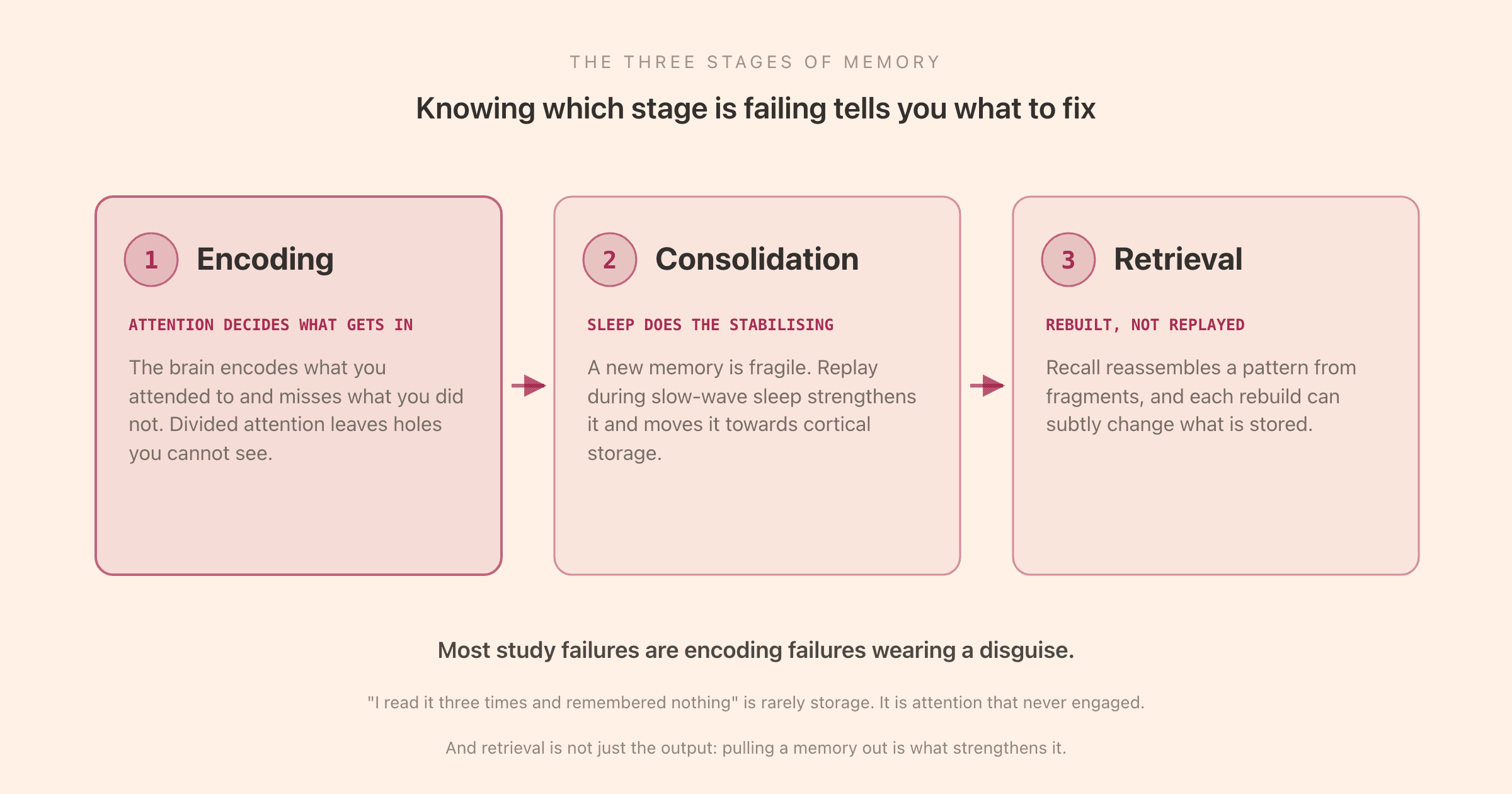
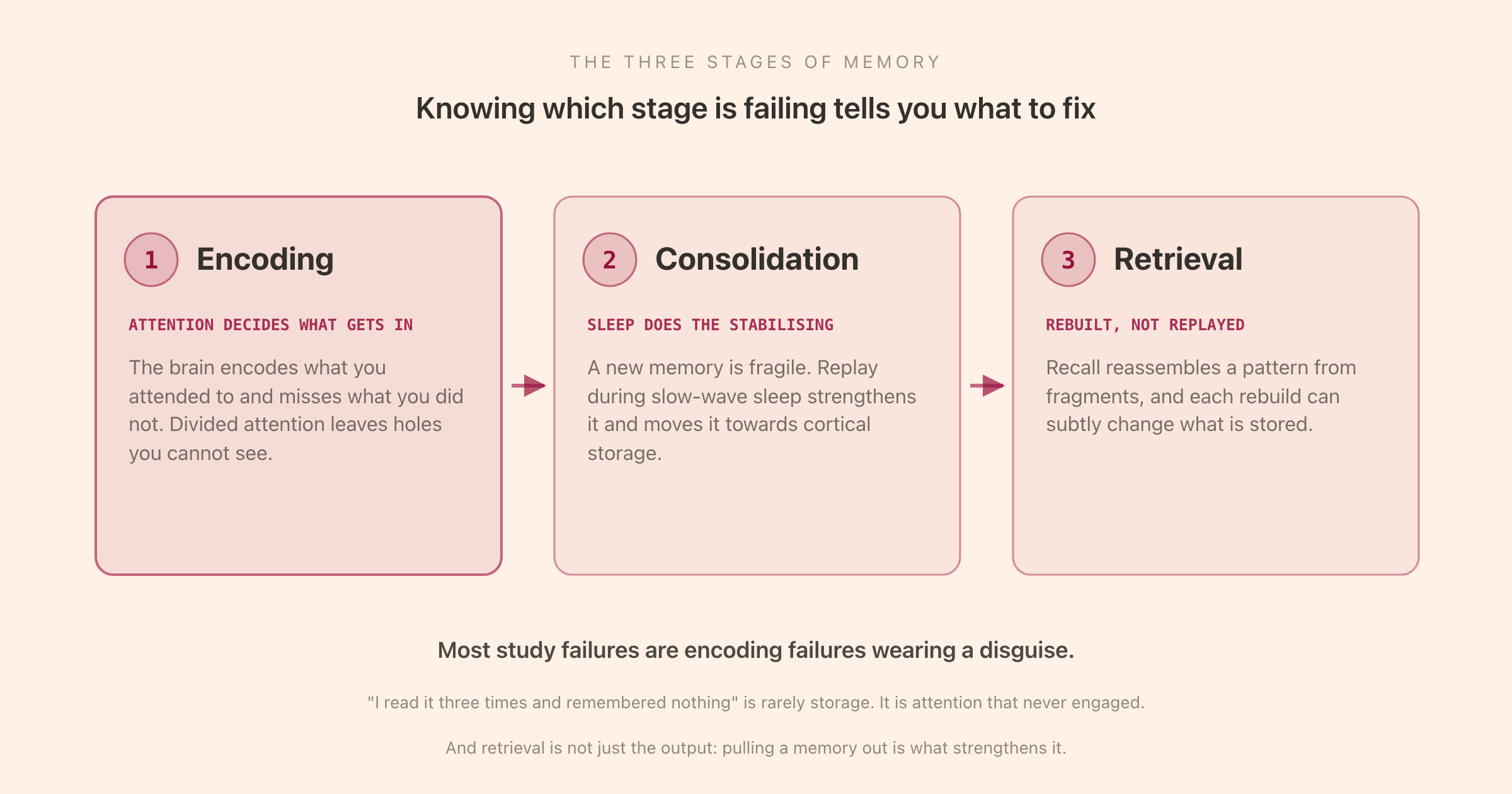
Every memory passes through the same sequence, and knowing which stage is failing tells you what to fix.
Encoding. Turning an experience into something the brain can store. This is where attention decides everything: the brain encodes what you attended to and largely misses what you did not. Divided attention does not produce a half-strength memory of everything, it produces patchy memories with holes you cannot see, because you have no record of what was never recorded.
Storage and consolidation. A newly encoded memory is fragile. Over hours and days it is stabilised, and over longer periods it is gradually integrated into the cortex for long-term keeping. This is not passive: consolidation is active work, much of it done while you sleep.
Retrieval. Getting it back. Retrieval is not reading a file, it is reassembling a pattern, and each reassembly can subtly change what is stored. Retrieval is also the stage most people neglect in learning, despite it being the one that strengthens memory most.
Most study failures are encoding failures wearing a disguise. "I read it three times and remembered nothing" is usually not a storage problem; it is attention that never engaged with the material in the first place.
The Types of Memory
The clearest division is by duration and by kind.
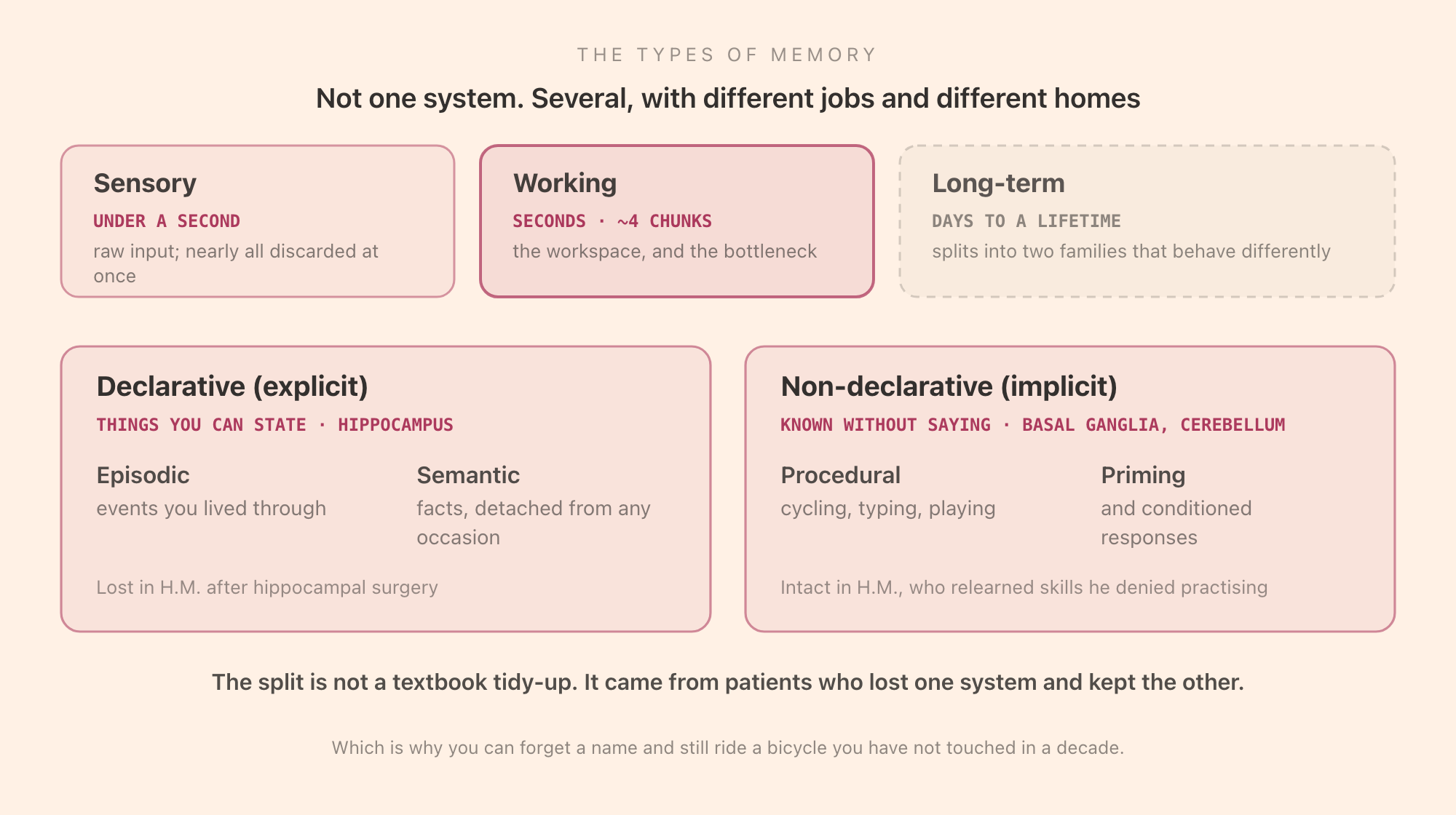
Sensory memory is the very brief persistence of raw sensory input, well under a second for vision. It is why a moving light appears to leave a trail. Almost all of it is discarded immediately; what survives is whatever attention grabs.
Working memory holds and manipulates a small amount of information over seconds. This is the mental workspace where you hold a phone number, follow an argument, or keep track of where you are in a problem. Its capacity is famously small, and the older "seven plus or minus two" figure is now generally considered too generous, with around four chunks a better estimate for most tasks. It is the bottleneck in almost all difficult thinking.
Long-term memory divides into two families that behave very differently.
Declarative (explicit) memory is what you can consciously state, and it splits again into episodic memory for events you experienced (your first day at a job) and semantic memory for facts detached from any occasion (the capital of Peru). This family depends heavily on the hippocampus.
Non-declarative (implicit) memory is everything you know without being able to state it. Procedural memory covers skills: cycling, typing, playing an instrument, all supported by the basal ganglia and cerebellum rather than the hippocampus. It also includes priming and conditioned responses.
That split is not a tidy classification invented for textbooks. It came from patients who lost one system and kept the other, most famously the man known as H.M., who could not form new conscious memories after hippocampal surgery yet could learn new motor skills perfectly well while insisting each time that he had never attempted the task before.
Consolidation, and Why Sleep Is Part of Learning
A memory does not finish being made when the experience ends. Over the following hours and days it is stabilised, and much of that work happens during sleep.
During sleep, particularly slow-wave sleep, the hippocampus replays the day's patterns in compressed form, in dialogue with the cortex, which is thought to be how memories are strengthened and gradually moved towards long-term cortical storage. REM sleep appears to contribute differently, helping integrate new material with what you already know, which may be part of why a difficult problem sometimes looks solvable the next morning.
The practical consequence is blunt: sleep after learning is not recovery from learning, it is a stage of it. A short or fragmented night means the previous day's material was less well consolidated, no matter how well the session itself went. This is the strongest argument against cramming through the night, and a large part of why good sleep hygiene is a study technique rather than a wellness one. The specific sleep stages doing this work are exactly the ones lost when a night is cut short.
Forgetting Is a Feature
Forgetting feels like malfunction, but a memory system that kept everything would be worse than useless.
Hermann Ebbinghaus mapped the shape of it in the 1880s by memorising nonsense syllables and testing himself over time. His forgetting curve is steep at first and then flattens: most of what you lose, you lose quickly, and what survives the first few days survives much longer. Crucially, each review flattens the curve further, which is the entire basis of spaced repetition.
Several things cause forgetting, and they are not the same. Decay is the fading of unused traces. Interference is other memories competing, either older ones blocking new (proactive) or new ones overwriting old (retroactive), and it is why studying two similar subjects back to back works badly. Retrieval failure is the most common and most frustrating: the memory is intact but the cue is missing, which is what the tip-of-the-tongue state is, and why walking into the right room suddenly returns it.
The useful reframe is that forgetting is selective filtering rather than loss of data. A system that retained every detail of every day would make it nearly impossible to generalise, and generalising is most of what thinking is.
Recall Is Reconstruction, Not Playback
This is the part with real consequences, and it is well established.
When you remember an event you rebuild it from fragments, filling gaps with expectation, general knowledge, and whatever you have heard since. The rebuild feels identical to a recording, which is exactly the problem: confidence and accuracy are only loosely related, and a vividly felt memory can be substantially wrong.
Elizabeth Loftus's work showed how readily this happens. In her studies, the wording of a question changed what people reported seeing: asked how fast cars were going when they "smashed" rather than "hit", people gave higher speeds and were more likely to report broken glass that was never in the film. Subsequent research has shown that entirely false memories of childhood events can be implanted through suggestion in a meaningful proportion of people, without any intent to deceive on either side.
There is also the strange case of flashbulb memories, the vivid recollections of where you were during a dramatic public event. They feel exceptionally reliable and are not: studies tracking people's accounts over years find substantial drift, while confidence stays high. The lesson is not that memory is worthless, most of it works well enough for daily life, but that vividness is not evidence, which matters enormously for eyewitness testimony and moderately for arguing with your family about what happened.
What Actually Improves Memory
The evidence-backed methods are unglamorous, and most of them feel worse than the ineffective ones, which is precisely why people avoid them.
Retrieval practice. Testing yourself strengthens memory far more than re-reading. This is the single best-supported finding in the field, and the guide to active recall covers how to apply it. Re-reading produces fluency, which feels like knowledge and is not.
Spacing. Spreading study across days beats massing it into one session, even holding total time constant. Combined with retrieval practice it is the core of spaced repetition.
Interleaving. Mixing related topics rather than blocking one at a time. Performance during practice looks worse and later retention is better, which is the general pattern for the methods that work: these are "desirable difficulties", where the effort is the mechanism, not a sign of doing it wrong.
Elaboration. Connecting new material to what you already know, explaining it in your own words, asking why it is true. Memory is associative, so more connections mean more retrieval routes.
Sleep. Consolidation is not optional, and it is not something you can compensate for later.
Attention while encoding. The cheapest intervention available, and the one no later technique can rescue. An hour of divided attention cannot be repaired by review, because the material was never properly recorded.
The methods that feel best, re-reading, highlighting, reviewing notes, are the ones that mostly do not work. They generate a comfortable sense of familiarity that is easily mistaken for having learned something.
Memory and Focus
Memory and attention are locked together in both directions, which is why they cannot really be improved separately.
Going in, attention is the gatekeeper: what you attend to gets encoded, what you do not is simply absent. This is why multitasking through study or a meeting is so costly. You are not learning it slightly less well, you are largely not learning it.
Coming back out, memory supports concentration. Sustained work on anything complex requires holding context, and the more of the background you already know solidly, the less has to be juggled consciously. Expertise looks like effortless attention partly because so much of what a novice must hold in working memory has been offloaded into long-term storage. Building memory and building the capacity to focus are, over time, close to the same project.
Where Focus Music Fits
Everything above converges on one practical point: the encoding hour is where memory is won or lost, and encoding is exactly what interruptions destroy. An hour of fragmented attention produces a fragmented memory, and no amount of later review recovers what was never encoded.
That is the job Tomatoes is built for: focus music that gives you a steady, non-distracting sound environment, so a study or work session is genuinely one session rather than a series of restarts. It is free to try for 3 days, then from $4.99 a week, $29.99 a year, or $39 for lifetime access. If you want the hours you spend learning to actually stick, try Tomatoes free for 3 days.
Memory is more interesting than the filing-cabinet metaphor allows. It is several systems, not one; it is built in stages, with attention deciding the input and sleep doing the stabilising; it forgets on purpose, selectively, so that you can generalise; and it recalls by rebuilding rather than replaying, which makes it flexible, useful, and occasionally confidently wrong. The methods that follow from that are simple enough to list in a sentence: attend properly, test yourself instead of re-reading, space it out, connect it to what you know, and sleep on it.