Sleep hygiene is the set of everyday habits and conditions that decide how easily you fall asleep and how well you sleep once you do. It is an unglamorous phrase for something quite important: the light you see, the caffeine you drink, the time you go to bed, the temperature of the room, and what you do in the hour before you lie down all feed into a biological system that is far more mechanical than most people realise. Good sleep hygiene is not a wellness ritual or a bedtime aesthetic. It is a small number of habits that line your behaviour up with how the sleep system actually works, and the reason it matters for focus is direct: almost every cognitive ability you rely on during the day, attention, working memory, judgement, emotional control, is downstream of how you slept.
This article explains what sleep hygiene is, the two biological systems it operates on, the habits that genuinely move the needle (and the ones that are mostly noise), what sleep hygiene can and cannot fix, and how it connects to the focus you have available the next day.
What Is Sleep Hygiene?
Sleep hygiene is the collection of behaviours and environmental conditions that support healthy, consistent sleep. The term came out of sleep medicine, where it describes the baseline advice given to people with sleep complaints before anything more involved is considered. It covers your schedule (when you sleep and wake), your inputs (light, caffeine, alcohol, food, exercise), your environment (darkness, quiet, temperature), and your pre-sleep behaviour (what you do in the last hour, and what you do if you cannot sleep).
The word "hygiene" is doing something specific here. It is not a metaphor about cleanliness so much as an analogy to preventive habit: the same way brushing your teeth does not fix a cavity but reliably prevents most of them, sleep hygiene does not treat a sleep disorder but reliably prevents a lot of ordinary bad sleep. That framing is useful because it sets the right expectation. These habits are the foundation, not the cure.
What makes sleep hygiene more than a list of tips is that each item traces back to a mechanism. You are not being told to avoid late coffee because coffee is bad; you are being told because caffeine blocks the receptors for the chemical that makes you sleepy, and it does so for many hours. Once you can see the mechanism, the advice stops being arbitrary and starts being obvious.
The Two Systems Sleep Hygiene Works On
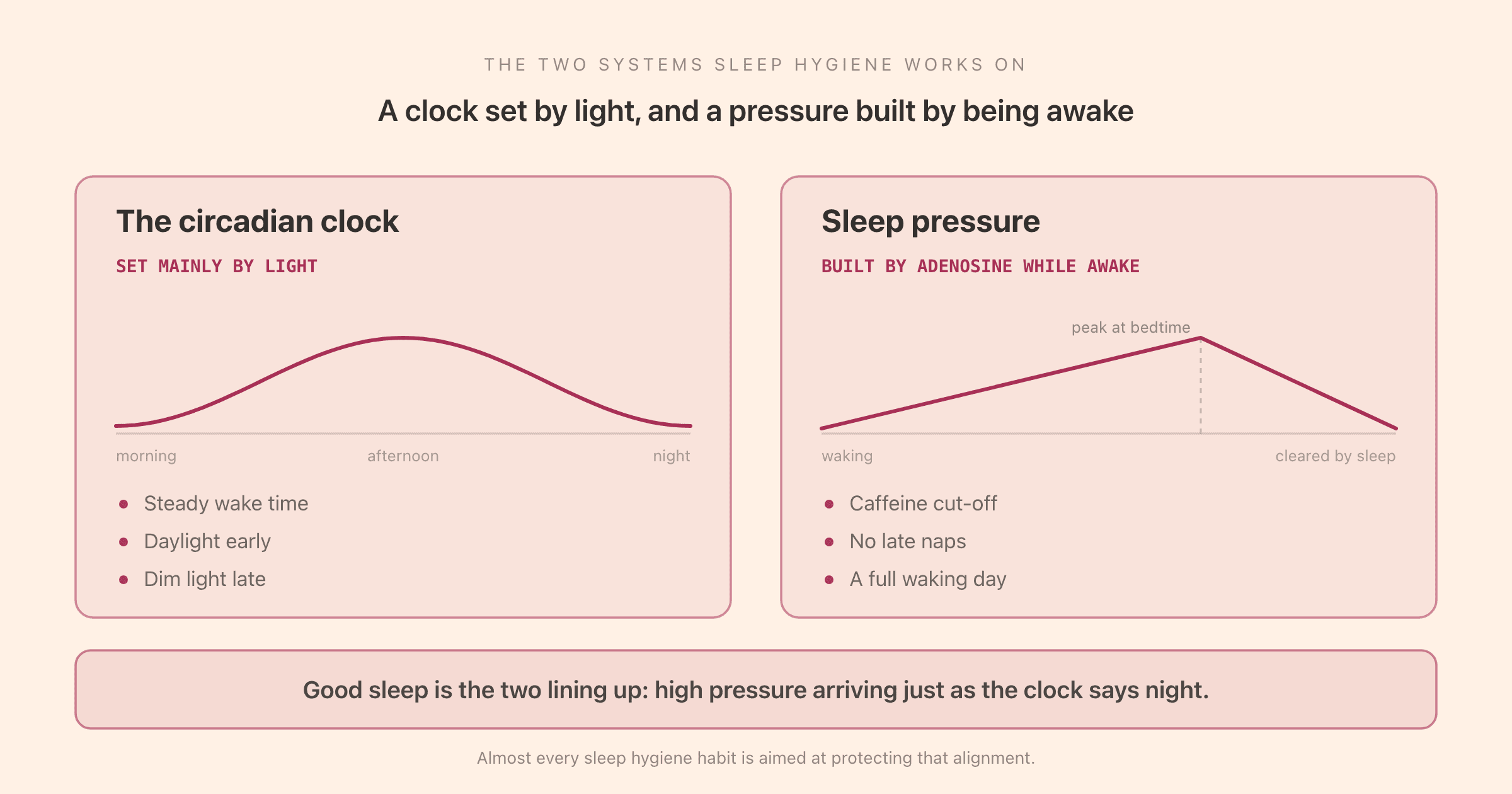
Sleep is governed by two systems working in parallel, and effectively every piece of sleep hygiene advice is aimed at one of them.
The circadian clock. Your body runs an internal daily rhythm, coordinated by a small region of the brain, that tells you roughly when it should be day and when it should be night. It governs the timing of sleepiness, alertness, body temperature, and hormone release, including melatonin, which rises in the evening as your body prepares for sleep. This clock does not run to a perfect 24 hours on its own; it is set each day mainly by light, which is why light exposure is the single most powerful lever in sleep hygiene. Getting the circadian rhythm right is what makes sleepiness arrive at a sensible hour instead of at 2am.
Sleep pressure. The longer you are awake, the more you build up a drive to sleep. The main chemical behind this is adenosine, which accumulates in the brain through the waking day and is cleared during sleep. High adenosine is a large part of what "feeling tired" is. This system is why a long, active day makes sleep come easily, why a 4pm nap can ruin your evening, and why caffeine works the way it does: it does not remove adenosine, it blocks its receptors, temporarily hiding a tiredness that is still accumulating underneath.
Good sleep is what happens when these two line up: high sleep pressure arriving at the same time your clock says it is night. Bad sleep is usually a mismatch, an exhausted body at a moment the clock insists is daytime, or a well-timed night with no pressure behind it because you dozed on the sofa at six. Almost every habit below is about protecting that alignment.
The Sleep Hygiene Habits That Actually Matter
There are long lists of sleep tips in circulation, most padded with items of marginal effect. These are the ones with a clear mechanism and a real payoff.
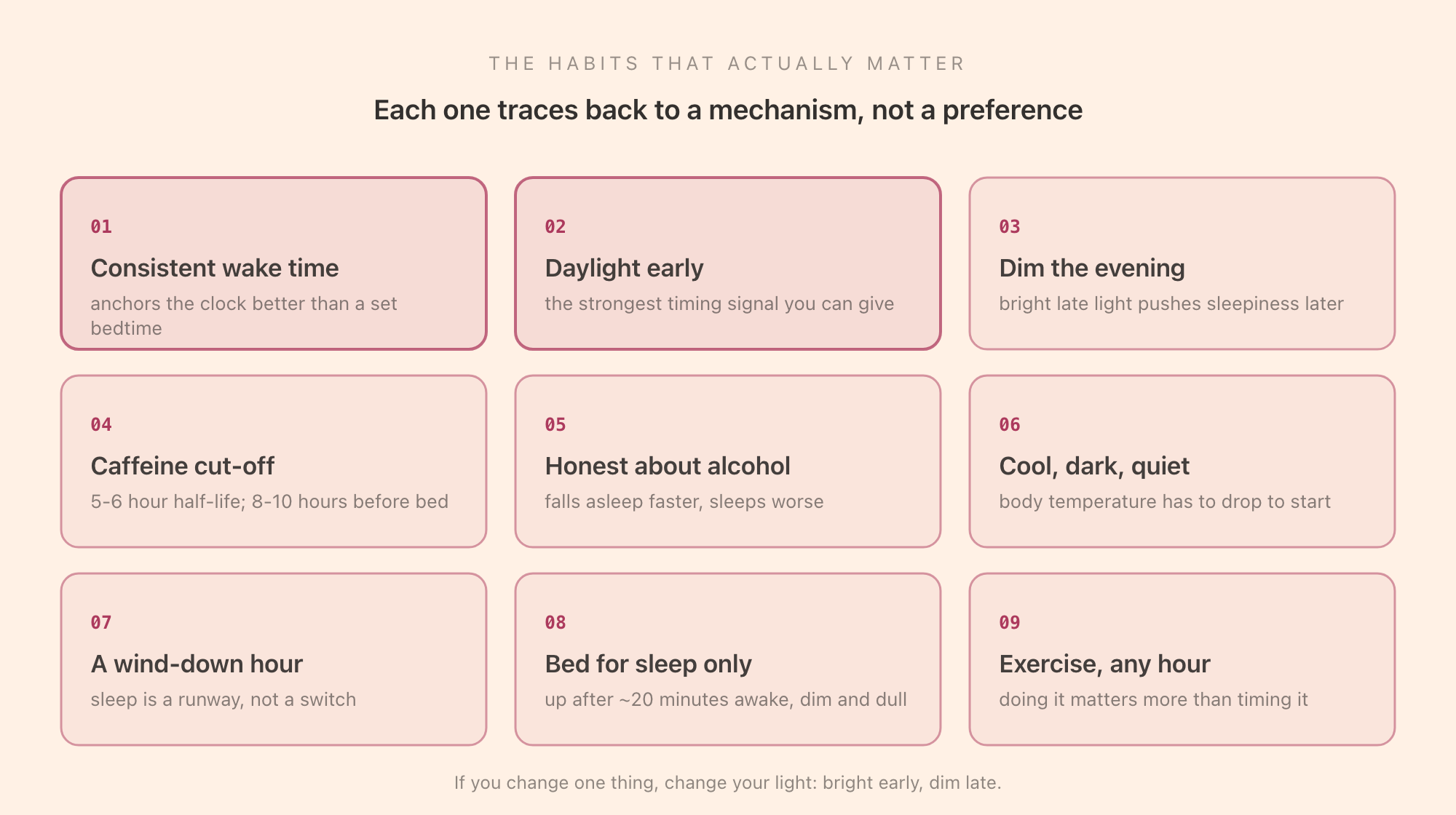
Keep a consistent wake time. The most underrated habit of the lot. A steady wake time anchors your circadian clock far more effectively than a steady bedtime, because waking (and the light that comes with it) is the strongest timing signal you give the system. Bedtime will follow if the wake time holds. This includes weekends; a two-hour lie-in on Saturday shifts your clock in much the same way a two-hour time-zone change does.
Get daylight early. Morning light is the strongest input to the clock. Even ten to twenty minutes outdoors, or by a bright window, tells the system that the day has started, which sets the timer for when melatonin rises that evening. Indoor lighting is far dimmer than daylight, and the difference matters more than it looks.
Dim the evening. The counterpart to morning light. Bright light in the evening, especially overhead and screen light, delays the clock and pushes sleepiness later. Dimming lights and reducing screen brightness for the last hour or two is a genuine intervention, not a superstition.
Set a caffeine cut-off. Caffeine has a half-life of roughly five to six hours, which means a mid-afternoon coffee is still meaningfully present at bedtime. Most people do best cutting off eight to ten hours before bed. Crucially, caffeine can shallow your sleep even when it does not stop you falling asleep, so "coffee doesn't affect me" is often "coffee affects my sleep quality without me noticing".
Be honest about alcohol. Alcohol is sedating, so it feels like a sleep aid, but it fragments sleep in the second half of the night and suppresses REM. It is one of the clearest cases of falling asleep faster and sleeping worse.
Make the room cool, dark, and quiet. Body temperature needs to drop for sleep to begin, so a cool room helps the process along rather than fighting it. Darkness supports melatonin, and quiet (or steady, unchanging sound) prevents the micro-awakenings that fragment sleep without waking you fully.
Protect a wind-down hour. Sleep is not a switch. Going straight from stimulating work or a demanding screen into bed asks the nervous system to change state instantly, which it cannot do. A predictable, low-stimulation last hour, reading, a shower, quiet music, tidying, gives it the runway it needs.
Keep the bed for sleep. Working, scrolling, and worrying in bed teaches the brain to associate the bed with wakefulness. The classic advice, and it is well-supported, is that if you have been lying awake for around twenty minutes, get up, do something quiet and dull in dim light, and return when you feel sleepy. Lying in bed frustrated strengthens exactly the association you want to weaken.
Exercise, but mind the timing. Physical activity improves sleep quality and deepens sleep pressure. Very intense exercise close to bedtime can delay sleep onset for some people, though this is individual; the general rule is that exercising at all matters far more than exercising at the perfect hour.
Light Is the Biggest Lever
If you only change one thing, change your light. The circadian system is calibrated by light more than by anything else, and modern life gets it backwards: we spend the day indoors under lighting far dimmer than daylight, then flood our eyes with bright light in the evening, when the system is expecting darkness. The result is a clock that never receives a strong "it is morning" signal and repeatedly receives a "it is still daytime" signal at 10pm.
Correcting it is straightforward. Bright light early, ideally outdoors, ideally within an hour or so of waking. Dim, warm, low light in the evening. That is most of the intervention. It costs nothing, requires no equipment, and works on the strongest input the system has. Compared to the elaborate routines and supplements people reach for, the return on simply going outside in the morning is remarkable.
What Sleep Hygiene Can and Cannot Fix
It is worth being straight about the limits, because overselling sleep hygiene is how people end up feeling like failures.
Sleep hygiene reliably improves ordinary bad sleep: sleep that is poor because of an erratic schedule, late caffeine, a bright and noisy bedroom, no wind-down, or a body clock that has drifted. That covers a great deal of the bad sleep most people experience, and the improvement can be substantial.
What sleep hygiene cannot do is treat a sleep disorder. Chronic insomnia, sleep apnoea, restless legs, and circadian rhythm disorders are clinical conditions, and telling someone with chronic insomnia to try a cooler room is not treatment. The first-line treatment for chronic insomnia is CBT-I (cognitive behavioural therapy for insomnia), which is more structured and more effective than sleep hygiene advice alone, and sleep apnoea needs medical assessment. If your sleep has been persistently bad for months despite decent habits, or you snore heavily and wake unrefreshed, that is a reason to see a doctor rather than to try harder at the habits.
There is also a trap worth naming: trying too hard at sleep. Anxiously monitoring your sleep, checking the clock, and treating every night as a performance to be scored tends to make sleep worse, because sleep is one of the few things that arrives more readily when you stop chasing it. Sleep hygiene should be a set of quiet defaults, not a nightly examination.
Sleep, Focus, and the Next Day
The reason any of this belongs on a focus site is that sleep is the largest single input to how well your brain works the following day, and it is the one most people quietly sacrifice. A short or fragmented night degrades sustained attention first, then working memory, then the executive control that lets you resist distraction and switch tasks cleanly. The subjective version of this is familiar: the day when nothing sticks, everything takes twice as long, and small irritations feel large. That is not a character failure, it is sleep debt presenting as brain fog.
It is worth understanding that lost sleep is not neutral, it accumulates, and the cognitive cost accumulates with it, which is why a run of six-hour nights can leave you performing measurably worse while feeling you have adjusted. Sleep hygiene is, in that sense, the cheapest focus intervention available. No technique, tool, or supplement compensates for chronically poor sleep, and equally, nothing else you do for your concentration pays off as reliably as fixing it.
Where Focus Music Fits
There is a practical overlap between good sleep habits and good work habits, which is that both depend on the environment doing some of the work for you. A predictable, low-stimulation sound environment helps in the evening for the same reason it helps during a working session: it reduces the unpredictable interruptions that keep the nervous system alert and make settling difficult.
Tomatoes is built for the working half of that: focus music designed to give you a calm, consistent sound environment for deep work, so your attention has something steady to settle into. It works best alongside the fundamentals rather than instead of them, and sleep is the biggest fundamental there is. It is free to try for 3 days, then from $4.99 a week, $29.99 a year, or $39 for lifetime access. If you are rebuilding your focus from the foundations up, try Tomatoes free for 3 days.
Sleep hygiene has a slightly worthy, tick-box reputation, which is a shame, because underneath the phrase is a genuinely mechanical story: a clock set by light, a pressure built by adenosine, and a short list of habits that either help those two line up or pull them apart. Get the wake time steady, get light early and dim it late, keep caffeine in the morning half of the day, make the room cool and dark, and give yourself an hour to slow down. None of it is exotic, all of it compounds, and the payoff shows up the next day in the one resource everything else depends on: a brain that is actually able to concentrate.