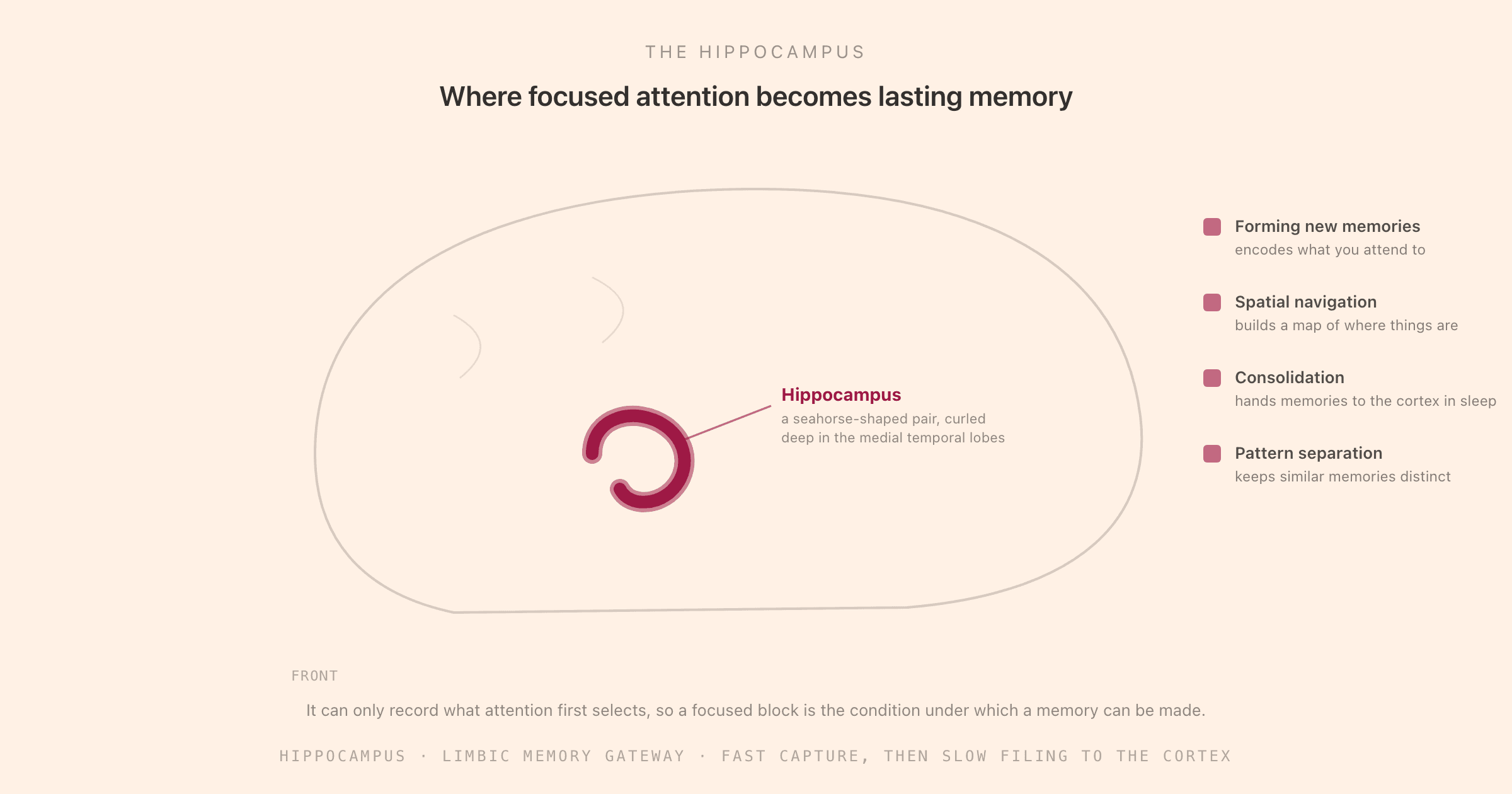
The hippocampus is the part of your brain that turns a passing experience into a memory you can keep. It is a curved, seahorse-shaped structure (two of them, one deep in each temporal lobe) and it sits at the centre of learning: nothing you read, hear, or work on becomes a durable memory without passing through it first. For anyone who cares about focus, the hippocampus matters for one blunt reason: it can only record what your attention selected. Focus is the gate; the hippocampus is what is waiting on the other side. If last week's piece on the prefrontal cortex was about the brain's control centre and the one on the amygdala was about its alarm, this is about its recorder, the structure that decides what survives the day. This is what the hippocampus does, where it is, and how to keep it working for you.
Understanding the hippocampus reframes what focused work is actually for. A concentrated work block is not just output; it is the only condition under which the hippocampus can encode something properly, because divided attention starves it of the clean signal it needs. Tomatoes is built around exactly that kind of protected, single-task block, the environment in which attention and memory can do their jobs. The app is free for 3 days, then $4.99/week, $29.99/year, or $39 lifetime.
What Is the Hippocampus?
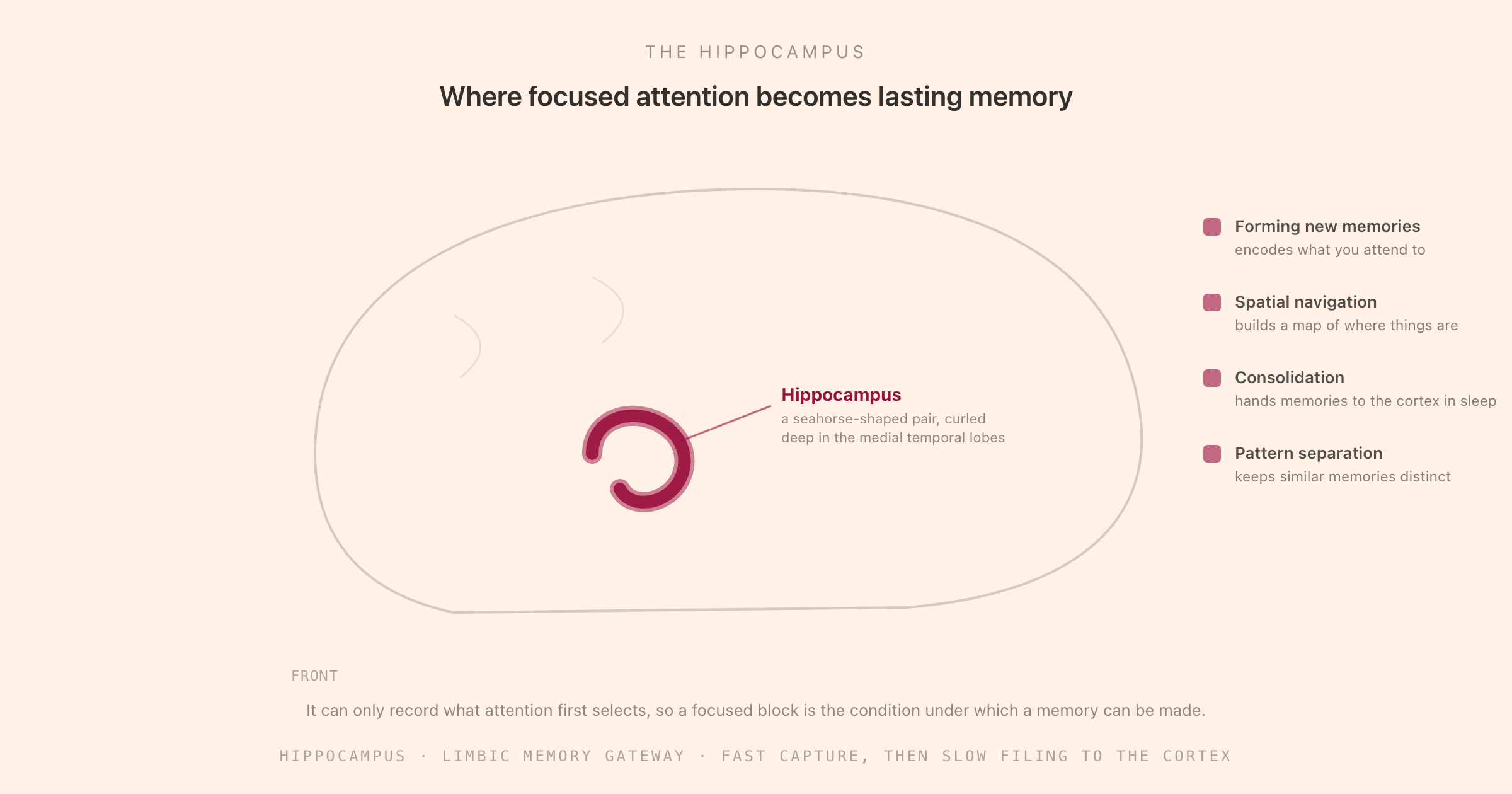
The hippocampus (from the Greek for "seahorse," which its curved shape resembles) is a structure in the brain's limbic system, the same set of deep structures that handle emotion, motivation, and memory. You have two, one curled inside each temporal lobe, sitting just inward from the amygdala it works closely with. It is old, evolutionarily speaking, and small, but it is indispensable: it is the brain's gateway for forming new conscious memories.
Its central job is converting short-term experience into long-term memory. When you learn a fact, meet a person, or work through a problem, the hippocampus binds together the scattered pieces (the sights, sounds, words, and context) into a single linked memory trace. It does not store that memory forever in one place; instead it acts as a fast, temporary index that captures the experience quickly and then, over hours and days, helps transfer it to the cortex for permanent storage. This two-step design, fast capture followed by slow filing, is the key to understanding why some things stick and most things vanish.
Where Is the Hippocampus?
The hippocampus location is deep in the medial temporal lobe, the part of the brain roughly behind your temples and a few centimetres in, on the inner edge of each hemisphere. It curls in a C-shape around the thalamus, with the amygdala sitting just in front of its tip. Because there are two, one per hemisphere, damage to one side can be partially compensated by the other, but losing both, as in the famous case of the patient H.M., who had both removed to treat epilepsy, leaves a person unable to form new long-term memories at all while leaving older memories and skills intact. That single, tragic result is the clearest proof of what the hippocampus does: it is not where old memories live, it is the machine that makes new ones.
What Does the Hippocampus Do?
The hippocampus has a few distinct jobs, and they are more connected than they first appear.
Forming new memories (encoding)
This is the headline function. The hippocampus encodes new declarative memories, the facts and events you can consciously recall. It is especially important for episodic memory (specific experiences tied to a time and place) and for binding the separate elements of an experience into one retrievable whole. Without it, new information washes through working memory and is gone within seconds.
Spatial navigation and the cognitive map
The hippocampus also builds your sense of where things are. It contains "place cells" that fire when you are in a specific location, forming an internal cognitive map of your environment. This is why the discovery of place cells (and the related grid cells nearby) won a Nobel Prize, and why London taxi drivers who memorise the city's streets show measurably larger hippocampal volume. Memory and spatial mapping turn out to use the same machinery, which is why ancient memory techniques like the "memory palace" work: they smuggle facts into the brain's powerful map of space.
Pattern separation
The hippocampus keeps similar memories from blurring into one another, a process called pattern separation. It is what lets you remember where you parked today versus yesterday, or distinguish two near-identical meetings. When this falters, similar experiences interfere and you mix them up.
Consolidation: the handoff to the cortex
Finally, the hippocampus runs consolidation: the slow transfer of a freshly encoded memory into the cortex for durable, long-term storage. Crucially, much of this happens offline, during sleep, when the hippocampus "replays" the day's encoded experiences and gradually trains the cortex to hold them on its own. This is the hinge between focus and learning, and it deserves its own section.
The Attention-to-Memory Pipeline
Here is the part that matters most for focused work. A memory does not appear in the hippocampus from nowhere. It runs a pipeline, and focus is the first stage of it.
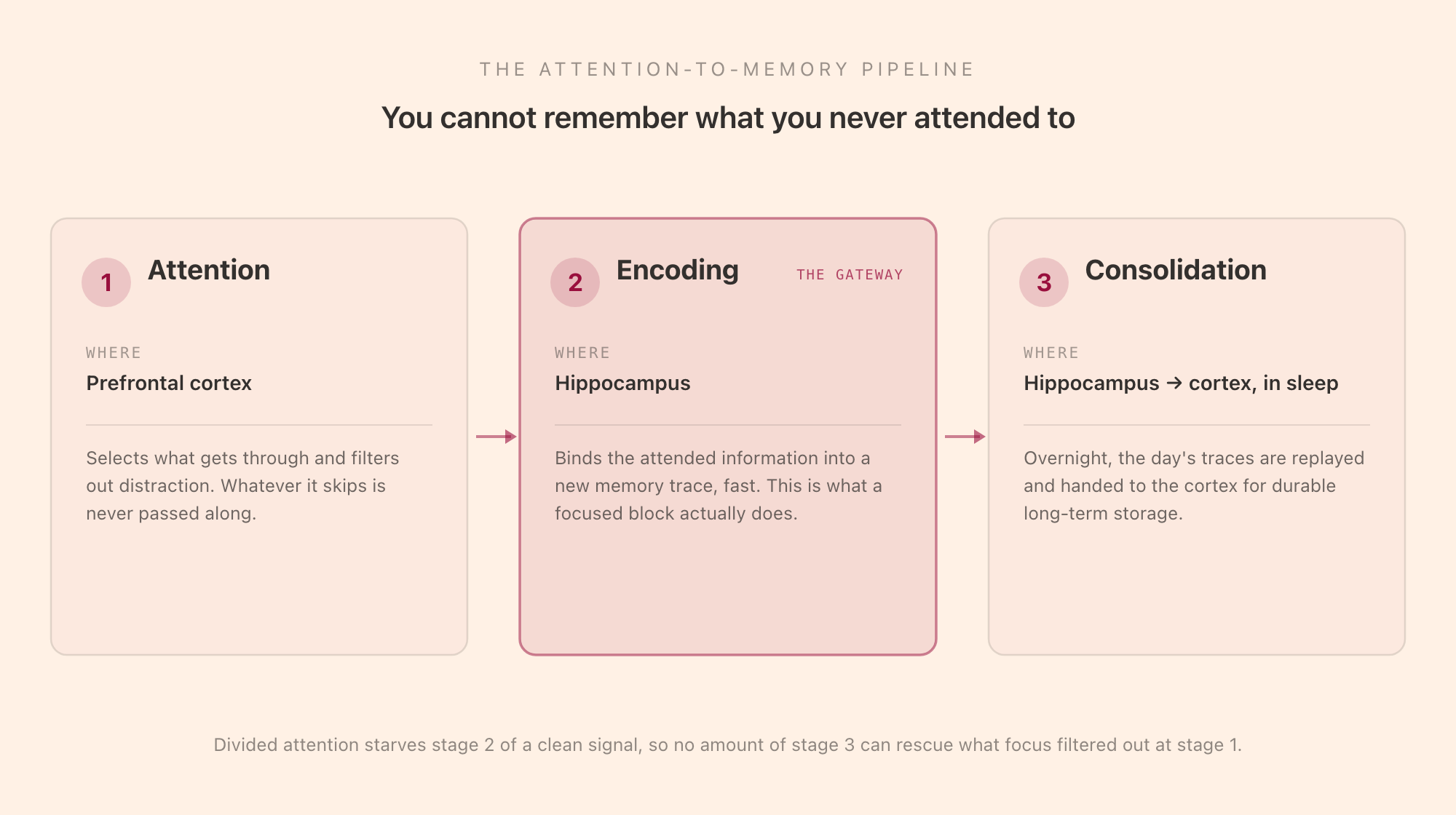
- Attention selects. The prefrontal cortex and attention networks decide what gets through. Whatever you do not attend to is never passed along, which is the entire reason divided attention destroys learning. When you study with a feed open, the hippocampus is handed a thin, fragmented signal, and it encodes a thin, fragmented memory.
- The hippocampus encodes. The attended information is bound into a new memory trace, fast. This is the work a focused block actually accomplishes under the surface.
- Sleep consolidates. Overnight, the hippocampus replays the day's traces and hands them to the cortex. The memory becomes durable and the hippocampus is freed up to encode again tomorrow.
The practical takeaway is stark: you cannot remember what you never attended to. No amount of consolidation rescues information that focus filtered out at stage one. This is why "I read it but nothing stuck" is almost always an attention problem, not a memory problem. It also explains why the research on multitasking is so consistently grim for learning: splitting attention does not just slow you down, it starves the hippocampus of the clean input it needs to record anything worth keeping.
The Hippocampus, Sleep, and Spacing
Two evidence-based levers follow directly from how the hippocampus works.
Sleep is not optional for memory. Because consolidation runs largely during sleep, especially the deep slow-wave stages, a night of poor sleep means the day's encoded memories are not properly filed. The hippocampus also relies on sleep to clear capacity; a sleep-deprived hippocampus encodes new information markedly worse the next day. If you want focused work to convert into knowledge, protecting sleep is part of the work, not separate from it. (See our piece on the sleep stages for what happens in each.)
Spacing beats cramming, by design. Each time you revisit and successfully recall something, the hippocampus re-engages and strengthens the trace, nudging it further into cortical storage. Spreading study across days exploits this; cramming it into one session does not, because a single encoding pass leaves a single fragile trace. This is the mechanism underneath spaced repetition and active recall, the two best-evidenced study techniques there are. They are not study hacks; they are the hippocampus's own consolidation cycle, used on purpose.
What Harms the Hippocampus (and What Protects It)
The hippocampus is unusually plastic, which cuts both ways: it is one of the few brain regions that can grow new neurons in adulthood (a process called neurogenesis), and it is also one of the most vulnerable to chronic stress.
- Chronic stress and cortisol. The hippocampus is dense with receptors for cortisol, and prolonged high cortisol from chronic stress measurably impairs hippocampal function and, over time, can shrink it. Acute stress and a calm hippocampus do not mix, which is another reason the anxious, hijacked brain learns so poorly.
- Sleep loss. As above, it both blocks consolidation and degrades next-day encoding.
- Exercise. Aerobic exercise is one of the most reliable boosters of hippocampal health and neurogenesis in the research, partly via a protein called BDNF that supports new neuron growth.
- Protected, single-task focus. Giving the hippocampus a clean, undivided signal to encode, and not forcing it to compete with a dozen attention switches, is the daily practice that makes the rest possible.
The throughline is that the hippocampus rewards the same conditions good focus needs: low stress, real sleep, and undivided attention. Treat them as one system, because they are.
The Bottom Line
The hippocampus is the brain's recorder: the seahorse-shaped structure deep in the temporal lobe that encodes new experiences into memory and, over sleep, files them into the cortex for keeps. Its single most important lesson for focused work is that it can only record what attention first selected, so concentration is not separate from learning, it is the precondition for it. Protect attention during the work, protect sleep after it, and revisit material across days rather than cramming it, and you are working with the hippocampus instead of against it.
That is the whole case for protected, single-task focus blocks: they are the condition under which attention, encoding, and consolidation can actually do their jobs. Tomatoes is built to make those blocks easy to start and easy to keep, so the work you do is work your brain can keep. It is free for 3 days, then $4.99/week, $29.99/year, or $39 lifetime. Focus is how the memory gets made.