The basal ganglia are the part of your brain that decides which action to start, and that turns the actions you repeat into habits you no longer have to think about. They are a cluster of structures buried deep beneath the cortex, and they run two of the most important jobs in all of behaviour: choosing what to do next, and automating whatever you do often. For focus and productivity, this matters enormously, because every habit the basal ganglia automates is one less thing your conscious, effortful brain has to manage. If the prefrontal cortex is the brain's deliberate control centre, the basal ganglia are its autopilot, and the better your autopilot is set up, the more your control centre is free for the work that actually needs it. This is what the basal ganglia do, how habit formation works, and why starting is so often the hardest part.
Understanding the basal ganglia reframes a lot of productivity advice. The reason building a routine is so powerful is not willpower; it is that a habit moves a behaviour out of the effortful prefrontal cortex and into the automatic basal ganglia, where it costs almost nothing to run. Tomatoes is built to make starting a focus session into exactly that kind of low-friction, repeatable cue, the hard part the basal ganglia struggle with most. The app is free for 3 days, then $4.99/week, $29.99/year, or $39 lifetime.
What Are the Basal Ganglia?
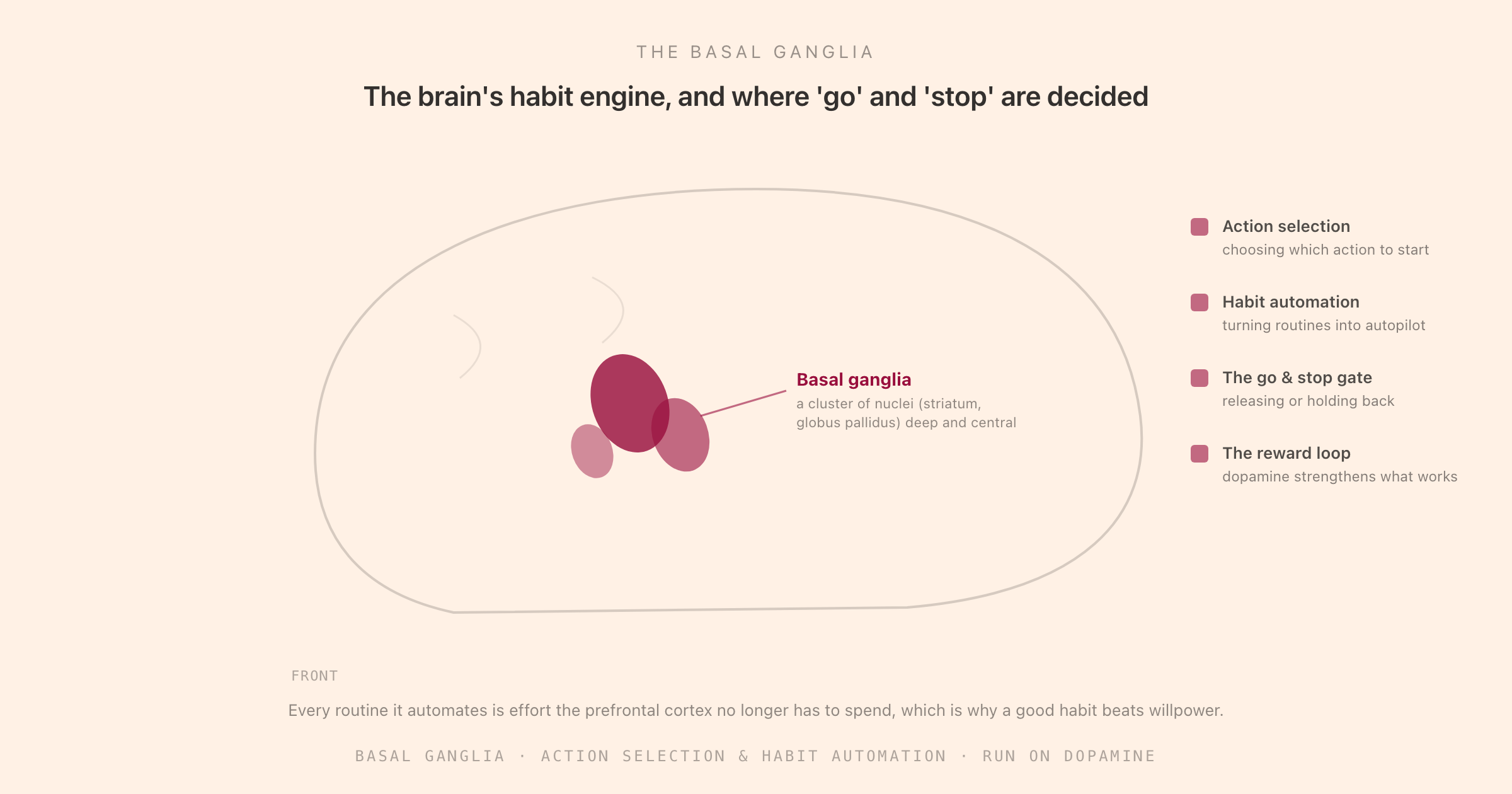
The basal ganglia (the name means "base knots") are a group of interconnected structures sitting deep below the cortex, near the centre of the brain and wrapped around the thalamus. The main components are the striatum (itself made of the caudate nucleus and the putamen), the globus pallidus, the subthalamic nucleus, and the substantia nigra. You do not need the anatomy to use the idea, but two names are worth knowing: the striatum is the main input station, the part that receives signals from across the cortex, and the substantia nigra is a key source of the dopamine that the whole system runs on.
Their central job is action selection: out of all the things you could do at any moment, the basal ganglia help choose one and release it, while holding the others back. They work as a kind of gate. Most of the time the gate is held shut (a "no-go" default that stops you doing everything at once), and the basal ganglia's job is to open it for the right action at the right time. This is why damage to the system produces movement disorders: in Parkinson's disease, the loss of dopamine-producing cells in the substantia nigra makes it hard to initiate movement at all, and in Huntington's disease the striatum degenerates and movement becomes uncontrolled. The basal ganglia are where "go" and "stop" are decided.
Where Are the Basal Ganglia?
The basal ganglia location is deep and central: a set of grey-matter masses sitting beneath the cerebral cortex and around the thalamus, in both hemispheres. Their position is the point. They sit at a crossroads, receiving inputs from almost the entire cortex, funnelling them through their internal circuits, and sending the results back up (via the thalamus) to the cortex. That loop, cortex to basal ganglia to thalamus and back to cortex, runs continuously, and it is the circuit through which deliberate intentions get turned into selected, automated actions.
What Do the Basal Ganglia Do?
Beyond the headline of action selection, the basal ganglia run several related jobs.
Selecting and initiating action
This is the core function: choosing which motor or cognitive action to release and which to suppress. It applies not just to movement but to thoughts and decisions, the basal ganglia help select which mental action to run, not only which physical one.
Automating routines into habits
This is the function that matters most for productivity. When you repeat an action in a stable context, the basal ganglia gradually take it over, "chunking" the sequence into a single automatic routine. The first time you drove a car, every step was effortful and conscious, run by the prefrontal cortex. After enough repetition, the whole sequence became a habit the basal ganglia execute while your conscious mind is elsewhere. A habit is a behaviour that has migrated from effortful cortical control into automatic basal-ganglia routine.
The go and stop gate
The system both releases wanted actions and inhibits unwanted ones. That inhibition matters for focus: holding back the impulse to check your phone is, in part, the basal ganglia keeping a gate shut, and that capacity is finite and tied to dopamine and arousal.
Learning what works, through dopamine
The basal ganglia are richly supplied with dopamine, and dopamine is how they learn. When an action leads to a better-than-expected outcome, a dopamine signal strengthens the circuit that produced it, making that action more likely next time. This is reinforcement learning happening in your own head, and it is the engine of habit formation.
How Habit Formation Works: Cue, Routine, Reward
Habit formation is the basal ganglia doing their automation job, and it follows a loop that is worth knowing because you can use it deliberately.
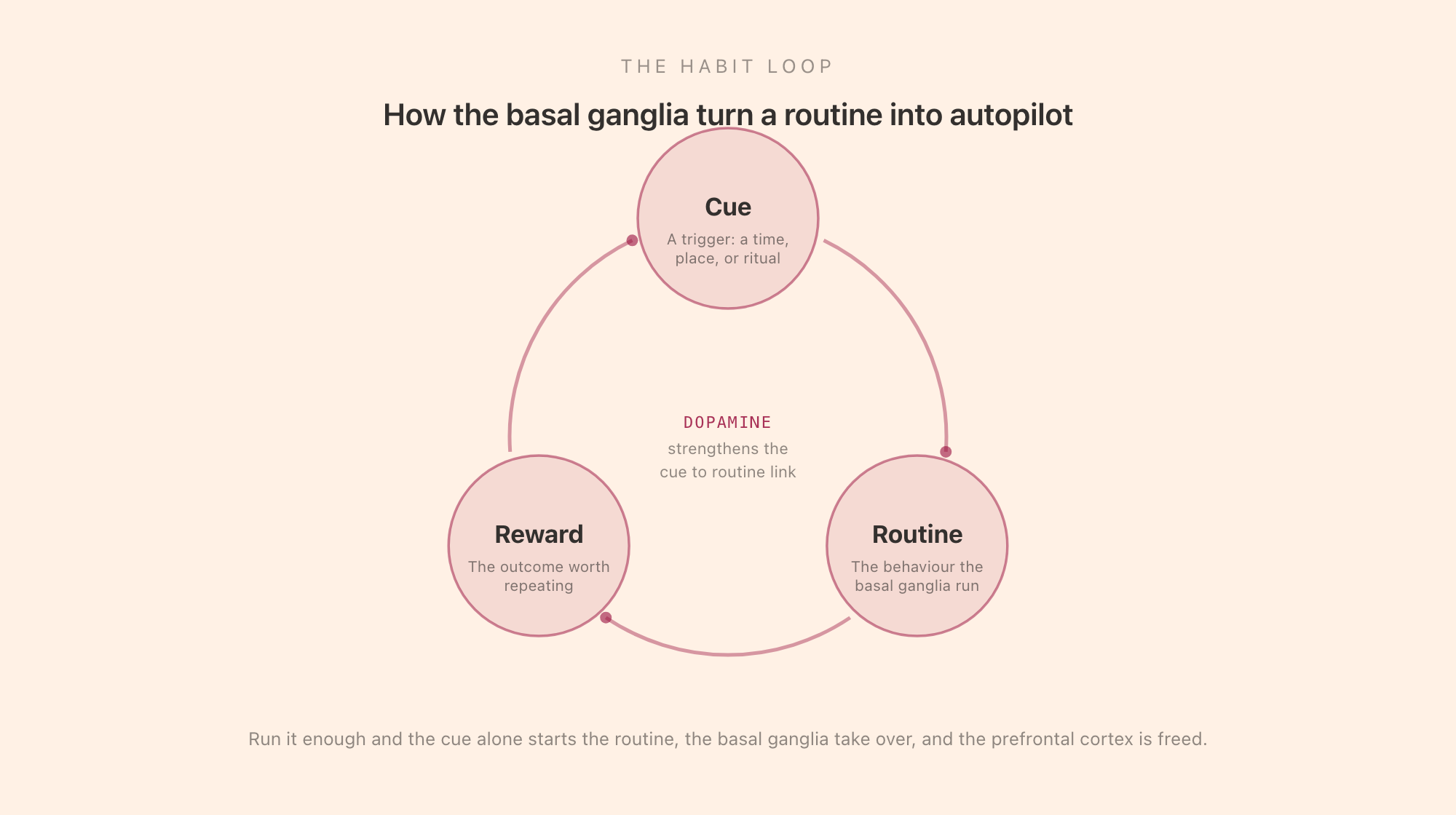
- Cue. A trigger in your context (a time of day, a place, a preceding action, an emotional state) that tells the brain which routine to run. Cues are the hook habits hang on.
- Routine. The behaviour itself, the chunked sequence the basal ganglia execute automatically once the cue fires.
- Reward. The outcome that tells the brain the routine was worth running. The reward drives the dopamine signal that strengthens the cue-to-routine link, so next time the same cue more reliably triggers the same routine.
Run that loop enough times and the behaviour becomes automatic: the cue alone is enough to start the routine, with little conscious effort. This is why the practical advice for building a habit is always about the cue (make it obvious and consistent) and the reward (make it satisfying and immediate), because those are the two ends of the loop the basal ganglia actually learn from. It is also why habits are so hard to break: the circuit does not get deleted, so the old cue can still trigger the old routine years later, which is why changing a habit is usually about substituting a new routine for the same cue rather than erasing the loop.
Why This Frees the Prefrontal Cortex
Here is the payoff for focus. Your prefrontal cortex, the seat of deliberate effort, focus, and willpower, has a small and easily depleted capacity. Every decision and act of self-control draws on it. The basal ganglia are the way the brain economises: by automating everything repeatable, they keep the expensive, limited prefrontal cortex free for the things that genuinely need thought.
This reframes why routines beat willpower. If starting work depends on a daily act of conscious decision, you are spending scarce prefrontal resources on it every single time, and on a tired or stressed day you will lose. If starting work is a habit triggered by a reliable cue (a time, a place, a ritual, a piece of music), the basal ganglia carry the load, and you begin almost without deciding to. The goal of a good focus system is to move as much as possible of the getting started out of the prefrontal cortex and into the basal ganglia, so that your limited willpower is spent on the work itself, not on the daily fight to begin it.
Why Starting Is the Hardest Part
The basal ganglia also explain a frustration everyone knows: that the hardest part of a task is starting it. Action initiation, getting the gate to open and release the first action, is a distinct function, and it is exactly what falters when dopamine is low, which is why low motivation feels like being unable to begin even things you want to do (and why initiation problems are so central to conditions like ADHD and to procrastination). Once you are moving, continuing is far easier, because a different part of the system carries it.
The practical implication is to lower the activation energy of starting. Make the first step tiny and the cue unmissable, so that beginning asks as little of the initiation system as possible. A consistent starting ritual, the same cue every time, does this by recruiting the basal ganglia's habit machinery to do the starting for you. Once the routine is automatic, the hardest part stops being hard.
The Bottom Line
The basal ganglia are the brain's action-selection and habit engine: a cluster of structures deep beneath the cortex that choose which action to start, gate "go" against "stop," and, through dopamine-driven learning, automate repeated behaviours into habits. For focus, their gift is automation: every routine they take over is effort the prefrontal cortex no longer has to spend, which is the real reason a good habit beats raw willpower. Build the cue, protect the reward, and make starting as small as possible, and you put the basal ganglia to work on your behalf.
That is the whole logic of a repeatable focus ritual: a consistent cue that hands the hardest part, beginning, to your brain's autopilot. Tomatoes is built to be that cue, the same simple start to every focus session until starting is automatic. It is free for 3 days, then $4.99/week, $29.99/year, or $39 lifetime. Make starting a habit, and the rest gets easier.