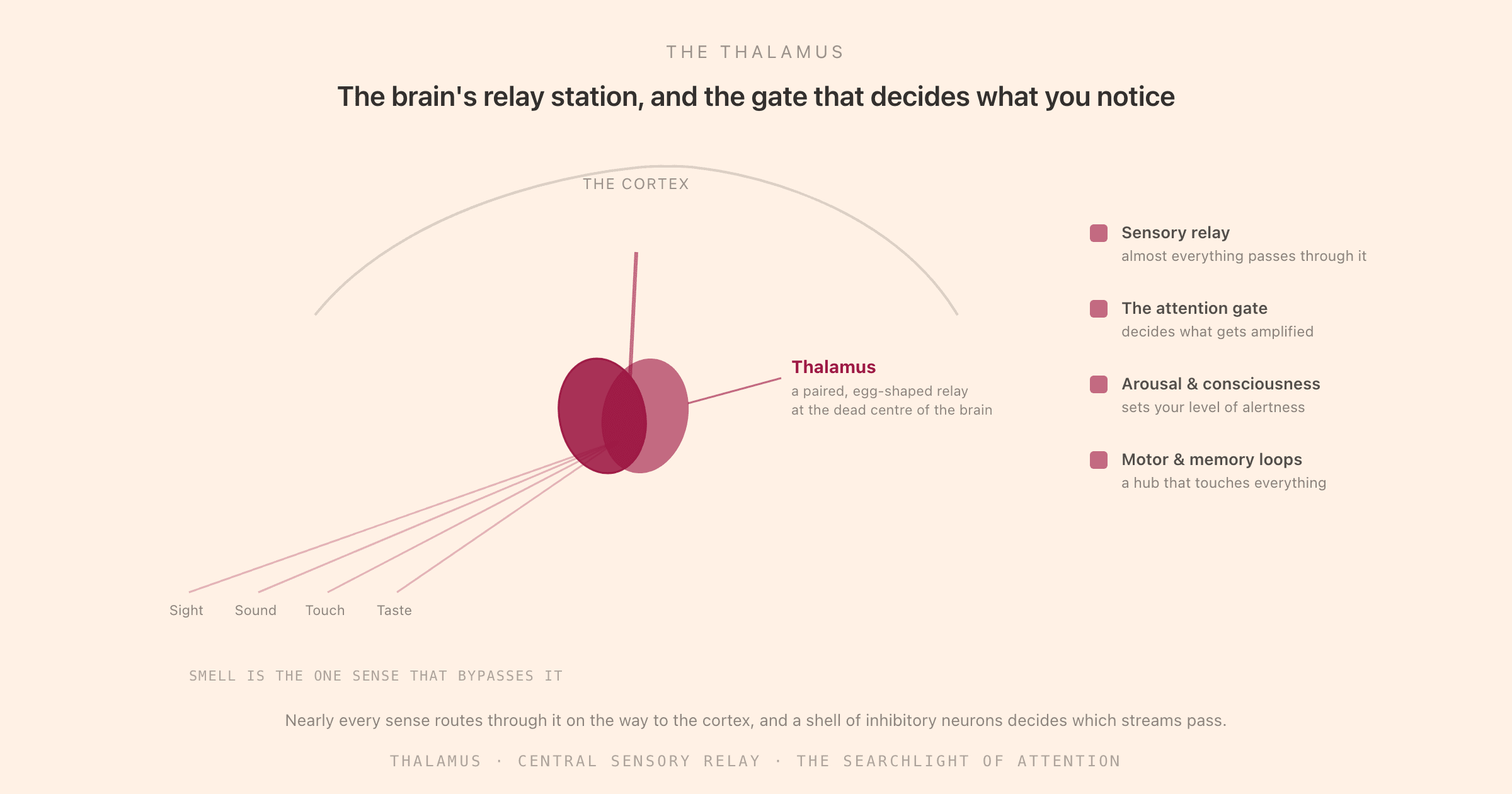
The thalamus is the brain's central relay station: a pair of egg-shaped structures sitting right at the core of the brain, through which almost everything you see, hear, touch, and taste must pass on its way to the cortex. Nothing reaches your conscious awareness without being routed, and often filtered, here first. For focus, that makes the thalamus quietly crucial, because it is not a passive switchboard. A part of it acts as a gate, deciding which signals get amplified and sent on and which get turned down, which means the thalamus is one of the places where attention physically happens. If the prefrontal cortex is the brain's control centre, the amygdala its alarm, and the hippocampus its recorder, the thalamus is its gatekeeper. This is what it does, where it is, and how it shapes what you notice.
Understanding the thalamus reframes what distraction actually is. A distraction is a signal that got through the gate when you wanted it kept out, and a deep focus is the gate doing its job: turning the world down so one thing can come through clearly. Tomatoes is built around protecting that state, the clean, single-channel attention a working gate produces. The app is free for 3 days, then $4.99/week, $29.99/year, or $39 lifetime.
What Is the Thalamus?
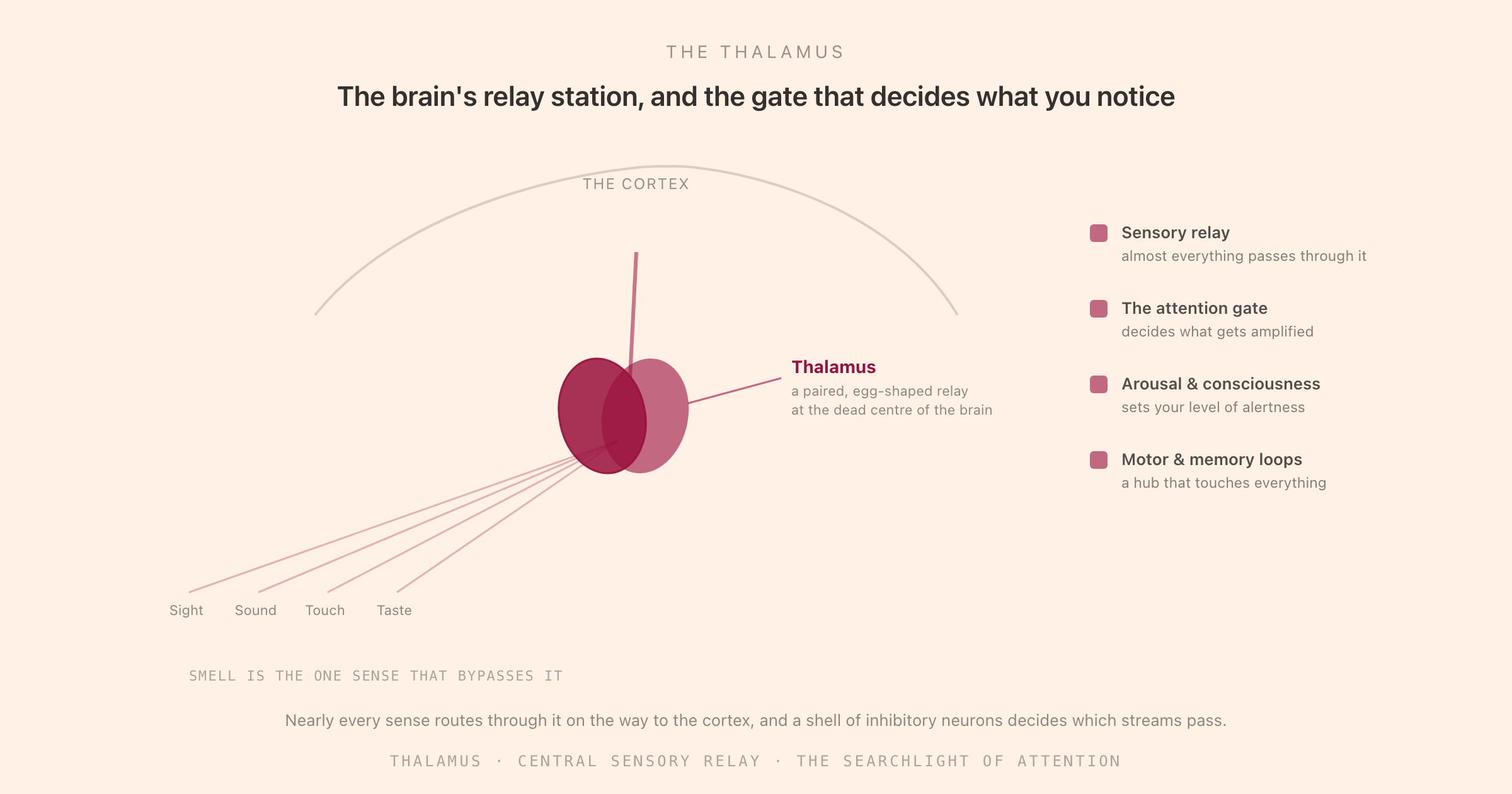
The thalamus (from the Greek for "inner chamber") is a pair of egg-shaped masses of grey matter sitting at the very centre of the brain, one in each hemisphere, just above the brainstem and beneath the cortex. Each is about the size of a walnut, and together they form the hub through which most of the brain's traffic flows. It is part of a region called the diencephalon, sitting directly below the great folded sheet of the cortex it serves.
Its headline job is to be the brain's sensory relay. With one famous exception, every sense routes its signals through the thalamus before they reach the cortex for conscious processing: vision, hearing, touch, taste, and balance all synapse here first and are then forwarded to the right part of the cortex. The single exception is smell, which has its own ancient pathway straight to the cortex and is the only sense that bypasses the thalamus, a quirk of evolutionary history that explains why smell is so directly and strangely tied to memory and emotion.
Where Is the Thalamus?
The thalamus location is dead centre: deep in the middle of the brain, sitting on top of the brainstem and surrounded by the cortex above and to the sides. Its central position is the whole point. Because nearly every sensory pathway and many cortical circuits have to pass through or near it, the thalamus is perfectly placed to act as a hub, a junction that connects the sensory world coming in, the cortex doing the thinking, and the arousal systems of the brainstem setting the overall level of alertness. Damage to the thalamus is serious precisely because so much converges there; it can disrupt sensation, movement, consciousness, and memory at once.
What Does the Thalamus Do?
The thalamus has several jobs, and they are more interconnected than a simple "relay station" suggests.
Sensory relay
This is the core function. The thalamus receives sensory signals from the body and the sense organs, processes and organises them, and forwards them to the appropriate sensory cortex. It is not a passive wire: it actively regulates the flow, which is the key to its role in attention.
The attention gate
Wrapped around the thalamus is a thin shell of inhibitory neurons called the thalamic reticular nucleus, and it is one of the most important structures in the whole science of focus. Francis Crick called it the brain's "searchlight of attention." The reticular nucleus can selectively turn down the signals passing through the thalamus, suppressing the streams you are not attending to and letting the ones you are attending to pass through amplified. In other words, when you focus on a conversation in a noisy room and the surrounding chatter fades, that fading is partly the thalamic gate doing its work. Attention is not just the cortex choosing; it is the thalamus filtering, under the cortex's direction.
Arousal, consciousness, and the reticular activating system
The thalamus also helps set your overall level of wakefulness and alertness, working with the brainstem's reticular activating system (the network that controls arousal and the sleep-wake cycle). The thalamus is a key relay in this system, which is why thalamic activity tracks so closely with states of consciousness: highly active and gating finely when you are alert and focused, and shifting into a very different mode during sleep. A focused, alert brain and a drowsy one are partly a story about what the thalamus is doing.
Motor and memory loops
Finally, the thalamus is a relay in the brain's motor circuits (coordinating with the basal ganglia and cerebellum to smooth movement) and in memory circuits, with parts of it tied closely to the hippocampus. It is a hub, so it touches almost everything.
The Thalamus and Focus: Turning the World Down
Here is why the thalamus matters for getting work done. We usually picture attention as a spotlight the mind shines on what it chooses. That is half right, but it misses the other half: attention is also a gate that turns down everything else. And a large part of that turning-down happens at the thalamus.
When you concentrate, the cortex sends signals back down to the thalamic reticular nucleus, in effect instructing the gate on what to let through. The relevant stream (the page, the code, the conversation) is passed up amplified; the irrelevant streams (the hum of the room, the notification you are trying to ignore, your own restlessness) are suppressed before they ever reach conscious awareness. Deep focus, experienced from the inside as the world going quiet around the one thing you are doing, is partly this gate clamping down on competing inputs.
This reframes distraction in a useful way. A distraction is not a moral failure of willpower; it is a signal that made it through the gate when you wanted it kept out. Some of that is unavoidable (a genuinely loud, novel, or threatening signal is designed to break through, which is why a sudden noise grabs you), but a lot of it is about the conditions you set. Every time you allow a new input into your environment (an open tab, a buzzing phone, a visible inbox) you hand the gate another stream it has to actively suppress, and its capacity to suppress is finite. The practical move is not to white-knuckle your focus but to reduce what the gate has to filter in the first place: fewer inputs, a quieter channel, one task. That is the same logic behind protecting attention so the prefrontal cortex is not spending its limited resources fighting temptation, seen one layer lower in the brain.
What This Means in Practice
The thalamus is not something you consciously control, but you can work with how it operates.
- Cut the number of competing streams. The gate suppresses distractions, but each open input costs it effort. A single-task environment is not just tidier; it asks less of the filter. Close the tabs, hide the phone, pick one channel.
- Protect arousal. Because the thalamus sets alertness in concert with the reticular activating system, a tired or under-slept brain gates poorly: everything feels more distracting because the filter is running down. Sleep is upstream of attention here, as it is everywhere.
- Use a steady, low-information sound channel. A consistent background sound (rather than silence punctuated by unpredictable noises) gives the gate less to react to, since novelty and sudden change are exactly what break through. This is part of why steady focus audio can help: it does not boost the brain so much as it lowers the number of surprises the thalamus has to handle.
- Let one thing be loud. Focus is a contrast effect. The clearer the single signal you want, and the quieter everything else, the easier the gate's job. Engineer the contrast and the thalamus does the rest.
The Bottom Line
The thalamus is the brain's central relay and gatekeeper: the walnut-sized pair of structures at the core through which nearly all sensory information passes on its way to the cortex, and where a shell of inhibitory neurons, the "searchlight of attention," decides what gets amplified and what gets turned down. Focus, from the inside, is what it feels like when that gate is working well: the world goes quiet and one thing comes through clearly. You cannot command the thalamus directly, but you can stop overloading it, by cutting competing inputs, protecting sleep and arousal, and letting a single signal stand out against a calm background.
That is the entire design goal of a protected focus block: give the gate one clear thing to pass and as little as possible to suppress. Tomatoes is built to make that block easy to start and easy to hold, so your attention has a clean channel to run on. It is free for 3 days, then $4.99/week, $29.99/year, or $39 lifetime. Turn the world down, and let one thing through.