The cerebellum is the part of your brain that turns clumsy, effortful actions into smooth, automatic ones. It is the tightly folded structure tucked under the back of your brain, and although it makes up only about a tenth of the brain's volume, it contains more neurons than all the rest of the brain put together. Its classic job is coordination: making movement precise, balanced, and well-timed. But its deeper gift, the one that matters for anyone trying to get good at something, is automation. The cerebellum is how practice turns a skill you have to think about into one you can simply do, freeing your conscious attention for everything else. If yesterday's basal ganglia are the brain's habit engine, the cerebellum is its skill-refining, fine-tuning machine. This is what the cerebellum does, how muscle memory works, and why it matters for focus.
Understanding the cerebellum reframes what practice is really for. Every skill you automate, from typing to reading to the routine of starting work, is a skill the cerebellum and basal ganglia now run for you, so your limited conscious attention is spent on the hard, novel parts instead. Tomatoes is built to protect that conscious attention for the work that genuinely needs it, while your automated skills carry the rest. The app is free for 3 days, then $4.99/week, $29.99/year, or $39 lifetime.
What Is the Cerebellum?
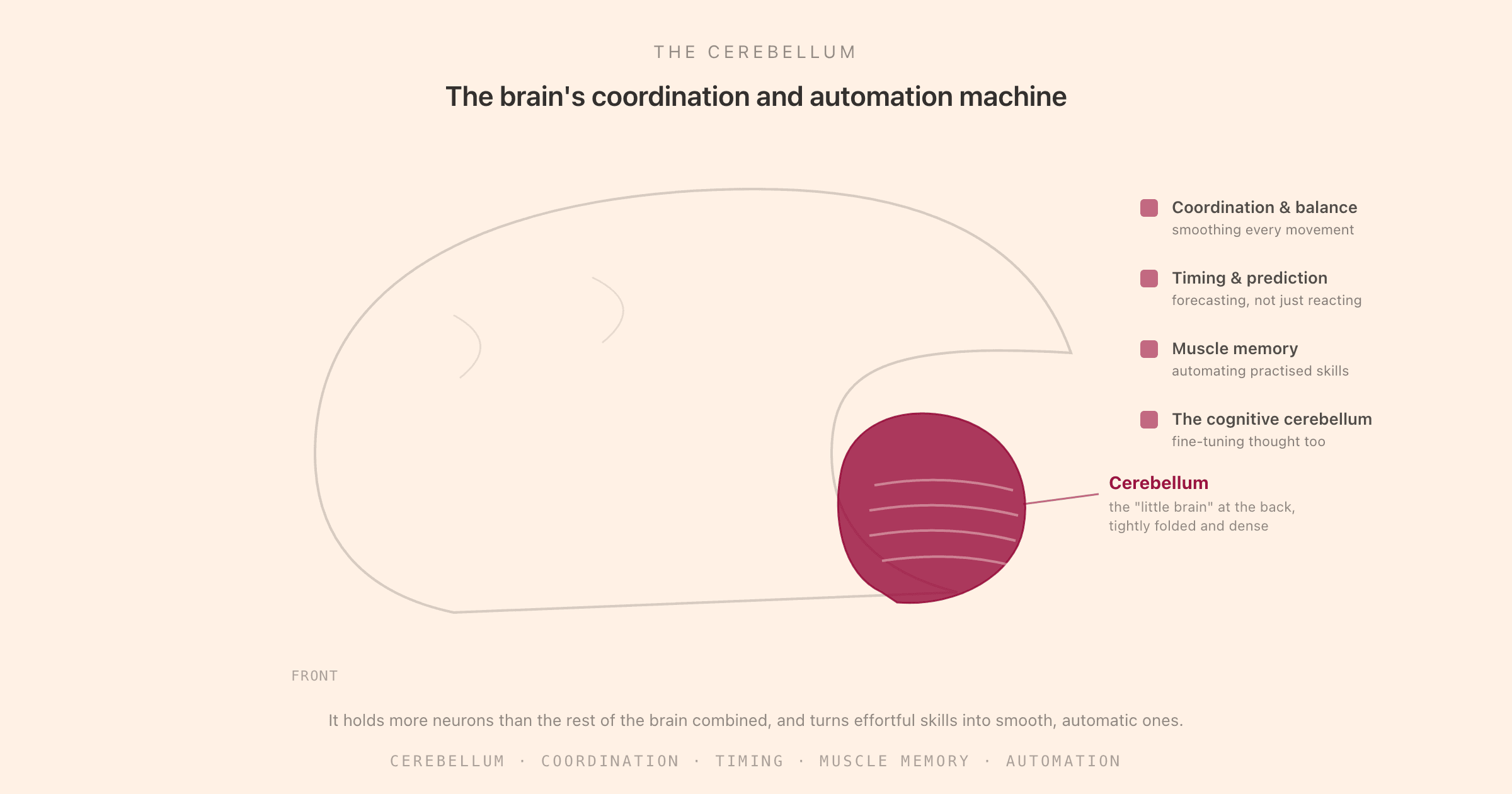
The cerebellum (Latin for "little brain," which it resembles) is a distinct structure sitting beneath the back of the cerebral cortex, behind the brainstem. It looks like a smaller, more tightly pleated version of the main brain, and those dense folds pack in an astonishing number of cells: the cerebellum holds roughly three-quarters of all the neurons in the brain, despite its small size. That density is a clue to what it does. It is a high-resolution processor for fine, precise, well-timed control.
Its classic and best-understood job is the coordination of movement. The cerebellum does not usually initiate movement (that starts elsewhere, in the motor cortex and basal ganglia); instead, it refines it. It takes the rough command "reach for the cup" and smooths it into an accurate, graceful motion, constantly comparing what you intended to do with what your body is actually doing and correcting the difference in real time. This is why damage to the cerebellum does not cause paralysis but clumsiness: movements become jerky, poorly timed, and inaccurate, a condition called ataxia. The cerebellum is the difference between a stiff, halting action and a fluid one.
Where Is the Cerebellum?
The cerebellum location is low and at the back: it sits at the base of the skull, underneath the occipital lobes of the cerebral cortex and behind the brainstem, to which it is connected by thick bundles of nerve fibres. That position lets it sit in the loop between the body and the brain, receiving a constant stream of information about where your limbs are and what your senses are reporting, and sending back the fine corrections that keep movement smooth and balanced. Its connection to the brainstem and spinal cord is why it is so central to balance and posture, and why alcohol, which affects the cerebellum, produces exactly the unsteady, uncoordinated movements of someone who has had too much to drink.
What Does the Cerebellum Do?
The cerebellum's jobs all share a theme: making things precise, timed, and automatic.
Coordination, balance, and fine motor control
This is the core function: smoothing and coordinating voluntary movement, maintaining balance and posture, and enabling fine motor skills like writing, playing an instrument, or threading a needle. It works by error correction, continuously comparing intended movement against actual movement and adjusting.
Timing and prediction
The cerebellum is the brain's master of timing. Precise timing is essential to coordinated movement, but it turns out to matter for much more, and the cerebellum acts as a prediction machine, anticipating the sensory consequences of actions so the brain can act ahead of events rather than just reacting to them. This predictive timing is part of why a practiced movement feels so smooth: the cerebellum is forecasting, not just reacting.
Muscle memory and procedural skill
Here is the function that matters most for learning. When you practise a skill, the cerebellum (working with the basal ganglia) gradually takes it over and automates it. This is the basis of muscle memory and procedural memory, the "knowing how" that lets you ride a bike, touch-type, or play a chord without conscious thought. The skill becomes encoded as an automatic motor program the cerebellum can run with little oversight, which is why a well-practised action feels effortless and why you can do it while your conscious mind is elsewhere.
The cognitive cerebellum
For most of history the cerebellum was thought to be purely about movement. That view is changing. A growing body of research shows the cerebellum is also involved in cognition: in language, attention, and the timing and smoothing of thought the same way it smooths movement. The idea of the "cognitive cerebellum" is that it applies its one trick, fine-tuning and automating sequences, not just to physical actions but to mental ones, which is why it connects to the thinking parts of the cortex far more than a pure movement structure would need to.
Muscle Memory: How Practice Makes Things Effortless
The single most useful idea the cerebellum gives us is what "muscle memory" actually is. There is no memory in your muscles; the memory is in your brain, much of it in the cerebellum. When you repeat a skill, the cerebellum refines the motor program for it, smoothing out the errors a little more each time, until the action becomes fast, accurate, and automatic.
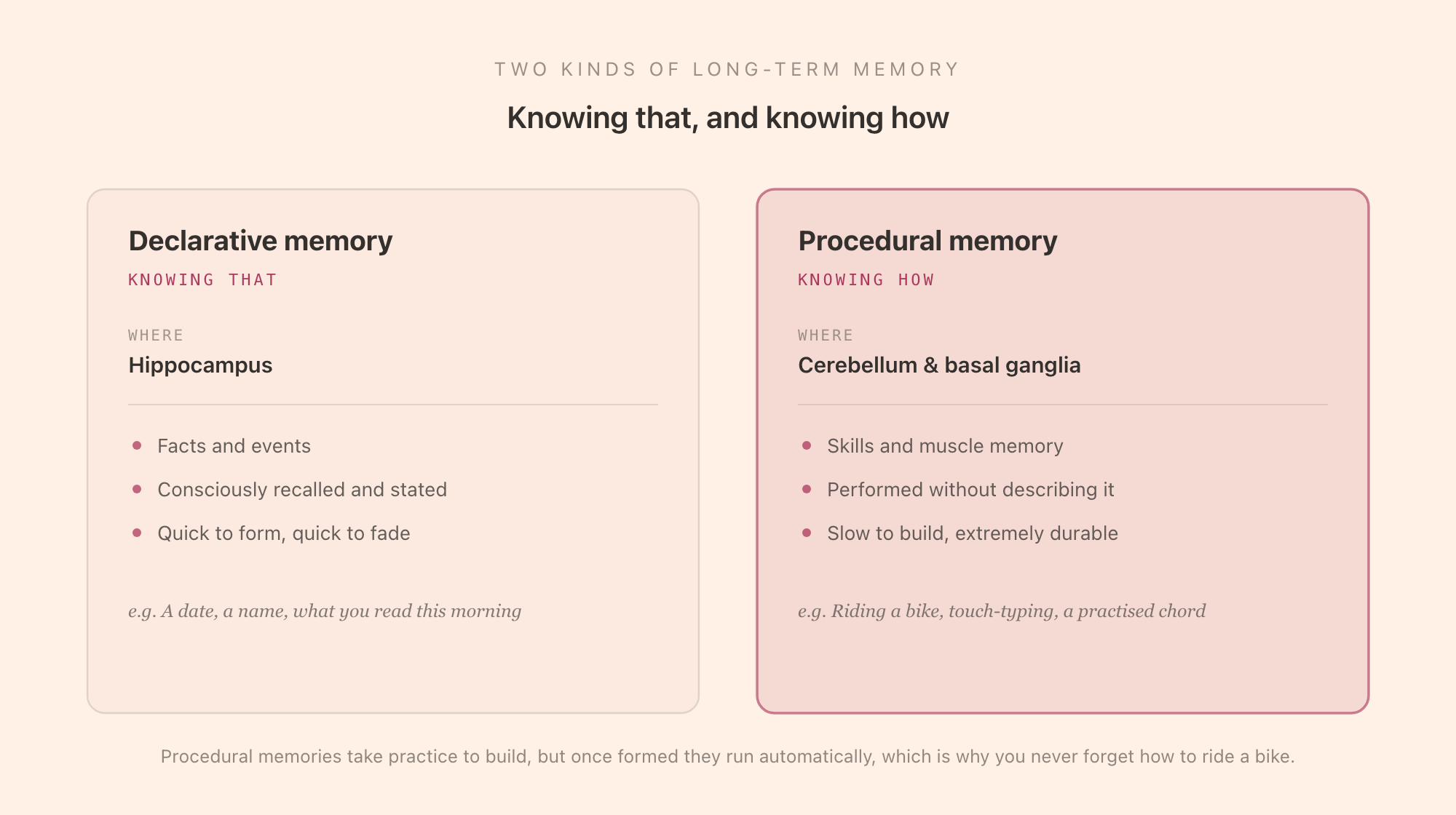
This is a different memory system from the one that stores facts. Psychologists distinguish two broad kinds of long-term memory:
- Declarative memory is "knowing that": facts and events you can consciously recall and state, like a date or what you had for breakfast. This is the domain of the hippocampus.
- Procedural memory is "knowing how": skills and actions you perform without being able to fully describe them, like riding a bike or typing. This is the domain of the cerebellum and basal ganglia.
The two behave very differently. Declarative memories are quick to form and quick to fade; procedural memories are slow to build (they need lots of practice) but extraordinarily durable once formed, which is why you never forget how to ride a bike even after decades. It is also why massed cramming works poorly for skills: motor learning, like the spaced learning that builds lasting facts, is consolidated over time and sleep, so distributed practice beats a single marathon session.
Why This Matters for Focus
The cerebellum's gift to focus is the same one the basal ganglia give: automation frees attention. Conscious attention, run by the prefrontal cortex, is scarce and effortful. Every skill the cerebellum automates is one less thing you have to consciously control, which is exactly why a beginner finds a task exhausting and an expert finds the same task easy: for the expert, most of it has been handed to automatic systems, leaving conscious attention free for the genuinely hard parts.
This is the deep reason practice matters beyond just "getting better." When you practise the mechanics of your work until they are automatic, you are offloading them from your limited conscious attention onto the cerebellum and basal ganglia, which frees that attention for higher-level thinking. The expert writer is not consciously forming letters; the expert coder is not thinking about syntax. They have automated the basics, so their focus is spent where it counts. The goal of deliberate practice is partly to keep moving the routine parts of a skill into automatic systems, so your conscious mind always has room for the edge of your ability.
The Bottom Line
The cerebellum is the brain's coordination and automation machine: the densely folded structure at the back of the brain that smooths movement, masters timing and prediction, and turns practised skills into automatic muscle memory, and that increasingly turns out to fine-tune thought as well as action. Its lesson for anyone trying to get good at something is that practice physically moves a skill out of effortful conscious control and into an automatic system, where it runs smoothly and frees your attention for the rest. Build the automatic foundations, and your focus is freed for the work that actually needs it.
That is the point of protecting your attention in the first place: spend it on the hard, novel edge of your work while your automated skills carry the routine. Tomatoes is built to guard those focused blocks, so your limited conscious attention goes where it matters. It is free for 3 days, then $4.99/week, $29.99/year, or $39 lifetime. Automate the basics, and focus on what is left.