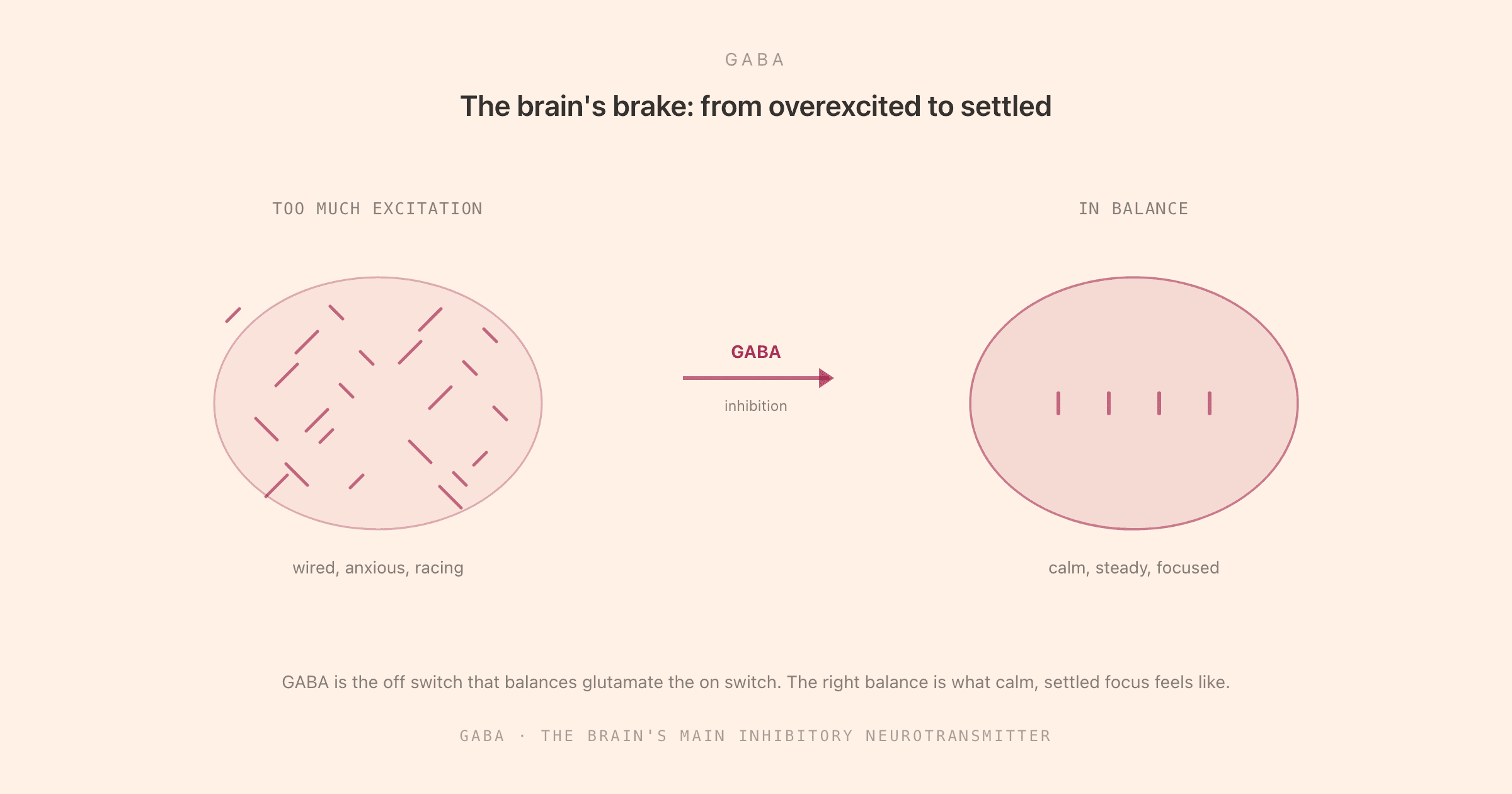
GABA is the brain's main "off switch." Where glutamate is the excitatory neurotransmitter that makes neurons fire, GABA is its opposite: the main inhibitory neurotransmitter, the signal that tells neurons to quieten down. It is what stops the brain from running away with itself. Without enough inhibition, neural activity spirals into overexcitation, the state that, taken to its extreme, becomes a seizure, and in milder forms feels like anxiety, racing thoughts, and the inability to settle. With it, the brain can be calm, steady, and focused. The balance between GABA and glutamate is one of the most fundamental things about how a brain works, and it has a lot to do with whether you feel wired or settled. This is what GABA is, what it does, and the honest truth about trying to boost it.
Understanding GABA reframes what calm focus actually is: not the absence of activity but the right balance of excitation and inhibition, an engaged brain that can also be quietened. Tomatoes is built to support that settled, low-distraction state where focus comes easily, the conditions a well-balanced brain needs. The app is free for 3 days, then $4.99/week, $29.99/year, or $39 lifetime.
What Is GABA?
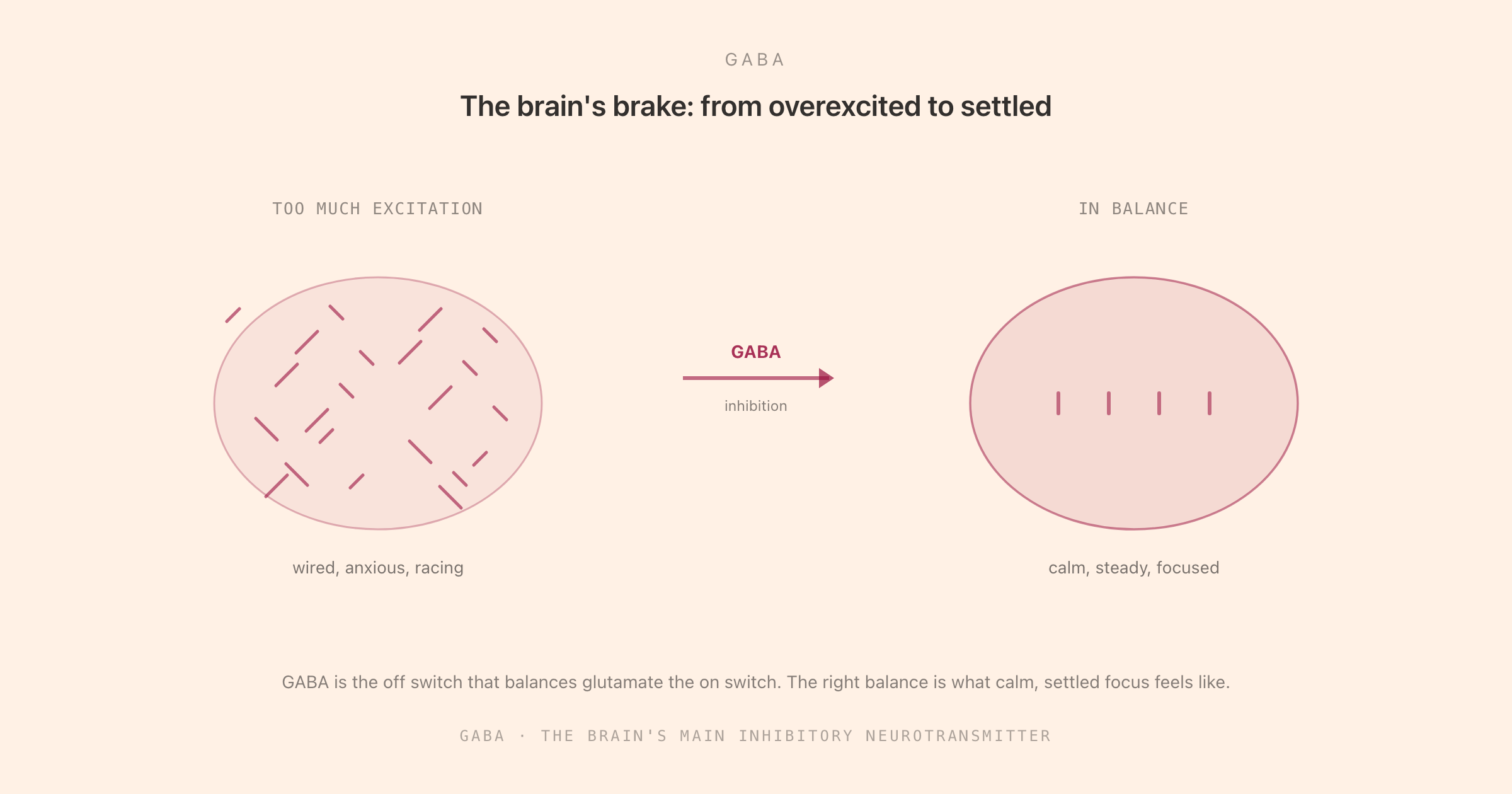
GABA (gamma-aminobutyric acid) is the brain's principal inhibitory neurotransmitter. "Inhibitory" means that when GABA is released onto a neuron, it makes that neuron less likely to fire, dampening activity rather than spreading it. It is the counterweight to glutamate, and between them these two molecules handle the great majority of fast signalling in the brain: glutamate exciting, GABA inhibiting. Roughly speaking, glutamate is the accelerator and GABA is the brake, and the brain needs both.
This braking role is not a minor housekeeping function; it is essential. A brain is a vast network of cells primed to excite one another, and without strong, constant inhibition that excitation would cascade out of control. GABA provides the restraint that keeps neural activity organised, targeted, and stable. It is the reason your brain can light up the specific circuits it needs while keeping the rest quiet, which is, in a sense, exactly what focus is.
What Does GABA Do?
GABA's jobs all stem from its role as the brain's brake.
Calming and stabilising brain activity
The core function: reducing neuronal excitability across the brain. This is what produces a calm, regulated nervous system rather than a jittery, overstimulated one. GABA keeps the overall level of activity in a healthy range, preventing the runaway excitation that would otherwise occur.
Reducing anxiety and promoting relaxation
Because it dials down overactivity, GABA is strongly associated with calm and reduced anxiety. When GABA signalling is working well, it is easier to feel relaxed and settled; when it is low or impaired, the brain tilts toward the overexcited, anxious end of the spectrum. This is why the GABA system is the target of many anti-anxiety treatments.
Supporting sleep and focus
A brain that cannot quieten cannot sleep, and GABA is central to the transition into rest. It is also part of focus, perhaps counterintuitively: concentrating on one thing means inhibiting the pull of everything else, and that suppression of competing activity relies on inhibition. A calm, well-regulated brain focuses better than an overexcited one.
Maintaining the excitation-inhibition balance
Most fundamentally, GABA holds up its half of the brain's excitation-inhibition (E/I) balance with glutamate. That balance is the thing that actually matters: too much excitation relative to inhibition produces anxiety, restlessness, and at the extreme seizures; too much inhibition produces sedation and sluggishness. Health and steady focus live in the balance, not at either extreme.
How Things Act on GABA: Alcohol and Anxiety Drugs
One of the clearest ways to understand GABA is to see what enhances it. Several of the most familiar sedating substances work by boosting GABA's inhibitory effect.
- Alcohol enhances GABA activity (and dampens glutamate), which is a large part of why it is sedating, relaxing, and, in excess, impairing: it is turning up the brain's brake and turning down its accelerator at once.
- Benzodiazepines, the class of anti-anxiety and sedative drugs, work directly on the GABA system, amplifying GABA's calming signal. That is why they reduce anxiety and induce sleep, and also why they carry risks of dependence.
The lesson is not to reach for any of these, but to notice what it tells you: calm, sedation, and reduced anxiety are, at the chemical level, largely a story about increasing inhibition. That points to gentler, sustainable ways to support the same balance.
The GABA Supplement Myth (and What Actually Helps)
Because GABA is associated with calm, GABA supplements are widely sold with promises of relaxation and better sleep. Here the science calls for honesty: GABA taken as a supplement does not easily cross the blood-brain barrier, the protective filter around the brain. The GABA in a pill largely cannot get into the brain to act as the neurotransmitter directly, which is why the evidence for oral GABA supplements having a meaningful direct effect on brain GABA is weak and contested. Some reported effects may come from GABA acting on the nervous system outside the brain, or from placebo, but the simple picture of "swallow GABA, raise brain GABA" does not hold up.
What does genuinely support a healthy GABA system and a good excitation-inhibition balance is less exciting but better evidenced:
- Sleep. The brain regulates its E/I balance partly through sleep; poor sleep tilts it toward overexcitation.
- Exercise. Regular physical activity is associated with healthier GABA signalling and lower anxiety.
- Managing chronic stress. Long-term stress and high cortisol disrupt the balance; protecting against chronic stress protects inhibition.
- Calming practices. Slow breathing, meditation, and similar practices shift the nervous system toward the calmer, more inhibited state.
The theme, as with the rest of brain chemistry, is that balance beats boosting. The goal is not to flood the brain with one molecule but to support the conditions in which its own systems stay in proportion.
Why This Matters for Focus
The deep point is that good focus is not pure excitation; it is balance. You need enough glutamate-driven activity to engage with the work, and enough GABA-driven inhibition to suppress everything else and stay calm enough to think. An overexcited brain, tilted too far toward excitation, is the anxious, scattered, can't-settle state that makes focus impossible, however motivated you are. A brain in good E/I balance can light up what it needs and quieten the rest.
This reframes a lot of focus struggles as balance problems rather than effort problems. When you cannot concentrate because your mind is racing, the issue is often too little inhibition, not too little willpower, and the answer is to lower the arousal (through sleep, calm, fewer inputs) rather than to push harder. The calm that lets you focus and the calm that GABA provides are, at bottom, the same thing.
The Bottom Line
GABA is the brain's main inhibitory neurotransmitter, the brake that balances glutamate's accelerator and keeps neural activity from spiralling into overexcitation. It underlies calm, lower anxiety, sleep, and the settled state that good focus needs, and its balance with glutamate, the excitation-inhibition balance, is what actually determines whether you feel wired or steady. The honest take on raising it is that supplements largely cannot cross into the brain, and that the real levers are sleep, exercise, lower chronic stress, and calming practices. Balance, not boosting, is the goal.
That is the case for a calm, protected focus environment: it supports the balance in which concentration comes naturally, instead of fighting an overexcited brain with willpower. Tomatoes is built to make that calm, focused state easier to reach and hold. It is free for 3 days, then $4.99/week, $29.99/year, or $39 lifetime. Find the balance, and focus follows.