Glutamate is the brain's main "on switch." It is the most abundant neurotransmitter in your nervous system, carrying the great majority of the fast excitatory signals between neurons, and almost every thought, perception, and memory rides on it. If a brain cell tells the next one to fire, the message is usually written in glutamate. That makes it the counterpart to its great partner, GABA, the main inhibitory neurotransmitter that tells neurons to quieten down, and the balance between the two is one of the most fundamental things about how a brain works. For learning and focus, glutamate matters most for one reason: it is the molecule through which experience physically rewires the brain. This is what glutamate is, how it balances with GABA, and how it turns repeated experience into lasting memory.
Understanding glutamate reframes what learning actually is at the cellular level: not a metaphor but a physical strengthening of connections, driven by this one molecule, every time you focus on something and repeat it. Tomatoes is built to protect the focused, repeated practice that drives exactly that strengthening, so the work you concentrate on is the work that sticks. The app is free for 3 days, then $4.99/week, $29.99/year, or $39 lifetime.
What Is Glutamate?
Glutamate is an amino acid that doubles as the brain's principal excitatory neurotransmitter. "Excitatory" means that when glutamate is released from one neuron and lands on the next, it makes that next neuron more likely to fire, passing the signal along. It is responsible for the large majority of fast signalling in the brain, which is why it is sometimes described as the workhorse of the nervous system: vision, movement, thought, and memory all depend on glutamate carrying messages from cell to cell.
It is worth clearing up a common confusion straight away. The glutamate in your brain is not the same thing, in any meaningful dietary sense, as the monosodium glutamate (MSG) in food. The brain tightly controls its own glutamate and manufactures what it needs; dietary glutamate does not freely cross into the brain and flood it. The decades-old worry about MSG has not held up in careful research. The glutamate that matters here is the brain's own signalling molecule, not a seasoning.
What Does Glutamate Do?
Glutamate's jobs all flow from its role as the main excitatory signal.
Fast excitatory signalling
This is the core function: carrying the rapid, moment-to-moment signals that let neurons communicate. When you see, think, or move, networks of neurons are exciting one another through glutamate. It acts on several receptor types, of which two are worth naming: AMPA receptors, which handle the fast, ordinary transmission, and NMDA receptors, which are special, and central to learning, as we will see.
Learning and memory
This is the function that matters most. Glutamate, acting through NMDA receptors, is the molecular basis of how the brain learns. It is the mechanism behind long-term potentiation, the strengthening of connections that stores experience, which deserves its own section below.
Keeping the brain balanced with GABA
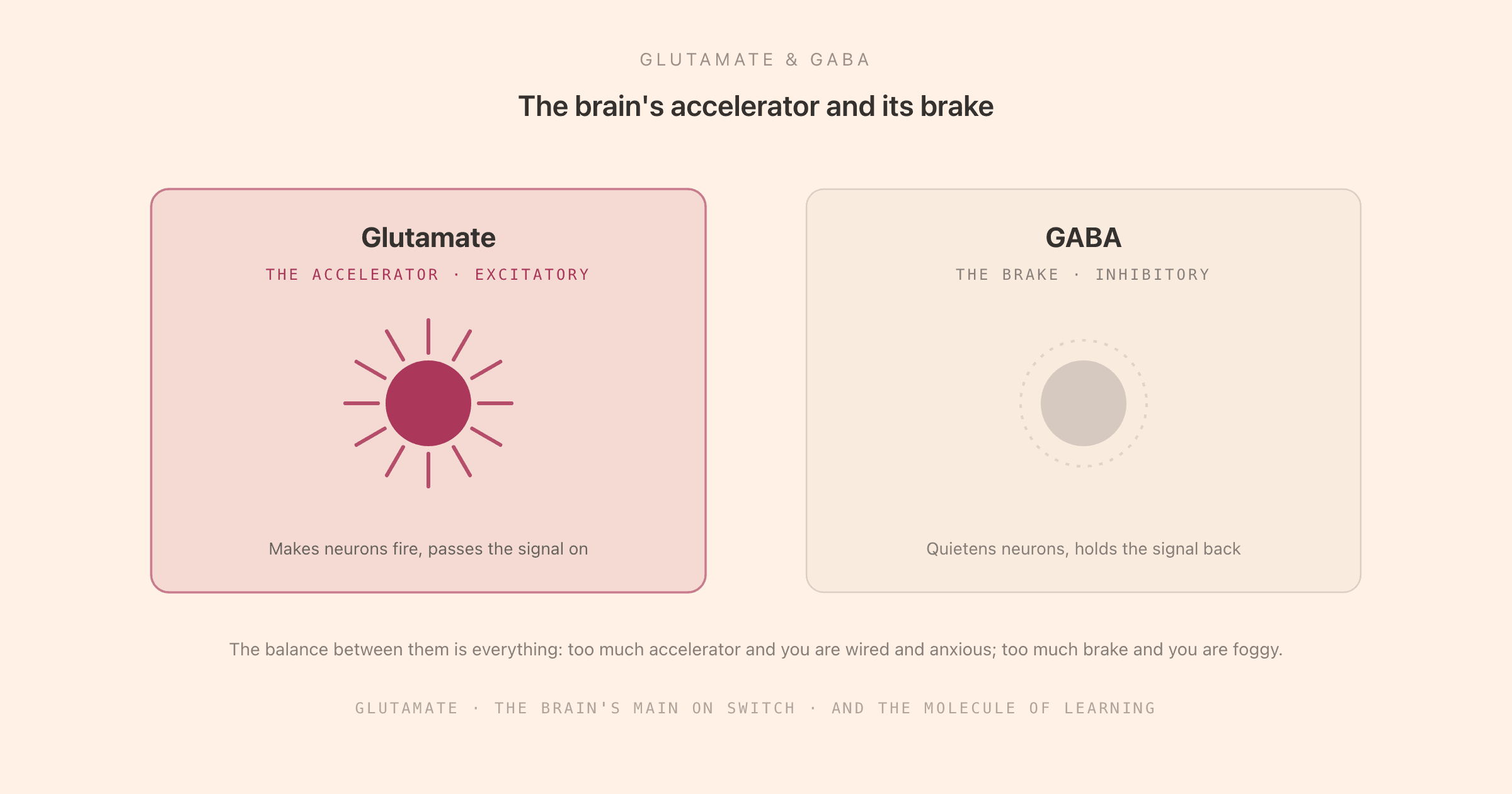
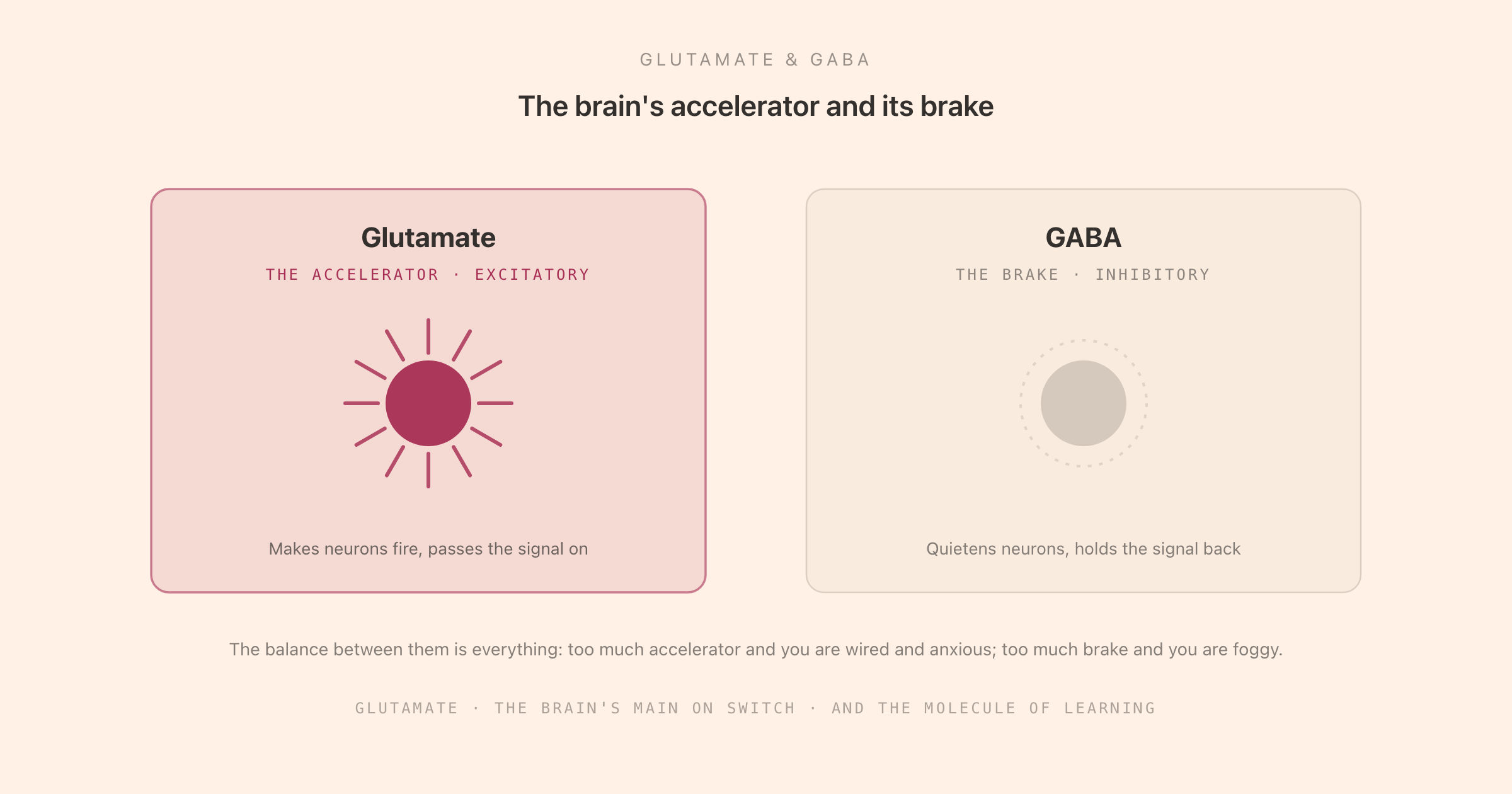
Glutamate never works alone. Its excitatory push is constantly balanced by the inhibitory pull of GABA, the brain's main calming neurotransmitter. Together they form the brain's excitation-inhibition balance, and that balance is everything: too much excitation and the system becomes overactive, anxious, even seizure-prone; too much inhibition and it becomes sluggish and underpowered. A healthy, focused brain is one where glutamate and GABA are in the right proportion, the accelerator and the brake working together.
Glutamate and GABA: The Accelerator and the Brake
The simplest way to understand glutamate is through its partnership with GABA. If glutamate is the accelerator that makes neurons fire, GABA is the brake that holds them back, and the brain depends on both.
This balance is not just a background detail; it shapes how you feel and function. When excitation runs too high relative to inhibition, the result is the wired, overstimulated, anxious state where it is hard to settle and focus. When inhibition is too strong, the result is sluggishness and mental fog. Many things that affect the brain work by nudging this balance: alcohol, for instance, enhances GABA and dampens glutamate, which is why it is sedating; and in the extreme, a runaway excess of glutamate signalling is what happens in a seizure. The goal, for steady focus, is balance, an excitable brain that can also be quietened, so attention is neither scattered by overstimulation nor dulled by too much braking.
Long-Term Potentiation: How Memories Physically Form
Here is the most important thing glutamate does, and it is the cellular heart of learning. When two connected neurons fire together repeatedly, the connection between them strengthens, so that in future, activating the first more easily activates the second. This strengthening is called long-term potentiation (LTP), and it is widely regarded as the main physical basis of learning and memory.
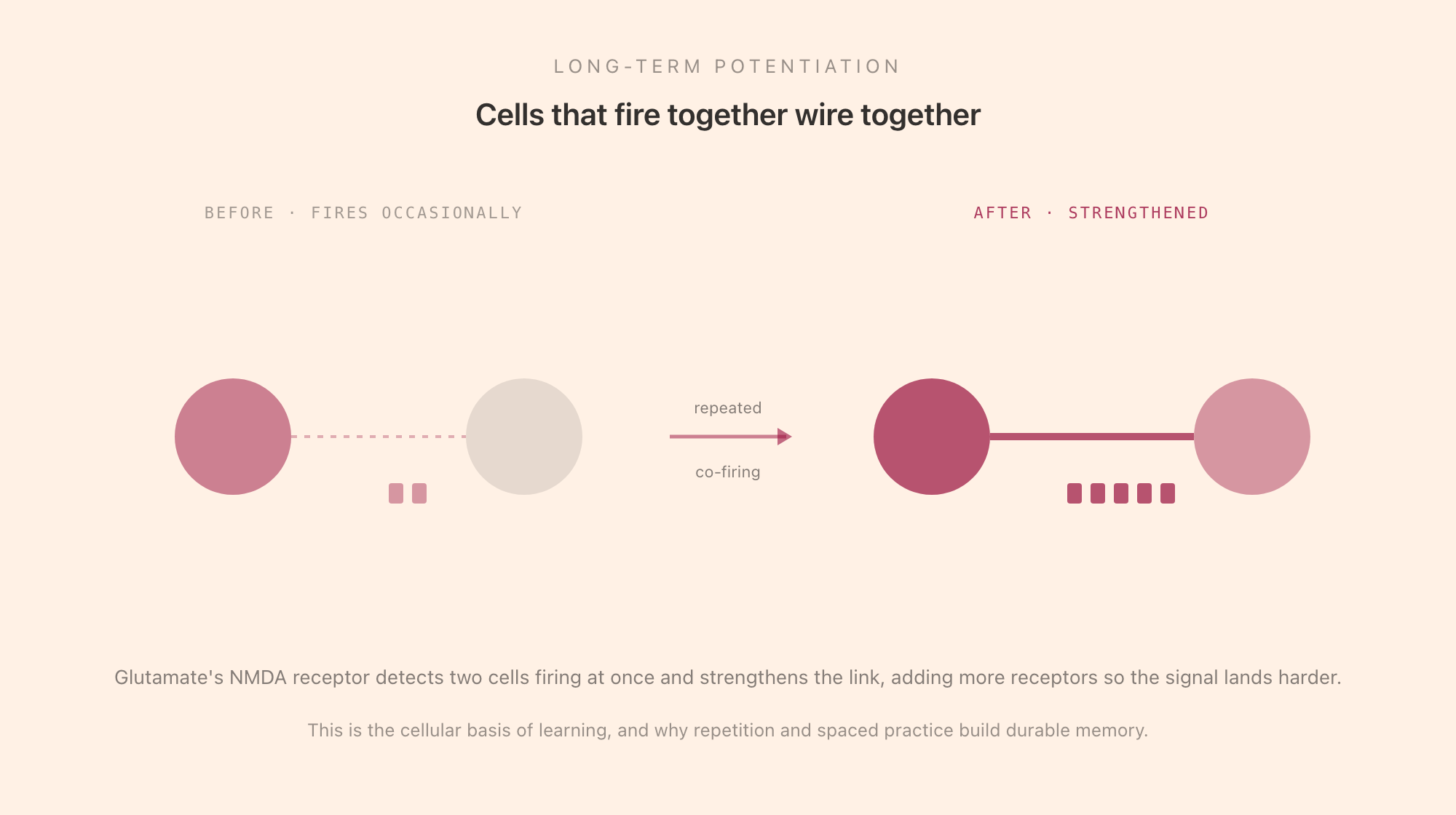
Glutamate and its NMDA receptor are the key to how this works. The NMDA receptor is a clever molecular device: it only fully opens when two things happen at once, glutamate is present and the receiving neuron is already active. In other words, it detects coincidence, the simultaneous firing of two cells, and when it fires it triggers changes that strengthen the synapse (including adding more AMPA receptors, so the same signal lands harder next time). This is the molecular machinery behind the famous slogan "cells that fire together wire together."
The practical implications are large. This is the same machinery the hippocampus uses to encode new memories, and it is why repetition and active practice build durable learning: each repetition that fires the same circuit together strengthens it a little more. It is the cellular reason that spaced repetition and active recall work, because they repeatedly reactivate a memory circuit, driving the LTP that consolidates it. When you focus on something and practise it, you are, quite literally, using glutamate to rewire your brain.
The Dark Side: Excitotoxicity
Glutamate's power to excite neurons is also its danger. Because it makes neurons fire, too much glutamate is harmful: an excess overstimulates neurons until they are damaged or die, a process called excitotoxicity. This is part of what causes brain-cell death in events like strokes and head injuries, and it is implicated in several neurological diseases. The brain works hard to prevent it, rapidly clearing glutamate from synapses after each signal so it cannot accumulate.
This is a useful reminder that "more" is not better with brain chemistry. The whole system is built around balance and tight control: enough glutamate to learn and think, cleared quickly enough to stay safe, held in check by GABA. The popular idea that you should try to "boost" a single neurotransmitter usually misses this point; what the brain wants is the right balance, not the maximum of any one signal.
Why This Matters for Focus and Learning
The big lesson of glutamate is that learning is physical, and it follows from attention and repetition. Every time you concentrate on something and engage with it repeatedly, you drive the glutamate-and-NMDA machinery that strengthens the circuits involved. Scattered, divided attention spreads that strengthening thinly across too many things; focused, repeated engagement concentrates it where you want it. This is the deep, molecular reason that focus is the precondition for learning: the rewiring only happens robustly for what you actually attend to and repeat.
It also reframes the conditions for good mental work. A brain in a healthy excitation-inhibition balance, neither overstimulated nor foggy, is one that can both fire to learn and settle to consolidate. Protecting sleep, managing stress, and working in focused, repeated blocks all support that balance and the learning it enables.
The Bottom Line
Glutamate is the brain's main excitatory neurotransmitter, the "on switch" behind most of its fast signalling, and, through long-term potentiation and the NMDA receptor, the molecule that physically encodes learning and memory. It works in constant balance with GABA, the brain's brake, and that excitation-inhibition balance underlies whether you feel sharp, anxious, or foggy. Its lesson is that learning is a physical rewiring driven by attention and repetition, and that the brain prizes balance over excess. Focus on what matters, repeat it, and you are using glutamate to wire it in.
That is the molecular case for protected, repeated focus: it is the condition under which your brain actually rewires itself around what you practise. Tomatoes is built to guard those focused blocks, so your attention, and the learning it drives, goes where you want it. It is free for 3 days, then $4.99/week, $29.99/year, or $39 lifetime. Focus, repeat, and let the wiring follow.