Habit formation is the quiet superpower behind almost everything you do well and everything you wish you did differently. The behaviours that make up most of your day, how you start work, whether you reach for your phone in a lull, what you do when you sit down to focus, are not fresh decisions each time; they are habits, automatic responses your brain has learned to run without conscious effort. That is both the problem and the opportunity. Bad habits run on the same machinery as good ones, and once you understand how habits actually form, you can deliberately build the ones that serve you and dismantle the ones that do not.
This article explains what habit formation really is, the habit loop that drives it, how long building a habit actually takes (the popular number is a myth), and the concrete strategies for building good habits and breaking bad ones. The goal is not willpower, which is exactly the thing habits let you stop relying on, but understanding the mechanism well enough to work with it.
What Is Habit Formation?
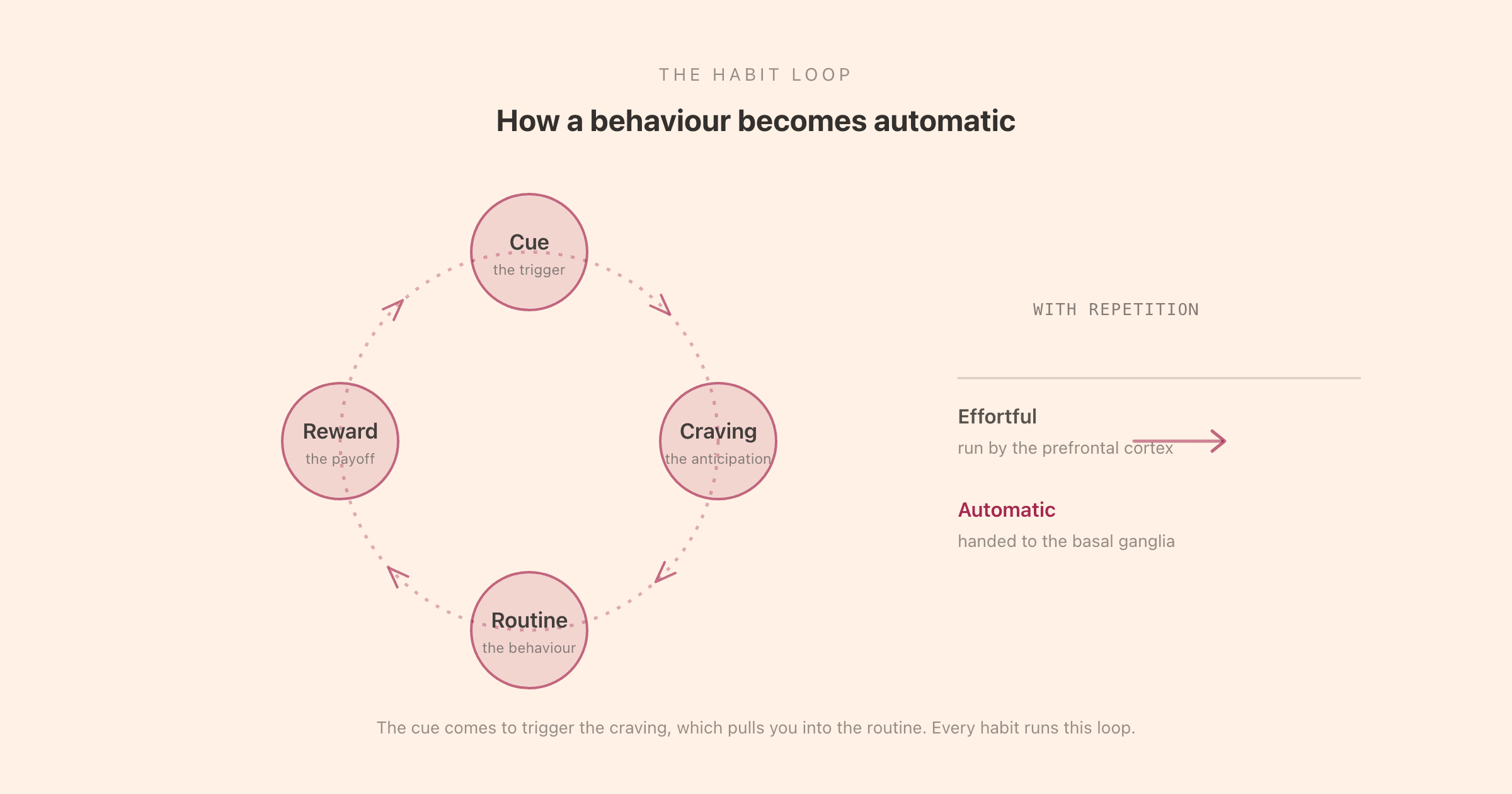
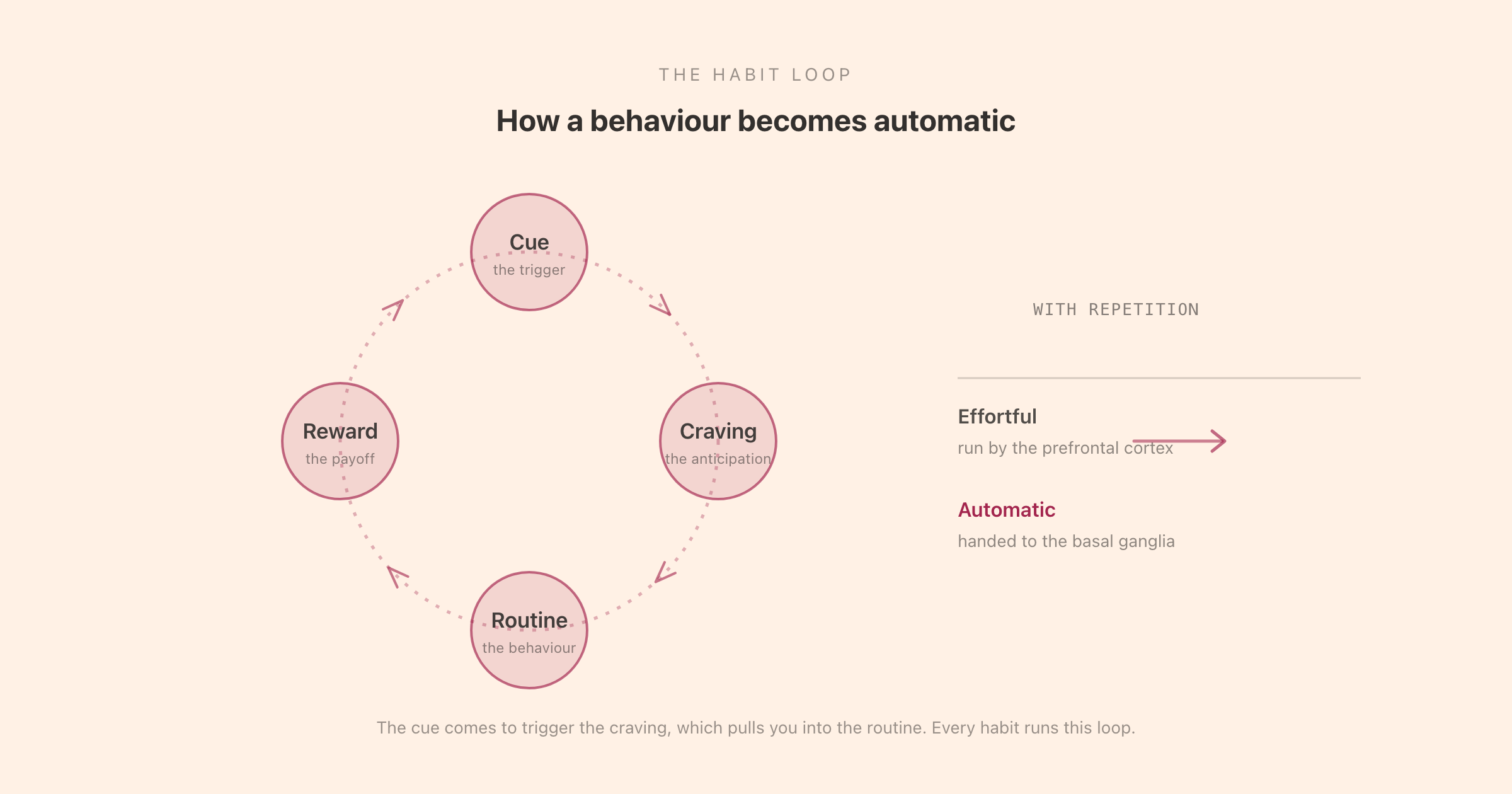
Habit formation is the process by which a repeated behaviour becomes automatic. When you first do something, it takes conscious effort and attention, run by the prefrontal cortex, the brain's deliberate, decision-making region. But when you repeat a behaviour in a consistent context, the brain gradually hands control of it to deeper, more automatic structures, chiefly the basal ganglia, so it can run with little conscious involvement. That transfer, from effortful to automatic, is habit formation.
The purpose of this is efficiency. Conscious thought is expensive and limited, so the brain automates whatever it can, freeing your attention for things that genuinely need it. A habit is the brain's way of not having to decide the same thing over and over. This is enormously useful, it is why you can drive a familiar route while thinking about something else, but it is also why bad habits are so hard to shift: they have been moved out of the realm of conscious choice and into automatic execution, running before your deliberate mind even gets involved.
Understanding this reframes the whole project. Building a habit is not about motivation or willpower in the moment; it is about repeating a behaviour consistently enough, in a stable enough context, that your brain automates it. Once it does, the behaviour stops costing you effort, which is the entire point.
The Habit Loop
Every habit runs on a simple neurological loop with three parts, plus a fourth that ties them together.
The cue is the trigger that tells your brain to start the behaviour: a time, a place, a feeling, a preceding action, or the presence of certain people. The cue is what initiates the automatic response.
The routine is the behaviour itself, the habit you actually perform, whether that is going for a run or reaching for a biscuit.
The reward is the benefit your brain gets from the behaviour, the thing that tells it this loop is worth remembering and repeating. Rewards are what drive the whole system, because the brain learns to repeat behaviours that pay off.
Binding these together is craving, the anticipation of the reward, powered by dopamine. Over time, the cue itself starts to trigger the craving for the reward, and it is that craving that pulls you into the routine. This is why you feel the urge to check your phone the moment you feel a flicker of boredom: the cue (boredom) has become linked to the craving for the reward (novelty), and the loop runs automatically. Every habit, good or bad, follows this same four-part structure, and every technique for changing habits works by targeting one of its parts.
How Long Does It Really Take?
You have probably heard it takes 21 days to form a habit. It is one of the most repeated pieces of self-improvement advice, and it is a myth. The "21 days" figure traces back to a 1960s plastic surgeon's observation about how long patients took to adjust to their new appearance, not to any study of habit formation, and it stuck because it was neat and encouraging.
The real answer comes from research by Phillippa Lally and colleagues, who tracked people forming new habits and found it took an average of about 66 days for a behaviour to become automatic. But the more important finding was the range: it varied from around 18 days to over 250, depending on the person, the behaviour, and the consistency. Simple habits automate faster than complex ones, and the more reliably you repeat the behaviour in the same context, the faster it forms.
The practical lesson is twofold. First, be patient: real habit formation takes weeks to months, not days, so do not conclude you have failed when a new habit still feels effortful after three weeks. Second, consistency matters more than intensity. Repeating a small behaviour reliably, in the same context, forms a habit faster than doing a big version of it sporadically. Missing an occasional day does not derail it, but missing regularly prevents the automation from ever taking hold.
How to Build a Good Habit
Because every habit runs on the same loop, you build good ones by deliberately engineering each part of it.
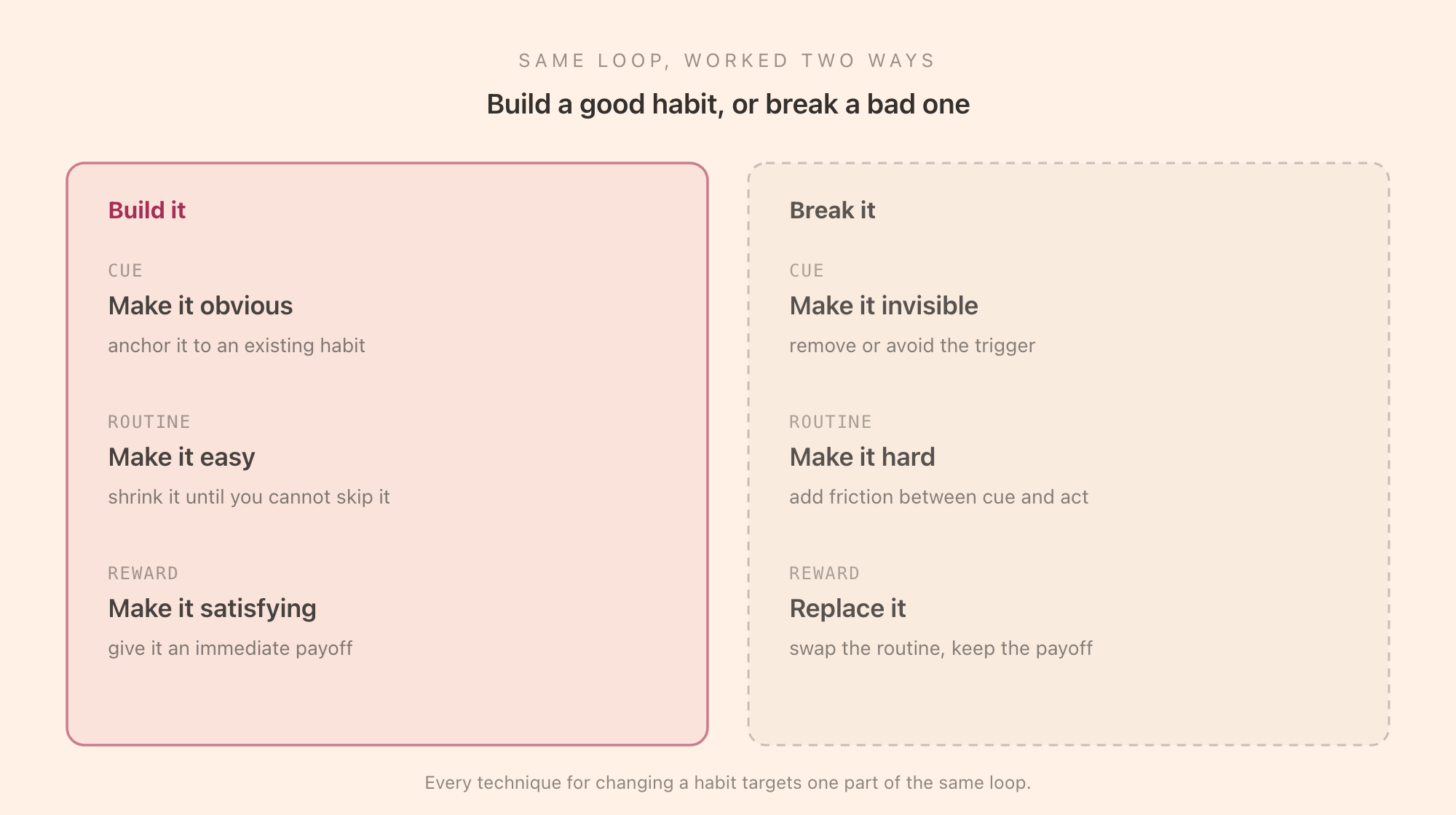
Make the cue obvious. Habits need a reliable trigger, so anchor the new behaviour to a clear, consistent cue. The most effective version is habit stacking: attaching the new habit to an existing one ("after I pour my morning coffee, I write for ten minutes"), which borrows an already-automatic cue.
Make the routine easy. The single biggest predictor of whether a habit sticks is how small and easy it is to start. Shrink the behaviour until it is almost impossible to skip, two minutes of it, one page, one set, and let consistency build it. A tiny habit done daily beats an ambitious one abandoned in a week, because the point at this stage is to groove the loop, not to achieve.
Make the reward satisfying. The brain repeats what pays off, so give the behaviour an immediate reward, even a small one, especially early on. The satisfaction is what tells your brain the loop is worth keeping, and it bridges the gap until the habit becomes its own reward.
Design the environment. Put the cue in your path and the friction on your side. Lay out the running shoes, keep the book on the pillow, and the environment does the remembering for you.
How to Break a Bad Habit
Breaking a habit uses the same loop in reverse. You rarely erase a habit outright, but you can starve it or replace it.
Make the cue invisible. Remove or avoid the trigger. If the phone on your desk cues the checking habit, put it in another room. Eliminating the cue is far easier than resisting the routine once it fires.
Make the routine hard. Add friction. Every obstacle between the cue and the behaviour gives your deliberate mind a chance to intervene, log out, delete the app, make the bad habit inconvenient.
Replace, do not just remove. A cue that reliably fires needs somewhere to go. The most durable way to break a habit is to keep the cue and reward but swap the routine for a better one that delivers a similar payoff, so the loop is redirected rather than left demanding to be fed.
Where Focus Music Fits
Focus itself is best built as a habit, and habits need a consistent cue. One of the most effective ways to make focused work automatic is to give it a reliable ritual that signals to your brain that it is time to concentrate, and sound is an ideal cue: pressing play on the same kind of focus music each time you sit down becomes a trigger your brain learns to associate with getting into work.
Tomatoes is designed to be exactly that cue: start the focus music, and over time the act of pressing play becomes the reliable signal that pulls you into a work session, turning focus from a decision you have to make into a habit that runs on its own. It is free to try for 3 days, then from $4.99 a week, $29.99 a year, or $39 for lifetime access. If you want focused work to become automatic rather than a daily battle, building it into a habit with a consistent cue is the way, and a focus ritual is a good place to start: try Tomatoes free for 3 days.
Habit formation is the closest thing there is to a cheat code for behaviour, because it lets you do the right things without having to decide to, every single time. The mechanism is not mysterious: a cue, a craving, a routine, a reward, repeated consistently until your brain takes over. Learn to engineer that loop, be patient through the weeks it takes to automate, and design your environment to do the remembering, and you can install the behaviours you want as the automatic defaults of your day, which is exactly where the good ones belong.