The vagus nerve is the most important part of your body that you have probably never thought about. While adrenaline gets all the attention as the chemical of stress and action, the vagus nerve runs the opposite system: it is the main nerve of "rest and digest," the calming counterweight that slows your heart, settles your body, and brings you back to baseline after a stressor has passed. It is, in effect, your body's brake. And because the ability to calm down, to shift out of a wired, over-aroused state and into a focused, settled one, is central to concentration, the vagus nerve turns out to matter a great deal for focus as well as for health. Understanding it is understanding how your body switches off the alarm.
This article explains what the vagus nerve is, how it forms the counterpart to the adrenaline-driven stress response, what "vagal tone" means and why it matters, how you can actually influence it, and what all of this has to do with focus. It is the other half of the story told in our guide to adrenaline: if adrenaline is the accelerator, the vagus nerve is the brake, and good functioning depends on both.
What Is the Vagus Nerve?
The vagus nerve is the longest of the cranial nerves, running from the brainstem down through the neck and chest into the abdomen, branching out to touch the heart, the lungs, the digestive system, and more. Its name comes from the Latin for "wandering," because it wanders so far and so widely through the body. It is the main nerve of the parasympathetic nervous system, the branch of your autonomic (automatic) nervous system responsible for rest, recovery, and digestion.
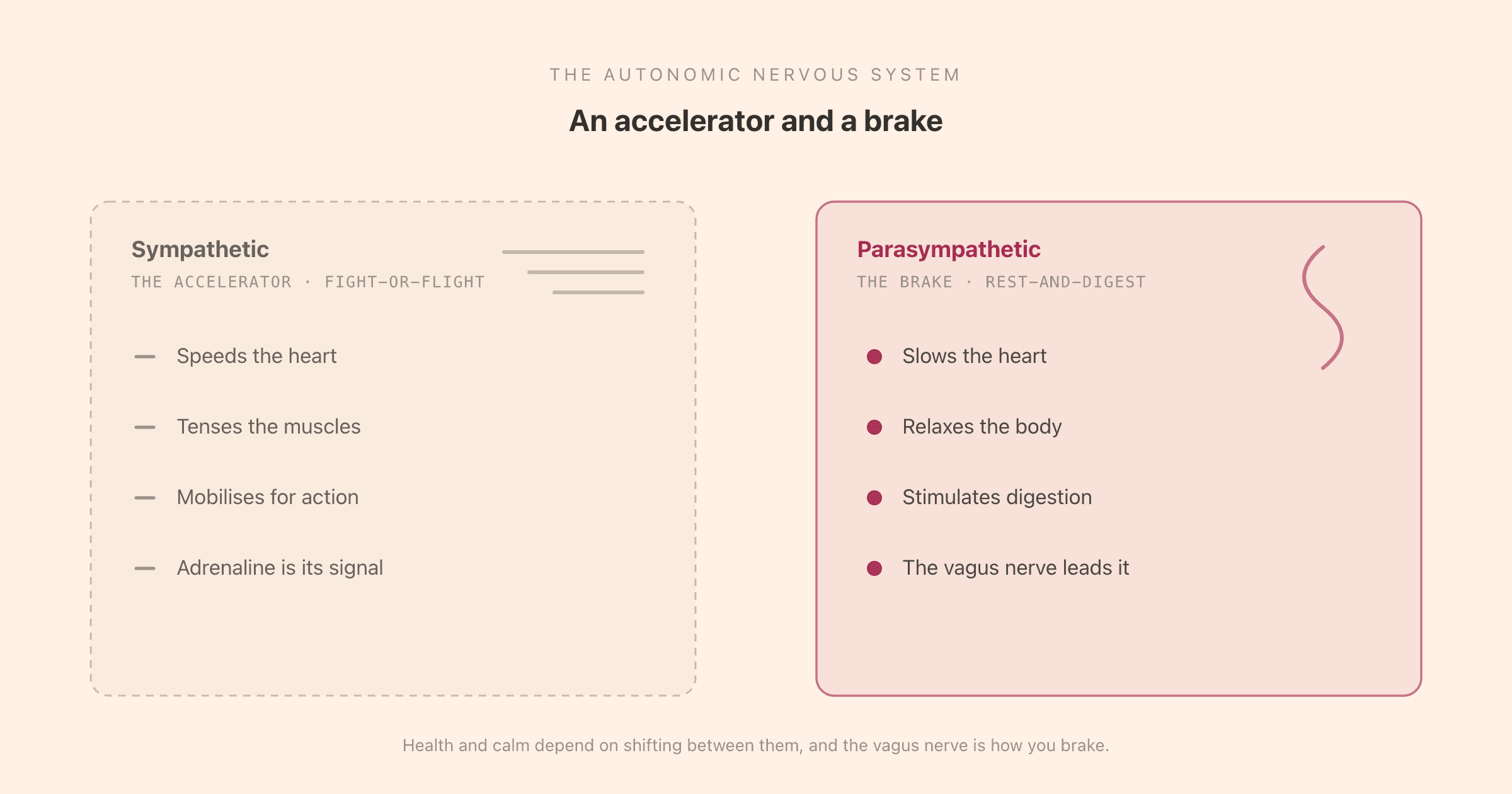
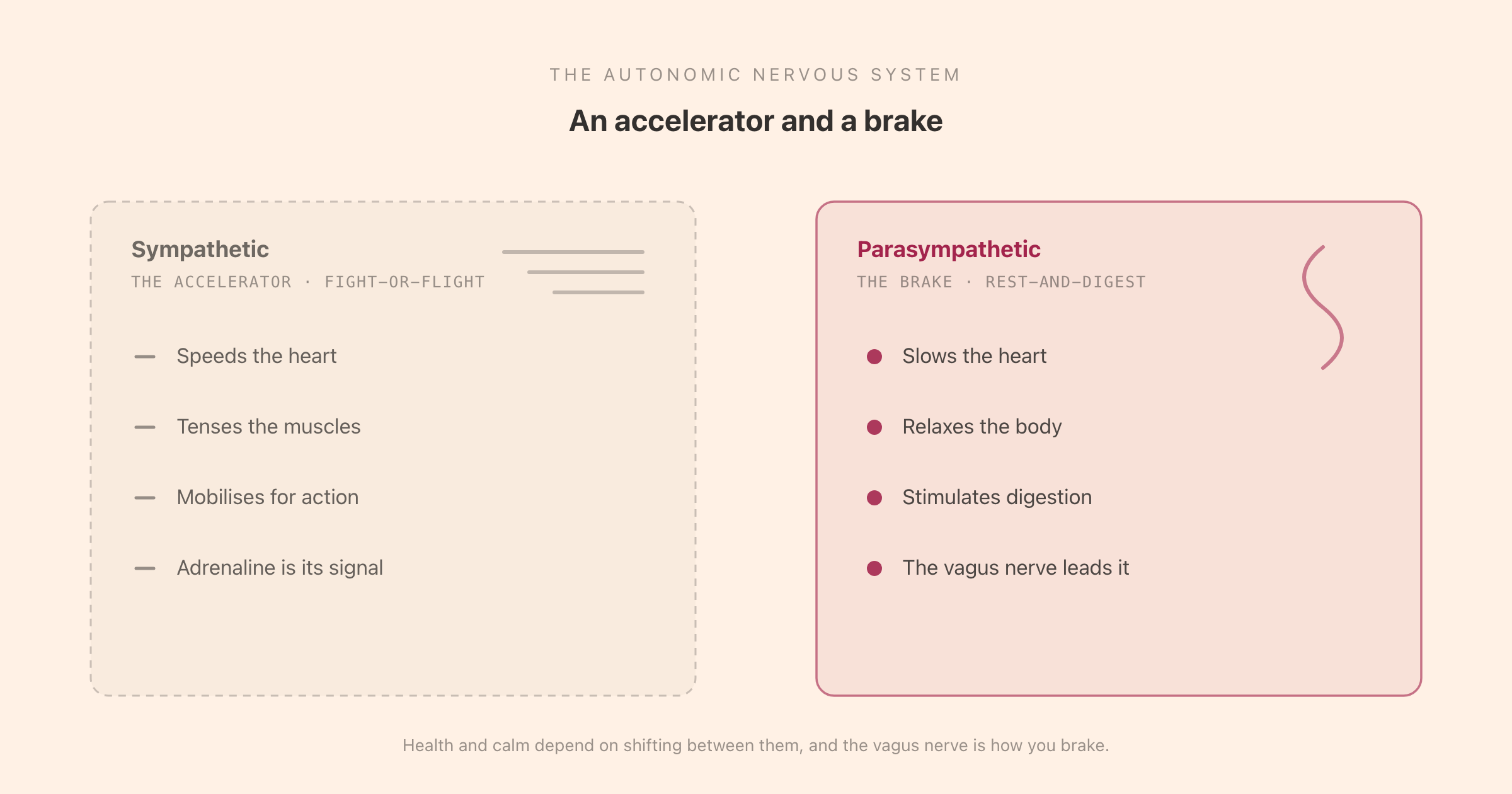
The autonomic nervous system has two opposing branches, and understanding the pair is the key to the whole thing. The sympathetic branch is the accelerator: it drives the fight-or-flight response, and adrenaline is its chemical signal, speeding the heart, tensing the muscles, and preparing the body for action. The parasympathetic branch, led by the vagus nerve, is the brake: it slows the heart, relaxes the body, stimulates digestion, and conserves energy. Where the sympathetic system spends, the parasympathetic system restores.
Your body is constantly balancing these two, and health and calm depend on being able to shift fluidly between them, ramping up when you need energy and, crucially, ramping back down when the moment has passed. The vagus nerve is the main instrument of that ramping down, the physical mechanism by which your body switches off the stress response and returns to rest.
The Brake to Adrenaline's Accelerator
The relationship between the vagus nerve and the adrenaline-driven stress response is the single most useful thing to understand about it. When a stressor hits, the sympathetic system fires, adrenaline floods in, and your body mobilises. That is appropriate and useful in the moment. But the response is only meant to be temporary, and what brings you back down afterward, slowing the racing heart, releasing the tension, calming the system, is largely the vagus nerve applying the brake.
This is why the vagus nerve matters so much in a world full of stressors that never resolve into physical action. When the sympathetic system is repeatedly or chronically activated, and the brake is not applied strongly or often enough, the body gets stuck in a state of over-arousal: wired, tense, unable to settle. Much of the physical toll of chronic stress, and the exhaustion of burnout, comes from a stress response that stays switched on because the recovery side, the parasympathetic brake, is not doing enough to switch it off. A well-functioning vagus nerve is what lets the body complete the stress cycle rather than getting stuck mid-way through it.
Vagal Tone: Why It Matters
The strength and responsiveness of your vagus nerve is often described as your "vagal tone," and it is one of the more useful concepts in this area because it can actually be measured, indirectly, through heart rate variability (HRV), the small, natural variation in the time between your heartbeats. Higher HRV generally reflects higher vagal tone: a vagus nerve that is applying the brake responsively, keeping the system flexible.
Higher vagal tone is associated with a range of good things: better emotional regulation, a greater ability to calm down after stress, more stable mood, and better recovery. People with higher vagal tone tend to be more resilient, to bounce back from stressors faster, and to shift more easily out of an anxious, activated state. Low vagal tone, by contrast, is associated with getting stuck in stress, poorer emotional regulation, and difficulty settling. The encouraging part is that vagal tone is not fixed; it responds to how you live, which means the capacity to calm yourself is, to a real degree, trainable.
The Vagus Nerve and Focus
Here is why any of this matters for concentration. Good focus is not a state of maximum arousal, it is a state of calm alertness, energised but not frazzled, the sweet spot on the arousal curve. Reaching and holding that state depends on being able to regulate your level of activation: to bring yourself up when you are flat, and, more often in modern life, to bring yourself down when you are over-aroused. That downregulation is the vagus nerve's job.
When you are anxious, scattered, and wired, heart racing at your desk, unable to settle into work, you are sympathetically over-activated, and no amount of trying to force focus will work, because the problem is physiological. What actually helps is engaging the parasympathetic brake to bring your arousal down into the focused range. A responsive vagus nerve, and the habits that support it, are therefore a direct asset to concentration: they are the mechanism by which you move from frazzled to settled, which is the precondition for deep focus.
How to Stimulate the Vagus Nerve
Because vagal tone is trainable, there are genuine, evidence-supported ways to engage and strengthen the parasympathetic brake. None are exotic, and most work by directly triggering the body's calming reflexes.
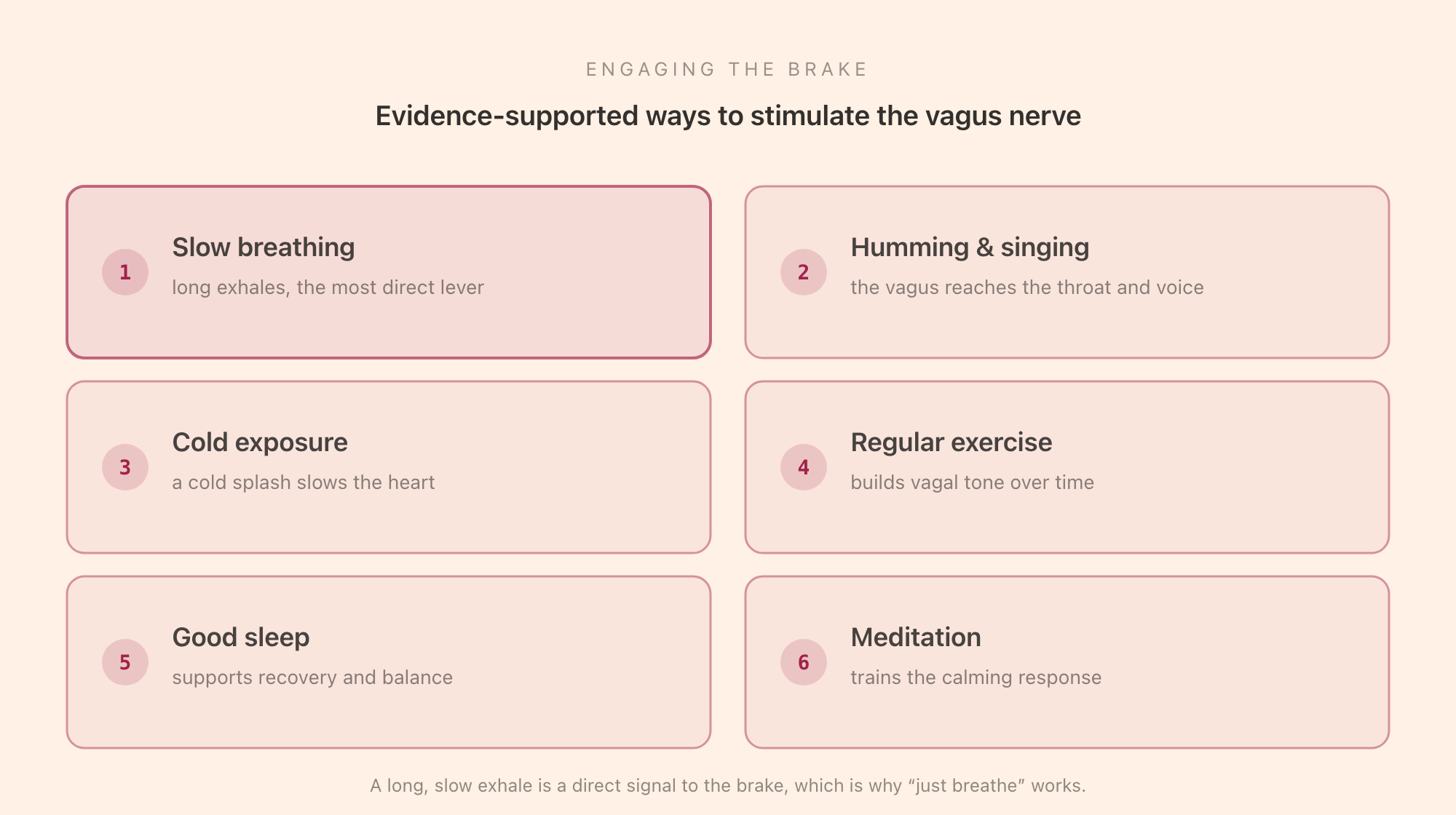
Slow breathing, especially long exhales. The most direct and best-supported lever. Slow, deep breathing, particularly extending the exhale longer than the inhale, activates the vagus nerve and shifts you toward the parasympathetic state. This is the physiological reason "just breathe" actually works: a long, slow exhale is a direct signal to the brake.
Humming, singing, and gargling. The vagus nerve connects to the muscles of the throat and voice box, so activities that engage them, humming, singing, chanting, even gargling, can stimulate it. This is part of why singing and chanting feel calming across so many traditions.
Cold exposure. Brief exposure to cold, a cold splash on the face or a cold shower, triggers a vagal response that slows the heart, which is why it can help reset an over-activated state.
Regular exercise and good sleep. The unglamorous fundamentals support healthy vagal tone over time, as does managing chronic stress. There is no shortcut around them.
Calming practices. Meditation, and relaxation practices generally, engage the parasympathetic system and, done regularly, appear to improve vagal tone, part of why they build a lasting capacity to stay calm.
Where Focus Music Fits
If reaching a focused state depends on being able to downshift from over-arousal into calm alertness, then anything that helps engage the parasympathetic brake helps focus, and your environment is one of the most direct levers. A calm, steady, predictable sound environment sends a continuous signal of safety to the nervous system, supporting the shift out of a wired, sympathetically-driven state and into the settled one where deep focus becomes possible.
Tomatoes is built to help create that calm-alert state: steady, non-jarring focus music that gives the nervous system a consistent, unthreatening backdrop, supporting the downshift from frazzled toward the settled focus where concentration comes naturally. It is free to try for 3 days, then from $4.99 a week, $29.99 a year, or $39 for lifetime access. If your focus keeps getting lost in a wired, can't-settle state, supporting your body's calm system is a direct way back: try Tomatoes free for 3 days.
The vagus nerve is a quiet hero of the body: the wandering nerve that touches nearly every organ and, above all, applies the brake that brings you back to calm after the alarm has sounded. In a world that keeps the accelerator pressed, the ability to engage that brake, to settle a racing system, recover from stress, and drop into a focused calm, is one of the most valuable capacities you can build. And because vagal tone responds to how you breathe, move, and live, it is a capacity genuinely within your reach. Learn to work with your body's calm system, and both your health and your focus have a great deal to gain.