Adrenaline is the chemical behind every moment you have felt your heart pound, your senses sharpen, and your body flood with sudden energy, the near-miss in traffic, the stage before you speak, the deadline bearing down. It is the body's fast-acting emergency signal, released in a fraction of a second to prepare you to fight or flee, and it is one of the most powerful and immediate forces in your physiology. Adrenaline also has a direct and double-edged relationship with focus: the right amount sharpens your attention and speeds your reactions, while too much floods the system, hijacks your thinking, and makes concentration impossible. Understanding adrenaline is understanding the fine line between being switched on and being overwhelmed.
This article explains what adrenaline is, how the fight-or-flight response works, how adrenaline differs from the other stress chemicals it is often confused with, and, most usefully, the relationship between adrenaline and focus, why a little is exactly what you want and too much is the enemy of good work.
What Is Adrenaline?
Adrenaline, also called epinephrine, is a hormone and neurotransmitter produced by the adrenal glands, which sit on top of your kidneys. Its defining feature is speed: when your brain perceives a threat or a challenge, adrenaline is released into the bloodstream within seconds, producing near-instant, body-wide changes designed to help you respond to danger. It is the chemical of the emergency, evolved to give you a burst of physical capability exactly when you need it.
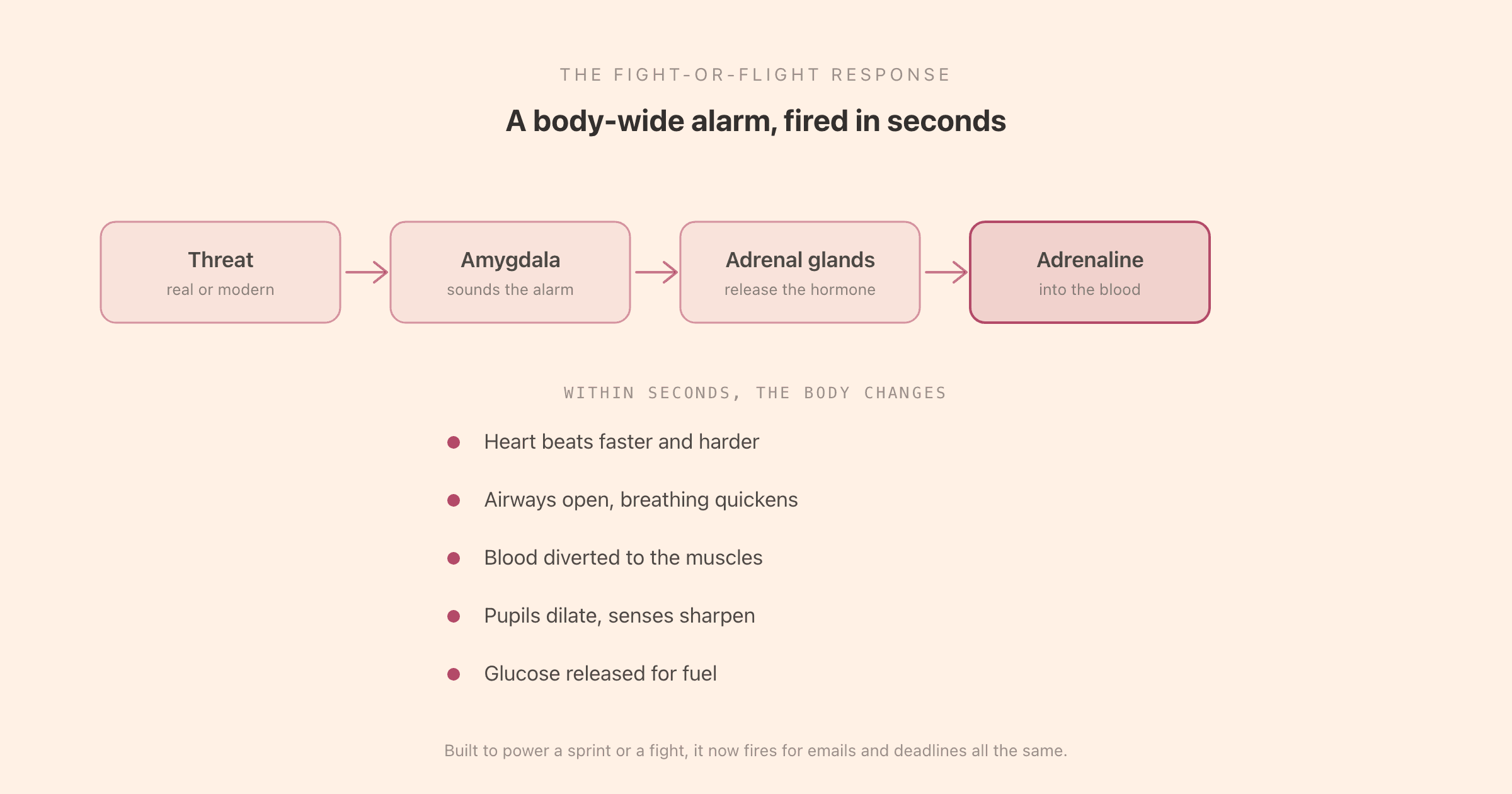
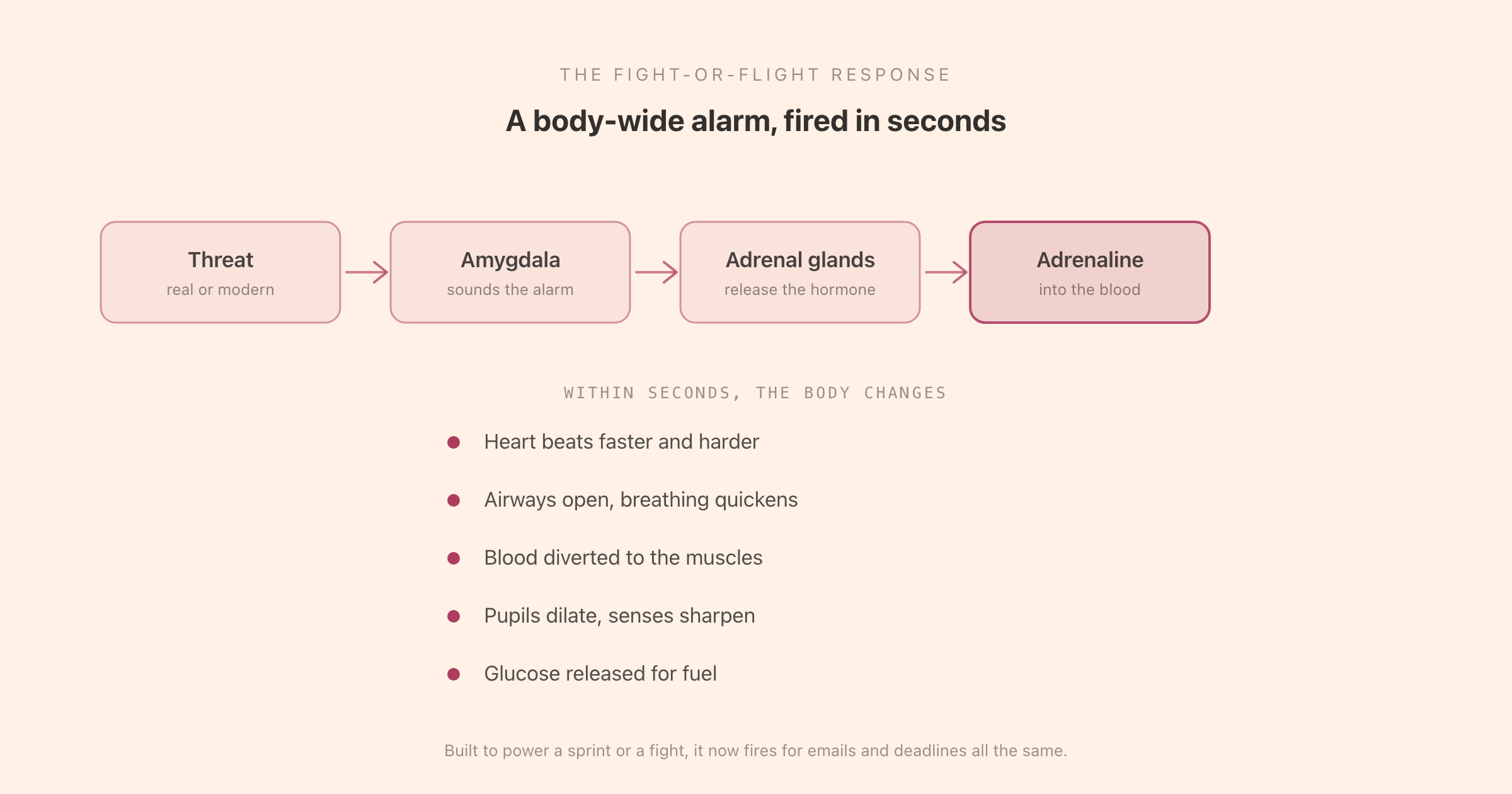
Once released, adrenaline acts on receptors throughout the body to produce the familiar sensations of the "adrenaline rush." Your heart beats faster and harder, pushing more blood to the muscles. Your airways open to take in more oxygen. Blood is diverted from non-essential functions like digestion toward the muscles and brain. Your pupils dilate, your senses sharpen, and stored energy in the form of glucose is released into the bloodstream for immediate fuel. All of this happens in moments, and all of it serves one purpose: to prepare the body for intense physical action.
This is the crucial thing to understand about adrenaline: it is not, in itself, good or bad. It is a tool, a rapid mobilisation of the body's resources. Whether that mobilisation helps or harms depends entirely on the situation and, above all, on the amount.
The Fight-or-Flight Response
Adrenaline is the chemical engine of the fight-or-flight response, the body's automatic reaction to a perceived threat. The sequence begins in the brain. The amygdala, the brain's threat detector, spots something alarming and, faster than conscious thought, sends an alarm signal to the hypothalamus, which activates the sympathetic nervous system. That signal reaches the adrenal glands, which flood the bloodstream with adrenaline, and the body-wide changes follow within seconds.
The genius and the problem of this system is that it is fast and automatic, it does not wait for you to think. That was perfect for escaping a predator, where a half-second head start meant survival and there was no time for deliberation. The trouble is that the same ancient system fires for modern threats that are not physical at all: a difficult email, a looming deadline, a social worry. Your body cannot easily tell the difference between a charging animal and a stressful meeting, so it mounts the same full physical response, pumping adrenaline to ready muscles for a fight or a sprint that is never going to come.
This mismatch is at the root of a great deal of modern stress and anxiety. The fight-or-flight response is a brilliant survival mechanism firing in a world it was not designed for, flooding you with energy for physical action when what you actually need is to sit still and think clearly.
Adrenaline vs Cortisol vs Noradrenaline
Adrenaline is often lumped together with the body's other stress chemicals, but they play distinct roles, and telling them apart clarifies a lot.
Adrenaline (epinephrine) is the fast one. It is released within seconds for the immediate, acute response, and its effects are powerful but short-lived. It handles the emergency in the moment.
Noradrenaline (norepinephrine) is closely related and works alongside adrenaline, but in the brain it plays a broader role as the neurotransmitter of alertness and vigilance, covered in our guide to norepinephrine. Where adrenaline mobilises the body, noradrenaline tunes the brain's state of arousal.
Cortisol is the slow one. Released over minutes rather than seconds, the cortisol response sustains the body's reaction to a longer stressor and handles the aftermath. Where adrenaline is the sprint, cortisol is the marathon, and chronic, elevated cortisol is what does the long-term damage of ongoing stress.
Together they form a layered stress response: adrenaline for the instant reaction, noradrenaline for alertness, and cortisol for the sustained effort. Adrenaline is the flash; cortisol is the burn.
Adrenaline and Focus: The Sweet Spot
Here is where adrenaline matters most for everyday work, and it is genuinely double-edged. A moderate amount of adrenaline is not the enemy of focus, it is one of its allies. That sharpening of the senses, the quickened reactions, the surge of alertness and energy is exactly what helps you rise to a challenge, hit a deadline, or perform under pressure. The mild arousal adrenaline provides can lift you from sluggish and unfocused into sharp and engaged.
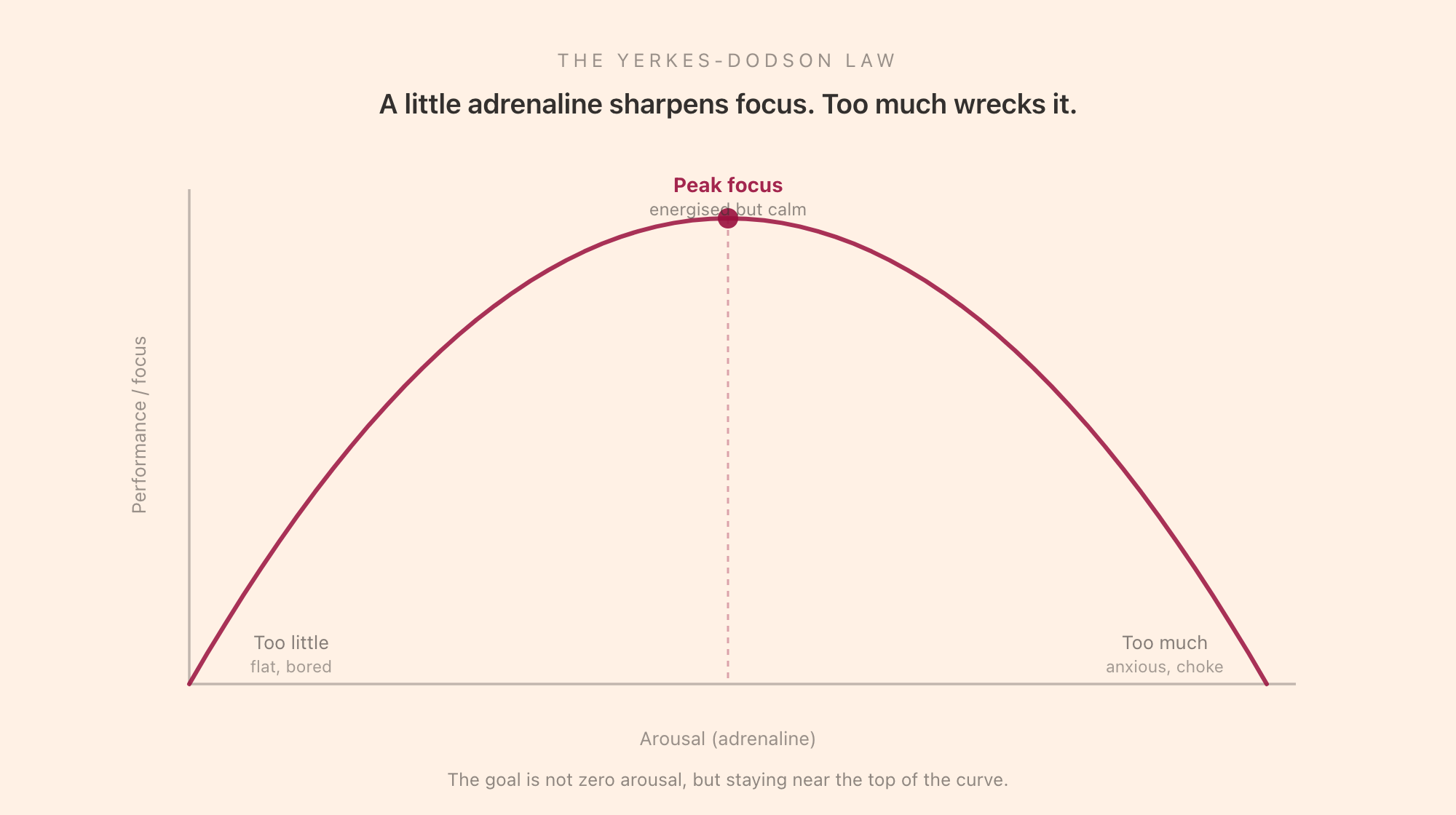
The relationship follows a well-established pattern known as the Yerkes-Dodson law: performance improves as arousal increases, but only up to a point. Too little arousal and you are flat, bored, and unfocused. The right amount, energised but calm, and you hit peak performance, the sweet spot where focus is sharp and effortless. But push past it, too much adrenaline and arousal, and performance falls off a cliff: focus fragments, thinking narrows, working memory buckles, and you tip into anxiety, panic, or the freeze of being overwhelmed. This is why a little pressure helps you work and too much makes you choke.
The practical goal, then, is not to eliminate adrenaline but to manage it, to find and stay near the top of that curve. When you are flat, a little challenge or urgency can raise arousal usefully. When you are over-aroused, anxious, scattered, heart racing at your desk, the task is to bring it down, because you are past the peak and adrenaline has become a liability.
When Adrenaline Works Against You
The fight-or-flight response is meant to be occasional and brief: a spike, then a return to calm. Modern life, with its constant low-grade stressors, can keep the system switched on far too often, and repeated or chronic activation carries a cost. Living with too much adrenaline, and the arousal it brings, keeps you the wrong side of the Yerkes-Dodson peak, in a state of jittery, anxious over-alertness where deep focus is impossible and the body never fully settles. Sustained over time, that chronic activation feeds into the exhaustion and depletion of burnout, the system worn down by an alarm that never switches off.
The signs of unhelpful adrenaline are familiar: a racing heart when nothing is physically wrong, restlessness, an inability to concentrate or sit still, a wired-but-tired feeling. When you notice them, the answer is not to push harder, which raises arousal further, but to deliberately bring the system down, through slower breathing, movement, or a calmer environment, back toward the focused sweet spot.
Where Focus Music Fits
Because focus lives at a specific point on the arousal curve, one of the most useful things you can do for concentration is manage your level of arousal, and your environment is a powerful lever on it. A calm, steady, predictable environment sends a quiet signal to the nervous system that there is no emergency, helping bring an over-adrenalised, scattered state back down toward the focused middle of the curve.
Tomatoes is built to help create that state: steady, non-jarring focus music that gives the nervous system a calm, consistent backdrop, helping settle the wired, over-aroused feeling and hold you nearer the sweet spot where focus is sharp rather than frantic. It is free to try for 3 days, then from $4.99 a week, $29.99 a year, or $39 for lifetime access. If your focus keeps tipping into a racing, anxious over-drive, a calmer environment is a direct way to bring it back: try Tomatoes free for 3 days.
Adrenaline is one of the body's most remarkable systems, a rapid, powerful mobilisation that can save your life or, in the wrong dose at the wrong time, wreck your concentration and your calm. The key is not to fear it or chase it, but to understand its double edge: a little is the energy that sharpens you, and too much is the flood that overwhelms you. Learn to read where you are on that curve, and to nudge yourself back toward its peak, and you can make adrenaline an ally of your focus rather than its enemy.