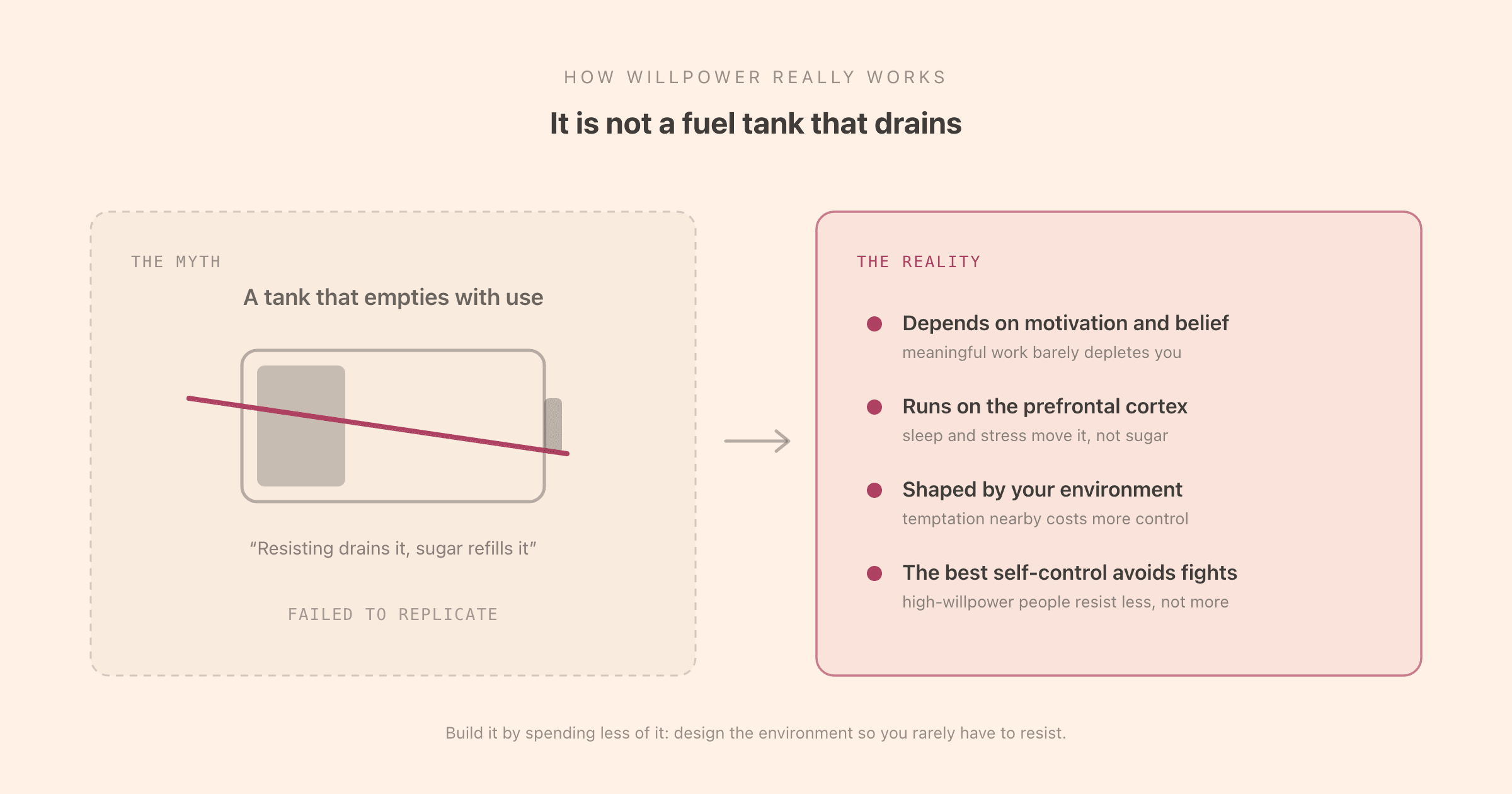
Willpower is the most misunderstood mental skill there is. Most people picture it as a kind of inner fuel: a tank of self-control you start the day with, that drains a little each time you resist a biscuit, a distraction, or the urge to quit, until by evening you have none left and give in. It is an intuitive story, it feels true, and it was backed for years by famous psychology experiments. It is also, it turns out, mostly wrong. Willpower and self-control are real and they matter enormously for focus and achievement, but they do not work like a fuel tank, and understanding how they actually work changes how you build them.
This article explains what willpower and self-control really are, why the influential "ego depletion" theory that treated willpower as a draining resource failed to hold up, what genuinely determines your self-control, and, most usefully, the habits that build it. The punchline, supported by the research that survived scrutiny, is surprising and freeing: the people with the best self-control are not the ones who out-muscle temptation. They are the ones who rarely have to fight it at all.
What Are Willpower and Self-Control?
Willpower and self-control are essentially two words for the same thing: the ability to override an immediate impulse in favour of a longer-term goal. It is choosing to keep working when you want to check your phone, to eat the thing you intended rather than the thing you crave, to do the hard task now rather than the easy one. Psychologists sometimes distinguish shades of meaning, but for practical purposes they are the same capacity, and this article uses them interchangeably.
Self-control matters because so much of a good life runs on it. The famous "marshmallow test," in which young children who could wait for a second marshmallow tended to have better outcomes later, made the point vivid, even if its findings have since been qualified. The ability to delay gratification and stay with a goal underpins focus, learning, health, and almost every worthwhile thing that competes with an easier immediate alternative. The question is not whether self-control matters. It is how it actually works, because the popular model is misleading.
The Ego-Depletion Myth
For two decades, the dominant scientific theory of willpower was "ego depletion." The idea, from a set of well-known experiments, was that self-control draws on a single limited resource that gets used up as you exert it. In the best-known study, people asked to resist a plate of fresh cookies and eat radishes instead subsequently gave up faster on a hard puzzle than people who had not had to resist, as though resisting the cookies had drained a shared tank. Some versions of the theory even proposed that the fuel was literally glucose, and that a sugary drink could top your willpower back up.
It was a compelling story, and it shaped a generation of advice. There was just one problem: when researchers ran large, rigorous attempts to reproduce the effect, it largely did not hold up. Big multi-lab replication efforts found the ego-depletion effect to be small, inconsistent, or absent, and the glucose explanation fared even worse. The current scientific view is that willpower is not a simple fuel tank that empties with use. Something real is going on when hard mental effort makes the next task feel harder, but "you ran out of a finite willpower substance" is not the right description.
What replaced it is more nuanced and more useful. Whether effort feels depleting turns out to depend heavily on motivation and belief. People who see a task as meaningful, or who simply do not believe willpower is a limited resource, show little or no depletion effect. This suggests that a lot of what felt like "running out of willpower" was really shifting motivation and attention: as one effortful task ends, your brain starts weighing the reward of stopping against the reward of continuing. That is not an empty fuel tank. It is a motivational trade-off, and trade-offs can be influenced.
What Actually Determines Your Self-Control
If willpower is not a draining resource, what governs how much self-control you can exert in a given moment? Several things, most of them changeable.
Your brain's control system. Self-control is largely a job of the prefrontal cortex, the executive region that holds your goal in mind and inhibits the impulse pulling against it. When the prefrontal cortex is working well, overriding an impulse is easier; when it is impaired, control collapses.
The strength of the temptation. Self-control is a contest between your goal and an immediate reward, and immediate rewards are powered by dopamine, which makes the tempting option feel urgent and vivid. The more available and salient the temptation, the more control it takes to resist, which is exactly why proximity matters so much.
Sleep and stress. A tired or stressed brain has a weakened prefrontal cortex, which is why self-control is the first thing to go when you are exhausted or overwhelmed. The same person has very different willpower rested versus depleted, not because a fuel tank is empty, but because the control machinery itself is running poorly.
Your beliefs and motivation. As the replication research showed, whether a task drains you depends partly on whether you find it meaningful and whether you believe your willpower is limited. Motivation is not the whole story, but it is a real lever, and it is one you have some influence over.
How to Build Willpower
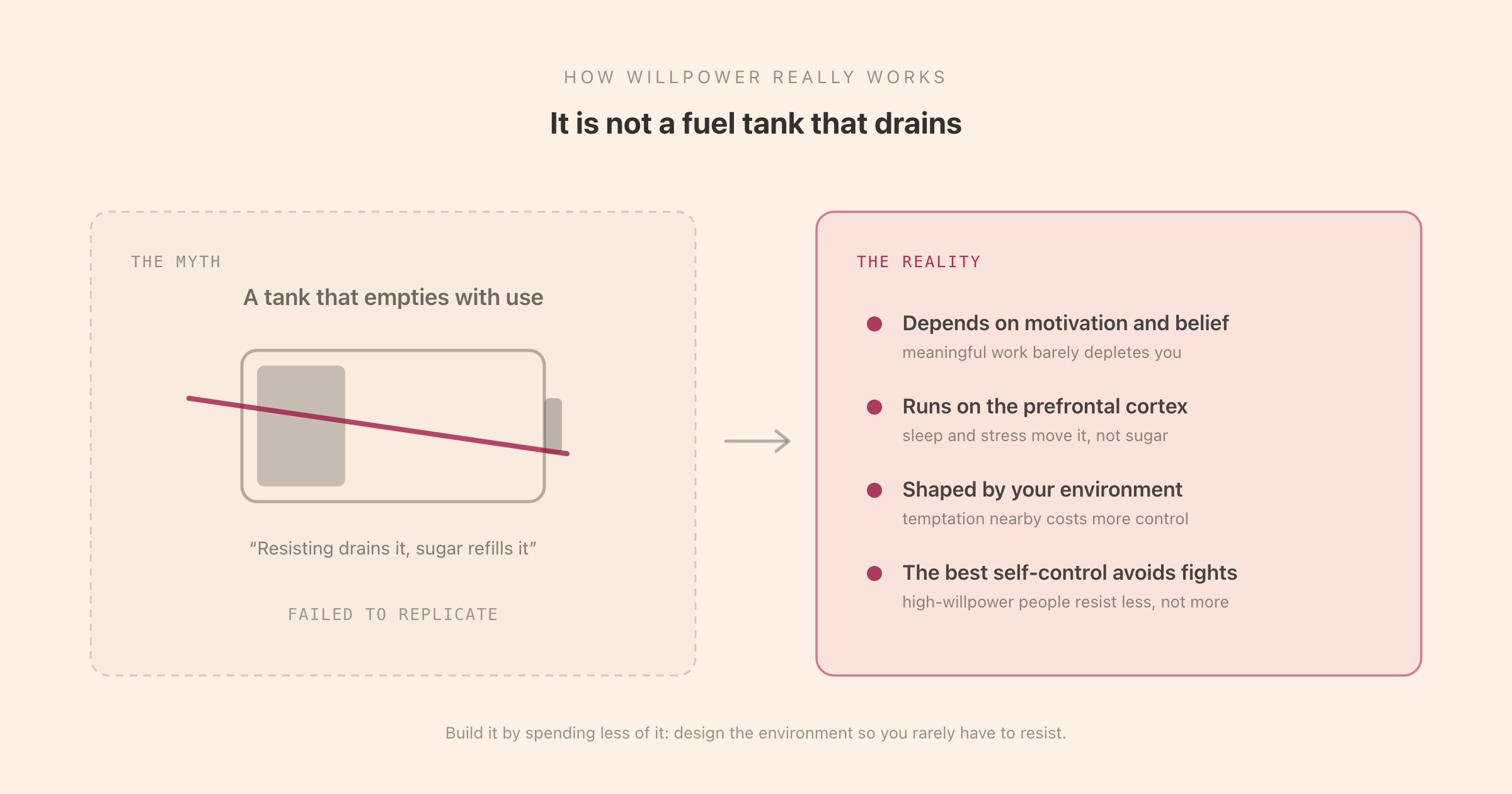
Here is the genuinely liberating part. Because self-control is not a fixed fuel supply you must ration, the goal is not to become a person who can out-muscle any temptation through sheer grit. Studies of people with high self-control find something counterintuitive: they do not experience more temptation and heroically resist it. They experience less temptation, because they have arranged their lives to avoid it. They spend less willpower, not more.
Design your environment so you need less willpower. This is the master strategy. Put the phone in another room, delete the app, keep the junk food out of the house, close the tempting tabs before you start. Every temptation you remove in advance is a battle you never have to fight in the moment. Willpower spent shaping your environment once is worth far more than willpower spent resisting in real time, over and over.
Reduce the number of decisions. Every choice is a small opening for the impulse to win. Deciding in advance, what you will work on, when, and for how long, means the moment arrives as a plan to execute rather than a negotiation to have. Routine is self-control you set up ahead of time.
Use "if-then" plans. One of the best-supported techniques in the research is the implementation intention: deciding in advance "if X happens, then I will do Y." "If I feel the urge to check my phone, then I will take three breaths and return to the task." Pre-loading the response means you do not have to generate it under pressure, when your control is weakest.
Build habits so the behaviour runs itself. Anything you do automatically requires no willpower at all. The more of your important behaviours you can turn into habits, triggered by a stable cue and repeated until automatic, the less you have to rely on in-the-moment self-control. Willpower gets the habit started; the habit eventually replaces the willpower.
Protect the fundamentals. Because self-control depends on a well-functioning prefrontal cortex, sleep, exercise, and managing chronic stress do more for your willpower than any motivational trick. There is no self-control technique that survives sustained sleep deprivation.
Where Focus Music Fits
The single most effective willpower strategy, spending less of it by shaping your environment, applies directly to focus. Every distraction you remove before you start is one you never have to resist mid-task, and your sound environment is one of the easiest to control. Unpredictable noise, and the pull to fill silence with something stimulating, are exactly the kinds of small temptations that erode a work session, and both can be designed away rather than fought.
Tomatoes generates focus music that gives your ears a steady, engaging input so silence does not tempt you toward distraction and unpredictable noise does not break your concentration, letting you spend your self-control on the work instead of on managing your surroundings. It is free to try for 3 days, then from $4.99 a week, $29.99 a year, or $39 for lifetime access. If your focus keeps losing the willpower battle, start by removing the fight: try Tomatoes free for 3 days.
Willpower is real, but it is not the fuel tank you were told it was, and that is good news. You do not have to win an endless war of resistance against every temptation. You have to be smart enough to avoid most of the fights, by designing your environment, deciding in advance, building habits, and protecting the sleep and calm your brain needs to keep control. Do that, and self-control stops feeling like a scarce substance you are always running out of, and starts feeling like what it actually is: a skill you can build, and mostly, a set of fights you learned not to have.