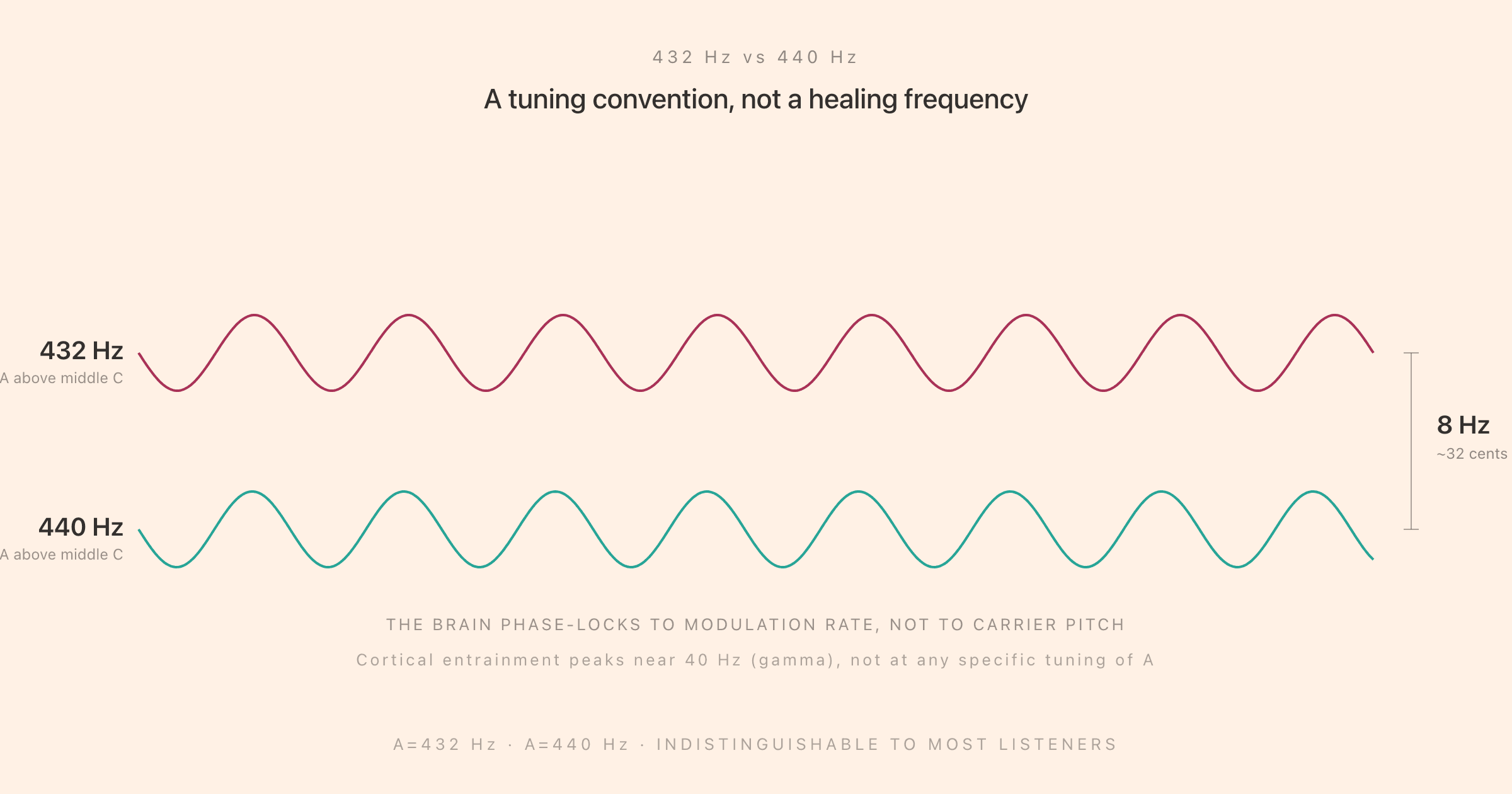
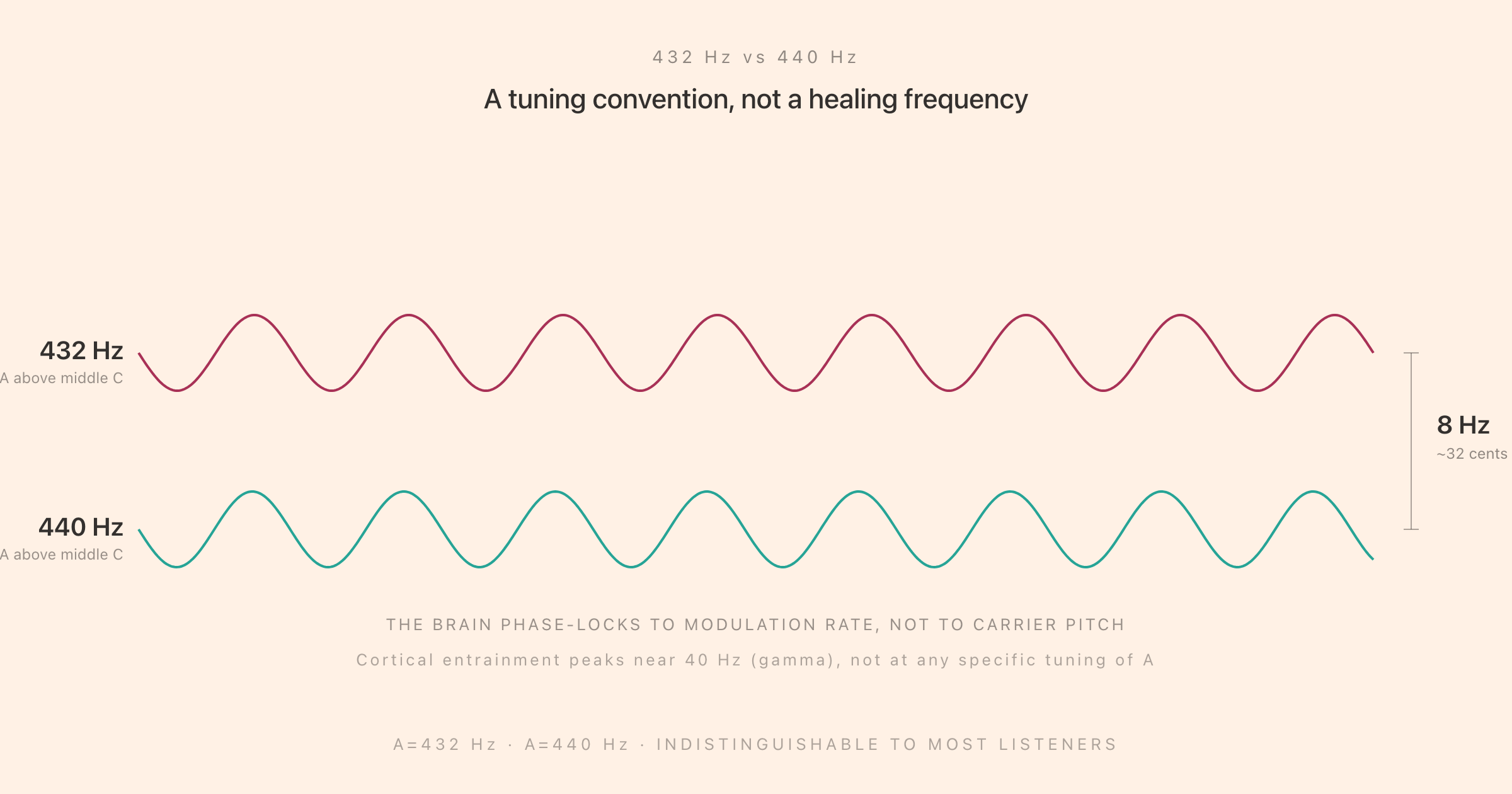
432 Hz is the frequency of the note A above middle C if you tune your A string to 432 vibrations per second instead of the modern standard 440. That is the entire technical content of the claim. Everything else stacked on top, that 432 Hz is the frequency of the universe, the Earth, the heart, the DNA, the love note, the natural pitch of every instrument that ever sounded right, comes from a chain of confidently-stated and weakly-sourced internet posts that have been linking to each other for about fifteen years. None of those claims survives a few hours with peer-reviewed literature.
This article works through what 432 Hz actually is, where the "miracle frequency" claim comes from, what the small handful of studies on 432 Hz vs 440 Hz actually measured, and where it fits in the bigger picture of frequencies the brain actually responds to. The honest answer is more interesting than the marketing version. If you want focus music built on the brainwave-entrainment frequency that does have strong peer-reviewed support (40 Hz gamma modulation, not the carrier pitch), Tomatoes does that. The rest of this article explains why we picked 40 Hz modulation over a 432 Hz carrier.
What 432 Hz Actually Is
A musical note has a fundamental frequency. The frequency is measured in cycles per second (hertz). When a piano tuner sets a piano, they pick a frequency for one specific note, conventionally the A above middle C, and tune every other note relative to it. That reference note is called the concert pitch.
Before about 1900, concert pitch varied wildly across countries, time periods, and even individual orchestras. Documented values for A range from below 400 Hz in some 17th-century instruments to above 460 Hz in some 19th-century brass bands. Pitch drifted upward over the 19th century, partly because higher tuning makes string instruments sound brighter and partly because individual orchestras kept tuning slightly higher than rivals.
In 1939, an international conference in London formally standardised concert pitch at A = 440 Hz. The International Organization for Standardization adopted this as ISO 16 in 1955 and reaffirmed it in 1975. Most modern Western music is recorded with A = 440 Hz tuning. Most modern instruments are manufactured to expect 440 Hz.
A = 432 Hz is the same A note tuned 8 Hz lower. In musical terms, that is about 32 cents flat, a third of a semitone, an interval most untrained listeners cannot reliably hear. Trained musicians can detect it (especially on sustained tones) but most blind A/B tests show that even practising musicians struggle to identify which version they are hearing more often than chance, particularly through small speakers or under any noise.
That is the whole technical content of "432 Hz". It is a tuning convention 8 Hz below the modern standard. It changes the absolute frequency of every note in the recording, but it does not change anything else about the music: the rhythm, the melody, the harmony, the timbre, the loudness, the dynamics. Two recordings of the same piece in 432 Hz and 440 Hz differ only by a tiny global pitch shift.
Where the Miracle Frequency Claim Comes From
The path from "8 Hz lower tuning convention" to "the frequency of universal love" runs through three distinct strands.
Strand one: the Verdi tuning argument. Giuseppe Verdi, the 19th-century composer, advocated for a slightly lower concert pitch in 1884 because pitch had drifted upward and high tuning was straining vocal cords. Verdi's preferred A was 432 Hz. This is a real historical fact and is the single piece of solid documentation that gets cited. It does not, however, support any claim about cosmic resonance. Verdi was making an ergonomic argument about singer fatigue. He was not making a claim about consciousness, vibration, or healing.
Strand two: the Maria Renold experiments. A Swiss harpist and Anthroposophist, Maria Renold, ran informal listener-preference tests in the mid-20th century claiming people preferred A = 432 Hz over A = 440 Hz. Renold's work is published only in the Anthroposophical literature, not in any peer-reviewed acoustics or psychology journal, used small non-randomised samples, and the original data is not retrievable for re-analysis. It is the source most "people prefer 432 Hz" claims trace back to. As evidence, it does not meet the modern bar for a perception study.
Strand three: the New Age numerology layer. Starting around the late 1990s and accelerating with YouTube in the 2010s, a chain of blog posts and videos started claiming that 432 Hz is "the frequency of the universe", that it produces "geometric patterns in water", that it "resonates with the Schumann resonance" (it does not; see our Schumann resonance breakdown for the math), and that it is the only frequency that "harmonises with sacred geometry". Each of these claims links to other claims, not to data. The numerology around 432 (its divisors, its relationship to the speed of light, its appearance in the dimensions of various ancient buildings) is the kind of post-hoc number-spotting that works for almost any whole number you pick.
The convergence of these three strands produced a broadly held internet folk belief that 432 Hz is special, that 440 Hz was imposed on the world by various conspiracies (the most popular version names Joseph Goebbels, which is historically incoherent because the 440 Hz standard was set internationally in 1939 by a body Goebbels did not control), and that re-tuning music to 432 Hz unlocks therapeutic effects ranging from "deeper relaxation" to "reduced anxiety" to "physical healing".
The therapeutic-effect claim is the only one that is testable. So testing it is what the rest of this article is about.
What the Peer-Reviewed Studies Actually Found
There are fewer than ten studies in the peer-reviewed literature that directly compare 432 Hz to 440 Hz on any health, perception, or cognition outcome. Of those, the methodological quality is mixed and the results are weak.
The most-cited is Calamassi and Pomponi (2019), a small randomised controlled trial in Acta Bio Medica. The authors compared listening to music tuned at 432 Hz versus 440 Hz on heart rate, blood pressure, and self-reported relaxation in healthy adults. They reported a small but statistically significant decrease in heart rate and systolic blood pressure during the 432 Hz condition. The sample was 33 participants, the listening duration was 20 minutes, and the differences were on the order of 4 to 5 bpm in heart rate. The study has been criticised for its small sample, lack of pre-registration, and the absence of a no-music control arm (so it is not clear whether the difference is "432 Hz beats 440 Hz" or "any music-vs-baseline change at slightly different magnitudes").
A second study, Aravena and colleagues (2014), published in the International Journal of Psychophysiology, looked at autonomic nervous system responses to 432 Hz vs 440 Hz tuning in a within-subjects design. They found no significant difference between conditions on heart-rate variability, skin conductance, or self-reported mood.
A third, Yoshikawa and Hayashi (2018) in a Japanese journal, compared 432 Hz vs 440 Hz on sleep quality in older adults and found no significant difference between conditions but a difference between music-listening and silence.
Two further pilot studies in dental and pre-operative anxiety (Castaldo, 2020; Anto and colleagues, 2022) reported small benefits of 432 Hz on anxiety scales but were unblinded, used convenience samples, and did not separate "any music" from "specifically 432 Hz" effects.
A 2021 narrative review by Rosa and colleagues concluded that the evidence base for unique effects of 432 Hz over 440 Hz is "preliminary and methodologically weak" and that no strong claim about therapeutic differences between the two tunings is justified by current data.
The honest summary: there are a handful of small studies, some report tiny effects, others report no effects, none have been independently replicated, and none use sample sizes or designs that would survive in a pre-registered acoustics or psychology context. The strongest fair statement is "we do not know, and the effect, if any, is much smaller than the marketing claims".
Why the Tuning Probably Cannot Do What People Claim
Beyond the empirical evidence, there are good mechanistic reasons to expect 432 Hz vs 440 Hz to produce no large cognitive or physiological effect.
The first reason is psychoacoustic just-noticeable-difference. The smallest pitch change a typical listener can detect (a JND) is about 5 to 10 cents at frequencies in the audible mid-range. The difference between 432 and 440 Hz is about 32 cents. So the difference is detectable in isolation by trained listeners, but it sits at the lower edge of perceptibility for untrained listeners and disappears entirely once any rhythm, harmony, or timbre cues are present. Most listening tests where participants cannot tell which version they are hearing are not surprising; they are exactly what the JND literature predicts.
The second reason is how the brain entrains to sound. Brainwave entrainment, the phenomenon underlying binaural beats and isochronic tones, depends on the brain's ability to phase-lock its neural firing to a periodic stimulus. The frequency that matters for entrainment is the modulation rate of the stimulus, not the carrier pitch. A 432 Hz tone amplitude-modulated at 10 Hz produces alpha-band entrainment because of the 10 Hz modulation. A 440 Hz tone modulated at 10 Hz produces the same effect. Switching the carrier from 432 to 440 Hz does not measurably change the auditory steady-state response (ASSR), which has been mapped extensively (see for example our deep-dive on 40 Hz gamma and the auditory steady-state response literature it references). The auditory cortex does not phase-lock to 432 Hz any differently than to 440 Hz.
The third reason is the carrier-vs-envelope confusion in the popular literature. A lot of "432 Hz tones the body" content seems to assume that the body has resonant frequencies at the carrier pitch and that matching them produces measurable effects. But the body's mechanical resonances (chest cavity, eyeballs, head) are in the few-hertz range, not the few-hundred-hertz range. A 432 Hz tone is well above any biomechanical resonance in the human body. The infrasonic-resonance and ultrasonic-bioeffect literatures are real, but they are not what 432 Hz claims invoke.
The combination of "32-cent pitch shift below most listeners' detection threshold for music with rhythm and harmony", "no carrier-pitch effect on entrainment", and "no carrier-pitch effect on biomechanical resonance" is why the predicted size of any specifically-432-Hz effect on cognition or physiology is small or zero, before you ever run the experiment.
What the Brain Does Phase-Lock To
The 432 Hz claim is interesting partly because it gets the right idea (the brain responds to specific frequencies in audio) and applies it to the wrong layer of the signal (the carrier pitch instead of the modulation rate).
The cleaner version of the question is: what frequencies does the auditory cortex actually entrain to, in a way that has been replicated in EEG studies. The answer, briefly, is:
- Alpha (8 to 13 Hz) modulation produces alpha-band ASSR, associated with relaxed wakefulness. Useful for low-arousal listening states.
- Beta (13 to 30 Hz) modulation produces beta-band ASSR, associated with active concentration. Useful for sustained focus tasks.
- Gamma (30 to 80 Hz, with a peak near 40 Hz) modulation produces the strongest ASSR of any band. The cortex phase-locks more reliably and more consistently to 40 Hz than to any other modulation frequency. This is why 40 Hz keeps showing up in entrainment studies and in clinical work on cognition (the Tsai-Han-Tsai 2019 line of work, the 2022 GENUS protocol from Tsai and colleagues, and others).
- Theta (4 to 8 Hz) modulation produces theta-band entrainment, associated with light meditative and creative states.
- Delta (0.5 to 4 Hz) modulation drives sleep-related cortical responses and is generally not useful for focus (see our delta waves breakdown for why the "delta for focus" claim is a sell-side error).
None of those bands has anything to do with the carrier pitch being 432 vs 440 Hz. They are all about modulation rate. Tomatoes uses 40 Hz amplitude modulation embedded in the focus tracks because that is the entrainment band with the strongest peer-reviewed support, not because of any tuning convention applied to the underlying notes.
Should You Listen to 432 Hz Music
If you genuinely prefer how 432 Hz music sounds, listen to it. Subjective preference is real and a music you enjoy will produce more sustained focus and relaxation than music you do not enjoy, regardless of the pitch reference.
If you are listening to 432 Hz music because you have been told it is therapeutically superior to 440 Hz music, the evidence does not support that claim, and the mechanistic story behind it is broken in the ways described above. Spending more on a 432 Hz subscription than on a 440 Hz one is not buying you anything that has been demonstrated to differ.
If you are listening to focus music to actually focus, the question to ask the producer is not "what is the carrier tuning" but "what is the modulation rate, and is it embedded consistently in the audio". A 432 Hz track with no embedded modulation produces no entrainment. A 440 Hz track with embedded 40 Hz modulation produces measurable cortical phase-locking.
Tomatoes is built on that second answer. The carrier pitch of the underlying instruments is conventional. The 40 Hz amplitude modulation is the part doing the work. One-time $39, no subscriptions, no accounts. If a 432 Hz track helps you focus because you find it pleasant, keep listening to it. If you want to know what the audio is actually doing to your cortex, the honest answer lives in the modulation rate, not in the tuning of A.