Binaural beats for sleep are everywhere: open any music app and you will find hours-long tracks promising deep sleep, lucid dreams, and instant calm through nothing more than a low humming tone. The pitch is appealing and the underlying physics is real, but the gap between "this is a genuine auditory phenomenon" and "this will reliably knock you out" is wide, and most of the marketing lives in that gap. This article walks through what binaural beats actually are, what the sleep research has and has not shown, and how to use them in a way that matches the evidence rather than the hype.
The short, honest version is that binaural beats are a real perceptual effect with modest, mixed evidence for improving subjective sleep and reducing anxiety, no convincing evidence that they reliably rewrite your brainwaves on command, and almost no downside to trying. That is a more useful starting point than either "miracle" or "scam." Let us get into why.
What a Binaural Beat Actually Is
A binaural beat is an auditory illusion. Play one pure tone at 200 Hz into your left ear and another at 202 Hz into your right ear, and your brain does not hear two separate tones. It perceives a single tone that pulses, or beats, at 2 Hz, the difference between the two. That 2 Hz beat is not present in the air. Neither speaker is producing it. It is constructed inside the auditory system when the brainstem combines the two signals.
This is why headphones are not optional. If you play both tones through a speaker, the two frequencies mix in the air, you get a normal acoustic beat, and the binaural illusion never happens. The whole effect depends on each ear receiving a different frequency in isolation. No headphones, no binaural beat.
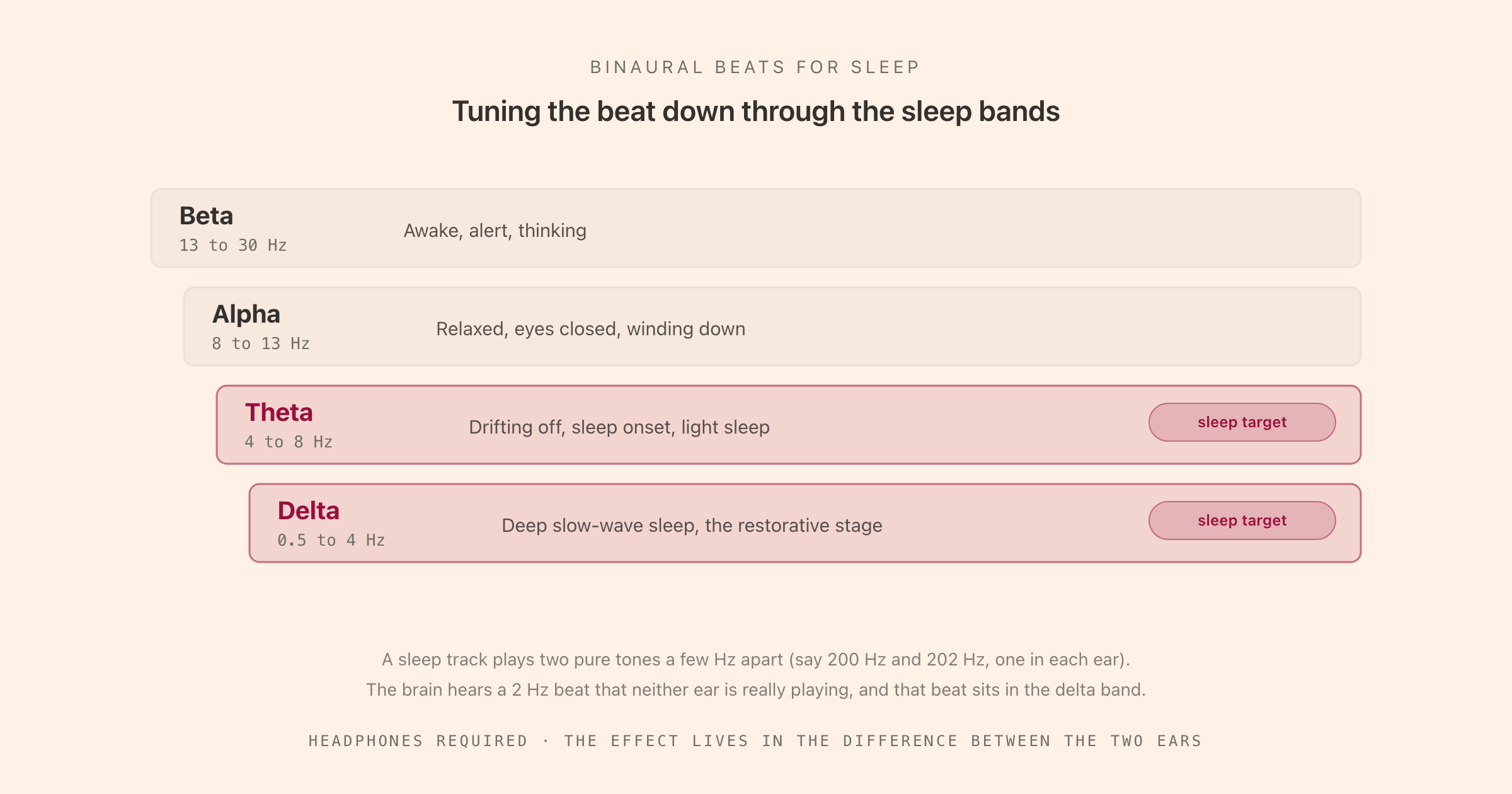
The reason sleep tracks aim for low difference frequencies is the brainwave map. Your EEG slows down as you move from wakefulness into sleep: beta when you are alert, alpha when you are relaxed with your eyes closed, theta as you drift off, and delta during the deep, restorative slow-wave stage. A sleep-oriented binaural track sets the difference frequency in the theta or delta range, on the theory that nudging your brain toward those rhythms will help carry you into sleep. The frequencies people search for as the "best hz for sleep" almost always land in this 0.5 to 8 Hz window for exactly that reason.
The Theory: Brainwave Entrainment
The mechanism that is supposed to make this work is called the frequency-following response, or brainwave entrainment. The claim is that when you feed the brain a steady rhythmic stimulus, populations of neurons begin to synchronise their firing to that rhythm, a measurable effect known as the auditory steady-state response. Drive the brain at a delta frequency, the theory goes, and you encourage a delta-dominant state, which is what deep sleep looks like on an EEG.
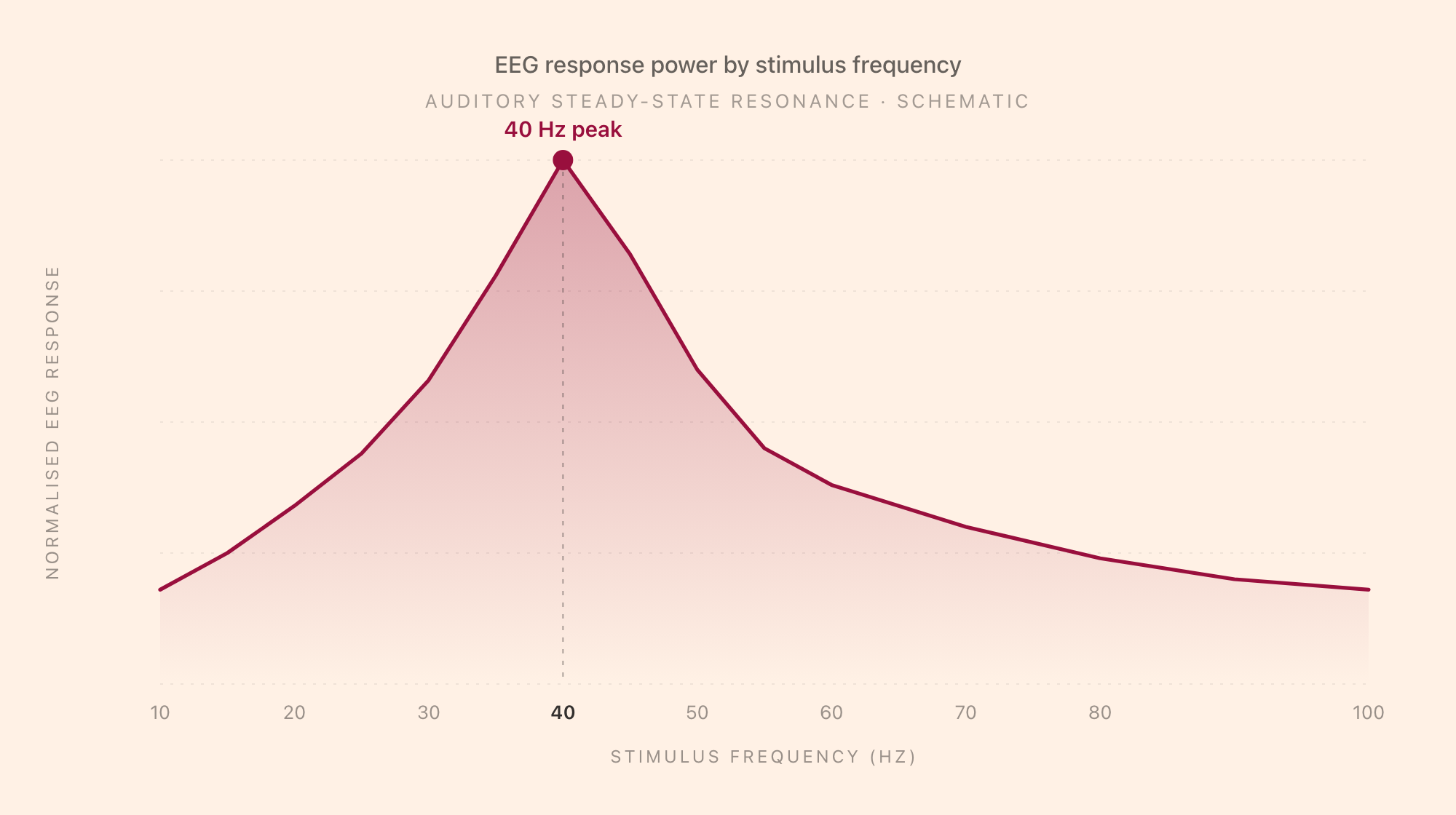
The auditory steady-state response is real and well documented. The brain genuinely does track rhythmic sound, and you can see it in the EEG. The leap that the marketing makes, and that the evidence does not fully support, is from "the brain tracks the rhythm" to "therefore the brain adopts that state and you fall asleep." Tracking a stimulus is not the same as being entrained into a whole behavioural state. A speedometer follows your speed; watching one does not make the car go faster. Whether a binaural beat can pull your global brain state into delta sleep, rather than just producing a small steady-state response in the auditory cortex, is precisely the question the studies have struggled to answer cleanly.
What the Sleep Research Actually Found
Here is where the honesty matters. The literature on binaural beats for sleep is made up of small studies, often with a few dozen participants, frequently without proper blinding or control sounds, and with mixed results. A few patterns do hold up reasonably well.
The strongest signal is for subjective improvement. In several studies, people who listened to delta or theta binaural beats reported falling asleep more easily, sleeping more deeply, or feeling more rested, compared with how they normally slept. That is a genuine and useful finding, even if part of it is expectation and relaxation rather than literal brainwave entrainment.
The signal for objective sleep change, measured by EEG or sleep-tracking, is much weaker and less consistent. Some studies find small shifts in sleep architecture; others find no measurable difference between binaural beats and silence or pink noise. The honest summary is that binaural beats may help you feel like you slept better, with limited and contested evidence that they meaningfully change the underlying sleep your brain produces.
There is a related and slightly more robust line of evidence for anxiety reduction. Several trials have found that listening to binaural beats lowered self-reported anxiety, and since pre-sleep anxiety and rumination are among the biggest barriers to falling asleep, a calming effect could improve sleep indirectly without ever needing to entrain a single brainwave. For a lot of people, that is the realistic mechanism: not "delta waves rewired my brain" but "a steady, low, predictable sound gave my racing mind something to settle on."
Where Binaural Beats Sit in Actual Sleep
It helps to remember what real sleep looks like, because binaural-beat marketing often flattens it into "deep sleep = good, get more of it." Your night is a cycle through stages, and the deep, delta-dominant slow-wave sleep that the tracks target is only one part of it, concentrated mostly in the first few cycles.
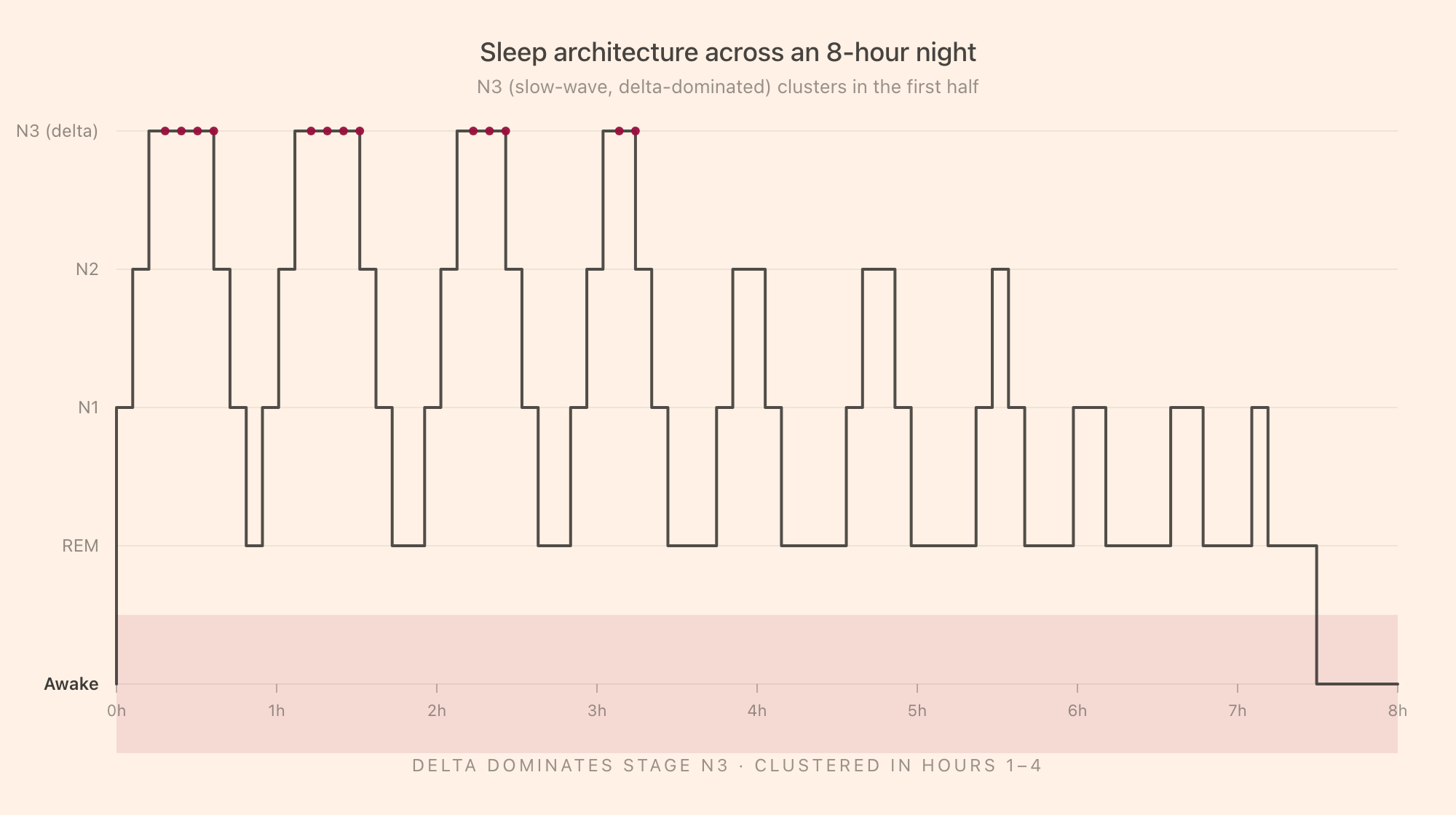
A binaural track can, at best, help you relax and transition into sleep at the start of the night. What it cannot do is hold you in delta all night, and you would not want it to: your brain needs the full architecture, including the lighter stages and the REM that lengthens toward morning, to do its restorative and memory work. This is one reason the deeper dive on delta waves matters, and why understanding the stages of sleep is more useful than chasing a single magic frequency. The goal is to fall asleep and let the cycle run, not to manually program one band.
How to Use Binaural Beats for Sleep Properly
If you want to try binaural beats for sleep, here is how to do it in a way that matches the evidence and gives the effect the best chance to show up.
Use headphones, ideally comfortable ones you can lie down in. The effect literally cannot exist without separate signals to each ear. Flat sleep headphones or a headband speaker are far better than earbuds that dig in when you turn over.
Keep the volume low. You are not trying to drown out the room; you are giving your auditory system a quiet, steady rhythm to track. Low and unobtrusive beats loud every time.
Pick a delta or theta track and stop fiddling. The "best hz for sleep" question gets over-thought. A difference frequency somewhere in the 1 to 6 Hz range is the standard sleep target. Choosing between 2 Hz and 3 Hz is not where the outcome is decided. Pick one, give it a couple of weeks, and judge it on how you actually sleep.
Set a timer or use a track that fades. You want the sound to help you fall asleep, not to play through your REM cycles and risk fragmenting them. Many people fade it out after 30 to 60 minutes, which is plenty to cover sleep onset.
Treat it as one input, not the whole plan. Binaural beats work best stacked on top of ordinary sleep hygiene: a consistent schedule, a dark room, and a wind-down routine. If your circadian rhythm is scrambled or you are drinking coffee at 6pm, no tone is going to rescue the night.
One safety note: keep the volume moderate and give your ears breaks, the same as with any overnight audio. If you want the full rundown on listening safely, the binaural beats safety guide covers it.
The Honest Bottom Line
Binaural beats for sleep are a real auditory phenomenon with a plausible mechanism, modest and mixed evidence for helping you feel like you sleep better, a more credible case for calming pre-sleep anxiety, and very little risk in trying. They are not a switch that flips your brain into deep sleep on command, and any track that promises that is selling certainty the science does not have. Used sensibly, with headphones and at a low volume as part of a real wind-down, they are a low-cost, low-risk thing to experiment with, and plenty of people find they genuinely help.
That is the same philosophy behind Tomatoes: real signal processing, an honest account of what the sound is doing, and no mystical claims about reprogramming your mind. The app generates clean binaural and noise-based audio for focus during the day and for winding down at night, as a one-time purchase with no subscription. If you would rather have a properly built tool than an autoplaying YouTube loop of unknown provenance, see the Tomatoes pricing and try it tonight.