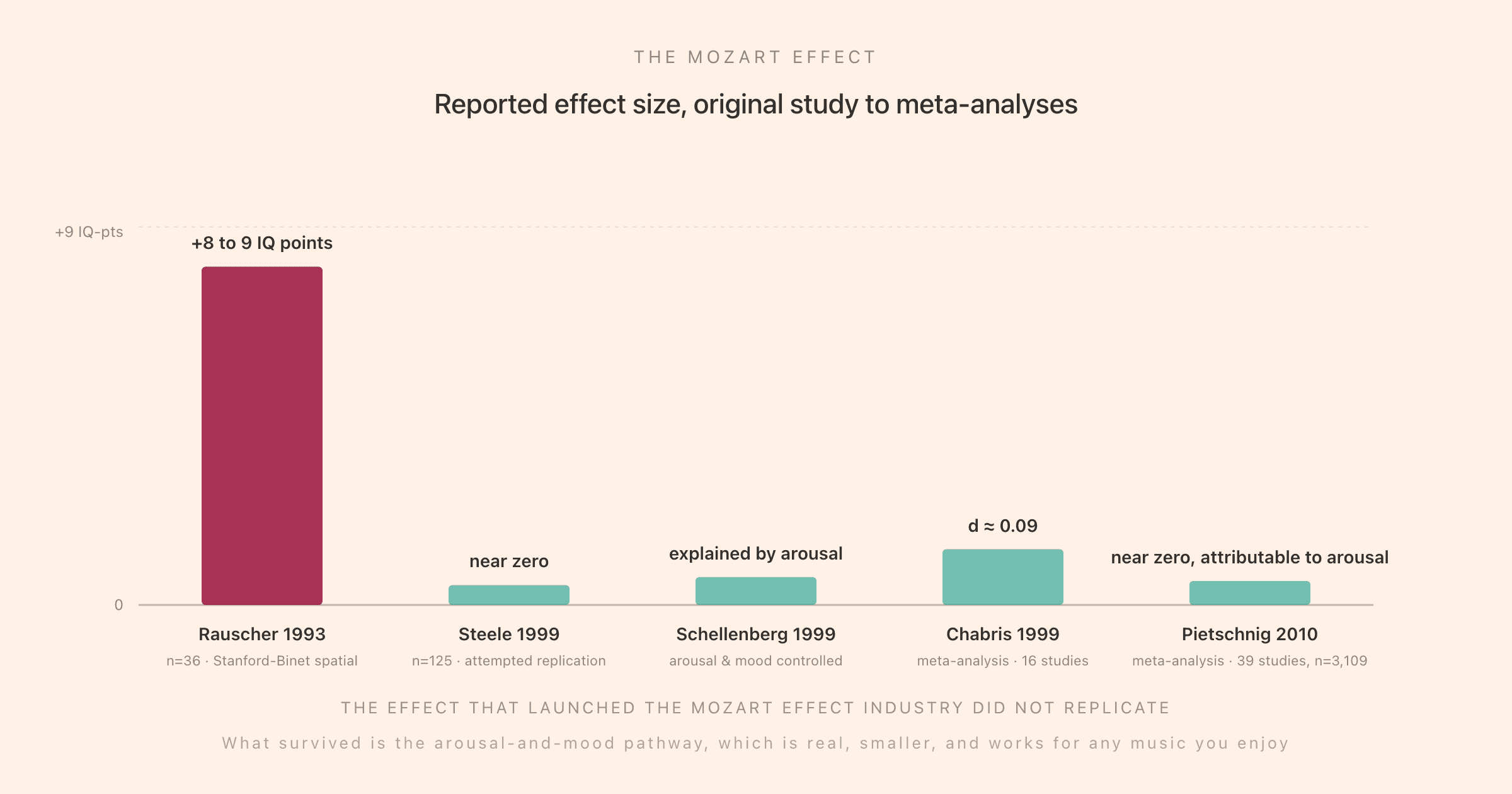
Classical music for studying is the most-recommended cognitive aid in the history of self-help, and almost everything most people believe about it is wrong. The "Mozart effect" was a 1993 study with 36 undergraduates that reported a small, short-lived bump on a single spatial-reasoning task after listening to Mozart's Sonata for Two Pianos in D Major. It was misreported in the popular press as evidence that Mozart raises IQ, picked up by parenting magazines, codified into Georgia Governor Zell Miller's 1998 budget proposal to mail every newborn a classical-music CD, and became the dominant folk theory of music-and-cognition for the next twenty years. By 2010, a meta-analysis of 39 studies and 3,109 participants had reduced the original effect to a small, generic arousal-and-mood bump that has nothing to do with Mozart specifically, classical music specifically, or IQ at all.
This article is what survives when you strip the marketing and read the studies. It walks through what the original Mozart-effect paper actually claimed, why it did not replicate, what the arousal-and-mood pathway is and how it explains the small real effect, what that means for choosing classical music for studying (baroque, instrumental, familiar but not novel, around 60 to 70 BPM), and where instrumental music sits in the broader landscape of focus audio. If you want focus music engineered for the modulation pathway that does have strong peer-reviewed support (40 Hz gamma, not classical-music-as-cognitive-enhancer), Tomatoes does that as a one-time $39 app, and the rest of this article explains why the carrier matters less than the modulation.
What the Original Mozart-Effect Paper Actually Said
The 1993 paper, Rauscher, Shaw, and Ky, in Nature (volume 365, page 611), is one page long and reports a single experiment. Thirty-six undergraduate psychology students at the University of California, Irvine, were given three conditions in a within-subjects design: 10 minutes of Mozart's Sonata for Two Pianos in D Major (K.448), 10 minutes of relaxation instructions, or 10 minutes of silence. After each condition they completed three subtests of the Stanford-Binet intelligence scale: pattern analysis, multiple choices, and matrices.
The Mozart condition produced a higher score on the pattern-analysis subtest than the other two conditions. Converted to a Stanford-Binet IQ-equivalent scale (which is why the effect was reported as "+8 to 9 IQ points"), the difference was about 8 points on that one subtest. The effect was short-lived, lasting roughly 10 to 15 minutes. The other two subtests showed no effect.
Three things about that paper are worth noting before any of the popular narrative kicks in. First, the effect was on one subtest of one IQ scale, not on general intelligence. Second, the effect lasted long enough to complete the test and not much longer. Third, the original authors never claimed Mozart raised IQ; they reported that listening to a specific Mozart sonata produced a brief, task-specific performance bump on a spatial-reasoning subtest. The "Mozart makes babies smarter" claim was a press distortion that the original authors spent the next decade trying to walk back, with limited success.
Why the Original Effect Did Not Replicate
The first serious attempted replication was Steele, Bass, and Crook (1999) in Psychological Science. They ran 125 participants across three institutions, used the same Mozart sonata, and found no significant effect on spatial-reasoning performance after Mozart compared to silence. Several other lab groups produced similar null results in the late 1990s. The Mozart effect, as originally reported, simply did not replicate when more participants were tested under tighter conditions.
That left the field with a question: was the original 1993 result a fluke, or was there a real but smaller effect that needed a better explanation? The answer came from Glenn Schellenberg's 1999 paper in Psychological Science and his subsequent decade of work. Schellenberg reasoned that if the Mozart effect was real but not specific to Mozart, the right comparison was not Mozart-vs-silence but Mozart-vs-other-music-the-listener-also-enjoyed. He ran a series of experiments comparing Mozart to other music conditions matched for arousal and mood. When he equated arousal levels across conditions (by picking music the participants found similarly stimulating), the Mozart-specific effect disappeared. When he equated mood (by picking music that put participants in a similarly positive state), the effect disappeared. The residual effect that survived was not "Mozart raises IQ" but "any stimulus that raises arousal and mood produces a small, brief boost in cognitive performance".
The Schellenberg explanation became the consensus among cognitive psychologists by the early 2000s. It was confirmed at scale by Chabris (1999), who pooled 16 studies into a meta-analysis and found a tiny effect (Cohen's d around 0.09) that was indistinguishable from a generic arousal effect. The most comprehensive meta-analysis to date, Pietschnig, Voracek, and Formann (2010) in Intelligence, pooled 39 studies and 3,109 participants and concluded that there is "little evidence for a specific, performance-enhancing Mozart effect" and that the small residual effect, where it exists, is "fully attributable to arousal-and-mood mediated cognitive priming".
The Mozart effect, as originally claimed, is no longer a serious scientific position. The arousal-and-mood pathway, as Schellenberg formulated it, is the survivor.
The Arousal-and-Mood Pathway: Real, Smaller, Generic
The arousal-and-mood pathway is the Schellenberg replacement theory and it explains a fairly large body of music-and-cognition findings. The mechanism is straightforward.
When you listen to music you enjoy, your physiological arousal increases (heart rate up slightly, skin conductance up, pupillary diameter up). Your subjective mood also lifts. Both of those changes have well-documented small positive effects on short-term cognitive performance: arousal modulates the deployment of attention, mood biases working memory toward expansive rather than narrow processing, and the combination produces a measurable bump on tasks that benefit from either. The bump is small (Cohen's d in the 0.1 to 0.3 range across most studies), short-lived (10 to 30 minutes after the listening period), and generic to any music the listener enjoys. Mozart, baroque, jazz, lo-fi, ambient, and personal-favourite playlists all produce the same effect when matched for liking.
The implications for "classical music for studying" are useful and unromantic. Classical music helps if you enjoy it. It helps about as much as any other music you also enjoy. It helps less, or not at all, if you do not enjoy it (in which case other studies have actually shown small decrements in cognitive performance, presumably because your attention is being pulled toward something you find unpleasant). The "best classical music for studying" question reduces to "what classical music do you actually like and find unobtrusive enough to fade into the background while you work."
If you want a deeper map of how different music types support focus, our focus music taxonomy walks through the five families and what mechanism each one leans on.
What This Means for Choosing Classical Music
Once the arousal-and-mood pathway replaces the Mozart-magic theory, the practical guidance becomes cleaner.
Pick instrumental, not vocal. Lyrics compete with internal verbal processing on tasks that involve language: reading, writing, problem-solving with self-talk. Instrumental music is more reliably background. This is also where the "instrumental music for studying" search reflects real intuition; the subgenre matters less than the lack of lyrics.
Aim for ~60 to 70 BPM. This is where "baroque music for studying" comes from. The widely-cited claim that baroque is uniquely suited to studying because of its 60 BPM tempo originates with Georgi Lozanov's 1970s "Suggestopedia" pedagogy, which is methodologically much weaker than the Schellenberg explanation. The tempo claim, though, lines up with a separate finding: tempos near resting heart rate produce smaller arousal jumps and are more sustainable for hour-plus listening sessions. So baroque, slower piano music, and most chamber music in the 60 to 80 BPM range work for the same reason: they raise arousal a little, not a lot, and stay there.
Prefer familiar but not novel. Novel music recruits attention to itself; familiar music does not. If you want music that fades into the background while you work, pick pieces you have heard before. The "I keep getting distracted by classical music I do not know" problem is a feature of novelty, not classical music specifically.
Avoid solo voice and dramatic dynamic shifts. A piece that swells from pianissimo to fortissimo will pull attention each time it does. Piano music for studying tends to perform well because most piano-focused works (Bach inventions, Mozart sonatas, Chopin nocturnes, Debussy preludes, Satie's Gymnopédies) have flatter dynamic envelopes than orchestral works. Recordings of solo piano keep attention smoother than orchestral recordings of the same period.
Match it to task type. For tasks that need verbal precision (writing, debugging, math notation), instrumental classical music helps via arousal-and-mood at small effect sizes. For tasks that need pure sustained focus on monotonous input (data entry, transcription, repetitive coding), brown noise or pink noise will outperform any music because they raise sensory floor without competing with task content. We covered the noise-vs-music split in white vs pink vs brown noise and brown noise: what the research actually says.
Specific Pieces That Work (and Why)
Once you accept that "classical music for studying" is really "any unobtrusive instrumental music in your liked-and-familiar set", the question of which pieces becomes about texture rather than composer. Some pieces that consistently come up in the academic music-and-cognition literature as low-disruption study music:
- Bach: The Well-Tempered Clavier (preludes and fugues, solo keyboard, mostly 60 to 90 BPM). The textbook "baroque for studying" choice. Also the first reference for the Lozanov tempo claim.
- Bach: Goldberg Variations (especially the slower variations). Glenn Gould's 1981 recording is slower than the 1955 and is more sustainable for long sessions.
- Mozart: Piano Sonatas K.330, K.331, K.332, K.333, K.545 (solo piano, regular tempo, low dynamic range). Stick to the slow movements if you want the lowest-arousal version.
- Chopin: Nocturnes Op. 9 and Op. 27 (slow, melodic, modest dynamic envelope). Romantic-era, but the nocturnes are the closest the Romantic period gets to background-friendly.
- Debussy: Préludes Book 1 ("La cathédrale engloutie", "La fille aux cheveux de lin"). Late Romantic / early Impressionist; fewer dramatic shifts than typical Romantic works.
- Satie: Gymnopédies and Gnossiennes (solo piano, very slow, extremely flat dynamic envelope). Probably the most background-compatible classical music ever written.
- Pärt: Spiegel im Spiegel (modern classical, austere, two instruments, slow tempo). Often used in study playlists for its near-zero arousal jump.
Note what is not on this list: the most popular "study Mozart" choice is Mozart's Sonata K.448 (the original Mozart-effect study used K.448), which is actually one of Mozart's more dynamically active pieces. It was good for the original 10-minute paper-and-pencil test, but it is less suitable than the slower piano sonatas for hour-plus study sessions. The "best classical music for studying" is rarely the most famous classical music. It is the least dramatic.
Where Instrumental Music Sits in the Bigger Picture
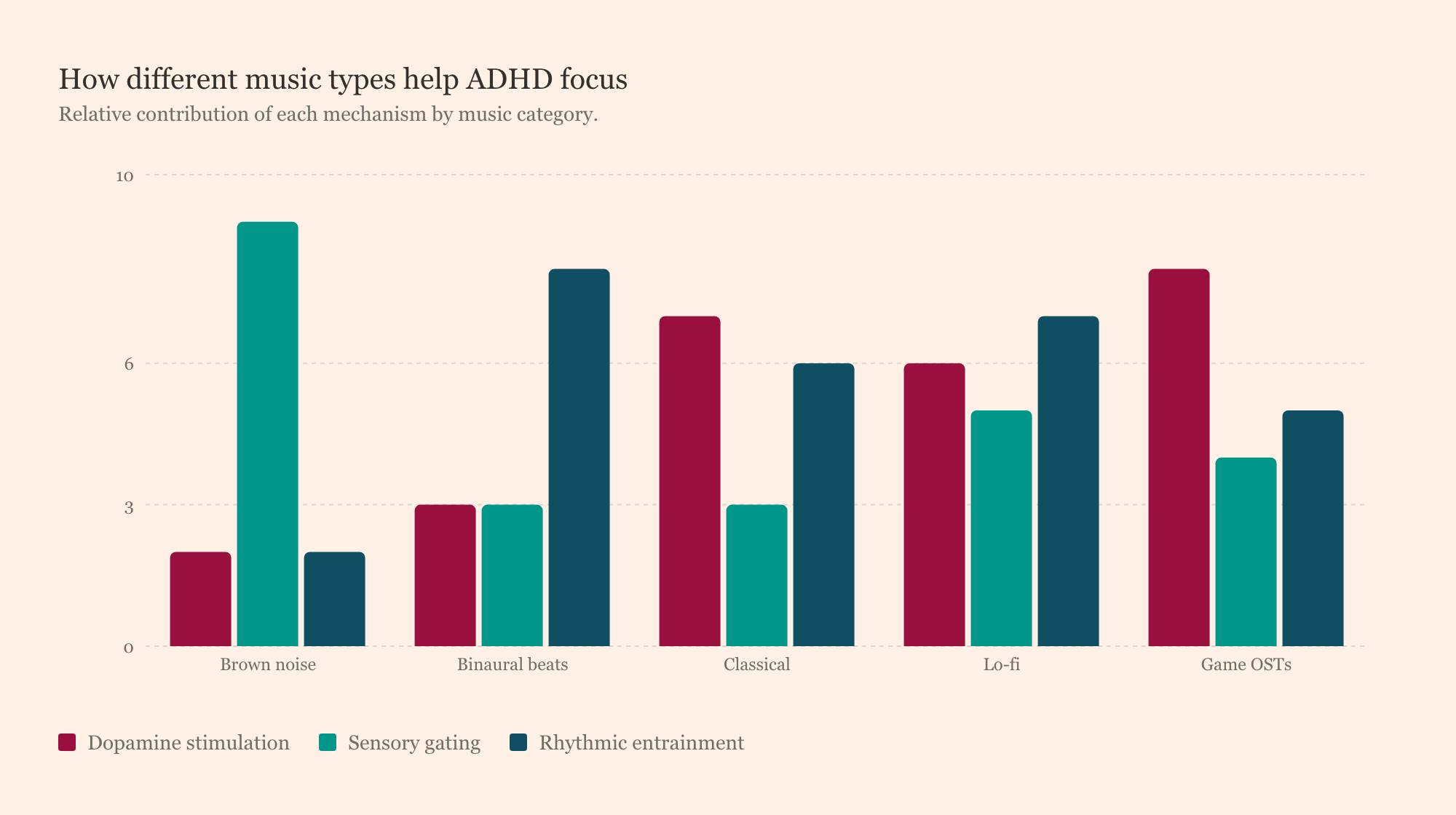
Instrumental classical music is one of five major families of focus audio, and it is in the middle of the pack on most cognitive measures. The full taxonomy:
- Brainwave-entrainment audio (binaural beats, isochronic tones, modulated tones at 40 Hz gamma, 10 Hz alpha, etc.) leans on the auditory steady-state response: the brain's tendency to lock to a periodic auditory modulation. This is what Tomatoes is built around. Effect sizes for sustained attention on entrainment audio are small but more reliably replicated than the Mozart effect.
- Stochastic noise (brown, pink, white, sometimes green) raises the sensory floor and reduces external-distractor salience. Best for monotonous-input tasks. Larger and more consistent effect sizes for ADHD focus than music.
- Instrumental music (classical, lo-fi, ambient, video-game OSTs) leans on the arousal-and-mood pathway, which is real but small.
- Lyrical music (any music with vocals) interferes with verbal cognitive tasks at small but measurable effect sizes; tends to be net-negative for studying.
- Silence is sometimes the best choice for novel, demanding cognitive work where you want zero competing input. The "music for studying" assumption is not universally correct.
The honest comparison: instrumental classical music is fine for studying. It is not magic. It is not better than any other instrumental music you enjoy. It is probably better than working in silence if you find silence aversive, and probably worse than silence if you do not. For pure focus support, brown noise or 40 Hz modulated tones have stronger evidence and larger effect sizes; for mood support, the music you actually like does the same job as Mozart.
What to Take Away
The Mozart effect was never about Mozart. The original 1993 result was a small, brief, task-specific arousal bump on one IQ subtest in 36 undergraduates, and the "Mozart raises IQ" claim that followed was a media artefact that has been thoroughly walked back. The arousal-and-mood pathway that replaced it is real, generic, small, and works for any music you enjoy. Classical music for studying works to the extent that you enjoy it, the music is instrumental, the tempo is moderate, the dynamic envelope is flat, and the pieces are familiar enough not to recruit your attention.
That makes the choice of which classical music almost entirely about texture and personal taste, and almost not at all about which composer's name is on the cover. If you are looking for the largest evidence-backed cognitive boost from audio while studying, classical music is in the middle of the field, and the front of the field is brainwave-entrainment audio engineered specifically for sustained attention. Tomatoes is built on that pathway, costs $39 once with no subscription, and we picked it over a 432 Hz carrier or a Mozart-sonata loop because the modulation rate is the part of the audio the brain actually phase-locks to.