Cognitive load is the reason you can follow a clear explanation effortlessly but feel your brain seize up in front of a cluttered spreadsheet, a badly-written manual, or a task with too many moving parts at once. It is the amount of mental effort being held in your working memory at any given moment, and because working memory is startlingly small, that load has a hard ceiling. Go over it and comprehension collapses: you re-read the same sentence, lose the thread, and make careless mistakes. Understanding cognitive load, and learning to manage it, is one of the most practical things you can do for focus, learning, and getting hard work done.
This article explains what cognitive load is, the three types that make it up, why your working memory is the bottleneck that sets the limit, the signs that you have exceeded it, and the concrete ways to reduce the load that is being wasted so your mind has room for the work that matters. The core idea is freeing: a lot of what feels like not being smart enough or focused enough is really just an overloaded working memory, and load is something you can manage.
What Is Cognitive Load?
Cognitive load is the total amount of mental effort being used in your working memory. Working memory is the small mental workspace where you hold and manipulate information in the moment, the numbers you are adding, the sentence you are parsing, the steps of the task you are mid-way through. Cognitive load is simply how full that workspace is.
The concept comes from Cognitive Load Theory, developed by the educational psychologist John Sweller in the late 1980s, originally to explain why some teaching methods work far better than others. Its central insight is that working memory can only handle a few pieces of new information at once, so any learning or thinking task that demands more than that capacity will fail, not because the person is incapable, but because the channel is overwhelmed. The practical upshot is that managing load is not a nice-to-have; it is the difference between information that gets processed and information that bounces off.
Crucially, not all load is equal. Some of it is the unavoidable difficulty of the thing you are trying to do, some is useful effort that builds real understanding, and some is pure waste caused by how information happens to be presented. Telling these apart is where the theory becomes useful.
The Three Types of Cognitive Load
Cognitive Load Theory divides the load on working memory into three kinds, and the whole art of working within your limits comes down to managing them differently.
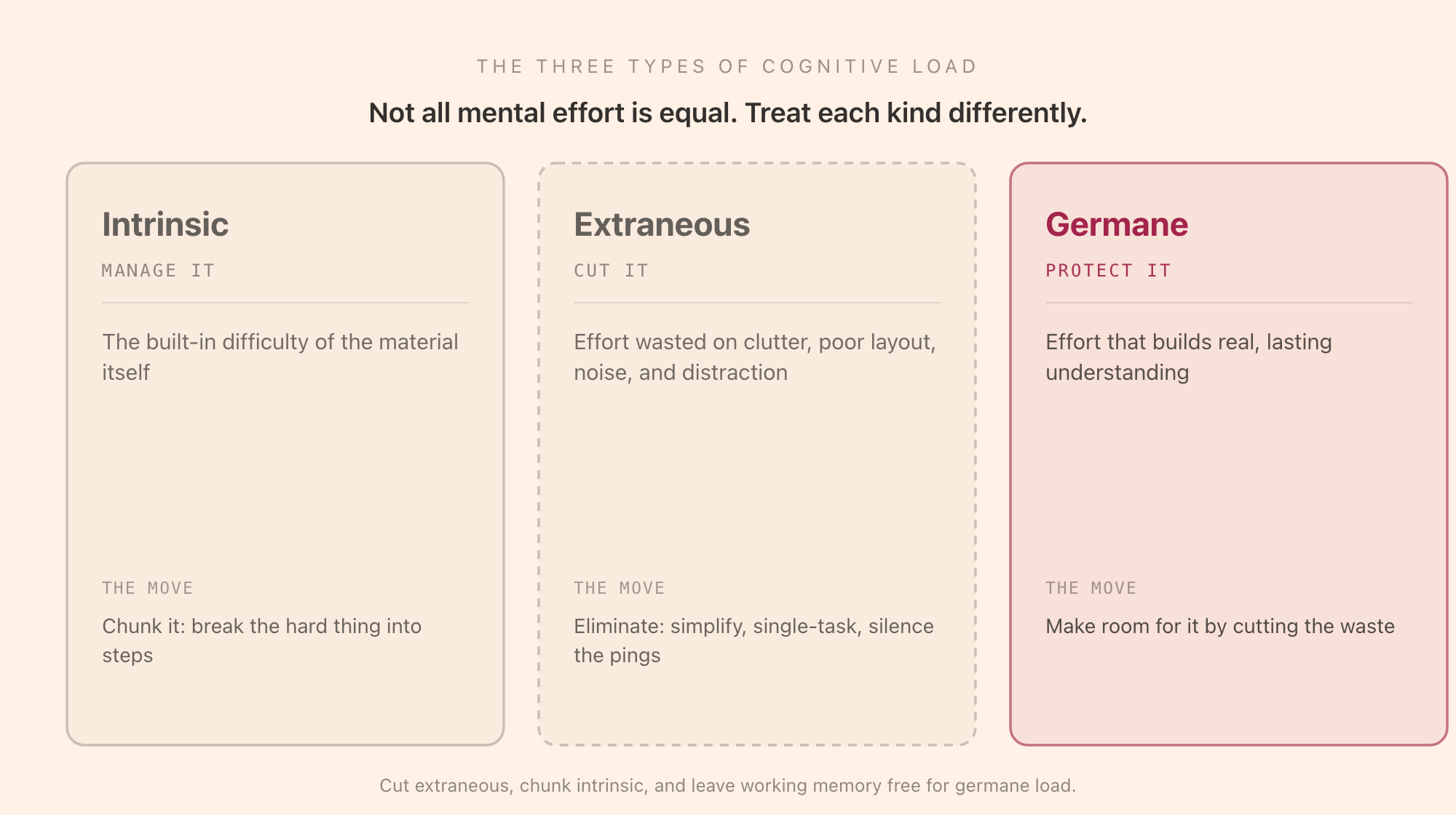
Intrinsic load is the inherent difficulty of the material itself. Solving a differential equation carries more intrinsic load than adding two numbers; the complexity is built into the task and how many elements you have to hold in mind at once. You cannot eliminate intrinsic load, but you can manage it, chiefly by breaking a complex whole into smaller parts and tackling them in sequence rather than all together.
Extraneous load is the effort wasted on things that have nothing to do with the actual task: a confusing layout, a cluttered interface, an explanation that buries the point, background noise, a pinging phone. This is the load you want to eliminate, because every scrap of working memory spent decoding bad presentation or fighting distraction is capacity stolen from the real work. Most "I can't focus" problems are really extraneous load problems.
Germane load is the good load: the mental effort that actually goes into understanding, connecting new information to what you already know, and building the durable mental models that turn effort into learning. Unlike the other two, you want more germane load, within your total budget. The goal of managing cognitive load is to cut extraneous load to the bone so there is room for germane load to do its work.
The strategy falls straight out of the three: reduce extraneous load ruthlessly, manage intrinsic load by chunking, and leave as much capacity as possible free for germane load.
Why Working Memory Is the Bottleneck
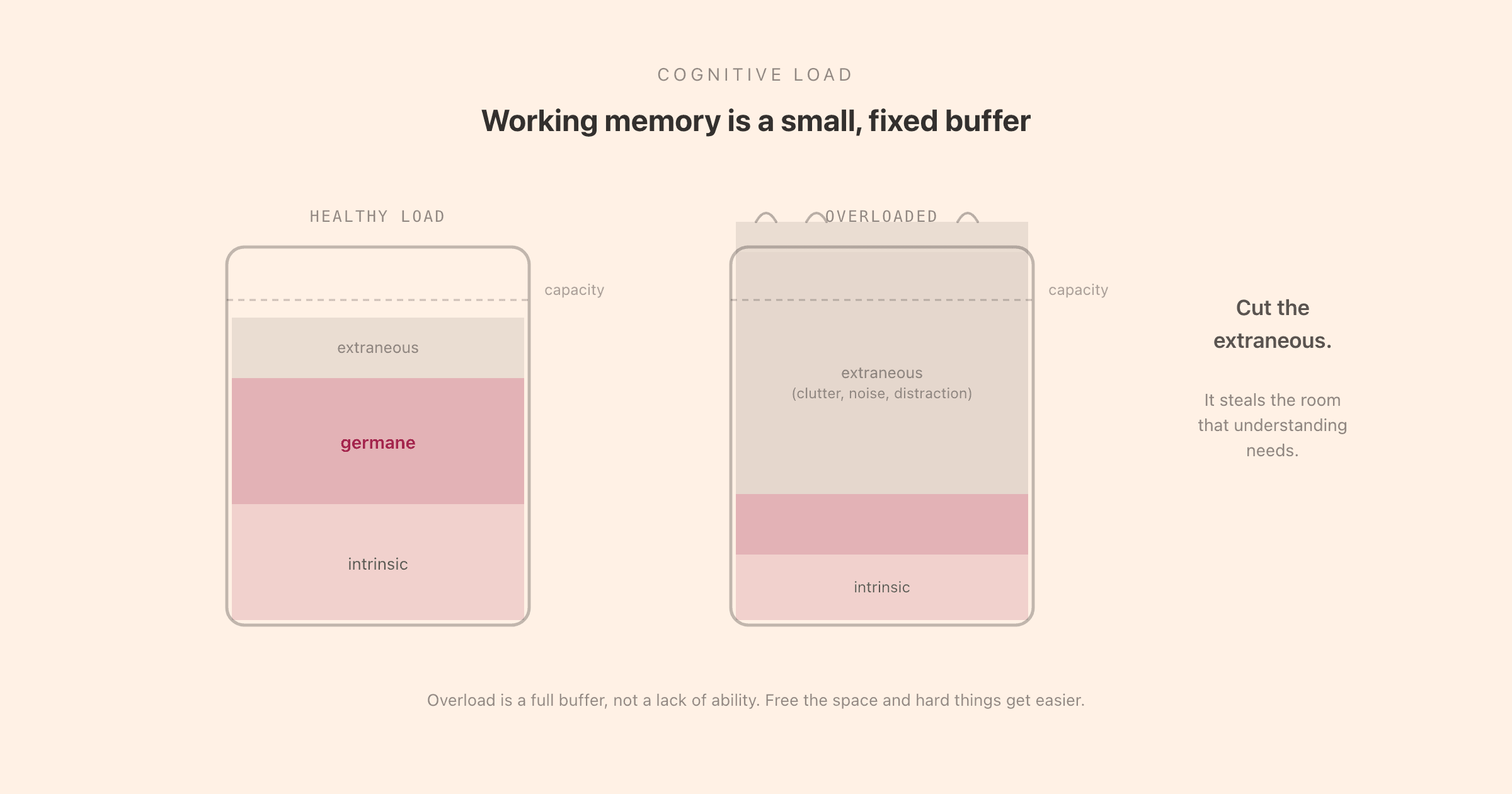
The reason cognitive load matters so much is that the workspace it fills is tiny. Working memory can hold only a handful of items at once, famously estimated at around seven but more realistically closer to four chunks of new information, and it holds them for mere seconds without active rehearsal. This is a hard biological limit, not a matter of trying harder.
Everything else about thinking has to funnel through this narrow channel. Long-term memory is effectively limitless, but to get anything into it, or to reason about anything new, the information has to pass through working memory first. When cognitive load exceeds that small capacity, the excess is simply dropped: you lose track, forget the earlier step, or fail to make the connection that would have produced understanding. The overload is not a character flaw. It is a full buffer.
This is also why expertise feels like it lowers cognitive load. Experts have built large, ready-made patterns in long-term memory, so what is many separate elements to a beginner is a single chunk to them, freeing working memory for higher-level thinking. You cannot expand the buffer, but you can, over time, pack more into each slot.
Signs You Are Overloaded
Cognitive overload has a recognisable feel, and learning to notice it early lets you act before your work degrades. The common signs: re-reading the same line without it going in, losing your place in a multi-step task, a sudden urge to check your phone or do something easier, simple mistakes creeping into work you can normally do, and that specific mental fog where you know you should be able to think but cannot seem to get traction.
These are not signs to push harder. Pushing harder against an overloaded working memory just produces more errors and more frustration. They are signs to reduce the load: simplify, slow down, offload something, or remove a distraction.
How to Reduce Cognitive Load
Here is the practical payoff. Most of the leverage is in cutting extraneous load, the wasted kind, and managing how much intrinsic load you take on at once.
Single-task. Every additional task you juggle multiplies load, because multitasking forces working memory to hold several contexts and pay a switching cost on each change. Doing one thing at a time is the single biggest reduction in cognitive load available to you.
Offload to the outside world. Working memory is for processing, not storage. Write down the steps, keep a running note, use a checklist, sketch the problem. Anything you externalise is load you no longer have to carry, freeing capacity for actual thinking.
Chunk hard material. Break a complex task into smaller, self-contained pieces and complete them one at a time. This manages intrinsic load by never asking working memory to hold the whole thing at once, and it is why good instruction always builds up in steps.
Cut the extraneous ruthlessly. Close the extra tabs, clear the desk, silence notifications, simplify the document you are working from. A cluttered environment is a tax on every second of thinking. This is also where controlling your attention span and your surroundings pays off directly.
Protect the fundamentals. A tired or stressed brain has less working-memory capacity to begin with, so the effective ceiling on your cognitive load drops when you are short on sleep. The same task overloads you on a bad night and flows on a good one.
Where Focus Music Fits
A great deal of extraneous cognitive load comes straight from your environment, and sound is one of its most underrated sources. Unpredictable noise, snatches of speech, and sudden interruptions all consume working memory, each one a small demand on the buffer you are trying to reserve for the task. Silence would be ideal, but true silence is rare and often gets filled by the pull to seek stimulation, which is its own load.
Tomatoes generates focus music built to lower that environmental load: a steady, non-verbal, non-distracting backdrop that masks unpredictable noise and gives your attention a stable input, so more of your limited working memory stays free for the work instead of being spent fending off interruptions. It is free to try for 3 days, then from $4.99 a week, $29.99 a year, or $39 for lifetime access. If your focus keeps buckling under a cluttered mental workspace, start by quieting the environment feeding it: try Tomatoes free for 3 days.
Cognitive load is a quietly powerful idea because it reframes so much of what feels like personal failure. The overwhelm in front of a hard task, the fog when everything is happening at once, the inability to hold a thought: these are usually not signs that you are incapable, but that a small working memory is full. And a full working memory is something you can act on, by cutting the waste, chunking the difficulty, offloading what you can, and protecting the capacity you have. Work within the limit instead of against it, and hard things get noticeably easier.