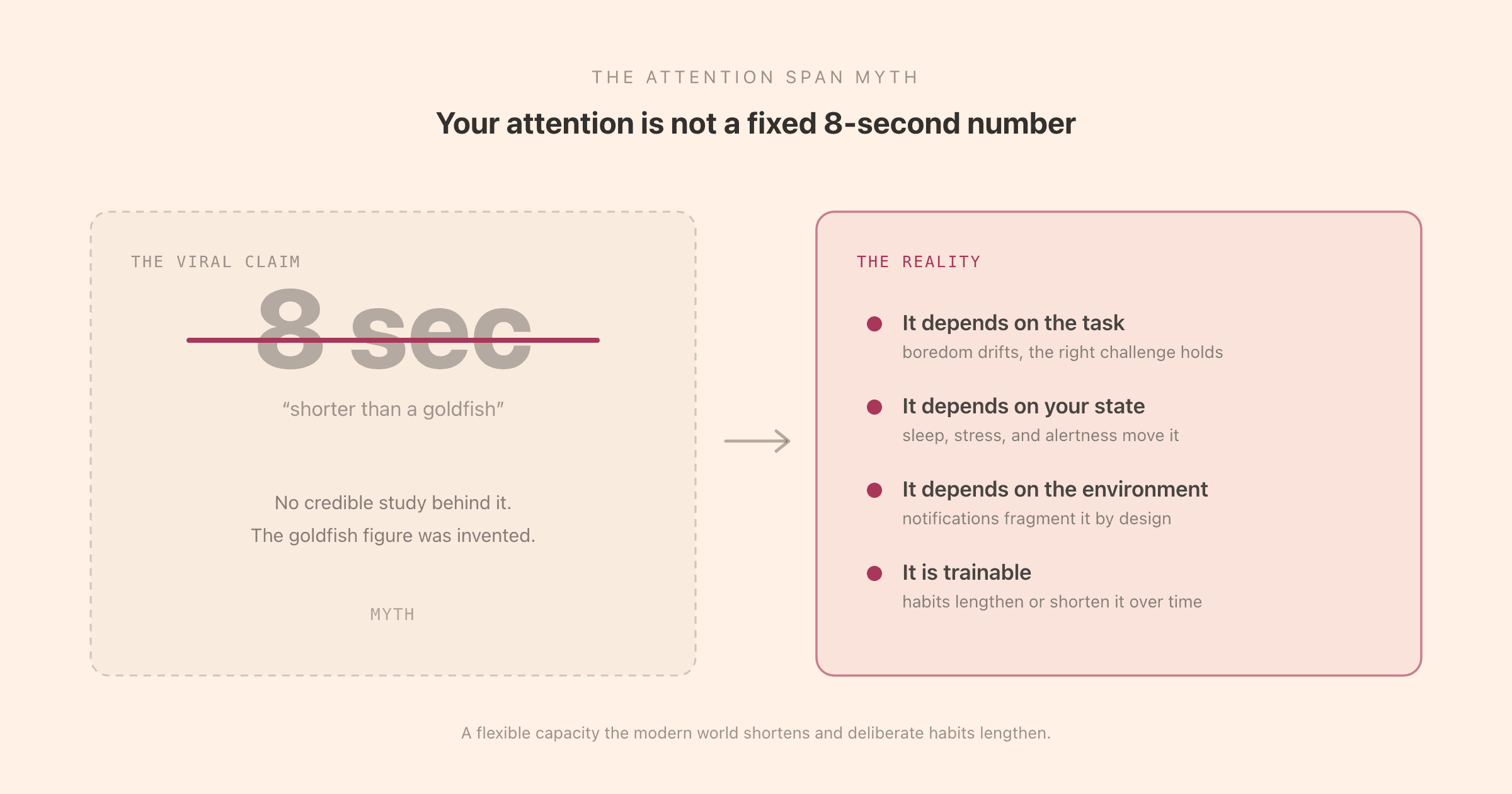
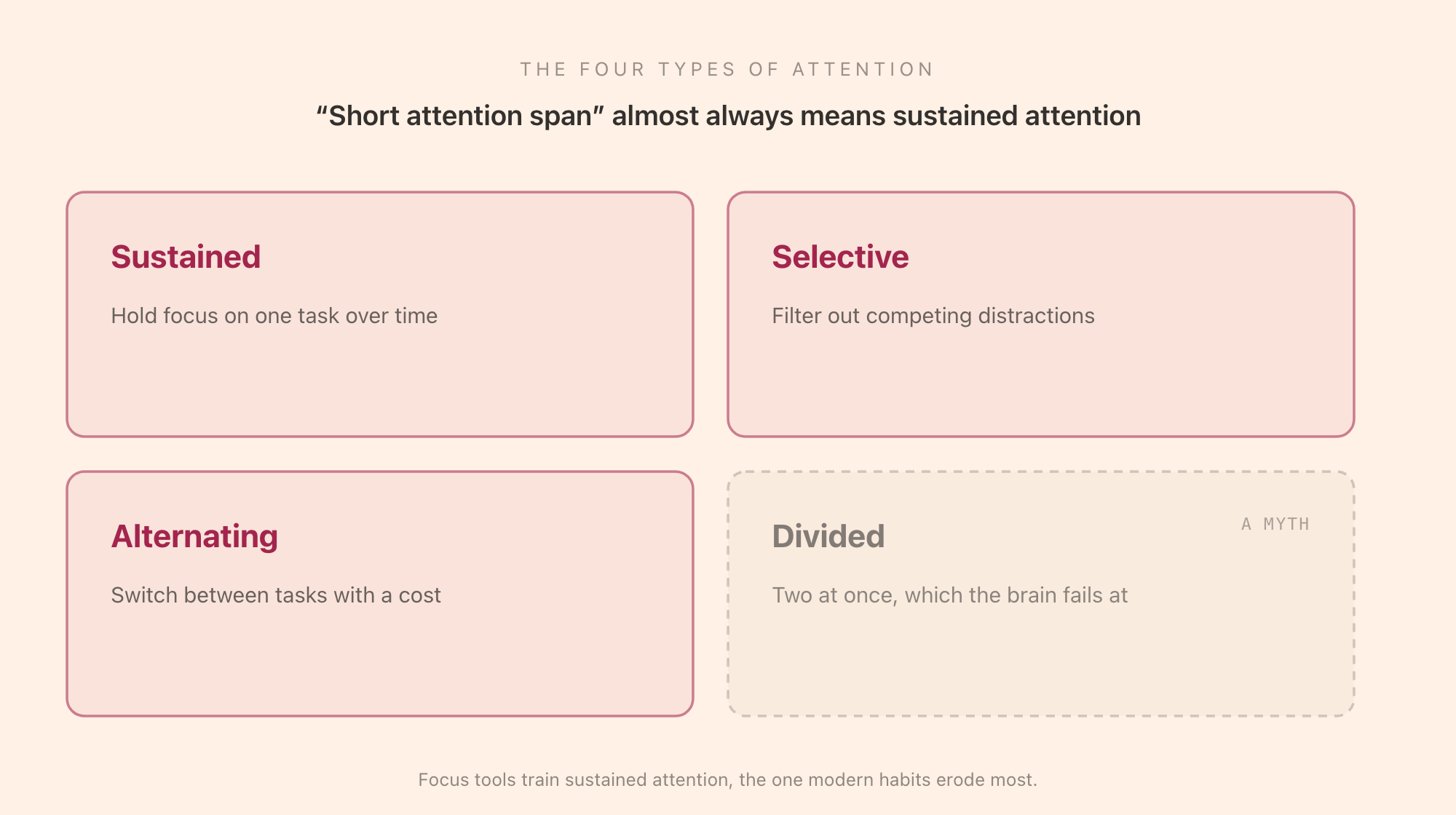
Your attention span is probably better than you have been told, and worse than it could be. You have almost certainly heard the statistic that the human attention span has fallen to eight seconds, shorter than a goldfish. It is one of the most repeated facts on the internet, quoted in TED talks, marketing decks, and news articles. It is also completely made up. There is no credible study behind it, and the goldfish comparison appears to have been invented whole. But the reason the claim spread so fast is that it points at something real: attention genuinely does feel harder to hold than it used to, and understanding why is the first step to getting it back.
This article explains what attention span actually is, why the famous goldfish figure is a myth, what really determines how long you can focus, and, most usefully, the habits that lengthen your attention span rather than erode it. The good news running underneath all of it is that attention is not a fixed trait you are stuck with. It is a trainable capacity, and the same forces shortening it can be reversed.
What Is Attention Span?
Attention span is the length of time you can concentrate on a task without becoming distracted. That sounds simple, but the important thing to understand is that it is not a single number. Attention is not one faculty but several, and how long you can sustain it depends heavily on what you are doing and why.
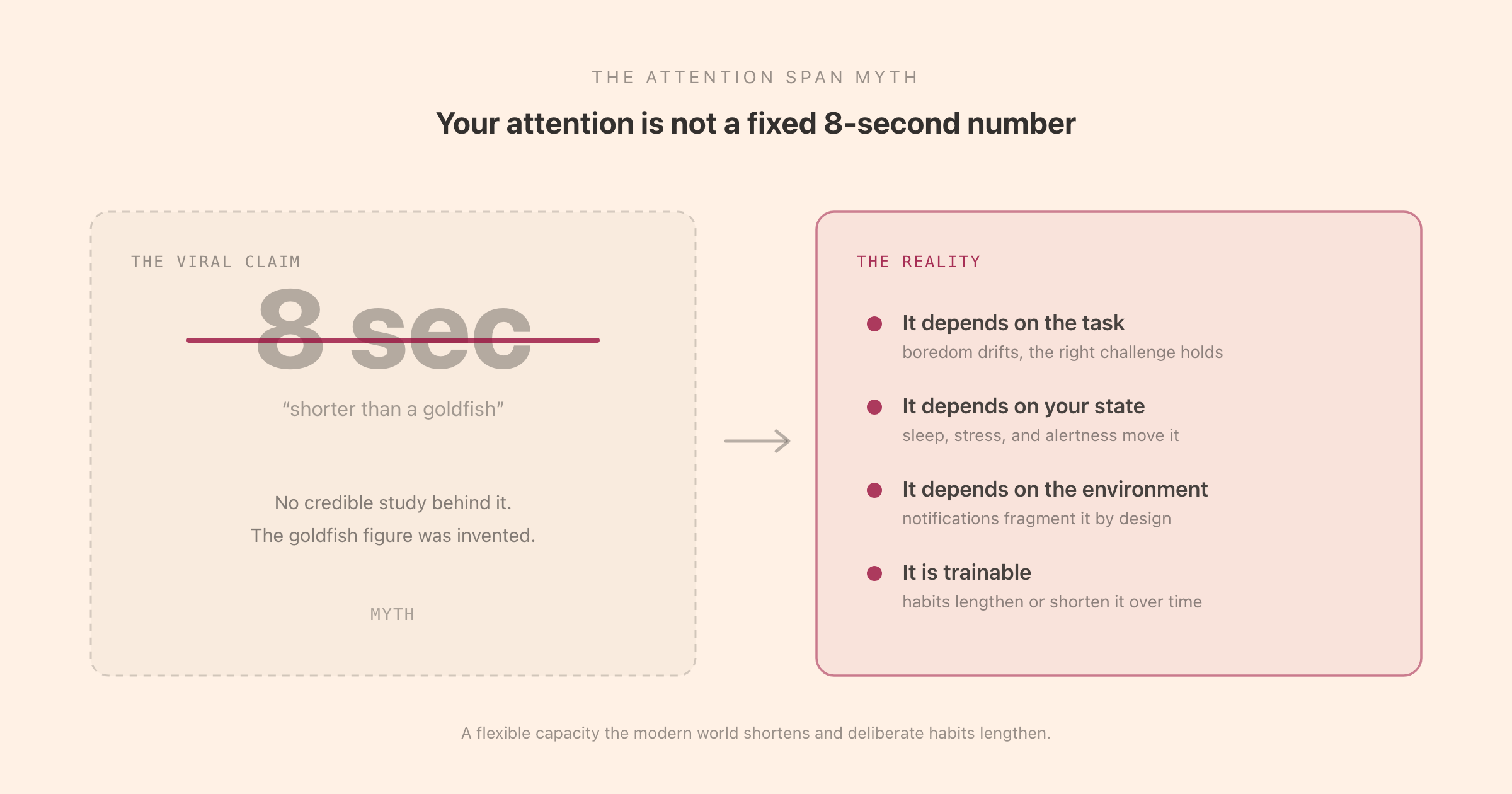
Psychologists usually break attention into distinct types, and knowing them clears up most of the confusion around the topic. There is sustained attention, holding focus on one thing over time (reading a long report). There is selective attention, focusing on one thing while filtering out competing distractions (following a conversation in a noisy room). There is alternating attention, switching between tasks with different demands. And there is divided attention, the thing we call multitasking, attempting to attend to two things at once, which the brain does poorly because it is really rapid switching in disguise.
When people worry about their "short attention span," they almost always mean sustained attention: the ability to stay with one demanding thing without reaching for their phone. That is the capacity this article is about, and it is the one most affected by modern habits and most responsive to training.
The Average Attention Span, and the Goldfish Myth
So what is the average attention span? Honestly, there is no single reliable figure, because it depends entirely on the person, the task, and the conditions. A bored student in a dull lecture might drift within minutes; the same student deep in a video game or a novel they love can hold focus for hours. Attention is contextual, which is exactly why any headline number should make you suspicious.
The famous "eight seconds, shorter than a goldfish" statistic is the clearest case. It was popularised around 2015 and repeated endlessly, but when journalists and researchers tried to trace it, the trail went nowhere. There is no published study establishing an eight-second human attention span, and no research supporting the idea that goldfish have a nine-second one. Both figures appear to be fabrications that spread because they confirmed what everyone already felt. The truth is less tidy but more hopeful: human attention has not been measured shrinking to a fixed tiny number. What has changed is the environment we ask it to work in.
That distinction matters. If your attention span were a fixed biological constant that had genuinely collapsed to eight seconds, there would be little you could do. Because it is instead a flexible capacity being constantly interrupted by a distracting environment, the levers are in your hands.
What Actually Determines Your Attention Span
If not a fixed number, what governs how long you can concentrate? Several factors, most of them changeable.
The task and your interest in it. Attention follows meaning and challenge. A task that is too easy bores you and attention wanders; one that is too hard triggers anxiety and you disengage. The sweet spot, a task that is challenging but achievable, is where attention holds naturally and can even tip into flow, the state of complete absorption. Much of what feels like poor attention is really a mismatch between the task and the right level of difficulty.
Your brain's focus machinery. Sustained attention is run by the prefrontal cortex, the executive part of the brain that holds a goal in mind and suppresses distractions, working with the reticular activating system that sets your overall level of alertness. When you are rested and appropriately alert, this machinery works well. When you are exhausted or over-aroused, it does not.
Sleep, stress, and physical state. Attention is one of the first things to degrade when you are short on sleep or running on chronic stress. A tired prefrontal cortex cannot inhibit distraction, which is why a poor night makes everything feel scattered. Your attention span on a rested day and a depleted one are effectively two different capacities.
Training and habit. This is the crucial one. The environment you spend your days in trains your attention, for better or worse. A day of constant notifications, quick-cut video, and task-switching teaches your brain to expect novelty every few seconds. A day structured around sustained, single-tasked work teaches it to settle. Attention is a habit as much as a trait.
Why Modern Life Shortens It
The reason attention feels harder than it used to is not that our brains have degraded; it is that we have built an environment engineered to fragment focus. Understanding the mechanism helps you counter it.
The core problem is the collision of distraction and reward. Every notification, feed refresh, and message offers a small hit of novelty, and novelty triggers dopamine, which makes the interruption feel rewarding. Your brain learns, correctly, that checking the phone pays off, and it starts seeking that reward on its own, pulling you off task before any external ping even arrives. This is why you reach for your phone in a lull without deciding to.
Layered on top is the myth of multitasking. Because divided attention is really rapid switching, every switch carries a cost: a fraction of a second to reload the new context, plus residue from the last task clinging on. A day of switching between tabs, chats, and tasks is a day of paying that tax hundreds of times, and it leaves you feeling scattered and drained despite being busy. The environment does not just interrupt your attention; it trains your brain to interrupt itself.
How to Increase Your Attention Span
Here is the practical heart of it. Because attention span is trainable, deliberate habits genuinely lengthen it. None of these are exotic; they work by reversing exactly what shortens it.
Single-task on purpose. The most direct lever. Choose one thing, close everything else, and stay with it. Every time you resist the switch, you are training sustained attention like a muscle. Multitasking trains the opposite, so removing it is half the battle.
Work in timed focus blocks. Attention is easier to sustain when it has a defined finish line. Committing to a single task for a set stretch, then taking a real break, is the principle behind the Pomodoro technique, and it works because a bounded effort is far less daunting than an open-ended one. Start with a length you can actually hold and extend it as your capacity grows.
Remove the triggers, do not rely on willpower. You will lose a moment-to-moment fight against a phone designed to capture you. Put it in another room, turn off non-essential notifications, and close the tabs. Making distraction require effort beats trying to resist it in the instant.
Protect sleep and move your body. Because attention degrades with fatigue and stress, the fundamentals matter enormously. A rested, exercised brain has a materially longer attention span than a depleted one. There is no focus technique that survives chronic sleep deprivation.
Give attention something worth holding. Match the task to the right difficulty, break big vague tasks into concrete challenging ones, and your attention will hold far more willingly. A well-scoped task is half the reason focus feels effortless when it does.
Reduce constant novelty-seeking. The more you feed your brain quick hits of novelty in idle moments, the more it expects them during work. Letting yourself be a little bored, rather than filling every gap with a scroll, slowly retrains your tolerance for staying with one thing.
Where Focus Music Fits
One reliable lever for sustained attention is controlling your sound environment, and this is where focus music earns its place. A stable, non-distracting audio backdrop does two useful things at once: it masks the unpredictable noises that break selective attention, and it gives your brain a steady, low-demand input that makes it easier to settle into and hold sustained focus rather than reaching for stimulation.
Tomatoes generates focus music designed for exactly this, holding a consistent sonic environment so your attention has one less reason to wander and can stay with the task long enough to build the habit of concentration. It is free to try for 3 days, then from $4.99 a week, $29.99 a year, or $39 for lifetime access. If your attention span feels shorter than you would like, a calmer, more consistent focus environment is one of the simplest places to start: try Tomatoes free for 3 days.
Your attention span is not a broken eight-second relic and never was. It is a flexible, trainable capacity that a distracting world has been quietly shortening and that deliberate habits can just as surely lengthen. Ignore the goldfish. Single-task, protect your sleep, remove the triggers, and give your focus something worth holding, and you will find the attention was there all along, waiting for a quieter place to work.